Within Ivory Coast Curiosities
What Do Abidjan's Ritual Masks Really Represent?
Abidjan's national museum reveals why a mask behind glass is only one fragment of a living ceremonial presence.
On this page
- Inside the Museum of Civilisations
- Masks as moving social presences
- Looting, provenance and missing objects
Page outline Jump by section
Introduction
Abidjan’s Museum of Civilisations is the closest Ivory Coast comes to a national cabinet of ritual curiosities, but it is also a reminder that many of its most striking objects were never intended to be viewed as silent works of art. Behind the glass are masks, carved figures, ceremonial regalia and ritual objects that once appeared in funerals, initiation ceremonies, judicial performances, healing rites and public festivals. Their unusual quality lies not simply in their appearance, but in the fact that they originally formed part of living performances in which music, costume, movement and community participation were inseparable from the carved object itself.
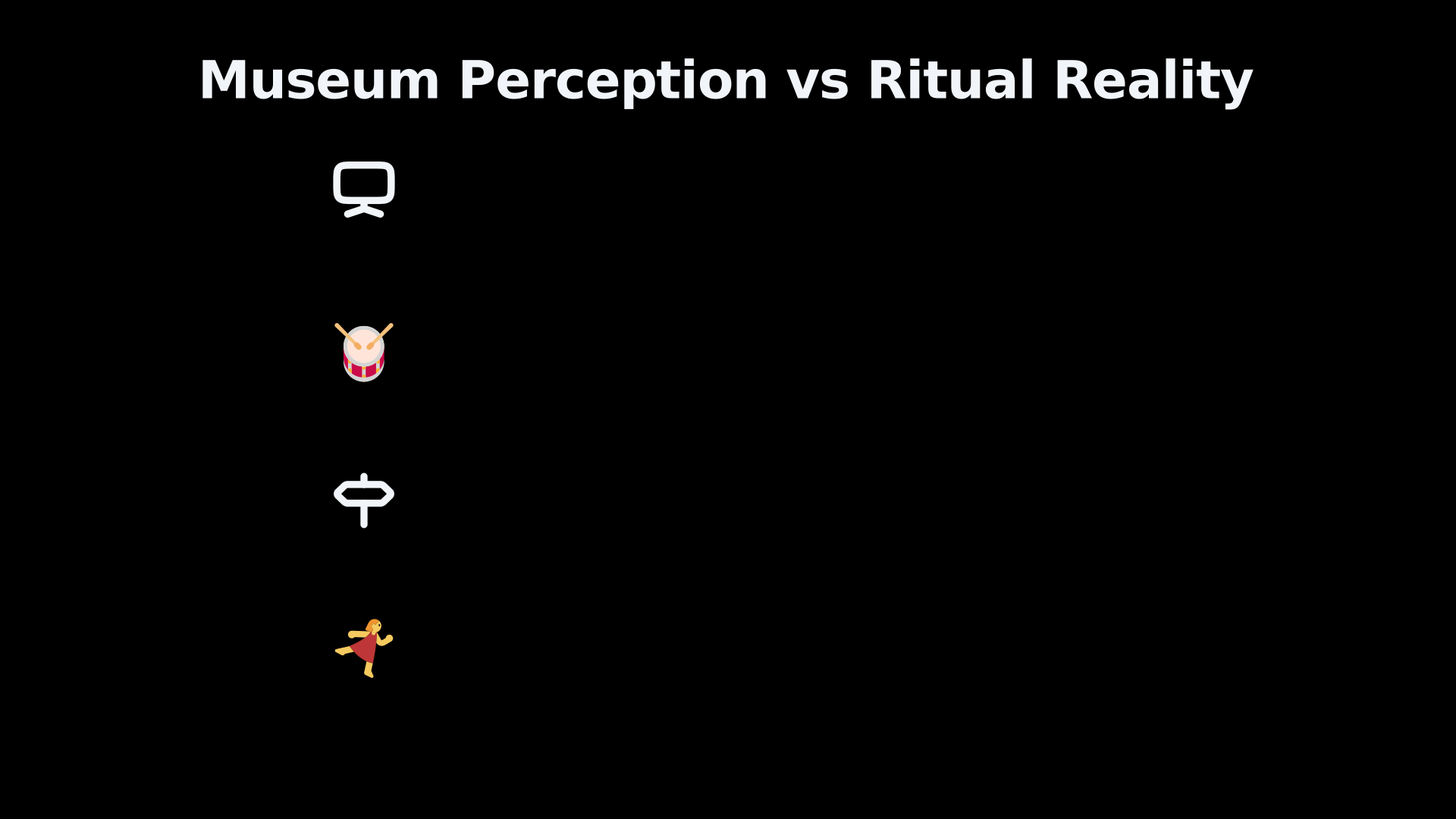
For visitors interested in the uncanny, the museum offers an opportunity to understand why a mask displayed on a plinth represents only one fragment of a much larger ceremonial presence. At the same time, the collection raises difficult questions about museum display, cultural ownership and the loss of important artefacts through conflict and illicit trafficking.
Inside the Museum of Civilisations
Located in central Abidjan, the Museum of Civilisations houses Ivory Coast’s principal public collection of ethnographic and archaeological material. The galleries bring together objects from many of the country’s cultural traditions, including masks, statues, musical instruments, royal insignia, textiles, jewellery and ceremonial equipment.
Unlike many curiosity museums built around eccentric collecting, this institution was created to preserve national heritage. Nevertheless, for many visitors the ritual galleries are the most arresting because they present objects associated with invisible forces, ancestral authority and ceremonial transformation rather than ordinary domestic life.
Many of the masks originate from societies whose masquerades continue to exist today. Some are linked to funeral ceremonies, others to initiation, public entertainment, conflict resolution or rituals intended to restore social order. The carved face itself is therefore only one element of a much larger ensemble that originally included elaborate fibre costumes, musicians, attendants and carefully controlled ceremonial settings.[ResearchGate]researchgate.netOpen source on researchgate.net.
Masks as Moving Social Presences
The greatest misunderstanding facing many first-time visitors is assuming that the wooden carving is the complete artwork.
Across several Ivorian masking traditions, the mask becomes meaningful only when activated through performance. The carved face is joined to a full-body costume, accompanied by music and dance, and appears under rules governing who may see it, who may wear it and how it should behave. Museum displays inevitably separate these elements.
Museum anthropologists studying Guro masquerades have argued that conventional exhibitions risk producing what they describe as a “deadening effect”. Once isolated in a display case, a mask may appear to belong entirely to the past, even though many masquerade traditions continue to evolve in contemporary villages and towns. Text panels, photographs, recordings and film can help, but they cannot fully reproduce the experience of encountering an active masquerade.[AnthroSource]anthrosource.onlinelibrary.wiley.comCHALLENGING THE DEAD HAND OF THE MUSEUM DISPLAY: The Case of Contemporary Guro (Côte d'Ivoire) Masquerades - Bouttiaux - 2012…
This distinction matters because many masks were understood not simply as costumes but as the visible appearance of powerful beings during particular moments. Their authority came from performance, ritual knowledge and community recognition rather than from the carved wood alone.
Beyond “beautiful African art”
Many internationally famous Ivorian masks are admired primarily for their refined carving. Yet the aesthetic qualities appreciated in galleries represent only one side of their significance.
Research on Guro masking traditions, for example, distinguishes elegant entertainment masks from other masquerades associated with more dangerous or disruptive spiritual powers. Some appear during funerals, campaigns against suspected witchcraft, or rituals responding to periods of social upheaval. Others deliberately combine human and animal features to express beings that occupy an ambiguous position between ordinary society and the spiritual world.[Cambridge University Press & Assessment]cambridge.orgCambridge University Press & AssessmentThe Power of Ambiguity: The Nature and Efficacy of the Zamble Masks Revealed by ‘Disease Masks’ Am…
Understanding this wider ceremonial context helps explain why museum labels that simply identify an object as a “mask” often leave out much of its original meaning.
Why the Displays Can Feel Uncanny
For many visitors, the atmosphere created by these galleries comes less from horror than from uncertainty.
The masks frequently possess calm, idealised faces while representing beings believed to exercise authority beyond ordinary human life. Others combine animal horns, exaggerated features or composite forms that deliberately blur distinctions between people, spirits and wild creatures.
Because the original performances often involved music, dust, movement and restricted access, viewing the object in complete silence behind museum glass creates an unusual tension. The carving appears still, yet almost every historical source emphasises that it was designed to move.
That contrast between motion and stillness gives the collection much of its uncanny quality. Rather than presenting supernatural objects as sensational curiosities, the museum preserves traces of ceremonies whose full meaning depended on performance rather than display.
Looting, Provenance and Missing Objects
The Museum of Civilisations also tells a story of absence.
During the 2010–11 post-election conflict in Côte d’Ivoire, the museum suffered extensive looting. Reports indicated that dozens of important artefacts—including masks, sculptures, gold ornaments and other culturally significant objects—were stolen while fighting engulfed Abidjan. Empty display cases became visible reminders of what had been lost.[Mail & Guardian]mg.co.zaMail & Guardian Looters plunder Côte d’Ivoire’s museum – The Mail & GuardianMail & GuardianLooters plunder Côte d’Ivoire’s museum – The Mail & GuardianSeptember 24, 2011…
This history affects how visitors should think about provenance. Questions about where an object originated, who had authority to remove it, and how it entered a museum collection are not secondary details but central parts of the story.
Scholars studying Ivorian masquerades also note that international demand for ritual objects has influenced the traditions themselves. In some communities, masks once stored in sacred locations became vulnerable to theft for the art market, encouraging changes in how they were protected or replaced. In many cases, communities commissioned new masks after older examples were sold or stolen, illustrating that living ceremonial traditions cannot always be reduced to a single original object.[AnthroSource]anthrosource.onlinelibrary.wiley.comCHALLENGING THE DEAD HAND OF THE MUSEUM DISPLAY: The Case of Contemporary Guro (Côte d'Ivoire) Masquerades - Bouttiaux - 2012…
Reading the Collection Today
Visitors interested in strange collections often arrive expecting mysterious relics with hidden powers. The Museum of Civilisations offers something more subtle and arguably more revealing.
The displays demonstrate how museums transform active ceremonial objects into historical artefacts. A mask that once danced, judged disputes, honoured the dead or embodied a spiritual presence becomes an object to be studied under controlled lighting.
Recognising that transformation changes the experience of the collection. Instead of asking whether a mask is “really magical”, a more useful question is how different communities have understood its role, how museums attempt to communicate those meanings, and what inevitably disappears when a living ceremonial tradition is frozen behind glass.
Within Ivory Coast’s landscape of unusual heritage, this tension between ritual life and museum display is precisely what makes Abidjan’s mask collection so distinctive. The most uncanny objects are not mysterious because they are inexplicable; they are uncanny because they preserve only one visible fragment of ceremonies whose fullest meanings existed in movement, sound, memory and community rather than in carved wood alone.
Amazon book picks
Further Reading
Books and field guides related to What Do Abidjan's Ritual Masks Really Represent?. Use these as the next step if you want deeper reading beyond the article.
A History of Zimbabwe
The first single-volume history of Zimbabwe with detailed coverage from pre-colonial times to the present, this book examines Zimbabwe's...
A History of African Archaeology
First published 1990. Subjects: History, Antiquities, Archaeology, Archéologie, Antiquités.
eBay marketplace picks
Marketplace Samples
Live-tested eBay searches with available results related to this page.
Selected fromAfrican archaeology decor oneBay.co.uk.
Endnotes
1.
Source: researchgate.net
Link:https://www.researchgate.net/publication/264720343_Challenging_the_dead_hand_of_the_museum_display_The_Case_of_Contemporary_Guro_Cote_d%27Ivoire_Masquerades
2.
Source: cambridge.org
Link:https://www.cambridge.org/core/journals/africa/article/power-of-ambiguity-the-nature-and-efficacy-of-the-zamble-masks-revealed-by-disease-masks-among-the-gouro-people-cote-divoire/4455EE68792EB817226CB07258B9B994
Source snippet
Cambridge University Press & AssessmentThe Power of Ambiguity: The Nature and Efficacy of the Zamble Masks Revealed by ‘Disease Masks’ Am...
3.
Source: news.abidjan.net
Link:https://news.abidjan.net/articles/404632/cambriolage-du-musee-des-civilisations-dabidjan-des-oeuvres-dart-dune-valeur-de-plus-de-2-7-milliards-voles
Source snippet
du Musée des civilisations d’Abidjan: Des œuvres d’art d’une valeur de plus de 2,7 milliards volés - Abidjan.net NewsJuly 15, 2011 — PU...
Published: July 15, 2011
4.
Source: cambridge.org
Link:https://www.cambridge.org/core/journals/africa/article/abs/power-of-ambiguity-the-nature-and-efficacy-of-the-zamble-masks-revealed-by-disease-masks-among-the-gouro-people-cote-divoire/4455EE68792EB817226CB07258B9B994
Source snippet
543 - 569 DOI: [https://doi.org/10.3366/E0001972009001065](https://doi.org/10.3366/E0001972009001065) [Opens in a new window] Copyright REFE...
5.
Source: youtube.com
Title: Zaouli Mask / Dance, Bouaflé, Ivory Coast
Link:https://www.youtube.com/watch?v=5O40sipAhvA
Source snippet
Ivory Coast - Guere Masks...
6.
Source: youtube.com
Title: Ivory Coast
Link:https://www.youtube.com/watch?v=0kF0qrXwLoA
7.
Source: anthrosource.onlinelibrary.wiley.com
Link:https://anthrosource.onlinelibrary.wiley.com/doi/abs/10.1111/j.1548-1379.2012.01120.x
Source snippet
CHALLENGING THE DEAD HAND OF THE MUSEUM DISPLAY: The Case of Contemporary Guro (Côte d'Ivoire) Masquerades - Bouttiaux - 2012...
8.
Source: mg.co.za
Title: Mail & Guardian Looters plunder Côte d’Ivoire’s museum – The Mail & Guardian
Link:https://mg.co.za/article/2011-09-24-looters-plunder-cte-divoires-museum/
Source snippet
Mail & GuardianLooters plunder Côte d’Ivoire’s museum – The Mail & GuardianSeptember 24, 2011...
Published: September 24, 2011
Additional References
9.
Source: museedescivilisations.com
Title: A La découverte du Musée des Civilisations d’Abidjan (1ère partie)
Link:https://www.museedescivilisations.com/ressources/actualites/a-la-decouverte-du-musee-des-civilisations-d-abidjan-1ere-partie.html?format=amp
Source snippet
Ses collections sont estimées à 15.200 spécimens représentatifs de toutes les régions de la Côt...
10.
Source: metmuseum.org
Title: In Dan society, danger
Link:https://www.metmuseum.org/art/collection/search/316184
Source snippet
Face Mask - Dan peoples - The Metropolitan Museum of ArtFace Mask Dan peoples 19th–20th century Not on view The border between Cote d'Ivo...
11.
Source: metmuseum.org
Title: In Dan society, dang
Link:https://www.metmuseum.org/fr/art/collection/search/314439
Source snippet
Face Mask - Dan peoples - The Metropolitan Museum of ArtFace Mask Dan peoples 19th–20th century Not on view The border between Cote d'Ivo...
12.
Source: youtube.com
Title: Culture and music at the Museum of Civilizations of Côte d’Ivoire
Link:https://www.youtube.com/watch?v=FKy7whGptVw
Source snippet
Ivory Coast welcomes return of sacred drum taken during French colonial rule...
13.
Source: metmuseum.org
Title: Guro artist
Link:https://www.metmuseum.org/art/collection/search/311000
Source snippet
Face mask - Guro - The Metropolitan Museum of ArtFace mask Guro artist 19th–mid-20th century On view at The Met Fifth Avenue in Gallery 3...
14.
Source: test2.bravo.ci
Title: ci Accueil
Link:https://test2.bravo.ci/
Source snippet
Musée des Civilisations de Côte d'IvoireHISTOIRE QUATRE-VINGT ANS D’UNE ÉPOPÉE Né en 1942 d’un Centre artisanal fondé sous le Gouverneur...
15.
Source: sites.courtauld.ac.uk
Title: courtauld.ac.uk Masquerade
Link:https://sites.courtauld.ac.uk/illuminating-objects/illuminating-objects-home/west-african-loom-pulley/masquerade/
Source snippet
The Courtauld’s loom pulley most likely depicts a speci...
16.
Source: youtube.com
Title: Ivory Coast welcomes return of sacred drum taken during French colonial rule
Link:https://www.youtube.com/watch?v=LL8KmRywK24
Source snippet
The Spirit of the Mask - Ivory Coast...
17.
Source: youtube.com
Title: The Spirit of the Mask
Link:https://www.youtube.com/watch?v=lBxUwwX9pSc
Source snippet
Zaouli Mask / Dance, Bouaflé, Ivory Coast...