Within Cameroon Curiosities
Who Is Allowed to See a Sacred Object?
Palace museums at Mankon, Babungo and Oku reveal how display can preserve objects while disrupting rules about who may see them.
On this page
- Why some objects were never public
- How museum display changes their meaning
- Mankon, Babungo and Oku as living cases
Page outline Jump by section
Introduction
Cameroon’s palace museums raise an unusual question that many museums never face: what happens when objects that were once meant to be seen only by specific people are placed on public display? In the Grassfields kingdoms of western Cameroon, royal treasuries traditionally contained ritual objects, masks, insignia, weapons and ceremonial regalia whose visibility was carefully controlled. Access depended on rank, initiation, age, gender or royal permission rather than simple curiosity. When palace museums opened at places such as Mankon, Babungo and Oku, they did not simply transfer these collections into display cases. Instead, they created a negotiated space where heritage preservation, tourism and living royal authority coexist, often uneasily. Rather than ending secrecy altogether, these museums have developed ways of deciding what may be shown, what remains hidden and who continues to control that decision.[eScholarship]escholarship.orgThe Multiple Lives of Objects: Museum, Memory, and Modernity in the Cameroon GrassfieldsJanuary 1, 2014…
Why some objects were never public
In many Grassfields kingdoms, sacred objects were not considered valuable merely because they were old or beautifully carved. Their significance depended on relationships with royal authority, ancestral power and secret regulatory societies that played central roles in governing the kingdom. Some objects were activated only during particular ceremonies, while others were handled only by authorised palace officials or initiated members of specific associations. Their meaning therefore came partly from restricted access rather than continuous public visibility.[eScholarship]escholarship.orgThe Multiple Lives of Objects: Museum, Memory, and Modernity in the Cameroon GrassfieldsJanuary 1, 2014…
For this reason, secrecy was not simply about hiding information. It functioned as a form of governance. Restricting access protected political authority, preserved ritual knowledge and reinforced the distinction between ordinary subjects and those entrusted with ceremonial responsibilities. Removing an object from this system of controlled visibility could alter its social role even if the object itself remained physically unchanged.[eScholarship]escholarship.orgThe Multiple Lives of Objects: Museum, Memory, and Modernity in the Cameroon GrassfieldsJanuary 1, 2014…
Researchers studying Grassfields museums note that many royal treasuries continue to exist alongside the museum itself. The museum therefore represents only one layer of a much larger cultural landscape. Some ceremonial objects remain entirely outside public collections, while others may be displayed only after consultation with palace authorities or under conditions determined by the ruling court.[ResearchGate]researchgate.netResearchGate(PDF) Museums in the Palaces of the Cameroon Grassfields: Concerns about accessibility and sustainabilityApril 6, 2016…
How museum display changes their meaning
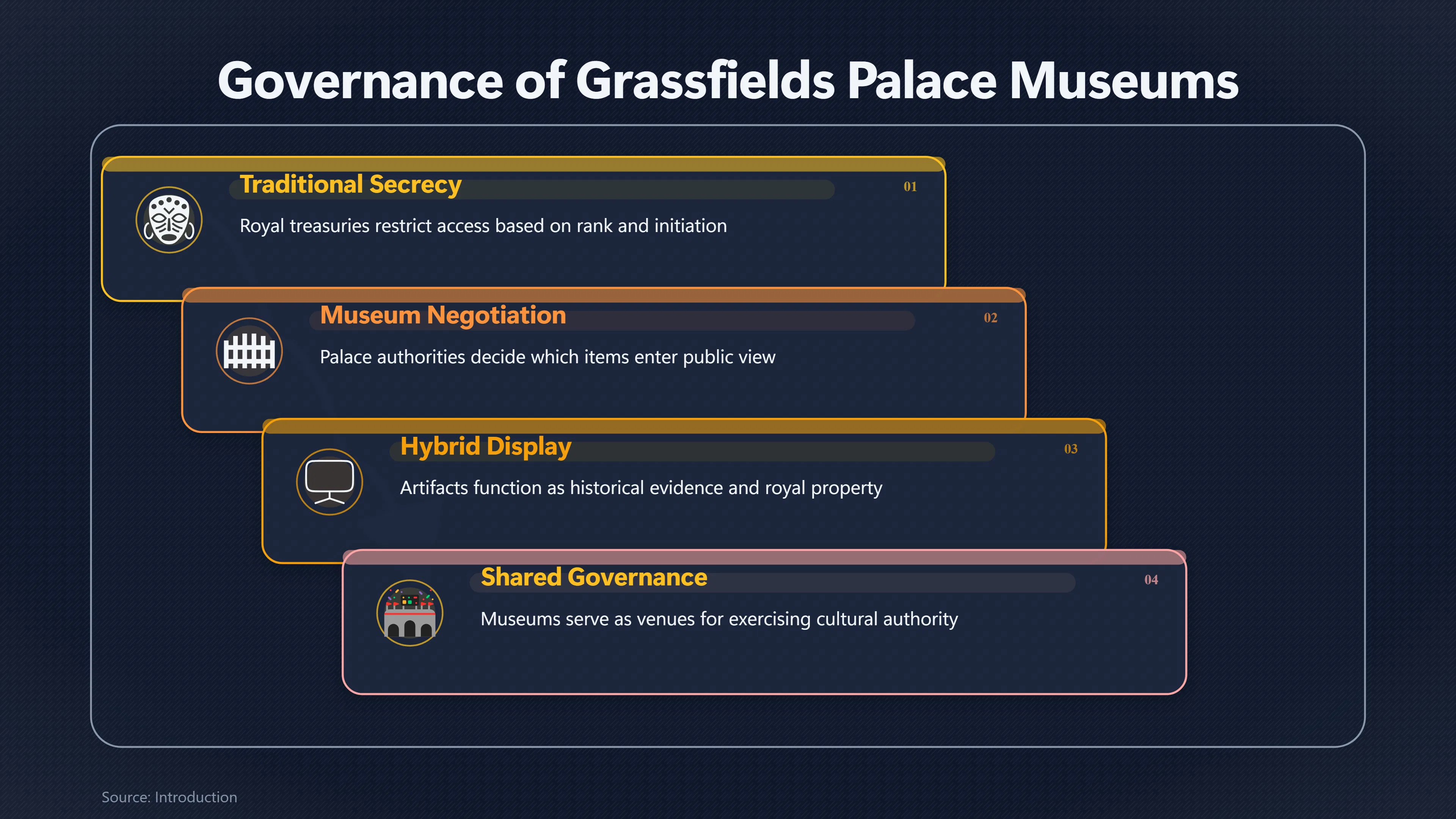
Placing a formerly restricted object behind museum glass does not automatically make it an ordinary museum exhibit. Instead, palace museums create a hybrid environment where an artefact may simultaneously function as historical evidence, royal property and a symbol of continuing authority. The museum label explains one aspect of the object, but its ceremonial significance may remain only partially disclosed.[SSRN]papers.ssrn.comMuseum in the Mirror: Palace Museums and Narratives of Power in the Cameroon Grassfields by Erica Jones:: SSRN…
This produces a very different visitor experience from that of a conventional art museum. Rather than promising complete explanation, palace museums often acknowledge that some knowledge remains deliberately limited. The absence of full interpretation is not necessarily a curatorial failure but reflects ongoing obligations to living institutions that continue to regulate sacred knowledge.[eScholarship]escholarship.orgThe Multiple Lives of Objects: Museum, Memory, and Modernity in the Cameroon GrassfieldsJanuary 1, 2014…
Scholars have argued that these museums therefore transform objects without stripping away all their original identities. An object may become part of national heritage and tourist interpretation while still belonging to a royal treasury and remaining embedded within contemporary ceremonial life. Instead of replacing traditional authority, the museum often becomes another setting through which that authority is expressed.[SSRN]papers.ssrn.comMuseum in the Mirror: Palace Museums and Narratives of Power in the Cameroon Grassfields by Erica Jones:: SSRN…
Mankon, Babungo and Oku as living cases
Mankon
The Mankon Palace Museum illustrates how display remains subject to royal oversight rather than purely museum practice. Created within the palace complex, it presents royal history and artistic heritage while remaining physically and institutionally connected to an active kingdom. Researchers describe the museum as part of a broader effort to preserve cultural heritage in its original setting rather than transferring collections into distant national institutions. Decisions about exhibition continue to involve palace leadership, meaning that public access remains negotiated rather than unrestricted.[Cambridge University Press & Assessment]cambridge.orgCambridge University Press & AssessmentDo We Need Museums in the Cameroon Grassfields? | African Research and Documentation | Cambridge Core…
Studies of visitor access also found that many local people continued to regard the museum as an extension of the palace’s sacred space rather than an entirely public institution. This perception influences expectations about behaviour, photography and movement within the complex.[ResearchGate]researchgate.netResearchGate(PDF) Museums in the Palaces of the Cameroon Grassfields: Concerns about accessibility and sustainabilityApril 6, 2016…
Babungo
Babungo presents perhaps the clearest example of debate over whether museums protect or endanger secret objects. Supporters argue that museum storage helps preserve fragile royal collections threatened by theft, deterioration or illicit art markets. Critics have worried that displaying formerly restricted objects risks weakening traditional rules surrounding secrecy. Field research found that many residents accepted the need for museums while simultaneously expressing concern that some objects should remain protected from unrestricted viewing.[AfricaBib]africabib.orgOpen source on africabib.org.
The resulting compromise is selective visibility. Museums preserve important collections, but not every object enters the exhibition galleries, and palace authorities continue to influence what visitors can and cannot see.[eScholarship]escholarship.orgThe Multiple Lives of Objects: Museum, Memory, and Modernity in the Cameroon GrassfieldsJanuary 1, 2014…
Oku
The Oku kingdom illustrates the same broader pattern even though documentation is less extensive than for Mankon or Babungo. Palace heritage remains closely connected to active royal institutions, and ceremonial authority continues to shape access to culturally sensitive objects. Rather than functioning as detached historical museums, Grassfields palace collections—including those associated with Oku—operate within living political and ceremonial systems where ownership and interpretation remain under local control.[eScholarship]escholarship.orgThe Multiple Lives of Objects: Museum, Memory, and Modernity in the Cameroon GrassfieldsJanuary 1, 2014…
Why the argument is about governance rather than secrecy alone
The central issue is not whether sacred objects should become public, but who has the authority to decide. Grassfields palace museums demonstrate that museums are not always neutral institutions. In Cameroon they frequently operate through negotiation between royal courts, local communities, heritage specialists and outside partners.
This explains why researchers describe these museums as distinctive examples of shared governance rather than simple exhibition spaces. The museum does not replace the palace treasury. Instead, it becomes one more institution through which cultural authority is exercised. Decisions about conservation, photography, research access and exhibition are therefore also decisions about political legitimacy, community identity and the continuing role of traditional leadership.[SSRN]papers.ssrn.comMuseum in the Mirror: Palace Museums and Narratives of Power in the Cameroon Grassfields by Erica Jones:: SSRN…
What visitors should expect
Visitors interested in Cameroon’s palace museums should expect neither unrestricted access nor theatrical displays of hidden mysteries. Instead, they are entering museums that remain embedded within living royal compounds.
That means several practical realities:
- Some important ceremonial objects may never be exhibited publicly.
- Exhibited objects may be described historically without revealing every ritual meaning.
- Palace etiquette, guided visits or photography restrictions may reflect continuing cultural rules rather than ordinary museum policy.
- What appears absent from a display may be as significant as what is visible, because omission itself can represent an intentional act of cultural protection.[researchgate.net]researchgate.netResearchGate(PDF) Museums in the Palaces of the Cameroon Grassfields: Concerns about accessibility and sustainabilityApril 6, 2016…
Seen in this light, the most unusual feature of Cameroon’s palace museums is not that they contain secret objects. It is that they openly acknowledge the limits of public knowledge while continuing to preserve collections that remain part of active royal and ceremonial life.
Amazon book picks
Further Reading
Books and field guides related to Who Is Allowed to See a Sacred Object?. Use these as the next step if you want deeper reading beyond the article.
Museums, Heritage and International Development
While many claims are made regarding the power of cultural heritage as a driver and enabler of sustainable development, the relationship...
The Predicament of Culture: Twentieth-Century Ethnography, Li...
The Predicament of Culture is a critical ethnography of the West in its changing relations with other societies. Analyzing cultural pract...
eBay marketplace picks
Marketplace Samples
Live-tested eBay searches with available results related to this page.
Selected fromAfrican mask decor oneBay.co.uk.

Endnotes
1.
Source: escholarship.org
Link:https://escholarship.org/uc/item/0300c641
Source snippet
The Multiple Lives of Objects: Museum, Memory, and Modernity in the Cameroon GrassfieldsJanuary 1, 2014...
Published: January 1, 2014
2.
Source: cambridge.org
Link:https://www.cambridge.org/core/journals/african-research-and-documentation/article/abs/do-we-need-museums-in-the-cameroon-grassfields/6E45CDE4966E87DC19C07655E25D1FDD
Source snippet
Cambridge University Press & AssessmentDo We Need Museums in the Cameroon Grassfields? | African Research and Documentation | Cambridge Core...
3.
Source: papers.ssrn.com
Link:https://papers.ssrn.com/sol3/papers.cfm?abstract_id=2253082
Source snippet
Museum in the Mirror: Palace Museums and Narratives of Power in the Cameroon Grassfields by Erica Jones:: SSRN...
4.
Source: researchgate.net
Link:https://www.researchgate.net/publication/299738505_Museums_in_the_Palaces_of_the_Cameroon_Grassfields_Concerns_about_accessibility_and_sustainability
Source snippet
ResearchGate(PDF) Museums in the Palaces of the Cameroon Grassfields: Concerns about accessibility and sustainabilityApril 6, 2016...
Published: April 6, 2016
5.
Source: researchgate.net
Title: Research Gate Do We Need Museums in the Cameroon Grassfields? | Request PDF
Link:https://www.researchgate.net/publication/360200811_Do_We_Need_Museums_in_the_Cameroon_Grassfields
6.
Source: africabib.org
Link:https://www.africabib.org/rec.php?RID=374630887
7.
Source: africabib.org
Link:https://www.africabib.org/rec.php?DB=p&RID=374630887
8.
Source: researchgate.net
Link:https://www.researchgate.net/publication/363272896_Modern_museums_in_the_palaces_of_the_western_Grassfields_Cameroon
9.
Source: books.google.com
Link:https://books.google.com/books/about/Mankon.html?id=UAXqAAAAMAAJ
Additional References
10.
Source: ora.ox.ac.uk
Link:https://ora.ox.ac.uk/objects/uuid%3A3685441a-a2a9-4478-b928-96fb0be604d7
Source snippet
collections of Royal Palace Museums in The West Region of Cameroon with a focus on wildlife conservation - ORA - Oxford University Resear...
11.
Source: routedeschefferies.com
Title: Bienvenue | La Route Des Chefferies
Link:https://routedeschefferies.com/en/realizations/
Source snippet
December 22, 2022 — Realizations • Route Des Chefferies La Route des Chefferies is a unique association in sub-Saharan Africa, which has...
Published: December 22, 2022
12.
Source: youtube.com
Title: Lecture with Paul R. Davis: A “Mabuh” Headdress at the Menil
Link:https://www.youtube.com/watch?v=njGcIPtSLI8
Source snippet
Elephant Mask, Kuosi Society, Bamileke Peoples, Cameroon...
13.
Source: repository.hsrc.ac.za
Link:https://repository.hsrc.ac.za/handle/20.500.11910/11233
14.
Source: routedeschefferies.com
Link:https://routedeschefferies.com/realisations/les-cases-patrimoniales/
15.
Source: routedeschefferies.com
Link:https://routedeschefferies.com/realisations/
16.
Source: youtube.com
Title: Top 10 Attractions in Bamenda, Cameroon
Link:https://www.youtube.com/watch?v=CkmTvoYLqDU
Source snippet
Cameroon's German Cultural Heritage: A Post-independence Legacy...
17.
Source: youtube.com
Title: Elephant Mask, Kuosi Society, Bamileke Peoples, Cameroon
Link:https://www.youtube.com/watch?v=t-4O17cw9cw
Source snippet
Mankon Museum in Bamenda, Cameroon...
18.
Source: unesco.org
Title: crises are affecting cultural heritage cameroon
Link:https://www.unesco.org/en/articles/crises-are-affecting-cultural-heritage-cameroon
19.
Source: youtube.com
Title: Cameroon’s German Cultural Heritage: A Post-independence Legacy
Link:https://www.youtube.com/watch?v=F6LBLsS_Zy4