What Makes Saint Vincent's Collections So Unusual?
Saint Vincent and the Grenadines does not have a large network of purpose-built “weird museums”. Its curiosity culture is smaller, more scattered and more closely tied to living traditions than to theatrical displays of monsters, magic or medical oddities.
Page outline Jump by section
Introduction
For visitors, the key point is that these places vary greatly in scale and formality. Some are carefully interpreted museums; others are heritage projects, working conservation sites or commercial attractions whose collections grew around a location. Opening arrangements can be irregular, and public information is sometimes fragmented. The reward is an unusually direct encounter with objects that still carry local argument, memory and identity rather than merely illustrating a safely finished past.
Bequia’s boats, whales and contested heritage
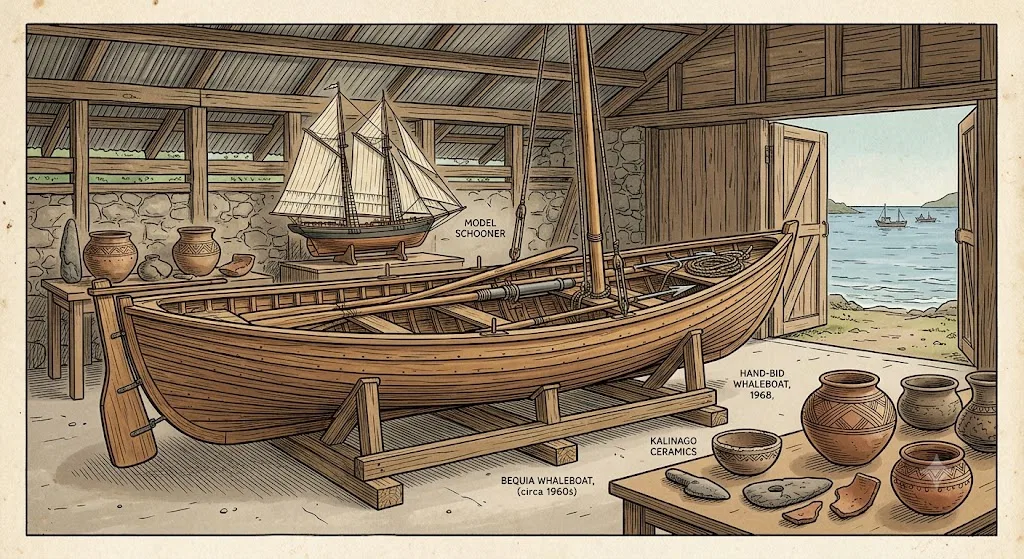
The Bequia Heritage Museum is the country’s clearest example of an unusual museum with a strong local identity. Overlooking Friendship Bay, it occupies two related buildings devoted to Bequia’s Indigenous settlement, boatbuilding, seafaring and whaling traditions. Its most striking exhibits include a large dugout canoe, locally built whaleboats and a whaleboat tender, alongside ship models, photographs, woodworking tools and other maritime objects. The museum is not simply displaying decorative nautical antiques: it preserves the technologies that enabled a very small island community to build vessels, travel between islands and hunt large animals from open wooden boats.[bequiabeachhotel.com]bequiabeachhotel.comBequia Heritage MuseumThe spacious, airy Boat Museum explores Bequia's famed maritime history, including boat-and shipbuilding and whalin…
The museum’s appeal lies partly in scale. A full-sized canoe or whaleboat makes Bequia’s maritime past feel less like a distant historical theme and more like practical engineering. The canoe connects the collection to much older Indigenous movement through the Lesser Antilles, while the whaleboats represent a tradition influenced by nineteenth-century New England methods and adapted by Bequians to local waters. Detailed signage, photographs and tools help explain how the vessels were built and used, although recent visitor accounts suggest that guided interpretation and oral testimony are often as important as the labels themselves.[bequiatourism.com]bequiatourism.comIsland historyThe spacious, airy Boat Museum (opened in November 2013) explores Bequia's famed maritime history, including boat-and shipb…
Whaling makes this more than a picturesque boat museum. Bequia’s hunt continues under the International Whaling Commission’s Aboriginal Subsistence Whaling system, with a quota of up to four humpback whales a year. The commission describes the hunt as a historic cultural activity using traditional open boats and notes that the quota has rarely been reached. This official framework does not remove the ethical dispute surrounding whaling, but it distinguishes Bequia’s small-scale hunt from industrial commercial whaling. The museum therefore occupies difficult ground: it preserves community knowledge and family history while documenting a practice that many visitors will find troubling.[International Whaling Commission]iwc.intPresently the whalers of Bequia carry out their historical, cultural activity under the IWC's regime, whales per…
That tension is precisely why the collection matters. A weaker display might turn the whaleboats into harmless maritime nostalgia. Bequia’s museum instead confronts visitors with a tradition that is simultaneously skilled, locally meaningful, legally regulated and internationally contentious. Its credibility depends on recognising all four aspects rather than treating the hunt either as an exotic spectacle or as a custom beyond criticism.
Practical arrangements require checking. Recent sources consistently report limited opening days, commonly Monday, Wednesday and Friday mornings, with visits outside those hours sometimes possible by arrangement. Seasonal closures also occur. Travellers should therefore confirm locally rather than relying on a general attractions listing or arriving on the assumption that it operates like a large national museum.[islandinthenet.com]islandinthenet.comthe view opens to the blue waters and hilly coastlineIsland in the NetVisiting the Bequia Heritage Museum - Island in the NetAugust 7, 2025 — 7 Aug 2025 — “Opening Hours: Mondays, Wednesdays…
Model ships and the miniature maritime world
Bequia’s smaller maritime displays extend beyond the Heritage Museum. The Bequia Maritime Museum has been described as a compact collection of model boats, schooner photographs and historical material linked to the island’s seafaring past. Sources identify models associated with Bequian craftsman Lawson Sargeant, including a miniature royal yacht, although published descriptions are brief and practical information is not always current.[Superyacht Services Guide]superyachtservicesguide.comOpen source on superyachtservicesguide.com.
What makes these models significant is that miniature boatbuilding remains a recognisable Bequian craft rather than a purely museum-bound technique. Full-scale wooden shipbuilding declined during the twentieth century, but artisans continued to produce detailed schooners, racing yachts and traditional boats in miniature. Shops and workshops around Port Elizabeth consequently function as informal curiosity cabinets: part souvenir trade, part craft demonstration and part archive of vessel types that are now rarely constructed at full size.[bequiabeachhotel.com]bequiabeachhotel.commodel boat buildersmodel boat builders
The distinction between museum object and commercial object is blurred here. A model may be sold to a visitor, displayed as evidence of local history or used to preserve the proportions of a remembered vessel. That mixture does not make the tradition less authentic, but it does mean that curation is decentralised. There may be no catalogue, conservation department or fixed historical narrative. Knowledge instead passes through makers, families, guides and the physical forms of the models themselves.
For curious travellers, the Heritage Museum and model-boat workshops work best as connected experiences. The museum provides the historical frame; the workshops reveal that the skills represented in the cases have not disappeared entirely. Together they form one of the country’s most distinctive collection cultures: a maritime archive made from timber, hand tools, memory and miniature hulls.
Indigenous objects and the problem of old labels
In Kingstown, the Saint Vincent and the Grenadines National Trust holds the country’s principal collection of pre-colonial archaeological material. An early UNESCO survey described the Saint Vincent Museum of Archaeology as possessing one of the region’s most extensive and significant collections of pre-Columbian objects. Later archaeological work has continued to place recovered ceramics and other finds in the national collection administered by the Trust.[UNESCO Documents]unesdoc.unesco.orgOpen source on unesco.org.
These objects include pottery, tools and other evidence of communities living in the islands before European colonisation. They may appear less immediately eccentric than whaleboats or film props, but they are crucial to the country’s curiosity landscape because archaeological objects in the Caribbean have often been detached from their original sites, classified through colonial terminology and made to carry sweeping stories about whole peoples. A small ceramic fragment can therefore become an object of debate about migration, identity and whose account of the past is being displayed.
Visitors should be cautious around older labels such as “Carib” and “Arawak”. Caribbean archaeology has used several overlapping cultural categories, while the term “Kalinago” is now widely used for Indigenous communities associated with the Lesser Antilles. Specialists warn that these names do not map neatly across every archaeological period or object type. A credible display should therefore separate what an artefact physically demonstrates from later ethnic identifications that may remain uncertain.[Grenada National Museum]museum.gdOpen source on museum.gd.
The National Trust itself was established in 1969 to safeguard the country’s monuments, sites and cultural patrimony. Government material acknowledges that the organisation experienced a period of dormancy before being revived, which helps explain why public information about its collection, premises and visiting arrangements has sometimes been inconsistent. Recent activity and visitor reports indicate that the Trust and its displays remain present in central Kingstown, but it is still sensible to confirm access before travelling specifically to see the collection.[tourism.gov.vc]tourism.gov.vcOpen source on tourism.gov.vc.
The collection’s unusual quality is not theatrical. It lies in the survival of fragile evidence from islands where heat, humidity, development and earlier collecting practices have all threatened archaeological context. For readers interested in anomalous objects or “mystery artefacts”, this is also an important corrective: an object may appear mysterious because its excavation record is incomplete, not because it contradicts established history. Good archaeology narrows uncertainty rather than marketing it.
A sugar mill turned memory chamber
At the Youroumei Heritage Village on Saint Vincent’s windward side, the museum occupies an old sugar-mill building within the former Orange Hill Estate. Government heritage material describes the complex as a group of historic structures in which the restored mill contains implements and objects from the plantation era. The attraction is closer to an industrial and social-history site than to a conventional gallery, with the surviving buildings forming part of the display.[nationalparks.gov.vc]nationalparks.gov.vcCruising St. Vincent and the GrenadinesCruising St. Vincent and the Grenadines
Old plantation machinery has the visual character of a giant mechanical curiosity: rollers, vats, mill components and heavy iron equipment whose function may not be obvious to a modern visitor. Yet presenting these objects only as picturesque ruins would conceal the system they served. Sugar estates were sites of forced labour, environmental transformation and concentrated colonial wealth. The implements are therefore not neutral examples of obsolete technology; they are physical remnants of a plantation economy sustained first by slavery and later by other unequal labour arrangements.
The heritage village also illustrates the difficulty of preserving industrial history in a small island state. Machinery is large, vulnerable to corrosion and expensive to maintain. Buildings must survive tropical weather, while interpretation needs to connect agricultural processes with the lives of labourers rather than focusing solely on engineering. The most meaningful reading of the site treats the mill as both machine and historical evidence.
Official online information confirms the heritage site’s continued listing under the National Parks, Rivers and Beaches Authority, but published visitor details remain limited. As with several Vincentian collections, the absence of a detailed, frequently updated museum website should not be mistaken for proof that the site has vanished. It does mean that access, staffing and the availability of interpretation should be checked directly.[nationalparks.gov.vc]nationalparks.gov.vc21 youroumie heritage village21 youroumie heritage village
Living collections: rare parrots and colonial plants
The Saint Vincent Botanic Gardens can be understood as a living cabinet of curiosity. Established in the eighteenth century, it was designed to gather, test and redistribute useful tropical plants within a colonial network. Its collections were connected to medicine, food production and imperial agriculture rather than modern ideas of leisure gardening. That history makes the garden an unusual archive in which living specimens embody centuries of plant movement, experimentation and economic ambition.[tourism.gov.vc]tourism.gov.vcbotanic gardensbotanic gardens
The best-known historical specimen is associated with breadfruit, introduced to Saint Vincent after Captain William Bligh’s second voyage to the Pacific. Breadfruit was promoted as an inexpensive food for enslaved plantation workers, so the familiar travel story of botanical adventure sits within a harsher history of slavery and plantation management. The gardens are therefore not merely a collection of beautiful tropical plants; they are evidence of how empires moved species around the world for strategic and commercial purposes.[tourism.gov.vc]tourism.gov.vcOpen source on tourism.gov.vc.
Within the grounds, the Nicholas Wildlife Aviary Complex maintains Saint Vincent parrots as part of a conservation breeding programme. The species, also known as the Saint Vincent amazon, is the country’s national bird and exists naturally only on Saint Vincent. Unlike a traditional natural-history museum, the aviary preserves a living population rather than stuffed specimens. Its purpose is scientific and conservation-led, although visitors may experience it as one of the country’s most remarkable public collections.[BirdsCaribbean]birdscaribbean.orgst vincent parrotst vincent parrot
The combination of historic plants and rare parrots creates an instructive contrast. Some organisms were deliberately brought to the island through colonial exchange; another evolved there and survives nowhere else in the wild. Together they show two sides of collection history: the human urge to transport and organise nature, and the modern need to protect species from the consequences of habitat loss, storms, introduced animals and other pressures.
Visitors should regard the gardens as a heritage and conservation landscape rather than a polished museum with a single exhibition route. Plans for a herbarium or museum devoted to the garden’s history have been discussed, but a recent account found no clearly operating historical museum inside the restored curator’s building. Claims that such a museum is already fully established should therefore be treated cautiously unless confirmed locally.[Island in the Net]islandinthenet.comIsland in the Net The Oldest Botanical Garden in the Western HemisphereIsland in the Net The Oldest Botanical Garden in the Western Hemisphere
Wallilabou’s pirate afterlife
Wallilabou Bay offers the country’s most commercial and pop-cultural curiosity collection. Parts of the bay were transformed for the filming of Pirates of the Caribbean: The Curse of the Black Pearl, and surviving set elements later became a visitor attraction. The site’s own promotional material describes a museum and a picture display inside one of the principal set buildings, while tour operators advertise remaining props, costumes and opportunities for visitors to dress as pirates.[wallilabou.com]wallilabou.comOpen source on wallilabou.com.
This is not a museum of real Caribbean piracy. It is a collection about the manufacture of fictional piracy: scenery, production memories, photographs and objects associated with a Hollywood film. That distinction is important because popular pirate imagery often merges several different things—historic maritime crime, colonial warfare, folklore, costume fantasy and modern entertainment. Wallilabou primarily preserves the last of these.
Its appeal comes from seeing how a real harbour was temporarily converted into an invented version of Port Royal. Surviving structures allow visitors to compare the landscape with its cinematic disguise, turning the site into a museum of illusion as much as a film location. Weathering, repair and changes in the waterfront also form part of the experience. Unlike props protected in a controlled studio archive, outdoor set pieces age within the tropical environment that helped make the film visually convincing.[Reddit]reddit.comI visited the original Pirates of the Caribbean movie set [PICSI visited the original Pirates of the Caribbean movie set [PICS
Curation appears to be tourist-led rather than academic. Visitors should not expect a comprehensive account of either Caribbean piracy or film production. The collection is valuable for what it genuinely is: an unusually persistent film-set afterlife where commerce, nostalgia and local landscape meet. It belongs within Saint Vincent and the Grenadines’ curiosity culture precisely because it shows how a temporary fiction can become permanent heritage.
The proposed Museum of Care
The most conceptually unusual museum project associated with the country is the Museum of Care, proposed by the David Graeber Institute. The plan involves reimagining an abandoned ship as an anti-colonial museum and practical community resource. Its intended collection, called the “Survival Kit”, would focus on objects and knowledge useful for sustaining human life rather than on conventional prestige artworks.[David Graeber Institute]davidgraeber.instituteOpen source on davidgraeber.institute.
The proposal challenges the traditional museum model. Instead of taking valuable objects out of circulation and placing them behind glass, it asks whether a collection can preserve methods of care, repair, emergency preparation and mutual aid. Discussions have also connected the vessel with hurricane shelter and community resilience, giving the project an immediate relevance in an island region exposed to destructive storms.[David Graeber Institute]davidgraeber.institutethe museum of care in saint vincentthe museum of care in saint vincent
However, it should not be presented as an established visitor attraction. Available project material describes meetings, plans and possible functions rather than a completed, regularly open museum with a stable permanent exhibition. Its importance is currently conceptual: it is evidence that the definition of a museum in Saint Vincent and the Grenadines may expand beyond archaeology, heritage buildings and tourist memorabilia.
The project is also a useful reminder that unusual museums are not always collections of bizarre things. Sometimes the unusual element is the curatorial rule itself. A museum organised around survival, care and usefulness reverses the normal cabinet-of-curiosity question. Instead of asking, “What rare object deserves to be preserved?”, it asks, “What knowledge and equipment might preserve people?”
What visitors should realistically expect
The country’s unusual collections are rewarding but unevenly documented. They are generally small, locally managed and dispersed between Saint Vincent and the Grenadine islands. A traveller searching for a single grand museum of folklore, witchcraft, cryptids, occult objects or medical curiosities is unlikely to find one. No well-substantiated public institution of those types emerged from the available evidence.
What does exist is more closely connected to the islands’ specific histories:
- For the strongest museum experience: visit the Bequia Heritage Museum for boats, whaling history, Indigenous material and guided local interpretation.
- For archaeological objects: investigate current access to the National Trust’s pre-colonial collection in Kingstown.
- For industrial remains: treat Youroumei Heritage Village as a plantation landscape with a museum inside a surviving sugar mill.
- For a living collection: visit the Botanic Gardens and its parrot conservation facilities, while separating confirmed displays from proposed museum developments.
- For popular-culture curiosities: approach Wallilabou as a surviving film location and commercial memorabilia display, not as a historical pirate museum.
- For experimental museum thinking: follow the Museum of Care as a developing project rather than a guaranteed visitor site.
Opening hours should be verified directly, particularly on Bequia and at smaller heritage sites. Limited staffing, seasonal schedules and incomplete websites are recurring features. These practical uncertainties are part of the country’s museum landscape, but they should not be romanticised: a collection remains useful only when visitors and local communities can reliably access, interpret and preserve it.

Why these collections matter
Saint Vincent and the Grenadines’ strange-history landscape is defined less by sensational objects than by unresolved relationships. Whaleboats connect heritage with animal conservation disputes. Archaeological pots raise questions about Indigenous identity and colonial classification. Sugar machinery links engineering to enslavement. Botanical specimens embody both scientific exchange and imperial control. Film props show entertainment turning into local tourist heritage. Rare parrots make conservation itself into a living display.
These collections matter because they resist a simple division between ordinary museum history and “weird” culture. Their oddness often lies in the way an object changes meaning. A boat can be a tool, a family inheritance, a museum exhibit and evidence in an international ethical debate. A plant can be a botanical treasure and a relic of plantation policy. A decaying timber façade can be both fake Caribbean history and authentic film history.
The country’s most rewarding curiosity sites therefore require careful looking rather than a taste for spectacle alone. They preserve histories that are intimate, contested and sometimes uncomfortable. In a nation where formal museum resources are limited, boats, mills, gardens, archaeological stores, aviaries and abandoned sets collectively perform the work that a larger museum system might otherwise divide among separate institutions.
Amazon book picks
Further Reading
Books and field guides related to What Makes Saint Vincent's Collections So Unusual?. Use these as the next step if you want deeper reading beyond the article.
A History of Zimbabwe
The first single-volume history of Zimbabwe with detailed coverage from pre-colonial times to the present, this book examines Zimbabwe's...
A History of African Archaeology
First published 1990. Subjects: History, Antiquities, Archaeology, Archéologie, Antiquités.
eBay marketplace picks
Marketplace Samples
Live-tested eBay searches with available results related to this page.
Selected fromAfrican archaeology decor oneBay.co.uk.
Endnotes
1.
Source: bequiabeachhotel.com
Link:https://bequiabeachhotel.com/bequia-heritage-museum
Source snippet
Bequia Heritage MuseumThe spacious, airy Boat Museum explores Bequia's famed maritime history, including boat-and shipbuilding and whalin...
2.
Source: bequiatourism.com
Link:https://www.bequiatourism.com/history.htm
Source snippet
Island historyThe spacious, airy Boat Museum (opened in November 2013) explores Bequia's famed maritime history, including boat-and shipb...
Published: November 2013
3.
Source: actionbequia.org
Link:https://actionbequia.org/bequiaheritageboatmuseum.php
Source snippet
Bequia Heritage Boat MuseumBequia whaleboat tender. Backed up with detailed signage, photographs, ships models, artefacts and...
4.
Source: postcard.inc
Title: Bequia Heritage Museum
Link:https://www.postcard.inc/places/bequia-heritage-museum-grenadines-h2-tn71HuEw
Source snippet
Bequia Heritage Museum - Grenadines8 Jun 2026 — A great place to spend a couple of hours...or more. There are interesting exhibit...
5.
Source: facebook.com
Link:https://www.facebook.com/groups/122198531593669/posts/1936441236836047/
6.
Source: facebook.com
Link:https://www.facebook.com/marlon.bobb.355/videos/-the-soul-of-bequia-at-the-bequia-heritage-museum-nestled-in-the-serene-st-hilla/2072725209890630/
7.
Source: bequiabeachhotel.com
Title: model boat builders
Link:https://bequiabeachhotel.com/model-boat-builders
8.
Source: unesdoc.unesco.org
Link:https://unesdoc.unesco.org/ark%3A/48223/pf0000059609
9.
Source: museum.gd
Link:https://museum.gd/kalinago/
10.
Source: tourism.gov.vc
Link:https://tourism.gov.vc/tourism/index.php?Itemid=134&id=205&option=com_content&view=article
11.
Source: nationalparks.gov.vc
Title: Cruising St. Vincent and the Grenadines
Link:https://nationalparks.gov.vc/nationalparks/images/brochures/Cruising_SVG.pdf
12.
Source: nationalparks.gov.vc
Link:https://nationalparks.gov.vc/nationalparks/images/brochures/Historic_svg.pdf
13.
Source: nationalparks.gov.vc
Title: 21 youroumie heritage village
Link:https://nationalparks.gov.vc/nationalparks/index.php/11-visitor-sites/21-youroumie-heritage-village
14.
Source: tourism.gov.vc
Title: botanic gardens
Link:https://tourism.gov.vc/tourism/index.php/12-projects/projects/botanic-gardens?start=3
15.
Source: tourism.gov.vc
Link:https://tourism.gov.vc/tourism/index.php/festivals-a-events
16.
Source: birdscaribbean.org
Title: st vincent parrot
Link:https://www.birdscaribbean.org/tag/st-vincent-parrot/
17.
Source: nationalparks.gov.vc
Link:https://nationalparks.gov.vc/nationalparks/index.php/biodiversity
18.
Source: wallilabou.com
Link:https://wallilabou.com/pirates-of-the-caribbean/
19.
Source: reddit.com
Title: I visited the original Pirates of the Caribbean movie set [PICS]
Link:https://www.reddit.com/r/piratesofthecaribbean/comments/1dkozdd/i_visited_the_original_pirates_of_the_caribbean/
20.
Source: museum.care
Title: island in the future museum of care amp the survival kit collection
Link:https://museum.care/events/island-in-the-future-museum-of-care-amp-the-survival-kit-collection/
21.
Source: facebook.com
Link:https://www.facebook.com/APISVG/posts/public-service-announcement-constantcarmichael-project-showcase-at-the-st-vincen/1472083008292414/
22.
Source: facebook.com
Link:https://www.facebook.com/Tequila.ross/posts/-before-colonization-the-kalinago-of-yurumein-st-vincent-carried-a-powerful-weap/10164214291452766/
23.
Source: facebook.com
Link:https://www.facebook.com/groups/223757653802035/posts/1004903975687395/
24.
Source: facebook.com
Link:https://www.facebook.com/DiscoverSVG/videos/sargeant-brothers-model-boat-shop/378360633368007/
25.
Source: facebook.com
Link:https://www.facebook.com/marlon.bobb.355/posts/ancient-memories-sugar-mill-factorylayou-saint-vincent-and-the-grenadines-/6352727258080057/
26.
Source: facebook.com
Link:https://www.facebook.com/groups/Barbadosphoto/posts/10160229454384929/
27.
Source: facebook.com
Link:https://www.facebook.com/insandoutsofSVG/posts/set-in-st-hillary-friendship-bay-the-bequia-heritage-museum-stands-as-the-result/1580848040712951/
28.
Source: facebook.com
Title: St Vincent and the Grenadines National Trust 100067589080100
Link:https://www.facebook.com/p/St-Vincent-and-the-Grenadines-National-Trust-100067589080100/
29.
Source: facebook.com
Link:https://www.facebook.com/groups/dullmensclub/posts/1810420909614442/
30.
Source: facebook.com
Link:https://www.facebook.com/groups/122198531593669/posts/1398292440650932/
31.
Source: facebook.com
Link:https://www.facebook.com/groups/792933745119254/posts/1618936819185605/
32.
Source: facebook.com
Title: ‘𝕻𝖎𝖗𝖆𝖙𝖊𝖘’ 𝙚𝙭𝙝𝙞𝙗𝙞𝙩𝙞𝙤𝙣
Link:https://www.facebook.com/100082918013210/videos/%F0%9D%95%BB%F0%9D%96%8E%F0%9D%96%97%F0%9D%96%86%F0%9D%96%99%F0%9D%96%8A%F0%9D%96%98-%F0%9D%99%9A%F0%9D%99%AD%F0%9D%99%9D%F0%9D%99%9E%F0%9D%99%97%F0%9D%99%9E%F0%9D%99%A9%F0%9D%99%9E%F0%9D%99%A4%F0%9D%99%A3-%F0%9D%99%89%F0%9D%99%96%F0%9D%99%A9%F0%9D%99%9E%F0%9D%99%A4%F0%9D%99%A3%F0%9D%99%96%F0%9D%99%A1-%F0%9D%99%88%F0%9D%99%96%F0%9D%99%A7%F0%9D%99%9E%F0%9D%99%A9%F0%9D%99%9E%F0%9D%99%A2%F0%9D%99%9A-%F0%9D%99%88%F0%9D%99%AA%F0%9D%99%A8%F0%9D%99%9A%F0%9D%99%AA%F0%9D%99%A2-%EF%B8%8Fahoy-mateys-%EF%B8%8Fthis-new-exhibition-at/1149852930156316/
33.
Source: facebook.com
Title: Discover SVG
Link:https://www.facebook.com/DiscoverSVG/posts/1146550480852235/
34.
Source: facebook.com
Link:https://www.facebook.com/groups/462016444314837/posts/1718445438671925/
35.
Source: facebook.com
Title: high commissioner of india to saint vincent and the grenadines svg subhhash gupt
Link:https://www.facebook.com/IndiaInSuriname/posts/high-commissioner-of-india-to-saint-vincent-and-the-grenadines-svg-subhhash-gupt/1041651897997954/
36.
Source: facebook.com
Link:https://www.facebook.com/groups/doyleguides/posts/1537988949927524/
37.
Source: facebook.com
Link:https://www.facebook.com/groups/122198531593669/posts/2270370563443111/
38.
Source: tourism.gov.vc
Title: svg national trust
Link:https://tourism.gov.vc/tourism/index.php/48-culture-department/svg-national-trust
39.
Source: tourism.gov.vc
Title: national sites of svg
Link:https://tourism.gov.vc/tourism/index.php/national-sites-of-svg
40.
Source: nationalparks.gov.vc
Link:https://nationalparks.gov.vc/nationalparks/index.php/heritage/16-heritage-and-culture/7-black-point-heritage-and-recreational-park
41.
Source: veep.gov.vc
Link:https://veep.gov.vc/veep/images/pdf/ESIA_Borehole_Construction_Overland.pdf
42.
Source: veep.gov.vc
Title: SAIN T VINCENT AND THE GRENADINESby GSATHE TO — Cultural Heritage
Link:https://veep.gov.vc/veep/images/pdf/ESIA_Interventions_Overland_Fancy_Perseverance.pdf
43.
Source: agriculture.gov.vc
Link:https://agriculture.gov.vc/agriculture/index.php?Itemid=288&catid=104&id=717%3Ahunting-season-opens-for-mainland-remains-closed-for-the-grenadines&option=com_content&view=article
44.
Source: transport.gov.vc
Link:https://transport.gov.vc/transport/images/stories/PDF/St_Vincent_and_the_Grenadines_National_Physical_Development_Plan_Draft_Consultation_Version_20211101.pdf
45.
Source: iwc.int
Link:https://iwc.int/management-and-conservation/whaling/aboriginal/bequia
Source snippet
Presently the whalers of Bequia carry out their historical, cultural activity under the IWC's regime, whales per...
46.
Source: islandinthenet.com
Title: the view opens to the blue waters and hilly coastline
Link:https://islandinthenet.com/visiting-the-bequia-whaling-museum/
Source snippet
Island in the NetVisiting the Bequia Heritage Museum - Island in the NetAugust 7, 2025 — 7 Aug 2025 — “Opening Hours: Mondays, Wednesdays...
Published: August 7, 2025
47.
Source: superyachtservicesguide.com
Link:https://www.superyachtservicesguide.com/20/9875/bequia-maritime-museum
48.
Source: tripadvisor.com
Title: National Trust
Link:https://www.tripadvisor.com/Attraction_Review-g147381-d27984152-Reviews-National_Trust-Kingstown_St_Vincent_St_Vincent_and_the_Grenadines.html
49.
Source: islandinthenet.com
Title: Island in the Net The Oldest Botanical Garden in the Western Hemisphere
Link:https://islandinthenet.com/the-oldest-botanical-garden-in-the-western-hemisphere/
50.
Source: davidgraeber.institute
Link:https://davidgraeber.institute/around-the-world/museum-of-care-in-st-vincent-and-the-grenadines/
51.
Source: davidgraeber.institute
Title: the museum of care in saint vincent
Link:https://davidgraeber.institute/museum-of-care/the-museum-of-care-in-saint-vincent/
52.
Source: tripadvisor.com
Title: Bequia Heritage Museum
Link:https://www.tripadvisor.com/Attraction_Review-g1938737-d24983494-Reviews-Bequia_Heritage_Museum-Friendship_Bequia_St_Vincent_and_the_Grenadines.html
53.
Source: discoversvg.com
Link:https://discoversvg.com/bequia-history-culture/
54.
Source: nevisheritage.org
Link:https://www.nevisheritage.org/resources
55.
Source: justbequia.co.uk
Title: bequia heritage museum
Link:https://www.justbequia.co.uk/activity/bequia-heritage-museum/
Additional References
56.
Source: youtube.com
Title: Saint Vincent and the Grenadines History in 3 Minutes
Link:https://www.youtube.com/watch?v=C2Jkt7oB468
Source snippet
This list provides footage and historical context regarding Saint Vincent and the Grenadines' whaling traditions, heritage museums, and m...
57.
Source: tripadvisor.co.uk
Title: Tripadvisor BEQUIA HERITAGE MUSEUM
Link:https://www.tripadvisor.co.uk/Attraction_Review-g1938737-d24983494-Reviews-Bequia_Heritage_Museum-Friendship_Bequia_St_Vincent_and_the_Grenadines.html
Source snippet
BEQUIA HERITAGE MUSEUM - All You SHOULD Know...Only open Monday, Wednesday Friday, Allow time to get the full experience Read...
58.
Source: youtube.com
Link:https://www.youtube.com/watch?v=gdUZjWAGYZQ
Source snippet
Whale Boat Blessing...Our Heritage, Bequia, St. Vincent and the Grenadines...
59.
Source: youtube.com
Link:https://www.youtube.com/watch?v=x_-Mhd7qQW4
Source snippet
Wallilabou Bay, Saint Vincent - Pirates Movie Set and filming location - Episode 12...
60.
Source: youtube.com
Title: Exploring the REAL Pirates of the Caribbean Movie Set in St Vincent!
Link:https://www.youtube.com/watch?v=X8a4HKKa3Nw
Source snippet
The Last Traditional Whale Hunters of St. Vincent and the Grenadines | A Barrouallie Legend...
61.
Source: youtube.com
Title: Wallilabou Bay, Saint Vincent
Link:https://www.youtube.com/watch?v=Bnv3cxUObJM
Source snippet
Saint Vincent and the Grenadines History in 3 Minutes...
62.
Source: instagram.com
Link:https://www.instagram.com/reel/DaxXqomRpw5/
63.
Source: nationaltrust.org.uk
Link:https://www.nationaltrust.org.uk/discover/history/art-collections/cultural-heritage-publishing
64.
Source: discoversvg.com
Link:https://discoversvg.com/
65.
Source: evendo.com
Link:https://evendo.com/locations/saint-vincent-and-the-grenadines/botanic-gardens-st-vincent/landmark/national-trust