Within Curious Fiji
What Do Fiji Museum's Strangest Objects Mean?
Fiji's national museum reveals how ritual forks, war clubs, canoes and maritime relics acquire meanings that labels alone cannot explain.
On this page
- Ritual forks, clubs and sacred status
- Canoes, the Bounty rudder and maritime memory
- Provenance, souvenirs and changing interpretation
Page outline Jump by section
Introduction
The Fiji Museum in Suva is best known for preserving archaeological treasures and national history, but many visitors remember it for a handful of objects that seem almost unbelievable at first glance: ritual feeding forks often called “cannibal forks”, elaborately carved war clubs, a giant double-hulled canoe, and the surviving rudder of HMS Bounty. Their appeal lies not in shock value but in the stories attached to them. The museum increasingly presents these artefacts as evidence of social status, ritual authority, craftsmanship and colonial collecting rather than as simple curiosities. Understanding where these objects came from—and how they entered the museum—is often more revealing than the objects themselves.[Fiji Museum]fijimuseum.org.fjFiji Museum About – Fiji MuseumFiji Museum About – Fiji Museum
Ritual forks, clubs and sacred status
Among the museum’s most famous exhibits are the carved wooden forks that generations of guidebooks labelled “cannibal forks”. They remain striking objects, but modern interpretation has become much more careful about what they actually represent.
Rather than functioning as ordinary eating utensils, these forks were associated with people of exceptional ritual status. Historical accounts and surviving examples suggest they were used by attendants to feed certain chiefs or priests who were prohibited from touching food directly. While some forks were connected with cannibal feasts during periods when ritual cannibalism existed in parts of Fiji, the blanket description of every surviving fork as a “cannibal fork” oversimplifies their cultural role. Comparable nineteenth-century examples in overseas museums carry similarly qualified interpretations, emphasising ceremonial use alongside the sensational reputation that later developed.[National Museum of Ireland]museum.ieOpen source on museum.ie.
The museum’s war clubs pose similar questions about meaning. At first glance they appear to be straightforward weapons, yet each form reflects specialised knowledge. Different shapes were designed for different fighting techniques, while fine carving and polished hardwood transformed many clubs into prestige objects carried by high-ranking individuals. Some surviving clubs are associated with oral traditions describing victories, chiefly authority or ceremonial exchange rather than battlefield use alone. Their significance therefore lies in the combination of artistry, violence and political symbolism.[Fiji Museum]fijimuseum.org.fjFiji Museum About – Fiji MuseumFiji Museum About – Fiji Museum
What makes these objects unusual is not simply that they survived, but that they preserve evidence of social rules that no longer exist. Without explanation they can look macabre; with context they become records of hierarchy, ritual obligation and changing interpretations of Fiji’s past.
Canoes, the Bounty rudder and maritime memory
The museum’s largest object is the double-hulled canoe Ratu Finau, one of the last great ocean-going vessels of its type preserved in Fiji. Measuring around 13 metres, it demonstrates the extraordinary maritime engineering that allowed Pacific Islanders to travel long distances, transport communities and wage war across the archipelago long before European arrival. Rather than being displayed as an isolated boat, it represents the technological achievements that underpinned Fijian society.[Wikipedia]WikipediaFiji MuseumFiji Museum
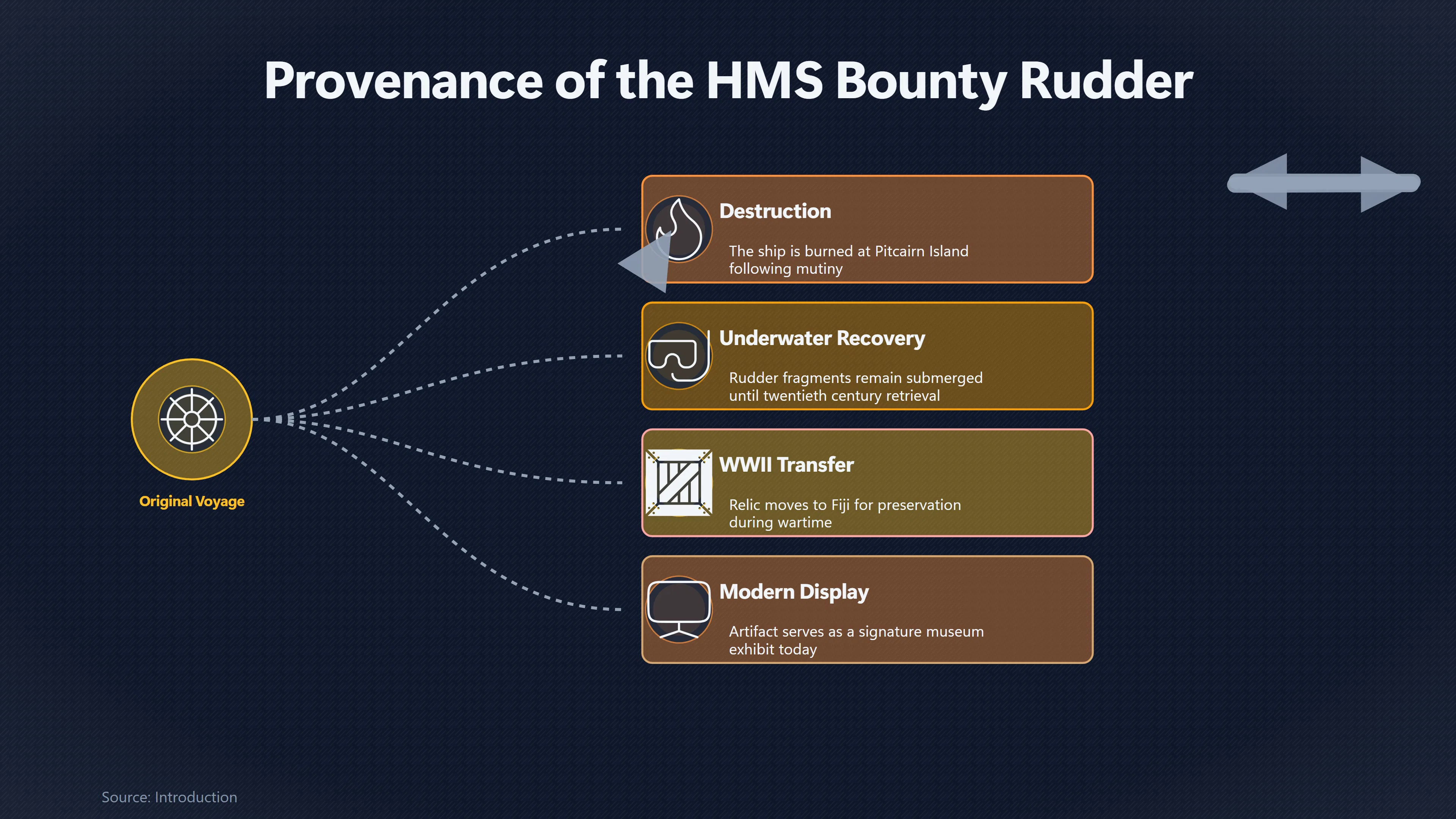
The rudder from HMS Bounty tells a completely different story. Its presence links Fiji with one of the Pacific’s most famous maritime episodes, even though the mutiny itself occurred elsewhere. After Bounty was burned at Pitcairn Island in 1790, part of the rudder remained underwater until it was recovered in the twentieth century. It spent years on Pitcairn before being transferred to Fiji for preservation during the Second World War, where it became one of the museum’s signature artefacts. The surviving wood also illustrates how objects accumulate histories after their original use: pieces were reportedly removed by souvenir hunters before the rudder reached museum care, reducing its size considerably. Royal Museums Greenwich still preserves smaller fragments, confirming the division of the original relic between institutions.[com.fj]fijitimes.com.fjFiji Times History of the museumFiji TimesHistory of the museum - The Fiji Times…
Placed side by side, the canoe and the rudder create an unusual dialogue. One embodies Indigenous Pacific navigation and craftsmanship, while the other represents European exploration, empire and one of history’s most famous naval mutinies. Their proximity encourages visitors to think about intersecting maritime histories rather than treating them as separate stories.
Provenance, souvenirs and changing interpretation
One reason the Fiji Museum’s collections remain so valuable is that provenance—the documented history of an object’s ownership and collection—is treated as part of the exhibit rather than a technical detail hidden in museum records.
Many nineteenth-century Fijian artefacts entered museums through missionaries, colonial officials, traders and private collectors. These individuals often recorded little about where an object had been made, who owned it or how it had been used. As a result, some dramatic claims attached to artefacts cannot now be verified with certainty. Museum staff and researchers increasingly distinguish between evidence supported by documentation and stories that emerged later through tourism or popular culture.[Fiji Museum]fijimuseum.org.fjFiji Museum About – Fiji MuseumFiji Museum About – Fiji Museum
The famous feeding forks illustrate why provenance matters. Authentic nineteenth-century ceremonial forks certainly exist, but later copies were also produced for collectors and visitors after cannibalism had disappeared. Museums outside Fiji have identified examples dating from the twentieth century that were probably created as souvenirs rather than ritual objects. Without reliable acquisition records, appearance alone cannot establish whether a fork participated in historical ceremonies or was carved for the tourist market decades later.[National Museum of Ireland]museum.ieOpen source on museum.ie.
The same caution applies to weapons. Fiji became a major source of ethnographic collecting during the colonial period, and demand from overseas buyers encouraged the production of decorative replicas alongside genuine historical clubs. Museums therefore rely on wood species, carving techniques, wear patterns, documented ownership and acquisition records instead of dramatic stories alone when assessing authenticity.
Why these objects still matter
The Fiji Museum’s strangest artefacts are memorable because they resist simple labels. A ritual fork becomes evidence of sacred protocol rather than merely cannibalism. A war club reveals artistic skill and political authority alongside warfare. A giant canoe demonstrates sophisticated Indigenous engineering, while the Bounty rudder connects Fiji to a global maritime legend through a carefully documented chain of custody.
Together they show how museum interpretation has shifted over time. Earlier displays often highlighted exotic or shocking aspects of Pacific history to satisfy colonial curiosity. Contemporary interpretation increasingly restores cultural context, acknowledges uncertainty where provenance is incomplete, and explains how collecting practices themselves shaped what survives in museums today. In that sense, the most fascinating story is often not what the object once did, but how it travelled from ritual use, battlefield, voyage or colonial collection into Fiji’s national museum, where it now serves as evidence rather than spectacle.[Fiji Museum]fijimuseum.org.fjFiji Museum About – Fiji MuseumFiji Museum About – Fiji Museum

Amazon book picks
Further Reading
Books and field guides related to What Do Fiji Museum's Strangest Objects Mean?. Use these as the next step if you want deeper reading beyond the article.
The People of the Sea
Countering the dominant paradigms of recent Pacific Islands' historiography, which tend to limit understanding of the sea's importance, t...
Oceanic Art
This updated edition of Nicholas Thomas’s authoritative World of Art volume is a comprehensive look at Oceanic art, and includes a new ch...
Oceania: The Native Cultures of Australia and the Pacific Isl...
First published 1989. Subjects: Social life and customs, Ethnology, Moeurs et coutumes, Manners and customs, Cultuur.
Cannibalism: A Perfectly Natural History
“Surprising. Impressive. Cannibalism restores my faith in humanity.” —Sy Montgomery, The New York Times Book Review For centuries scienti...
eBay marketplace picks
Marketplace Samples
Live-tested eBay searches with available results related to this page.
Selected fromPacific collectible oneBay.co.uk.



Endnotes
1.
Source: Wikipedia
Title: Fiji Museum
Link:https://en.wikipedia.org/wiki/Fiji_Museum
2.
Source: museum.ie
Link:https://www.museum.ie/en-IE/Collections-Research/Collection/Documentation-Discoveries/Artefact/Cannibal%E2%80%99s-Fork-from-Fiji/b7f4d30c-4c64-4924-a7a9-fd84504c2798
3.
Source: youtube.com
Title: Fiji Museum
Link:https://www.youtube.com/watch?v=98bdW3NHItA
Source snippet
The Ratu Finau Tui Nayau Canoe at the Fiji Museum...
4.
Source: fijimuseum.org.fj
Title: Fiji Museum About – Fiji Museum
Link:https://fijimuseum.org.fj/about/
5.
Source: fijitimes.com.fj
Title: Fiji Times History of the museum
Link:https://www.fijitimes.com.fj/history-of-the-museum/
Source snippet
Fiji TimesHistory of the museum - The Fiji Times...
6.
Source: rmg.co.uk
Link:https://www.rmg.co.uk/collections/objects/rmgc-object-63324
Source snippet
Armed Vessel 'Bounty' on plinth | Royal Museums GreenwichImage: An image showing 'Record Shot - Do not reproduce.' + - PIECES OF RUDDER O...
7.
Source: rmg.co.uk
Link:https://www.rmg.co.uk/collections/objects/rmgc-object-63325
Source snippet
Armed Vessel 'Bounty' | Royal Museums GreenwichImage: An image showing 'Record Shot - Do not reproduce.' Image: An image showing 'Wood fr...
8.
Source: fijimuseum.org.fj
Link:https://fijimuseum.org.fj/
Source snippet
Fiji Museum – 200 years of cultureADMISSION (FJD) Normal Admission Adults (16+ yrs) - $10.00 (local) | $20.00 (overseas) Child (2-15 yrs)...
9.
Source: infosekolah.net
Title: Fiji Museum
Link:https://infosekolah.net/en/Fiji_Museum
Source snippet
RESEARCH ARCHAEOLOGY AND EXCAVATION The museum's archaeological collections date back 3700 years.^{[10]} Osteological material from the a...
10.
Source: britishmuseum.org
Title: E Oc 7774
Link:https://www.britishmuseum.org/collection/object/E_Oc-7774
Source snippet
fork | British MuseumFORK Object Type fork Museum number Oc.7774 Description Two-pronged 'cannibal' fork made of hard brown wood, one pro...
Additional References
11.
Source: maa.cam.ac.uk
Link:https://maa.cam.ac.uk/Fiji-weapons
Source snippet
Spears were among the most technically accomplishe...
12.
Source: collections.bowers.org
Title: flesh fork icula
Link:https://collections.bowers.org/objects/135148/flesh-fork-icula
Source snippet
Fork (Icula) – Works – Bowers MuseumFlesh Fork (Icula) Previous Next Image: Flesh Fork (Icula), early 20th Century Fiji, Melanesia Wood...
13.
Source: youtube.com
Title: The Ratu Finau Tui Nayau Canoe at the Fiji Museum
Link:https://www.youtube.com/watch?v=VV69ZrHfB3Y
Source snippet
A Brief History of the Murder of Rev Thomas Baker...
14.
Source: youtube.com
Title: A Brief History of the Murder of Rev Thomas Baker
Link:https://www.youtube.com/watch?v=oV4Gir1I2kI
Source snippet
Fijian War Clubs - Tales from Te Papa episode 9...
15.
Source: britishmuseum.org
Link:https://www.britishmuseum.org/collection/object/E_Oc1920
Source snippet
Production date 1875 (before) Production place Made in: Fiji Excavator/field collector Field Collecti...
16.
Source: britishmuseum.org
Link:https://www.britishmuseum.org/collection/object/E_Oc1959
Source snippet
The fork is dark brown and includes four prongs, two of which are broken. Production ethnic...
17.
Source: youtube.com
Title: Fijian War Clubs
Link:https://www.youtube.com/watch?v=p-nUnOmtlPs
Source snippet
The Mace Parliament...
18.
Source: youtube.com
Title: The Mace Parliament
Link:https://www.youtube.com/watch?v=ecBp0IoplLM