Within Strange Panama
Why Panama's Colonial Saints Look So Severe
Panama's colonial sculptures, silverwork and devotional objects can appear macabre today because they were designed to inspire fear, pity and faith.
On this page
- What Survives in Religious Art Collections
- Wounds, Martyrdom and Devotional Emotion
- Reading Sacred Objects Without Gothic Distortion
Page outline Jump by section
Introduction
Many of Panama’s most striking colonial religious objects can appear unsettling to modern visitors. Saints with hollow eyes, Christ figures covered in wounds, blood-red martyrdom scenes and heavy silver processional objects were not created to frighten people for entertainment. They were designed to make religious stories feel immediate, emotional and unforgettable. In an age when much of the population learned Christian teaching through images rather than books, sculpture, painting and precious metalwork became powerful visual tools intended to inspire compassion, repentance, awe and hope rather than horror. Today, these same objects occupy an intriguing place within Panama’s curiosity landscape because their emotional intensity often feels closer to Gothic art than to the calm religious imagery many people expect from modern churches.[Sicultura]sicultura.gob.paSicultura · Museo de Arte Religioso ColonialJuly 23, 2024…
For visitors interested in Panama’s stranger heritage, colonial sacred collections reveal how fear, suffering and beauty were deliberately combined to communicate faith. Understanding that original purpose makes these works far more compelling than simply treating them as eerie relics.
Why Panama’s Colonial Saints Look So Severe
Spanish colonial religious art belonged to the wider artistic traditions of the Counter-Reformation, when the Catholic Church encouraged vivid images capable of moving worshippers emotionally. In Panama, sculptures, paintings and liturgical silver arrived through commercial links with centres such as Quito, Lima and Seville, while local artists and workshops also produced devotional works adapted to regional churches.[Panamá América]panamaamerica.com.paPanamá América Estampas del Museo de Arte Religioso | Panamá AméricaPanamá América Estampas del Museo de Arte Religioso | Panamá América
Rather than presenting idealised human figures, many colonial saints display exaggerated expressions of pain or spiritual struggle. Their faces may appear gaunt, their eyes lifted dramatically towards heaven, and their bodies marked by torture or martyrdom. These features were intentional. Viewers were expected to identify emotionally with the suffering of Christ and the saints, recognising endurance, sacrifice and redemption rather than violence for its own sake.
This explains why colonial sacred objects often surprise modern audiences. Contemporary museum visitors are accustomed to neutral displays, whereas these works originally functioned inside candlelit churches filled with incense, music, sermons and religious processions. Removed from that setting, their emotional intensity can seem unexpectedly severe.
What Survives in Religious Art Collections
Panama’s principal public collection of colonial devotional art has long been associated with the Museo de Arte Religioso Colonial in the former chapel of the Santo Domingo convent in Casco Antiguo. The collection includes sculptures, paintings, silverwork and liturgical objects dating from the sixteenth century through the early nineteenth century. The Ministry of Culture has announced the museum’s relocation to new galleries within the Palacio de Gobierno while conservation work continues on important paintings and the former chapel returns to religious use.[Mi Cultura]micultura.gob.pamuseo de arte religioso colonial en nueva sedeMi CulturaMuseo de Arte Religioso Colonial en nueva sede – Ministerio de Cultura de PanamáApril 1, 2025…
The surviving collection illustrates several recurring forms of colonial devotion:
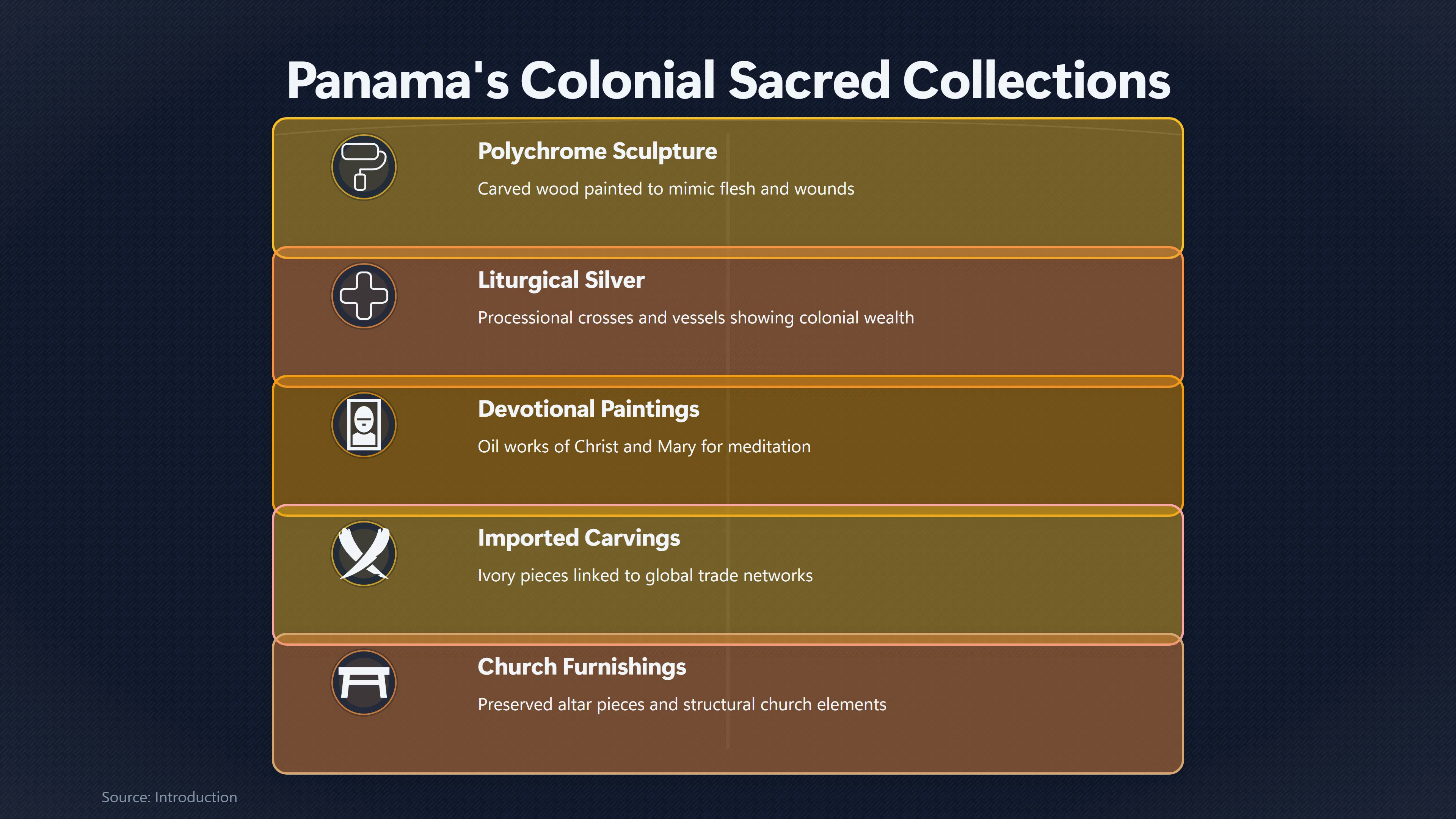
- Polychrome wooden sculpture, in which carved figures were painted to imitate living flesh, tears, bruises and blood.
- Silver processional crosses and liturgical vessels, demonstrating both artistic craftsmanship and the wealth that flowed through colonial Panama.
- Ivory and imported devotional carvings, showing the global trade networks linking Europe, the Americas and Asia through the Spanish Empire.
- Oil paintings of Christ, the Virgin Mary and saints, intended for meditation rather than decoration.
- Church furnishings and altar pieces, many preserved after churches were rebuilt, damaged or abandoned.[Panamá América]panamaamerica.com.paPanamá América Estampas del Museo de Arte Religioso | Panamá AméricaPanamá América Estampas del Museo de Arte Religioso | Panamá América
Seen together, these objects reveal Panama not simply as a transit route for treasure but as a place where imported artistic traditions mixed with local religious practice.
Wounds, Martyrdom and Devotional Emotion
To modern eyes, repeated images of wounds and suffering can appear unusually graphic. Within colonial Catholicism, however, physical suffering carried theological meaning.
The wounds of Christ reminded believers of sacrifice and salvation. Martyrs holding instruments of their execution demonstrated steadfast faith. Saints with sorrowful expressions encouraged empathy and self-reflection. Blood, tears and dramatic facial expressions were visual languages intended to communicate spiritual truths in societies where literacy varied greatly.
Artists therefore emphasised realism whenever possible. Painted glass eyes created lifelike gazes. Carefully modelled hands appeared tense with pain or prayer. Layers of paint produced convincing flesh tones and bruising. These techniques transformed carved wood into emotionally persuasive figures capable of engaging worshippers during services and processions.
The result can feel uncanny today precisely because the sculptures were designed to blur the boundary between artwork and living presence. They were meant to be encountered as devotional companions rather than distant museum exhibits.

The Black Christ of Portobelo and Living Devotion
No discussion of Panama’s sacred objects is complete without the famous Black Christ of Portobelo. Although better understood as a living devotional image than a museum object, it demonstrates how colonial religious sculpture can remain spiritually active centuries after its creation.
The life-sized wooden figure is housed in the Church of San Felipe in the historic colonial town of Portobelo. Legends surrounding its arrival vary, with accounts describing the statue being found at sea or repeatedly prevented from leaving Portobelo by storms, encouraging the belief that it had chosen to remain there. These traditions cannot be verified historically, but they continue to shape local identity and pilgrimage.[AP News]apnews.comDurante el evento, muchos fieles, como Ernesto Troya, recorren la última etapa de su viaje arrastrándose por las calles hacia la imagen d…
Each October, thousands of pilgrims travel to Portobelo, many fulfilling religious vows by walking long distances or crawling the final stretch towards the church. For participants, the sculpture is not an unsettling historical curiosity but a focus of prayer, gratitude and healing. The emotional response it inspires today resembles the devotional purpose that shaped many colonial sacred images from the beginning.[AP News]apnews.comDurante el evento, muchos fieles, como Ernesto Troya, recorren la última etapa de su viaje arrastrándose por las calles hacia la imagen d…
Its location within Portobelo’s wider colonial landscape—surrounded by churches, fortifications and former trading infrastructure—also illustrates how sacred objects, imperial history and Afro-Panamanian religious traditions became intertwined over centuries.[Sicultura]sicultura.gob.paSicultura · Conjunto Monumental Histórico de PortobeloMay 10, 2023…

Reading Sacred Objects Without Gothic Distortion
It is easy to approach colonial religious collections through a modern taste for the macabre, especially when sculptures display visible wounds or severe facial expressions. Doing so, however, risks misunderstanding both the objects and the people who created and preserved them.
A more accurate reading recognises several overlapping realities:
- These works were educational, communicating religious narratives through images.
- They were performative, intended for churches, feast days and public processions rather than silent galleries.
- They were artistic achievements, reflecting sophisticated carving, painting and metalworking techniques.
- They remain devotional objects for many Panamanians, even when displayed within museums.
- They also preserve evidence of colonial power, missionary activity and cultural exchange, making them historically significant beyond their religious role.
This balance matters because the same sculpture can be appreciated simultaneously as an artwork, a historical artefact and an object of continuing faith.
Why These Collections Matter Within Panama’s Strange Heritage
Panama’s colonial sacred objects occupy an unusual place within the country’s landscape of curious collections. Unlike cabinets of oddities or museums devoted to sensational subjects, their power comes from intention rather than mystery. They demonstrate how artists deliberately used realism, suffering and precious materials to shape religious experience.
For visitors exploring Panama’s more unconventional heritage, these collections reward careful observation. What first appears severe or unsettling often reveals sophisticated craftsmanship, global artistic connections and centuries of continuing belief. The objects have not become strange because they changed; they seem strange because modern viewers encounter them outside the devotional world for which they were originally created.
Amazon book picks
Further Reading
Books and field guides related to Why Panama's Colonial Saints Look So Severe. Use these as the next step if you want deeper reading beyond the article.

The Power of Images
This book was ground-breaking for its time because of Freedberg's insistence on a new? approach to the study of images that focused on wr...

Art of Colonial Latin America
First published 2005. Subjects: Civilization, Latin American Art, Spanish influences, History, Painting, latin american.
The Image of the Black in Western Art, Volume III
First published 2010. Subjects: Blacks in art.
eBay marketplace picks
Marketplace Samples
Live-tested eBay searches with available results related to this page.
Selected fromreligious art print oneBay.co.uk.

Endnotes
1.
Source: sicultura.gob.pa
Link:https://sicultura.gob.pa/espacios-culturales/museos-otros-espacios-exhibicion-interpretacion-patrimonial/museo-de-arte-religioso-colonial
Source snippet
Sicultura · Museo de Arte Religioso ColonialJuly 23, 2024...
Published: July 23, 2024
2.
Source: panamaamerica.com.pa
Title: Panamá América Estampas del Museo de Arte Religioso | Panamá América
Link:https://www.panamaamerica.com.pa/variedades/estampas-del-museo-de-arte-religioso-59055
3.
Source: micultura.gob.pa
Title: museo de arte religioso colonial en nueva sede
Link:https://micultura.gob.pa/museo-de-arte-religioso-colonial-en-nueva-sede/
Source snippet
Mi CulturaMuseo de Arte Religioso Colonial en nueva sede – Ministerio de Cultura de PanamáApril 1, 2025...
Published: April 1, 2025
4.
Source: apnews.com
Link:https://apnews.com/article/1394eb0de3ac6b6fe2d77f23e88505b3
Source snippet
Durante el evento, muchos fieles, como Ernesto Troya, recorren la última etapa de su viaje arrastrándose por las calles hacia la imagen d...
5.
Source: portobelo.municipios.gob.pa
Title: Portobelo Municipio SITIOS – Municipio de Portobelo
Link:https://portobelo.municipios.gob.pa/sitios/
6.
Source: sicultura.gob.pa
Link:https://sicultura.gob.pa/espacios-culturales/monumentos-sitios-declarados-patrimonio/conjunto-monumental-historico-de-portobelo
Source snippet
Sicultura · Conjunto Monumental Histórico de PortobeloMay 10, 2023...
Published: May 10, 2023
7.
Source: micultura.gob.pa
Title: La ministra de Cultura, María Eugenia Herre
Link:https://micultura.gob.pa/autoridades-inspeccionan-los-avances-de-la-restauracion-de-la-iglesia-de-portobelo/
Source snippet
Autoridades inspeccionan los avances de la restauración de la Iglesia de Portobelo – Ministerio de Cultura de PanamáFebruary 23, 2026 — A...
Published: February 23, 2026
8.
Source: files.sicultura.gob.pa
Title: sicultura.gob.pa Sicultura · Conjunto Monumental Histórico de Portobelo
Link:https://files.sicultura.gob.pa/espacios-culturales/monumentos-sitios-declarados-patrimonio/conjunto-monumental-historico-de-portobelo
9.
Source: staging.sicultura.gob.pa
Title: sicultura.gob.pa Sicultura · Museo de Arte Religioso Colonial
Link:https://staging.sicultura.gob.pa/espacios-culturales/museos-otros-espacios-exhibicion-interpretacion-patrimonial/museo-de-arte-religioso-colonial
10.
Source: sicultura.gob.pa
Title: Sicultura · Museo de la Real Aduana de Portobelo
Link:https://sicultura.gob.pa/espacios-culturales/museos-otros-espacios-exhibicion-interpretacion-patrimonial/museo-de-la-real-aduana-de-portobelo
11.
Source: portobelo.municipios.gob.pa
Link:https://portobelo.municipios.gob.pa/cultura/
Additional References
12.
Source: youtube.com
Link:https://www.youtube.com/watch?v=C6PUlTYnxLY
Source snippet
"Museo de Arte Religioso Colonial" Panama Museo de Arte Religioso Colonial de Panamá Daniel Adames...
13.
Source: estudiosamericanos.revistas.csic.es
Title: es“Guarded Women”
Link:https://estudiosamericanos.revistas.csic.es/index.php/estudiosamericanos/article/view/1104
Source snippet
The Founding of the Convent of La Limpia Concepción de Panamá in Post-Tridentine Times | Anuario de Estudios AmericanosDecember 18, 2025...
Published: December 18, 2025
14.
Source: youtube.com
Title: Exploring the Spanish Colonial art of Gaspar Miguel de Berrío
Link:https://www.youtube.com/watch?v=75BDajLTzWA
Source snippet
The Hidden Patterns of Latin American Baroque Art...
15.
Source: amcapanama.com
Link:https://amcapanama.com/
16.
Source: tourismpanama.com
Link:https://www.tourismpanama.com/places-to-visit/portobelo/things-to-do/culture-arts/
17.
Source: museocolonial.gov.co
Link:https://www.museocolonial.gov.co/colecciones/piezas-del-mes/Paginas/Resplandor.aspx
18.
Source: upo.es
Link:https://www.upo.es/revistas/index.php/atrio/article/view/6878?articlesBySimilarityPage=10
19.
Source: upo.es
Link:https://www.upo.es/revistas/index.php/atrio/article/view/6878?articlesBySimilarityPage=12
20.
Source: upo.es
Link:https://www.upo.es/revistas/index.php/atrio/article/view/6878?articlesBySimilarityPage=30
21.
Source: journals.iai.spk-berlin.de
Link:https://journals.iai.spk-berlin.de/index.php/indiana/article/view/3185