Within Curious Brunei
What Brunei's Shipwreck Cargo Can Really Tell US
Thousands of recovered ceramics reveal a lost trading world while leaving the ship, crew and final destination uncertain.
On this page
- The discovery and underwater recovery
- What the ceramics reveal about trade
- The mysteries archaeology cannot settle
Page outline Jump by section
Introduction
Brunei’s most intriguing archaeological collection is not a royal treasure or a religious relic, but the cargo of a merchant ship that never reached its destination. Displayed in the Brunei Darussalam Maritime Museum, more than 13,000 recovered artefacts—mostly ceramics—offer an unusually detailed snapshot of maritime trade in the fifteenth century. Yet the ship itself remains enigmatic. Archaeologists can identify much of what it carried, estimate when it sank and reconstruct parts of the trading network it served, but they still cannot say with certainty where the vessel was built, who sailed it, why it sank or exactly where it was heading. That combination of abundant physical evidence and enduring uncertainty makes the Brunei shipwreck one of Southeast Asia’s most fascinating unresolved archaeological stories.[Brunei Tourism]bruneitourism.comBrunei Tourism Brunei Darussalam Maritime MuseumBrunei TourismBrunei Darussalam Maritime Museum - Abode of Peace - Brunei Tourism Official Site…
The discovery and underwater recovery
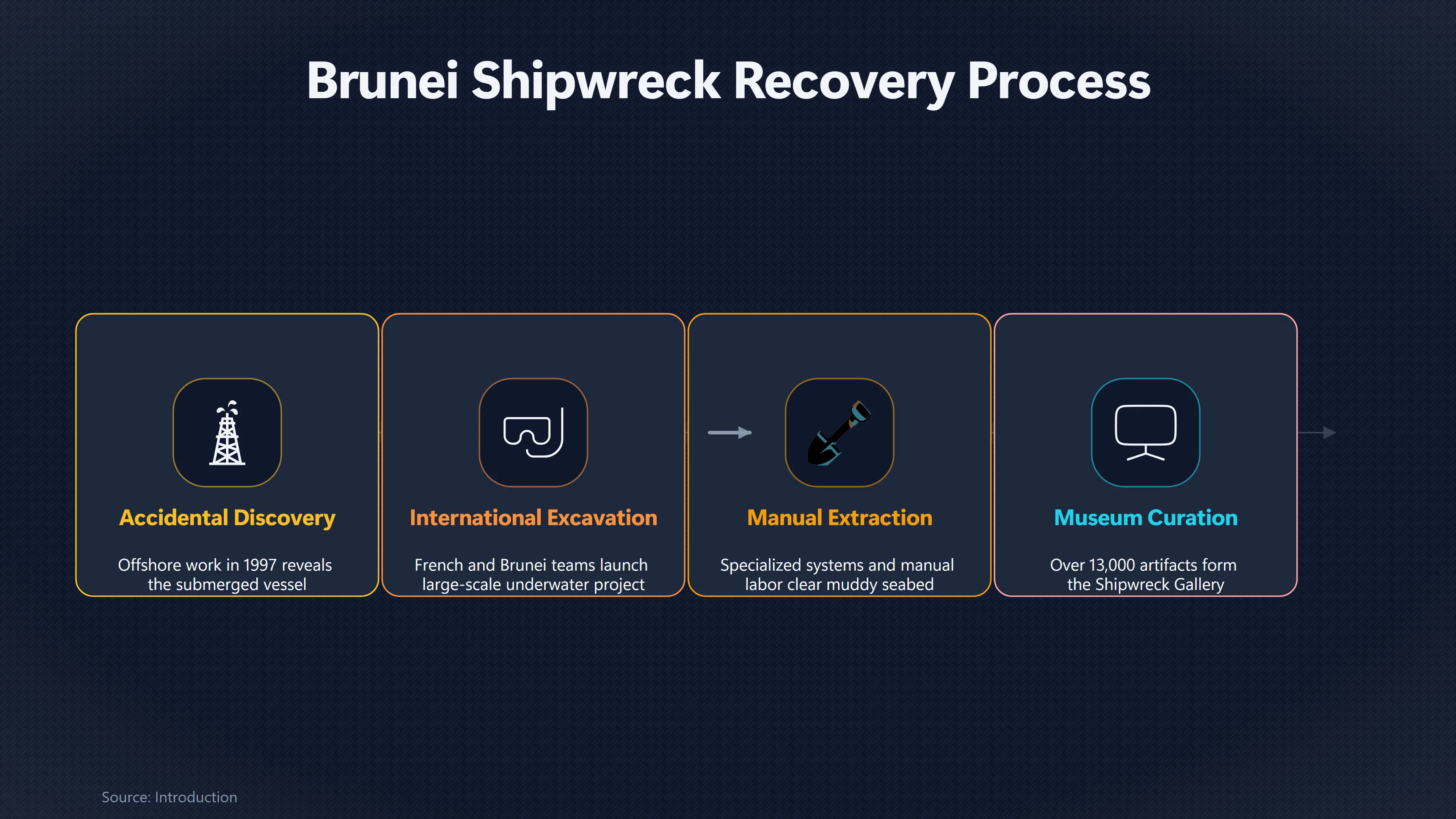
The wreck was discovered accidentally in 1997 during offshore work in Brunei’s Champion oilfield, around 32 nautical miles off the country’s coast at a depth of roughly 60–65 metres. The depth, poor visibility and strong currents meant this was far beyond the scope of ordinary archaeological diving.[Wikipedia]WikipediaBrunei Darussalam Maritime MuseumBrunei Darussalam Maritime Museum
An international excavation followed in 1998 under the direction of French underwater archaeologists working with Brunei’s authorities. The project became one of the largest underwater archaeological operations undertaken at the time. Hundreds of specialists documented artefacts, processed enormous quantities of seabed sediment and used specialised diving systems alongside remotely operated equipment. Even with advanced technology, the muddy water limited visibility so severely that many tasks still depended on painstaking manual excavation.[Archéologie]archeologie.culture.gouv.frArchéologie Brunei (Borneo) | Underwater archaeologyArchéologie Brunei (Borneo) | Underwater archaeology
The recovery produced approximately 14,000 significant artefacts, with more than 13,000 now forming the core of the Brunei Shipwreck Gallery. Rather than displaying treasure in the popular sense, the museum presents an archaeological cargo almost exactly as it was recovered, allowing visitors to appreciate the scale of medieval maritime commerce instead of focusing on a handful of spectacular objects.[Brunei Tourism]bruneitourism.comBrunei Tourism Brunei Darussalam Maritime MuseumBrunei TourismBrunei Darussalam Maritime Museum - Abode of Peace - Brunei Tourism Official Site…
What the ceramics reveal about trade
The cargo is remarkable because it represents a working merchant shipment rather than a ceremonial collection. Thousands of objects survived because fired ceramics withstand centuries underwater far better than wood, textiles or organic cargoes. Similar shipwrecks across Asia have transformed historians’ understanding of regional commerce, and the Brunei wreck provides one of the clearest examples from the fifteenth century.[Victoria and Albert Museum]vam.ac.ukshipwrecked ceramicsVictoria and Albert MuseumShipwrecked ceramics · V&AApril 17, 2024…
The recovered cargo includes:
- Thousands of blue-and-white porcelain vessels from Ming China.
- Large storage jars originating in China, Thailand and Vietnam.
- Glass bracelets and beads.
- Bronze gongs, cooking vessels and other everyday equipment.
- Metal bars and small ingots that probably served as trade goods or raw materials.[Archéologie]archeologie.culture.gouv.frArchéologie Brunei (Borneo) | Underwater archaeologyArchéologie Brunei (Borneo) | Underwater archaeology
What makes this collection especially valuable is its diversity. Instead of carrying goods from only one production centre, the ship appears to have loaded merchandise from several manufacturing regions across East and Southeast Asia. That suggests merchants were assembling mixed cargoes intended for customers who wanted practical household goods alongside higher-status ceramics.
The variety also reinforces Brunei’s position within the Maritime Silk Road. Rather than existing at the edge of Asian trade, Brunei functioned as part of a network linking Chinese kilns, mainland Southeast Asian producers and markets throughout the Indonesian archipelago. The shipwreck demonstrates these connections through physical objects rather than written records.[Brunei Tourism]bruneitourism.comBrunei Tourism Brunei Darussalam Maritime MuseumBrunei TourismBrunei Darussalam Maritime Museum - Abode of Peace - Brunei Tourism Official Site…
Many of the ceramics are ordinary tableware and storage vessels rather than luxury masterpieces. This is important because it reveals the everyday economics of long-distance commerce. Archaeologists often learn more from shipments of common goods than from isolated prestige objects, since bulk cargoes show what merchants expected to sell in significant quantities.[Victoria and Albert Museum]vam.ac.ukshipwrecked ceramicsVictoria and Albert MuseumShipwrecked ceramics · V&AApril 17, 2024…
The mysteries archaeology cannot settle
Despite the exceptional preservation of the cargo, several of the ship’s biggest questions remain unanswered.
When exactly did it sink?
Most specialists place the wreck in the middle or later fifteenth century, but no precise year can be established. Radiocarbon dating, coins recovered from the wreck and the production dates of certain ceramics all point towards the mid-1400s, yet none provides a definitive sinking date. Different researchers have proposed slightly different chronological ranges while agreeing broadly on the period.[British Museum]britishmuseum.orgBritish Museumbox | British MuseumBritish Museumbox | British Museum
Where was the ship travelling?
The destination remains unknown. The cargo indicates participation in regional trade, but archaeology alone cannot identify the intended port. The vessel may have been heading towards Brunei, departing from it or simply passing nearby when disaster struck. Without written records or identifying inscriptions, competing interpretations remain plausible.[Archéologie]archeologie.culture.gouv.frArchéologie Brunei (Borneo) | Underwater archaeologyArchéologie Brunei (Borneo) | Underwater archaeology
Who owned the vessel?
The ship’s construction and mixed cargo suggest an Asian merchant vessel rather than a European ship, but assigning it confidently to a particular kingdom, ethnic community or trading company has proved impossible. Maritime trade in the region frequently involved multicultural crews and commercial partnerships that left little trace in the archaeological record.[Archéologie]archeologie.culture.gouv.frArchéologie Brunei (Borneo) | Underwater archaeologyArchéologie Brunei (Borneo) | Underwater archaeology

Why did it sink?
No single explanation has been confirmed. Storms, navigational error, collision with reefs, structural failure or other accidents all remain possible. Unlike famous wrecks linked to warfare or piracy, the Brunei shipwreck offers no clear evidence for a dramatic final event. Its silence is part of its historical importance: archaeology has preserved the cargo but not the story of the disaster itself.[Archéologie]archeologie.culture.gouv.frArchéologie Brunei (Borneo) | Underwater archaeologyArchéologie Brunei (Borneo) | Underwater archaeology
Why the unanswered questions matter
The unresolved nature of the wreck is precisely what makes it so valuable. Rather than providing a neatly completed historical narrative, it demonstrates both the strengths and limits of archaeology.
The recovered objects allow researchers to reconstruct trade routes, manufacturing centres, consumer demand and commercial connections across the South China Sea with remarkable precision. At the same time, the absence of written documentation means some of the most human questions—who sailed the ship, what they expected to earn and how their voyage ended—may never be answered.
For visitors to Brunei Darussalam Maritime Museum, that uncertainty becomes part of the exhibition’s appeal. The galleries do not simply display beautiful ceramics; they present evidence from a lost trading world that is substantial enough to rewrite economic history while still leaving the ship’s final voyage tantalisingly incomplete.[Brunei Tourism]bruneitourism.comBrunei Tourism Brunei Darussalam Maritime MuseumBrunei TourismBrunei Darussalam Maritime Museum - Abode of Peace - Brunei Tourism Official Site…
Amazon book picks
Further Reading
Books and field guides related to What Brunei's Shipwreck Cargo Can Really Tell US. Use these as the next step if you want deeper reading beyond the article.
The Sea and Civilization: A Maritime History of the World
SHORTLISTED FOR THE MARITIME MEDIA AWARDS 2014 A monumental, wholly accessible work of scholarship that retells human history through the...
The Silk Roads: A New History of the World
The No. 1 Sunday Times and international bestseller - a major reassessment of world history in light of the economic and political renais...
Archaeology: A Very Short Introduction
This 'Very Short Introduction' provides an up-to-date account of the problems, concerns and nature of archaeology, with reference to all...
eBay marketplace picks
Marketplace Samples
Live-tested eBay searches with available results related to this page.
Selected fromceramic collectible oneBay.co.uk.
Endnotes
1.
Source: bruneitourism.com
Title: Brunei Tourism Brunei Darussalam Maritime Museum
Link:https://www.bruneitourism.com/places/brunei-darussalam-maritime-museum/
Source snippet
Brunei TourismBrunei Darussalam Maritime Museum - Abode of Peace - Brunei Tourism Official Site...
2.
Source: archeologie.culture.gouv.fr
Title: Archéologie Brunei (Borneo) | Underwater archaeology
Link:https://archeologie.culture.gouv.fr/archeo-sous-marine/en/brunei-borneo
3.
Source: Wikipedia
Title: Brunei Darussalam Maritime Museum
Link:https://en.wikipedia.org/wiki/Brunei_Darussalam_Maritime_Museum
4.
Source: vam.ac.uk
Title: shipwrecked ceramics
Link:https://www.vam.ac.uk/articles/shipwrecked-ceramics
Source snippet
Victoria and Albert MuseumShipwrecked ceramics · V&AApril 17, 2024...
Published: April 17, 2024
5.
Source: britishmuseum.org
Title: British Museumbox | British Museum
Link:https://www.britishmuseum.org/collection/object/A
6.
Source: britishmuseum.org
Title: British Museumewer | British Museum
Link:https://www.britishmuseum.org/collection/object/A
7.
Source: britishmuseum.org
Link:https://www.britishmuseum.org/collection/object/A_2000-1212-31?selectedImageId=1613997245
8.
Source: britishmuseum.org
Link:https://www.britishmuseum.org/collection/object/A_2000-1212-37?selectedImageId=1613980053
9.
Source: lonelyplanet.com
Title: Brunei Darussalam Maritime Museum | Attractions
Link:https://www.lonelyplanet.com/brunei-darussalam/bandar-seri-begawan/attractions/brunei-darussalam-maritime-museum/a/poi-sig/1522618/355847
10.
Source: lonelyplanet.com
Title: Brunei Darussalam Maritime Museum | Attractions
Link:https://www.lonelyplanet.com/points-of-interest/brunei-darussalam-maritime-museum/1522618
11.
Source: en.unesco.org
Link:https://en.unesco.org/silkroad/underwater-cultural-heritage-themes/museum
12.
Source: archeologie.culture.gouv.fr
Link:https://archeologie.culture.gouv.fr/archeo-sous-marine/fr/brunei-borneo
Additional References
13.
Source: china.org.cn
Title: Maritime museum witnesses Brunei-China trade history, cultural exchanges
Link:https://www.china.org.cn/arts/2018-11/17/content_73129163.htm
Source snippet
17, 2018 — MARITIME MUSEUM WITNESSES BRUNEI-CHINA TRADE HISTORY, CULTURAL EXCHANGES Image0 Comment(s)ImagePrintImage E-mail Xinhua, Novem...
14.
Source: xinhuanet.com
Link:https://www.xinhuanet.com/english/asiapacific/2018-11/16/c_137612111.htm
Source snippet
Xinhua | English.news.cnNovember 16, 2018 — FEATURE: MARITIME MUSEUM WITNESSES BRUNEI-CHINA TRADE HISTORY, CULTURAL EXCHANGES...
Published: November 16, 2018
15.
Source: unesco.org
Title: crystal palace houses shipwreck 0
Link:https://www.unesco.org/en/articles/crystal-palace-houses-shipwreck-0
Source snippet
A Crystal Palace houses a shipwreck | UNESCOOctober 18, 2017 — Article A CRYSTAL PALACE HOUSES A SHIPWRECK Image: The Guangdong Maritime...
Published: October 18, 2017
16.
Source: youtube.com
Title: THE TREASURE OF THE SUNKEN JUNK
Link:https://www.youtube.com/watch?v=hDIuok9xd8c
Source snippet
NOVA: Sultan's Lost Treasure (2001) | Ancient Chinese Shipwreck Revealed...
17.
Source: rtbnews.rtb.gov.bn
Title: rtb.gov.bn Latest News
Link:https://www.rtbnews.rtb.gov.bn/Lists/News%202018/NewDispForm.aspx?ID=51280
Source snippet
News - Maritime Museum Traveling ExhibitionJanuary 6, 2026 — 06/01/2026 MARITIME MUSEUM TRAVELING EXHIBITION National YouTube video play...
Published: January 6, 2026
18.
Source: youtube.com
Link:https://www.youtube.com/watch?v=1za2O3yMRYU
Source snippet
Lost Chinese Treasure: The True Star Shipwreck and Its 300000 Porcelain Secrets...
19.
Source: youtube.com
Title: BRUNEI SCUBA DIVING | Bolkiah Shipwreck and Oil Rig Wreck | Poni Divers
Link:https://www.youtube.com/watch?v=KicLI30JPrU
Source snippet
SHIPWRECK DIVING IN BRUNEI!! (Southeast Asia Travel VLOG)...
20.
Source: researchgate.net
Link:https://www.researchgate.net/publication/343046343_Unit_13_Asian_CeramicsTraining_Manual_for_the_UNESCO_Foundation_Course_on_the_Protection_and_Management_of_Underwater_Cultural_Heritage_in_Asia_and_the_Pacific
21.
Source: hadrianmendoza.com
Link:https://hadrianmendoza.com/brunei
22.
Source: nationalmuseum.gov.ph
Link:https://www.nationalmuseum.gov.ph/our-collections/maritime-and-underwater-cultural-heritage/maritime-pandanan-shipwreck/