Within Somalia Curiosities
Why Laas Geel Feels Like a Prehistoric Museum
Laas Geel turns painted rock shelters into an open-air gallery whose vivid cattle scenes still resist simple explanation.
On this page
- What survives inside the painted shelters
- What the cattle scenes may have meant
- Visiting a vulnerable site in contested territory
Page outline Jump by section
Introduction
Laas Geel is one of the most remarkable archaeological sites in the Horn of Africa because it preserves a prehistoric “gallery” of painted rock shelters rather than a conventional museum collection. Near Hargeisa, the granite outcrops contain vivid images of decorated cattle, human figures, dogs and a handful of wild animals that have survived for roughly five millennia in their original landscape. Instead of being removed to display cases, the paintings remain on the ceilings and walls where prehistoric artists created them, making the site feel like an open-air museum whose exhibits have never left home.[Archéologie]archeologie.culture.gouv.frArchéologie Laas Geel: the African Lascaux | Archéologie | culture.gouv.frArchéologie Laas Geel: the African Lascaux | Archéologie | culture.gouv.fr
For anyone interested in unusual collections or strange heritage, Laas Geel stands out because its greatest mystery is not whether the paintings are genuine—they unquestionably are—but why they were made. Archaeologists agree that they belong to early pastoral communities, yet many aspects of their symbolism remain uncertain. That combination of exceptional preservation and unanswered questions gives the site an enduring fascination.
What survives inside the painted shelters
Laas Geel consists of around twenty decorated rock shelters spread across a granite hill overlooking seasonal watercourses. The shelters are not caves in the dramatic underground sense but shallow overhangs whose protected ceilings created ideal conditions for preserving painted surfaces over thousands of years. The paintings came to international scholarly attention after a French archaeological expedition documented the site in December 2002, although local communities had long known of its existence.[Archéologie]archeologie.culture.gouv.frArchéologie Laas Geel: the African Lascaux | Archéologie | culture.gouv.frArchéologie Laas Geel: the African Lascaux | Archéologie | culture.gouv.fr
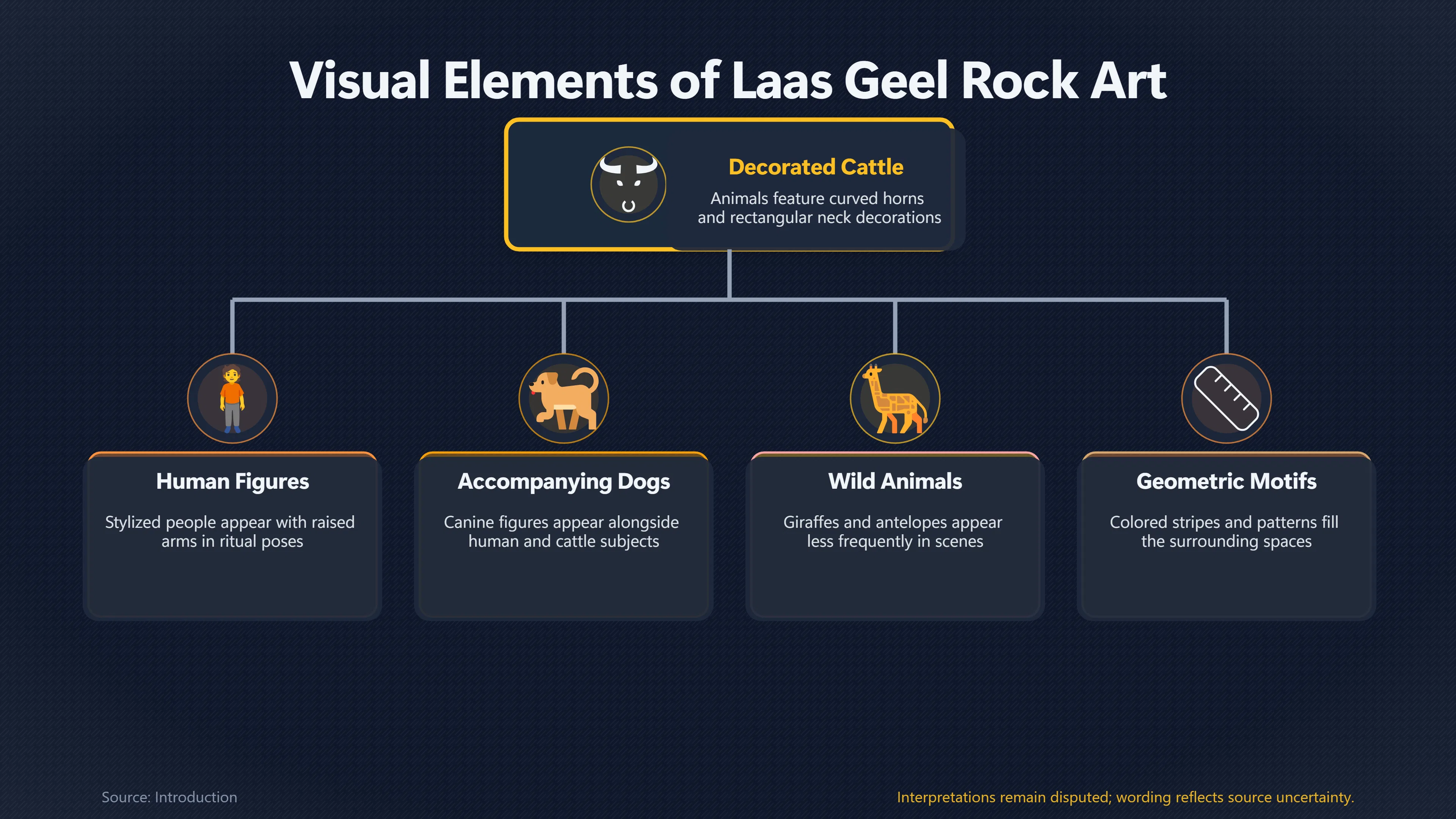
The overwhelming visual theme is cattle. Rather than simple livestock sketches, the artists produced carefully balanced compositions in red, white, yellow, brown, black and violet pigments. Many animals have elegant curved horns, prominent udders and striking rectangular neck decorations filled with coloured stripes or geometric patterns. Human figures frequently appear beneath or beside the cattle with raised arms, suggesting ritual or ceremonial relationships rather than ordinary herding scenes. Dogs accompany some figures, while giraffes, antelopes and a few other wild animals appear much less often. Geometric motifs fill spaces around the larger figures, adding to the impression of carefully planned compositions rather than casual drawings.[African Rock Art]africanrockart.britishmuseum.orgAfrican Rock Art Laas GeelAfrican Rock Art Laas Geel
Unlike many prehistoric rock-art sites, Laas Geel preserves colours of unusual intensity. The shelter roofs protected the pigments from direct rain and sunlight, allowing the paintings to retain a freshness that surprises many visitors. This exceptional state of preservation is one reason the site is often compared with famous European cave-art locations, although its artistic tradition and cultural context are entirely different.[Archéologie]archeologie.culture.gouv.frArchéologie Laas Geel: the African Lascaux | Archéologie | culture.gouv.frArchéologie Laas Geel: the African Lascaux | Archéologie | culture.gouv.fr
What the cattle scenes may have meant
The cattle are the heart of Laas Geel’s prehistoric gallery, but archaeologists remain cautious about assigning a single meaning to them.
The strongest evidence links the paintings to early pastoral societies that depended heavily on domesticated cattle. Excavations associated with the shelters indicate occupation during the fourth to third millennia BCE, placing the paintings among the earliest substantial artistic records of cattle-keeping communities in the Horn of Africa.[African Rock Art]africanrockart.britishmuseum.orgAfrican Rock Art Laas GeelAfrican Rock Art Laas Geel
Several features suggest that the animals represented more than economic wealth:
- The cattle are elaborately decorated rather than shown grazing or working.
- Human figures are stylised and consistently positioned in relation to particular animals.
- Raised arms and repeated body postures hint at formal actions or ceremonies.
- Decorative neck coverings may represent ceremonial ornaments, textiles or ritual equipment rather than natural anatomy.[African Rock Art]africanrockart.britishmuseum.orgAfrican Rock Art Laas GeelAfrican Rock Art Laas Geel
Even so, these remain interpretations rather than established facts. No written records survive, and archaeologists avoid claiming that the paintings depict specific religious beliefs. The safest conclusion is that cattle held exceptional symbolic importance alongside their practical value, reflecting a society in which livestock shaped identity, status and perhaps spiritual life.
Research has also shown that Laas Geel represents an early artistic tradition rather than an isolated masterpiece. Similar, though generally less spectacular, painted sites have since been identified elsewhere in Somaliland, allowing scholars to speak of a distinctive regional style instead of a one-off phenomenon.[African Rock Art]africanrockart.britishmuseum.orgAfrican Rock Art Laas GeelAfrican Rock Art Laas Geel
Why it feels like a prehistoric museum
Most museums separate artefacts from the places where they were found. Laas Geel does the opposite.
Visitors move between natural shelters that function almost like interconnected galleries. Instead of display labels and glass cases, the granite ceilings themselves carry the paintings. The surrounding landscape—dry valleys, exposed rock and seasonal watercourses—is part of the exhibit because it helps explain why prehistoric communities repeatedly occupied this location.[African Rock Art]africanrockart.britishmuseum.orgAfrican Rock Art Laas GeelAfrican Rock Art Laas Geel
This setting changes how the artwork is experienced. Scale becomes easier to appreciate when the paintings remain above head height, exactly where ancient artists placed them. The relationship between the shelters, nearby water sources and pastoral landscape is immediately visible in a way that would be impossible inside a conventional museum building.
For a country whose museum sector suffered extensive disruption during decades of conflict, Laas Geel has become one of the most powerful public encounters with Somalia’s deep past. Rather than reconstructing a lost collection, the site preserves an original prehistoric gallery in situ.
Visiting a vulnerable site in contested territory
Although Laas Geel is one of the Horn of Africa’s outstanding archaeological attractions, visiting requires realistic expectations.
The site lies in Somaliland, a self-governing territory that has operated separately from Somalia since 1991 but remains internationally recognised by most states as part of Somalia. Many travellers reach it from Hargeisa with local guides, and access is generally organised rather than entirely independent. Political recognition issues can affect travel planning even when local conditions around the site itself are stable.[Archéologie]archeologie.culture.gouv.frArchéologie Laas Geel: the African Lascaux | Archéologie | culture.gouv.frArchéologie Laas Geel: the African Lascaux | Archéologie | culture.gouv.fr
The paintings are highly vulnerable. Unlike museum collections protected by climate-controlled buildings, they remain exposed to natural weathering, accidental damage and increasing visitor pressure. Conservation therefore focuses on careful site management, controlled access and limiting physical contact rather than relocating the artwork. International heritage initiatives launched in recent years have included Laas Geel among their priorities for archaeological protection and sustainable tourism.[Expertise France]expertisefrance.frExpertise FranceProtection and promotion of Somaliland’s archaeological heritage | Expertise FranceDecember 19, 2025…
Responsible visitors should expect a heritage site rather than a commercial attraction. Facilities are modest, and the experience depends on respecting both the archaeological remains and the local communities that help safeguard them.

Why Laas Geel matters in Somalia’s landscape of curiosities
Among Somalia’s unusual heritage sites, Laas Geel occupies a unique position because it combines artistic brilliance with genuine archaeological mystery. It is not famous for hidden treasure, supernatural folklore or sensational claims. Its fascination comes from something rarer: an authentic prehistoric collection preserved exactly where it was created, with vivid cattle paintings that still resist complete explanation.
As an open-air gallery, Laas Geel demonstrates that some of the world’s most extraordinary collections are not assembled by modern curators but inherited directly from the distant past. The painted shelters remain both a work of art and an archaeological archive, preserving evidence of early pastoral life while continuing to challenge researchers attempting to understand the beliefs and ceremonies behind their extraordinary cattle imagery.[Archéologie]archeologie.culture.gouv.frArchéologie Laas Geel: the African Lascaux | Archéologie | culture.gouv.frArchéologie Laas Geel: the African Lascaux | Archéologie | culture.gouv.fr
Amazon book picks
Further Reading
Books and field guides related to Why Laas Geel Feels Like a Prehistoric Museum. Use these as the next step if you want deeper reading beyond the article.
The First Signs: Unlocking the Mysteries of the World's Oldes...
“If you love mysteries, you’ll love this book. Genevieve von Petzinger acts as guide and sleuth in this fascinating, accessible, and fast...
Cave Art
The first comprehensive, illustrated guide to all of the decorated Ice Age caves in Europe that are open to the public.
The Archaeology of Africa: Food, Metals and Towns
Africa has a vibrant past. It emerges from this book as the proud possessor of a vast and highly complicated interweaving of peoples and...

Africa, the Art of a Continent
First published 1996. Subjects: Art, african, African Art, Exhibitions, Beeldende kunsten, Art africain.
eBay marketplace picks
Marketplace Samples
Live-tested eBay searches with available results related to this page.
Selected fromcave art print oneBay.co.uk.
Endnotes
1.
Source: archeologie.culture.gouv.fr
Title: Archéologie Laas Geel: the African Lascaux | Archéologie | culture.gouv.fr
Link:https://archeologie.culture.gouv.fr/en/laas-geel-african-lascaux
2.
Source: africanrockart.britishmuseum.org
Title: African Rock Art Laas Geel
Link:https://africanrockart.britishmuseum.org/country/somalia-somaliland/laas-geel/
3.
Source: expertisefrance.fr
Link:https://www.expertisefrance.fr/en/projects/protection-and-promotion-somalilands-archaeological-heritage
Source snippet
Expertise FranceProtection and promotion of Somaliland’s archaeological heritage | Expertise FranceDecember 19, 2025...
Published: December 19, 2025
4.
Source: britishmuseum.org
Title: digital photograph (colour) | British Museum
Link:https://www.britishmuseum.org/collection/object/E_2013-2034-16092
5.
Source: britishmuseum.org
Title: digital photograph (colour) | British Museum
Link:https://www.britishmuseum.org/collection/object/E_2013-2034-15986
6.
Source: britishmuseum.org
Title: digital photograph (colour) | British Museum
Link:https://www.britishmuseum.org/collection/object/E_2013-2034-15841
7.
Source: britishmuseum.org
Title: digital photograph (colour) | British Museum
Link:https://www.britishmuseum.org/collection/object/E_2013-2034-15855
8.
Source: archeologie.culture.gouv.fr
Link:https://archeologie.culture.gouv.fr/monde/fr/laas-geel-le-lascaux-africain
9.
Source: archeologie.culture.gouv.fr
Link:https://archeologie.culture.gouv.fr/fr/laas-geel-le-lascaux-africain
10.
Source: africanrockart.britishmuseum.org
Title: rock art in central and east africa
Link:https://africanrockart.britishmuseum.org/regional_introduction/rock-art-in-central-and-east-africa/
Additional References
11.
Source: sciencedirect.com
Link:https://www.sciencedirect.com/science/article/abs/pii/S1040618214002626
Source snippet
ge in the Horn of Africa - ScienceDirectSeptember 1, 2014 — QUATERNARY INTERNATIONAL Volume 343, 1 September 2014, Pages 69-84 THE HARGEI...
Published: September 1, 2014
12.
Source: youtube.com
Title: The Ancient Rock Paintings of Laas Geel
Link:https://www.youtube.com/watch?v=fdsWbj0HKZI
Source snippet
This collection of videos features coverage, on-site footage, and expert perspectives directly examining the prehistoric cattle rock art...
13.
Source: fjexpeditions.com
Title: Laas Geel, Somaliland
Link:https://www.fjexpeditions.com/expeditions/past/somaliland17/laasgeel17.htm
Source snippet
The car park is some 200 metres from the hill, with a small exhibit broviding some background information...
14.
Source: tourism.gov.so
Title: Tourism Somalia Laas Geel
Link:https://tourism.gov.so/posts/de0b51ab-db1f-43b9-8571-3d606744a509
Source snippet
Among other things, they depict cattle in ceremonial robes accompanied by humans...
15.
Source: youtube.com
Title: Faces of Africa: Lessons from My Heritage
Link:https://www.youtube.com/watch?v=1ntgSattafA
Source snippet
These 5000-Year-Old Cave Paintings Are Not Even On The UNESCO List - Laas Geel...
16.
Source: govsomaliland.org
Link:https://www.govsomaliland.org/article/prehistory
Source snippet
July 23, 2020 — PREHISTORY * Jul 23, 2020 Image The Laas Geel complex on the outskirts of Hargeisa in northwestern Somaliland dates back...
Published: July 23, 2020
17.
Source: africabib.org
Link:https://africabib.org/rec.php?DB=p&RID=268606900
18.
Source: youtube.com
Link:https://www.youtube.com/watch?v=QbZDLOSJepU
Source snippet
The Ancient Rock Paintings of Laas Geel...
19.
Source: researchgate.net
Title: Research Gate(PDF) Les abris ornés de Laas Geel et l’art rupestre du Somaliland
Link:https://www.researchgate.net/publication/301631209_Les_abris_ornes_de_Laas_Geel_et_l%27art_rupestre_du_Somaliland
20.
Source: youtube.com
Title: UN envoy Michael Keating in Laas Geel
Link:https://www.youtube.com/watch?v=ywS2Q6oaF1U
Source snippet
Faces of Africa: Lessons from My Heritage...