Within Strange Nicaragua
How Reliable Are Nicaragua's Private Archaeological Collections?
Collections such as El Ceibo preserve striking burial vessels and stone figures while raising difficult questions about provenance.
On this page
- Burial vessels, stone beings and local finds
- How private collections were assembled
- Authenticity, provenance and interpretation
Page outline Jump by section
Introduction
Private archaeological collections occupy an unusual place in Nicaragua’s heritage landscape. They often preserve authentic pre-Columbian pottery, burial urns, stone tools and carved figures that might otherwise have remained scattered across farms or in family hands. At the same time, they raise difficult questions that public museums do not always face so directly: exactly where were the objects found, were they excavated scientifically, and how much of their original archaeological story has been lost? These questions matter because archaeology depends not only on the object itself but also on its original location, its relationship to other finds and the evidence surrounding it. Once that context disappears, even genuine artefacts become harder to interpret.[Museum of the Bible]museumofthebible.orgMuseum of the Bible Provenance | Museum of the BibleMuseum of the Bible Provenance | Museum of the Bible

On Ometepe Island, the privately founded El Ceibo Museum illustrates both sides of this debate. It is one of Nicaragua’s best-known private archaeological collections and contains an impressive display of ceramics, burial vessels, petroglyphs, stone implements and ornaments. Yet the museum itself openly reflects the complicated histories of discovery that characterise much of Nicaragua’s privately assembled archaeological heritage.[Instituto Nicaragüense de Cultura]inc.gob.niInstituto Nicaragüense de Cultura
Burial vessels, stone beings and local finds
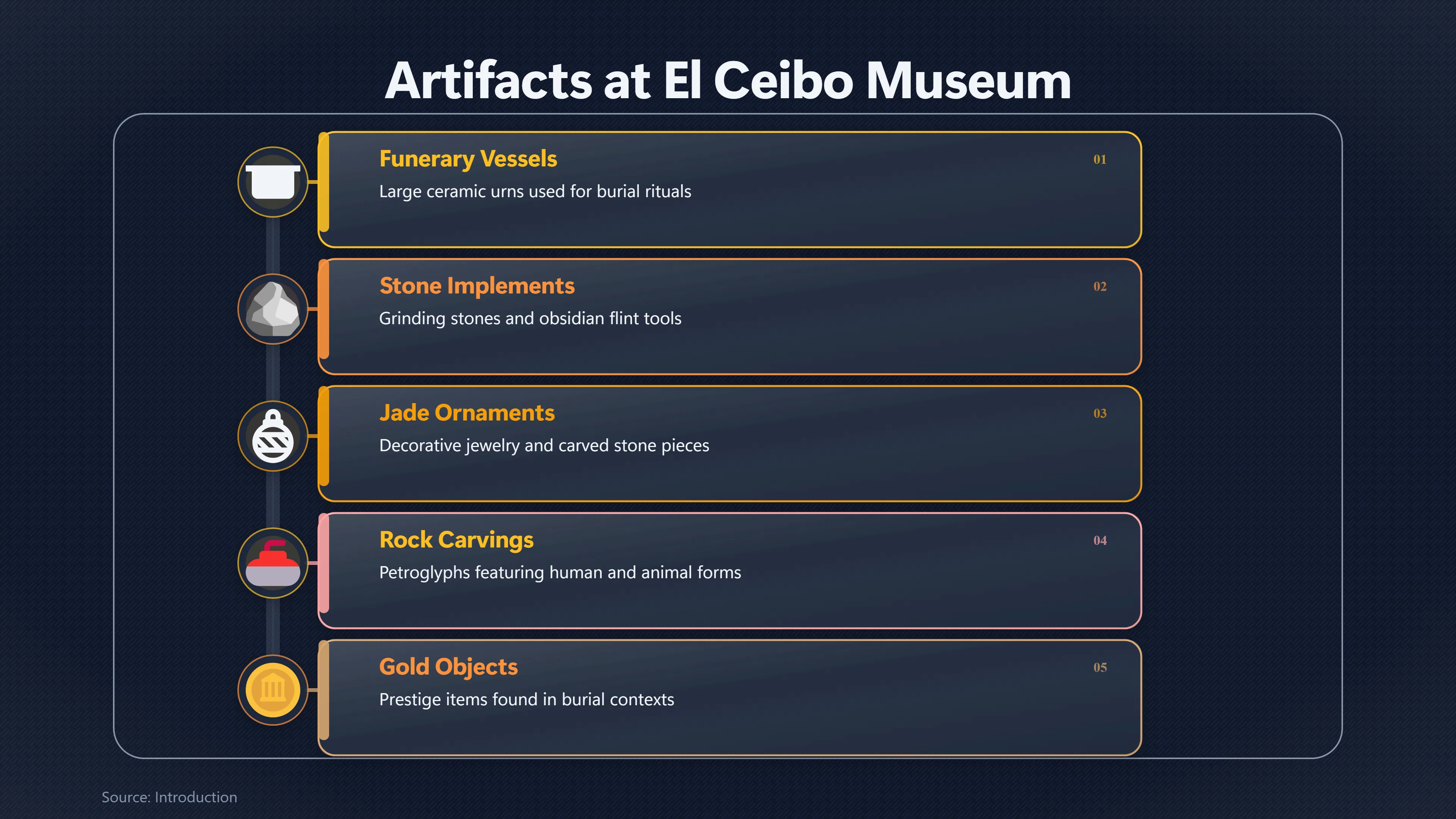
The archaeological section of El Ceibo presents more than 1,500 pre-Columbian objects recovered largely from Ometepe Island. Visitors encounter large funerary urns, finely decorated ceramics, grinding stones, obsidian and flint tools, jade ornaments and carved stone pieces alongside outdoor displays of petroglyphs. The emphasis is on showing the richness of the island’s Indigenous past rather than reconstructing a single excavation.[Instituto Nicaragüense de Cultura]inc.gob.niInstituto Nicaragüense de Cultura
One of the museum’s most striking exhibits is a reconstructed pre-Hispanic burial. According to the museum, the original grave was documented after being discovered near the site, with the position of human remains and associated objects recorded before reconstruction. The display includes bones placed within a ceramic vessel, jewellery, animal teeth, a gold object and other grave goods intended to illustrate how an important individual may have been buried. Although reconstructed displays inevitably simplify complex archaeological evidence, they help visitors understand the relationship between artefacts that would otherwise appear as isolated objects in glass cases.[Wikipedia]WikipediaEl Ceibo MuseumsEl Ceibo Museums
Equally memorable are the stone carvings and petroglyphs. Ometepe is famous for rock carvings distributed across volcanic landscapes, and El Ceibo displays several examples that were reportedly recovered locally. Some carved human and animal forms appear mysterious to modern visitors because their original ceremonial or symbolic meanings remain uncertain. Their significance comes less from supernatural speculation than from the fact that they belong to cultures whose beliefs are only partly understood through archaeology.[Wikipedia]WikipediaEl Ceibo MuseumsEl Ceibo Museums
How private collections were assembled
Private archaeological museums in Nicaragua often grew from local collecting rather than from large state excavations. El Ceibo itself originated from the collection of Moisés Ghitis, who began gathering archaeological material found on his farm and elsewhere on Ometepe before opening the museum to the public in 2007. Official tourism information also notes that the collection developed from artefacts discovered on the property together with donations and inherited family holdings.[Visita Nicaragua]visitanicaragua.comVisita Nicaragua El Ceibo Museum – Visit NicaraguaVisita Nicaragua El Ceibo Museum – Visit Nicaragua
This history reflects a wider pattern across rural Nicaragua. Agricultural work, erosion and construction regularly expose ancient pottery, stone tools and burial urns. Before stronger heritage protection became widespread, many discoveries entered private hands rather than archaeological projects. Families sometimes kept unusual objects for generations, while collectors sought to preserve items that otherwise risked damage or dispersal.[Wikipedia]WikipediaEl Ceibo MuseumsEl Ceibo Museums
That means a private museum can perform an important conservation role. Instead of remaining in scattered households or the antiquities market, many artefacts become publicly accessible, protected from weather and accompanied by at least some historical interpretation. El Ceibo has also become a recognised visitor attraction that introduces travellers to Ometepe’s archaeological heritage alongside its volcanic landscape.[Visita Nicaragua]visitanicaragua.comVisita Nicaragua El Ceibo Museum – Visit NicaraguaVisita Nicaragua El Ceibo Museum – Visit Nicaragua
Why provenance matters as much as authenticity
The central question for these collections is not usually whether the objects are genuine. Most specialists accept that many pieces displayed in museums such as El Ceibo are authentic pre-Columbian artefacts. The more difficult issue is provenance: the documented history of where an object was found, how it was recovered and whether its archaeological context was recorded.[Museum of the Bible]museumofthebible.orgMuseum of the Bible Provenance | Museum of the BibleMuseum of the Bible Provenance | Museum of the Bible
For archaeologists, context is often more valuable than the object alone. A burial urn discovered in a carefully excavated grave can reveal information about social status, ritual practices, trade networks and chronology because its precise position is known. The same urn, if removed decades earlier without documentation, still has historical value but cannot answer many of those broader questions.[Museum of the Bible]museumofthebible.orgMuseum of the Bible Provenance | Museum of the BibleMuseum of the Bible Provenance | Museum of the Bible
This distinction explains why visitors may notice labels that describe an object’s general origin—such as Ometepe Island—rather than an exact excavation site. In many cases that more detailed information was never recorded or no longer survives. As a result, museums must rely on stylistic comparison, materials, manufacturing techniques and regional archaeological research to interpret the pieces.[Wikipedia]WikipediaEl Ceibo MuseumsEl Ceibo Museums
Reading these collections with a critical eye
Private archaeological museums reward visitors who appreciate both their strengths and their limitations.
- The artefacts themselves are often genuine, representing real Indigenous communities that lived on Ometepe and elsewhere in Nicaragua centuries before European colonisation.[Instituto Nicaragüense de Cultura]inc.gob.niInstituto Nicaragüense de Cultura
- The original excavation history may be incomplete, meaning that precise dates or cultural interpretations sometimes remain tentative rather than definitive.[Museum of the Bible]museumofthebible.orgMuseum of the Bible Provenance | Museum of the BibleMuseum of the Bible Provenance | Museum of the Bible
- Reconstructed burials and thematic displays are interpretive tools, designed to explain archaeological evidence rather than reproduce every detail exactly as found.[Wikipedia]WikipediaEl Ceibo MuseumsEl Ceibo Museums
- Some mysteries remain unresolved, particularly regarding trade connections, symbolic carvings and unusual prestige objects such as gold artefacts whose origins may point to wider exchange networks across Lower Central America.[Wikipedia]WikipediaEl Ceibo MuseumsEl Ceibo Museums
Rather than weakening the visitor experience, these uncertainties reveal how archaeology actually works. The most honest collections acknowledge where evidence is secure, where reconstruction has been necessary and where important questions remain unanswered.

Why they matter in Nicaragua’s curiosity landscape
Among Nicaragua’s more unusual visitor experiences, private archaeological collections stand apart because the fascination comes from incomplete histories rather than dramatic storytelling. A burial vessel whose excavation was never fully documented can be more intellectually intriguing than a fabricated mystery because it poses genuine historical questions.
Within the country’s wider landscape of strange museums and curious collections, places such as El Ceibo show that uncertainty does not automatically mean unreliability. Instead, they demonstrate the balance between preservation and scientific evidence: authentic objects have survived, but some of the stories they could once have told disappeared long before they entered museum cases. That combination of remarkable artefacts and incomplete histories gives Nicaragua’s private archaeological collections their distinctive character.
Amazon book picks
Further Reading
Books and field guides related to How Reliable Are Nicaragua's Private Archaeological Collections?. Use these as the next step if you want deeper reading beyond the article.
Loot: The Battle over the Stolen Treasures of the Ancient World
A journey across four continents to the heart of the conflict over who should own the great works of ancient art Why are the Elgin Marble...
Who Owns Antiquity? Museums and the Battle over Our Ancient H...
Whether antiquities should be returned to the countries where they were found is one of the most urgent and controversial issues in the a...
Loot, Legitimacy and Ownership: The Ethical Crisis in Archaeo...
First published 2000. Subjects: Antiquities, Archaeological thefts, Art thefts, Collection and preservation, Cultural property.

Ancient Mexico and Central America
First published 2013. Subjects: Indians of Mexico, History, Indians of Central America, Civilization, Antiquities.
eBay marketplace picks
Marketplace Samples
Live-tested eBay searches with available results related to this page.
Selected fromarchaeology poster oneBay.co.uk.

Endnotes
1.
Source: inc.gob.ni
Title: Instituto Nicaragüense de Cultura
Link:https://www.inc.gob.ni/museos/1000/
2.
Source: Wikipedia
Title: El Ceibo Museums
Link:https://en.wikipedia.org/wiki/El_Ceibo_Museums
3.
Source: museumofthebible.org
Title: Museum of the Bible Provenance | Museum of the Bible
Link:https://www.museumofthebible.org/provenance
4.
Source: visitanicaragua.com
Title: Visita Nicaragua El Ceibo Museum – Visit Nicaragua
Link:https://www.visitanicaragua.com/en/The-Ceibo-Museum/
5.
Source: visitanicaragua.com
Title: El Ceibo Museum – Visit Nicaragua
Link:https://visitanicaragua.com/en/museo-el-ceibo/
6.
Source: visitanicaragua.com
Title: Museo El Ceibo – Visita Nicaragua
Link:https://www.visitanicaragua.com/museo-el-ceibo/
7.
Source: visitanicaragua.com
Title: Museo El Ceibo – Visita il Nicaragua
Link:https://www.visitanicaragua.com/it/Il-Museo-Ceibo/
8.
Source: visitanicaragua.com
Title: Musée El Ceibo – Visite du Nicaragua
Link:https://www.visitanicaragua.com/fr/Le-mus%C3%A9e-du-Ceibo/
Additional References
9.
Source: eldiarionica.com
Title: El Diario Nica Museo el Ceibo en la Isla de Ometepe
Link:https://eldiarionica.com/2024/03/06/museo-el-ceibo/
Source snippet
Museo el Ceibo en la Isla de Ometepe - El Diario NicaMarch 6, 2024 — MUSEO EL CEIBO EN LA ISLA DE OMETEPE Por Web 06 de marzo, 2024 Image...
Published: March 6, 2024
10.
Source: commons.wikimedia.org
Title: Category:Museos El Ceibo
Link:https://commons.wikimedia.org/wiki/Category%3AMuseos_El_Ceibo
Source snippet
wikimedia.orgCategory:Museos El Ceibo - Wikimedia CommonsFebruary 1, 2026 — * Ceramic & Teeth.JPG 2,048 × 1,536; 1.31 MB * Ceramic 1.JPG...
Published: February 1, 2026
11.
Source: ometepeislandinfo.com
Title: Ometepe Island Info
Link:https://ometepeislandinfo.com/Museo-El-Ceibo
Source snippet
Museo El CeiboJune 24, 2026 — MUSEO EL CEIBO Last updated on the 24^{th} of June 2026 Ometepe has more than 1700 recorded petroglyphs and...
Published: June 24, 2026
12.
Source: youtube.com
Title: We Found PARADISE in Nicaragua! | Ometepe Island Complete Guide
Link:https://www.youtube.com/watch?v=d4Czexoy1OI
Source snippet
Ometepe Island museum El Ceibo Nicaragua El Ceibo Museums - Ometepe Island museoselceibo...
13.
Source: youtube.com
Title: The Exchange: Art and crime
Link:https://www.youtube.com/watch?v=w_0L6DijDEE
Source snippet
We Found PARADISE in Nicaragua! | Ometepe Island Complete Guide...
14.
Source: nicaraguainvestiga.com
Title: Publicado abril
Link:https://nicaraguainvestiga.com/ocio/117204-conoza-el-extraordinario-museo-el-ceibo-de-ometepe/
Source snippet
Conozca el extraordinario museo “El Ceibo” de Ometepe - Nicaragua InvestigaApril 21, 2023 — OCIO CONOZCA EL EXTRAORDINARIO MUSEO “EL CEIB...
Published: April 21, 2023
15.
Source: youtube.com
Title: El Ceibo Museums
Link:https://www.youtube.com/watch?v=8KMWAEYqCVc
Source snippet
Why You MUST VISIT Ometepe Island Nicaragua - Central America's BEST ISLAND...
16.
Source: cambridge.org
Link:https://www.cambridge.org/core/journals/latin-american-antiquity/article/domestic-practice-in-postclassic-santa-isabel-nicaragua/A4BCC77812702B7F654D3A6622F7F4C1
17.
Source: universiteitleiden.nl
Link:https://www.universiteitleiden.nl/en/research/research-projects/archaeology/el-gavilan
18.
Source: research.tudelft.nl
Link:https://research.tudelft.nl/en/publications/reassembling-quarried-landscapes-through-non-destructive-x-ray-fl/