Within Italian Curiosities
Inside Rome's Bone Crypt of Mortality
Rome's Capuchin Crypt uses human bones and religious symbolism to explore mortality, memory and faith.
On this page
- The Capuchin Crypt and its origins
- Why human remains became devotional art
- Visitor experience and ethical questions
Page outline Jump by section
Introduction
Rome’s Capuchin Crypt is one of Italy’s most unusual heritage sites because it turns human remains into a religious meditation on death rather than a simple burial place. Beneath the church of Santa Maria della Concezione dei Cappuccini, the remains of thousands of Capuchin friars were arranged into decorative patterns of skulls, bones, skeletons and symbolic designs. The result is unsettling to modern eyes, but the purpose was not to create a horror attraction: the crypt was designed as a reminder that earthly life is temporary and that death is shared by all people.[Italia.it]italia.itMuseum and Crypt of the Capuchin Friars, RomaMuseum and Crypt of the Capuchin Friars, Roma
The site occupies a distinctive place in Italy’s unusual heritage landscape because it sits between several categories. It is a sacred Catholic space, a historic cemetery, a work of Baroque-era devotional art and a public attraction visited by travellers interested in strange history. Its importance comes from the way the Capuchins used actual human remains to communicate ideas about humility, mortality and spiritual preparation.[Turismo Roma]turismoroma.itTurismo Roma Museum and Crypt of the Capuchin FriarsTurismo Roma Museum and Crypt of the Capuchin Friars
The Capuchin Crypt and its origins
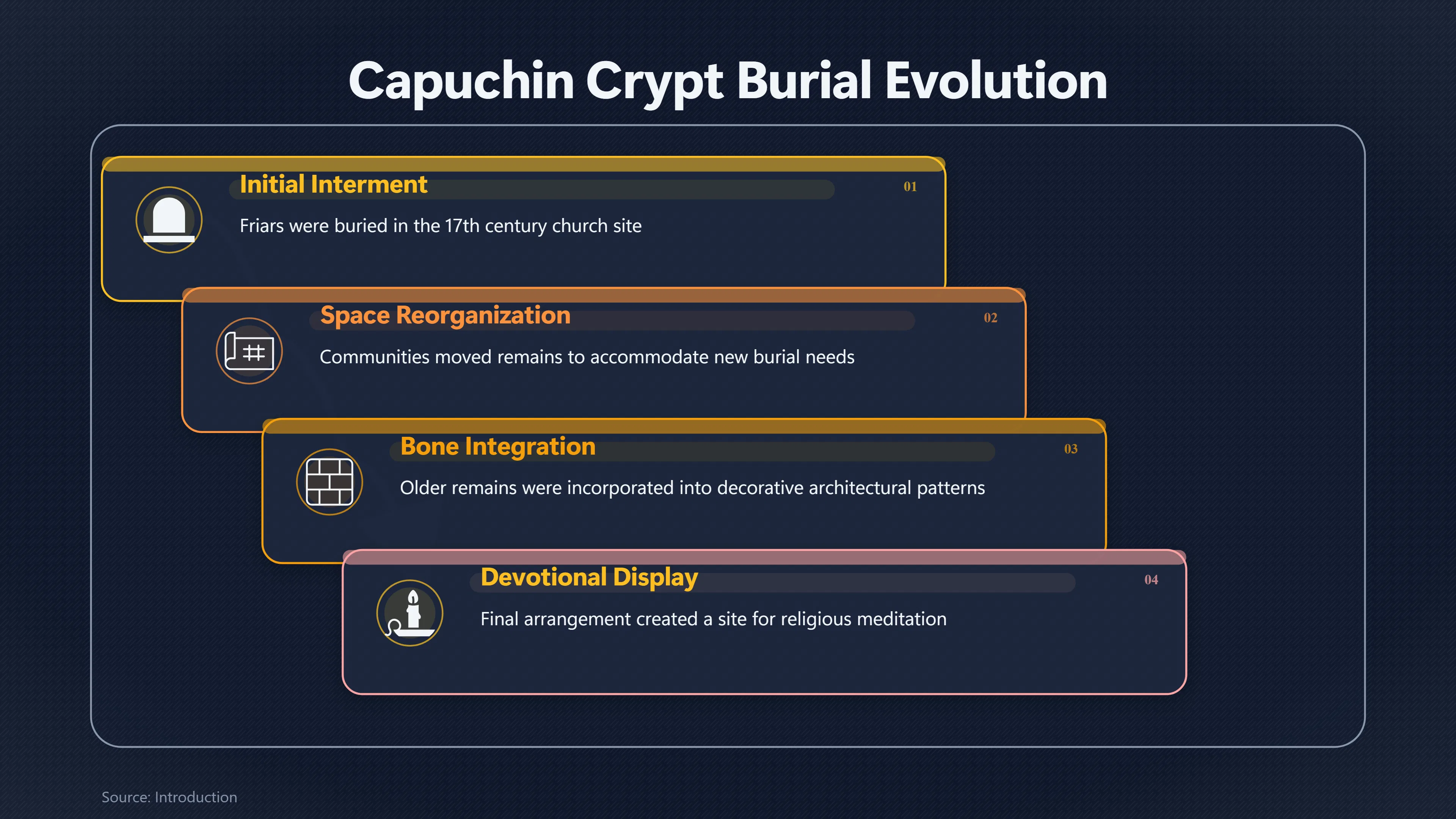
The crypt belongs to the church of Santa Maria della Concezione dei Cappuccini on Rome’s Via Veneto. The church was built in the 17th century at the request of Capuchin Cardinal Antonio Barberini, and the underground cemetery developed as part of the friars’ burial tradition. The remains displayed there are those of Capuchin friars who died in Rome from the 16th century to the 19th century, with around 4,000 individuals traditionally associated with the collection.[Italia.it]italia.itMuseum and Crypt of the Capuchin Friars, RomaMuseum and Crypt of the Capuchin Friars, Roma
The unusual arrangement of the bones was linked to practical burial customs as well as religious ideas. When Capuchin communities moved or reorganised burial spaces, older remains could be transferred and incorporated into the crypt’s decoration rather than simply hidden away. Over time, bones became part of the architecture: walls, patterns, borders and symbolic images were created from the remains of members of the order.[Italia.it]italia.itMuseum and Crypt of the Capuchin Friars, RomaMuseum and Crypt of the Capuchin Friars, Roma
The crypt’s design reflects a wider European Christian tradition of memento mori — the practice of remembering death as a way of encouraging reflection on how life should be lived. The famous message associated with the site, “What you are now, we used to be; what we are now, you will be,” expresses this idea directly: visitors are confronted not with strangers’ deaths alone, but with their own unavoidable mortality.[Italia.it]italia.itMuseum and Crypt of the Capuchin Friars, RomaMuseum and Crypt of the Capuchin Friars, Roma
Why human remains became devotional art
The most striking feature of the Capuchin Crypt is that the bones are not displayed as scientific specimens. They are arranged as symbols. Skulls, vertebrae, pelvises and long bones form repeating patterns that resemble the decorative language of churches: arches, rosettes, crosses and geometric designs. The effect combines the visual order of art with the physical reality of human death.[Turismo Roma]turismoroma.itTurismo Roma Museum and Crypt of the Capuchin FriarsTurismo Roma Museum and Crypt of the Capuchin Friars
This approach reflects Capuchin spirituality, which traditionally emphasised simplicity, humility and the rejection of worldly pride. By turning friars’ remains into a place of contemplation, the crypt reinforced the belief that status, wealth and appearance disappear in death. The skeleton became a universal symbol: everyone, from the powerful to the poor, eventually reaches the same physical end.[Italia.it]italia.itMuseum and Crypt of the Capuchin Friars, RomaMuseum and Crypt of the Capuchin Friars, Roma
Several areas of the crypt focus on particular parts of the body, giving the visitor a visual journey through mortality:
- The Crypt of the Skulls uses skulls as a direct reminder of human identity after life has ended.
- The Crypt of the Pelvises and the Crypt of the Leg Bones and Thigh Bones transform anatomical remains into architectural decoration.
- The Crypt of the Three Skeletons presents complete skeleton figures with symbolic objects, including imagery connected with death and judgement.
- The Crypt of the Resurrection links death with Christian hope through imagery of resurrection.[Catacombs of Rome]catacombs-of-rome.comCatacombs of Rome The Capuchin Crypt Rome: Complete Visitor GuideCatacombs of Rome The Capuchin Crypt Rome: Complete Visitor Guide
The symbolism is therefore not simply “death as an ending”. Within the Catholic worldview that shaped the crypt, death was also a transition connected to resurrection and spiritual reflection. The bones function as reminders of the body’s temporary nature rather than as objects of fear.[Turismo Roma]turismoroma.itTurismo Roma Museum and Crypt of the Capuchin FriarsTurismo Roma Museum and Crypt of the Capuchin Friars

Visitor experience and ethical questions
For modern visitors, the Capuchin Crypt creates a complicated reaction. Many people experience it as beautiful, disturbing, peaceful or uncomfortable at the same time. Unlike a museum display containing replicas or archaeological objects, the crypt presents real human remains in an environment that still has religious meaning. This makes the visit different from viewing ordinary historical collections.[Turismo Roma]turismoroma.itTurismo Roma Museum and Crypt of the Capuchin FriarsTurismo Roma Museum and Crypt of the Capuchin Friars
The central ethical question is whether human remains should be displayed publicly, even when the original intention was religious rather than commercial. Contemporary museums and heritage organisations increasingly discuss dignity, consent, cultural beliefs and respectful interpretation when dealing with human remains. Research into other Capuchin-associated collections, such as the mummified remains in Palermo’s Capuchin Catacombs, highlights the need to balance public education, preservation and respect for the dead.[STORE]eprints.staffs.ac.ukon, and Study of Mummified Human Remains in the Capuchin Catacombs of Palermo, Sicily - STORE - University of Staffordshire Online Reposi…
The Rome crypt is also different from many modern displays because the remains are not presented as anonymous curiosities. The friars’ bones form part of a collective religious message: visitors are invited to consider their own mortality rather than simply observe another person’s body as an unusual object. That intention does not remove every ethical debate, but it explains why the site has survived as a place of reflection rather than being understood only as a macabre attraction.[Turismo Roma]turismoroma.itTurismo Roma Museum and Crypt of the Capuchin FriarsTurismo Roma Museum and Crypt of the Capuchin Friars
The Capuchin Crypt’s lasting fascination comes from this tension. It is both a place of death and a place created to think about life. The bones are real, the symbolism is deliberate, and the visitor experience depends on recognising that the crypt was built around remembrance, humility and faith rather than simple fascination with the macabre.[Italia.it]italia.itMuseum and Crypt of the Capuchin Friars, RomaMuseum and Crypt of the Capuchin Friars, Roma
Amazon book picks
Further Reading
Books and field guides related to Inside Rome's Bone Crypt of Mortality. Use these as the next step if you want deeper reading beyond the article.
The Hour of Our Death
An “absolutely magnificent” book (The New Republic)—the fruit of almost two decades of study—that traces the changes in Western attitudes...
From Here to Eternity: Traveling the World to Find the Good D...
The best-selling author ofSmoke Gets in Your Eyes expands our sense of what it means to treat the dead with "dignity."
The Work of the Dead: A Cultural History of Mortal Remains
The meaning of our concern for mortal remains—from antiquity through the twentieth century The Greek philosopher Diogenes said that when...
Smoke Gets in Your Eyes: And Other Lessons from the Crematory
A young mortician goes behind the scenes, unafraid of the gruesome (and fascinating) details of her curious profession.
eBay marketplace picks
Marketplace Samples
Live-tested eBay searches with available results related to this page.
Selected fromskull decor oneBay.co.uk.
Endnotes
1.
Source: italia.it
Title: Museum and Crypt of the Capuchin Friars, Roma
Link:https://www.italia.it/en/lazio/rome/monuments/museum-and-crypt-of-the-cappuccini-friars
2.
Source: rome.info
Title: Capuchin Crypt Rome: Bone Chapel with 4,000 Monks | Tickets & Info
Link:https://www.rome.info/attractions/capuchin-crypt/
3.
Source: catacombs-of-rome.com
Title: Catacombs of Rome The Capuchin Crypt Rome: Complete Visitor Guide
Link:https://catacombs-of-rome.com/capuchin-crypt-rome/
4.
Source: eprints.staffs.ac.uk
Link:https://eprints.staffs.ac.uk/7397/
Source snippet
on, and Study of Mummified Human Remains in the Capuchin Catacombs of Palermo, Sicily - STORE - University of Staffordshire Online Reposi...
5.
Source: capuchins.org
Title: Rome Guides: Santa Maria della Concezione dei Cappuccini
Link:https://www.capuchins.org/posts/rome-guides-santa-maria-della-concezione-dei-cappuccini
6.
Source: rome.net
Title: Our Lady of the Conception
Link:https://www.rome.net/our-lady-conception-capuchins
7.
Source: tour.rome.it
Link:https://tour.rome.it/rome/what-to-see/details/museo-e-cripta-dei-cappuccini
8.
Source: youtube.com
Link:https://www.youtube.com/watch?v=oqDxaF4hsLo
Source snippet
Capuchin Crypt - Rome...
9.
Source: youtube.com
Title: Capuchin Crypt
Link:https://www.youtube.com/watch?v=33vA4y6bxh4
10.
Source: turismoroma.it
Title: Turismo Roma Museum and Crypt of the Capuchin Friars
Link:https://turismoroma.it/en/node/222/1000
11.
Source: thebettervacation.com
Title: capuchin crypt
Link:https://thebettervacation.com/rome/capuchin-crypt/
Source snippet
Rome: Tickets, Opening Hours & Visitor Guide 2026June 4, 2026 — CAPUCHIN CRYPT ROME: TICKETS, OPENING HOURS & VISITOR GUIDE 2026 Image: C...
Published: June 4, 2026
12.
Source: eprints.staffs.ac.uk
Link:https://eprints.staffs.ac.uk/7147/
13.
Source: eprints.staffs.ac.uk
Link:https://eprints.staffs.ac.uk/7416/
14.
Source: historyhit.com
Title: Capuchin Crypt
Link:https://www.historyhit.com/locations/capuchin-crypt/
15.
Source: catholicnewsagency.com
Title: Memento mori
Link:https://www.catholicnewsagency.com/news/37093/memento-mori-how-religious-orders-remember-death
16.
Source: claudiasscroll.com
Title: capuchin crypt
Link:https://claudiasscroll.com/capuchin-crypt/
17.
Source: turismoroma.it
Title: The Church of Santa Maria della Concezione of the Capuchins
Link:https://www.turismoroma.it/en/places/church-santa-maria-della-concezione-capuchins
18.
Source: cntraveler.com
Title: Capuchin Crypt
Link:https://www.cntraveler.com/activities/rome/capuchin-crypt
19.
Source: romanchurches.fandom.com
Title: Santa Maria della Concezione dei Cappuccini
Link:https://romanchurches.fandom.com/wiki/Santa_Maria_della_Concezione_dei_Cappuccini
Additional References
20.
Source: tandfonline.com
Link:https://www.tandfonline.com/doi/abs/10.1080/14655187.2021.2024742
Source snippet
Taylor & Francis OnlineEthical Considerations Associated with the Display and Analysis of Juvenile Mummies from the Capuchin Catacombs of...
21.
Source: cambridge.org
Link:https://www.cambridge.org/core/journals/international-journal-of-cultural-property/article/testing-ethical-disagreement-on-ancestral-human-remains-in-museums/1010E88D6D8E6F0661019D19350ADBA1
Source snippet
February 11, 2026 — TESTING ETHICAL DISAGREEMENT ON ANCESTRAL HUMAN REMAINS IN MUSEUMS Published online by Cambridge University Press: 11...
Published: February 11, 2026
22.
Source: pmc.ncbi.nlm.nih.gov
Link:https://pmc.ncbi.nlm.nih.gov/articles/PMC7618824/
Source snippet
ethical disagreement on ancestral human remains in museums - PMCFebruary 11, 2026 — TESTING ETHICAL DISAGREEMENT ON ANCESTRAL HUMAN REMAI...
Published: February 11, 2026
23.
Source: smithsonianmag.com
Link:https://www.smithsonianmag.com/travel/decorated-with-4000-skeletons-this-roman-church-will-have-you-pondering-your-own-mortality-180981573/
24.
Source: researchgate.net
Link:https://www.researchgate.net/publication/359458026_Ethical_Considerations_Associated_with_the_Display_and_Analysis_of_Juvenile_Mummies_from_the_Capuchin_Catacombs_of_Palermo_Sicily
25.
Source: tandfonline.com
Link:https://www.tandfonline.com/doi/full/10.1080/14655187.2021.2024742
26.
Source: theabroadguide.com
Link:https://theabroadguide.com/rome-catacombs-crypts-underground-tours-guide/
27.
Source: museoecriptacappuccini.it
Link:https://www.museoecriptacappuccini.it/la-cripta/
28.
Source: museoecriptacappuccini.it
Link:https://www.museoecriptacappuccini.it/missione/
29.
Source: romewithview.it
Link:https://www.romewithview.it/en/secrets-of-rome-a-visit-to-the-museum-of-skeletons-on-via-veneto/