Within Strange Paraguay
What Paraguay's Masks and Featherwork Really Mean
Masks and featherwork at Museo del Barro reveal how ceremonial objects can be visually startling without becoming tourist curiosities.
On this page
- How Museo del Barro combines popular, indigenous and modern art
- Masks, ornaments and the transformation of the human figure
- Provenance, named makers and responsible interpretation
Page outline Jump by section
Introduction
The masks and featherwork at Museo del Barro in Asunción are among Paraguay’s most visually striking museum objects, yet the institution deliberately resists presenting them as exotic curiosities. Instead, they are displayed as works of art created within living Indigenous traditions, where masks, feathers and body ornaments are inseparable from ceremony, performance, social identity and spiritual relationships. This approach makes the museum unusual within South America’s museum landscape: rather than separating Indigenous material into an ethnographic display and modern painting into an art museum, Museo del Barro presents Indigenous, popular and contemporary art as equally important expressions of Paraguayan culture.[Museo del Barro]museodelbarro.orgMuseo del Barro Museo de Arte IndígenaMuseo del Barro Museo de Arte Indígena
For visitors interested in Paraguay’s stranger cultural heritage, the collection demonstrates that some of the country’s most remarkable objects are not mysterious because they hide supernatural secrets, but because they embody ways of seeing the world that cannot be understood by appearance alone. A feathered ceremonial costume may look spectacular in a gallery, yet its deeper meaning lies in ritual, community and performance rather than spectacle.
How Museo del Barro changes the way visitors see Indigenous art
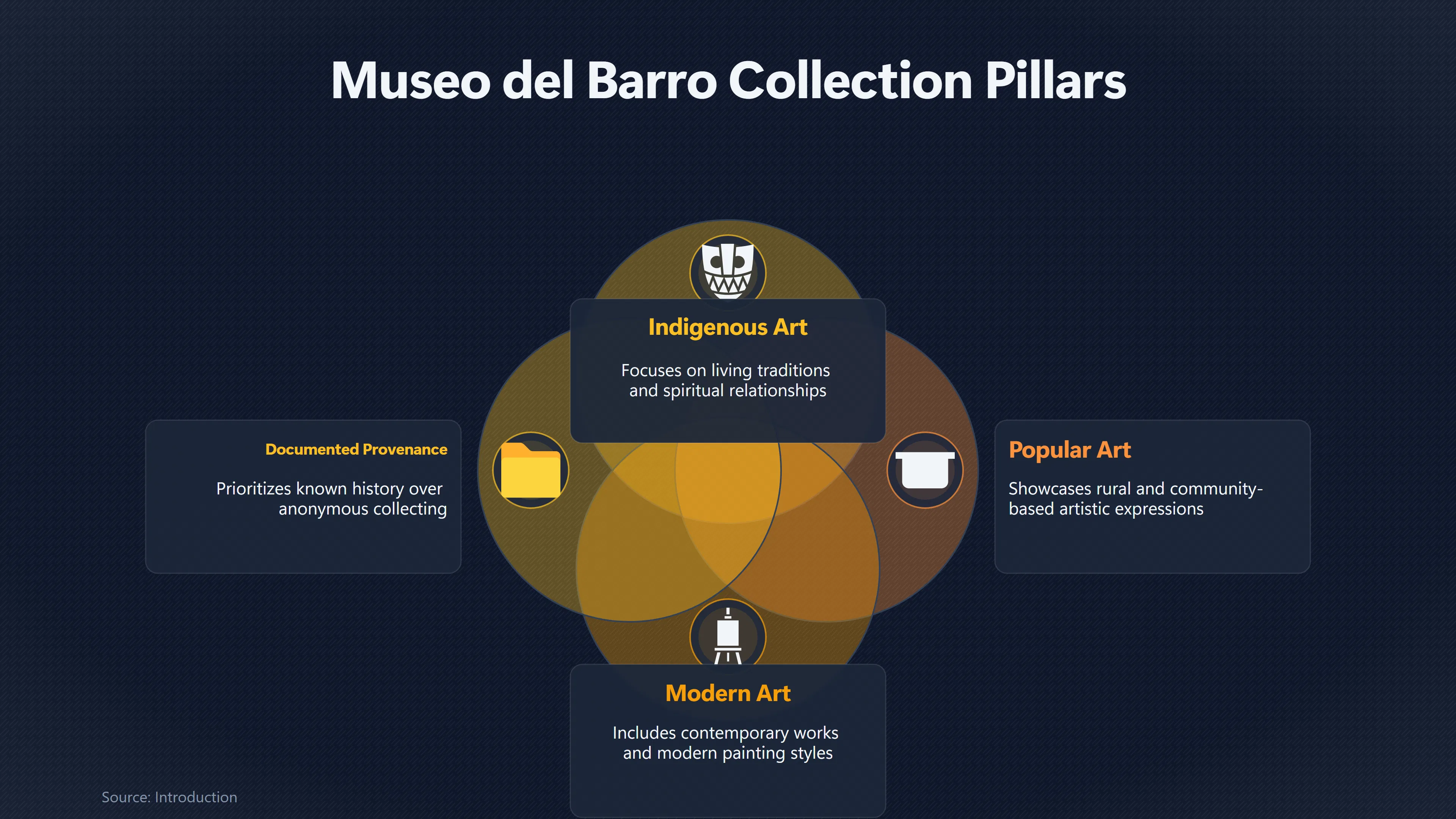
Museo del Barro combines three major collections: Indigenous art, popular or rural art, and modern and contemporary art. This curatorial decision reflects decades of work by curator and cultural critic Ticio Escobar and colleagues, who argued that Indigenous artistic production should be treated as art in its own right rather than as anthropological evidence or folkloric decoration.[Museo del Barro]museodelbarro.orgMuseo del Barro Museo de Arte IndígenaMuseo del Barro Museo de Arte Indígena
That philosophy shapes how masks and featherwork are interpreted.
Instead of presenting them as relics from vanished cultures or as anonymous “tribal” objects, the museum places emphasis on:
- artistic skill alongside cultural function;
- the continuing creativity of Indigenous communities;
- relationships between ritual, craftsmanship and aesthetics;
- documented provenance rather than anonymous collecting wherever possible.
The result is a museum experience that feels different from many nineteenth- and early twentieth-century ethnographic museums, where ceremonial objects were often displayed primarily as scientific specimens or evidence of supposedly “primitive” societies.
Masks, ornaments and the transformation of the human figure
The museum’s Indigenous Art collection contains more than 1,750 objects produced by members of numerous Indigenous peoples across Paraguay. Alongside pottery, basketry and textiles are ceremonial masks, feather ornaments and ritual costumes that reveal how the human body itself becomes part of artistic expression.[Museo del Barro]museodelbarro.orgMuseo del Barro Museo de Arte IndígenaMuseo del Barro Museo de Arte Indígena
One of the collection’s best-known groups consists of five ceremonial costumes created by the Ishir people of Alto Paraguay for the annual Debylyby ritual. These ensembles combine woven materials, masks made from caraguatá fibre and elaborate feather decorations from various Chaco bird species. They were created for performance rather than permanent display, meaning that movement, dance and ritual action originally completed the artwork.[Museo del Barro]museodelbarro.orgMuseo del Barro Museo de Arte IndígenaMuseo del Barro Museo de Arte Indígena
Seen behind museum glass, the costumes can appear theatrical or even uncanny. Large masks conceal individual identity, while feathers dramatically enlarge the human silhouette and alter movement. Yet this visual transformation is not intended simply to entertain. Within ceremony, changing the outward appearance of the participant helps express relationships between people, ancestors, animals and spiritual forces that cannot be conveyed through ordinary dress alone. The museum therefore encourages viewers to understand these objects as part of living ceremonial systems rather than isolated sculptures.[Museo del Barro]museodelbarro.orgMuseo del Barro Museo de Arte IndígenaMuseo del Barro Museo de Arte Indígena
Why feathers carry meaning beyond decoration
To many visitors, feathers first register as colourful ornament. Within the museum’s interpretation, however, featherwork is presented as a sophisticated artistic medium with cultural, ecological and symbolic importance.
Feathers are carefully selected, arranged and combined with fibres, textiles and other materials to create objects whose significance depends on more than visual beauty. Different bird species, colours and construction techniques may relate to particular ceremonies, social roles or community traditions. Because many ceremonial garments were made from organic materials intended for ritual use rather than centuries of preservation, surviving examples are especially valuable records of artistic practice.[Museo del Barro]museodelbarro.orgMuseo del Barro Museo de Arte IndígenaMuseo del Barro Museo de Arte Indígena
This emphasis helps visitors avoid a common misunderstanding. The remarkable appearance of featherwork is not evidence that Indigenous makers were primarily interested in spectacle. Rather, visual impact serves ritual communication, identity and performance.
Provenance, named collectors and responsible interpretation
One reason the collection has attracted scholarly attention is that the museum openly explains how it was assembled.
According to the museum, more than ninety per cent of the Indigenous collection was acquired by Ticio Escobar through purchases made with his own resources in Indigenous communities, craft markets and private collections. Additional works entered through donations from anthropologists, missionaries and other contributors, whose names are documented by the museum rather than hidden behind vague institutional language.[Museo del Barro]museodelbarro.orgMuseo del Barro Museo de Arte IndígenaMuseo del Barro Museo de Arte Indígena
This transparency matters because museums holding Indigenous ceremonial objects increasingly face questions about collecting history, consent and cultural ownership. While Museo del Barro acknowledges the role of individual collectors, it also frames the collection within continuing relationships with Indigenous communities rather than presenting it as a closed historical archive.
The museum has also produced an extensive digital catalogue for researchers, making much of the collection accessible beyond the gallery itself.[Museo del Barro]museodelbarro.orgMuseo del Barro Museo de Arte IndígenaMuseo del Barro Museo de Arte Indígena
The difference between ceremonial objects and tourist souvenirs
Museo del Barro offers an important corrective to a misunderstanding that affects many travellers. Across Latin America, masks and feathered ornaments are frequently reproduced as souvenirs, festival decorations or generic symbols of “Indigenous culture”. Once removed from their original setting, they can easily become detached from the ceremonies that gave them meaning.
The museum deliberately moves in the opposite direction. Labels, catalogues and gallery organisation encourage visitors to see each object within its artistic, cultural and historical context rather than as an anonymous curiosity. Even visually dramatic masks are interpreted through their makers, communities and ritual uses instead of being marketed as mysterious relics.[Museo del Barro]museodelbarro.orgMuseo del Barro Museo de Arte IndígenaMuseo del Barro Museo de Arte Indígena
This approach distinguishes the museum from attractions built around spectacle. The visual impact remains powerful, but interpretation consistently redirects attention from exotic appearance to cultural meaning.
Why these galleries matter within Paraguay’s unusual museum landscape
Visitors searching for Paraguay’s strangest museums often expect collections devoted to monsters, ghosts or unexplained mysteries. Museo del Barro offers something subtler but arguably more rewarding.
Its masks can appear unsettling. Its feathered ceremonial costumes can seem almost otherworldly. Yet their significance comes not from paranormal claims or sensational storytelling but from demonstrating how art can transform the human body, express collective identity and preserve ceremonial knowledge across generations.
Within Paraguay’s broader landscape of unusual collections, these galleries show that the country’s most memorable objects are often those that resist becoming mere curiosities. By presenting Indigenous masks and featherwork as living artistic achievements rather than exotic artefacts, Museo del Barro invites visitors to replace fascination with understanding—a perspective that makes the collection distinctive not only in Paraguay but across South American museums.[Museo del Barro]museodelbarro.orgMuseo del Barro Museo de Arte IndígenaMuseo del Barro Museo de Arte Indígena
Amazon book picks
Further Reading
Books and field guides related to What Paraguay's Masks and Featherwork Really Mean. Use these as the next step if you want deeper reading beyond the article.
Art of the Andes
This is a study of the art and architecture created by the various cultures of the ancient Andes. The book examines the goldwork, intrica...
The Art of the Pacific Islands
Du site de l'éd.: In spite of the wealth it has to offer, the art of the Pacific Islands remains perhaps the least known of the world's a...
eBay marketplace picks
Marketplace Samples
Live-tested eBay searches with available results related to this page.
Selected fromfeather art decor oneBay.co.uk.


Endnotes
1.
Source: museodelbarro.org
Title: Museo del Barro Museo de Arte Indígena
Link:https://www.museodelbarro.org/colecciones/museo-de-arte-indigena
2.
Source: museodelbarro.org
Link:https://www.museodelbarro.org/colecciones/museodelbarro
3.
Source: Wikipedia
Title: Museo del Barro
Link:https://en.wikipedia.org/wiki/Museo_del_Barro
4.
Source: museodelbarro.org
Title: Museo del Barro El Caudal
Link:https://www.museodelbarro.org/exposicion/el-caudal
5.
Source: museodelbarro.org
Link:https://www.museodelbarro.org/exposicion/promocion-de-artesanias
6.
Source: museodelbarro.org
Link:https://www.museodelbarro.org/museo/equipo
7.
Source: museodelbarro.org
Link:https://www.museodelbarro.org/exposicion/ayoreo
8.
Source: viaparaguay.com
Link:https://viaparaguay.com/en/directorio/turismo/ficha/museo-del-barro
9.
Source: tripadvisor.com
Title: Museo del Barro
Link:https://www.tripadvisor.com/Attraction_Review-g294080-d316219-Reviews-Museo_del_Barro-Asuncion.html
10.
Source: youtube.com
Title: From Rituals to Art: The Evolution of African Masks
Link:https://www.youtube.com/watch?v=Zf7rwb7kfsY
Source snippet
"Museo del Barro" Paraguay art English Museo del Barro Noche De Los Museos - Paraguay...
Additional References
11.
Source: youtube.com
Title: Aztec feather art more precious than gold (featherworks)
Link:https://www.youtube.com/watch?v=yv5INRHDMdc
Source snippet
Museum Subjectivities / Subjetividad en los museos...
12.
Source: journals.sagepub.com
Link:https://journals.sagepub.com/doi/10.1177/10925872261435577
Source snippet
Culturally Responsive Interpretation: Four Essential Elements for Interpreting Native American Cultures at Heritage Sites - Carol Fitzsim...
13.
Source: journals.sagepub.com
Link:https://journals.sagepub.com/doi/abs/10.1177/10925872261435577
Source snippet
Culturally Responsive Interpretation: Four Essential Elements for Interpreting Native American Cultures at Heritage Sites - Carol Fitzsim...
14.
Source: journals.sagepub.com
Link:https://journals.sagepub.com/doi/full/10.1177/10925872261435577
Source snippet
Culturally Responsive Interpretation: Four Essential Elements for Interpreting Native American Cultures at Heritage Sites - Carol Fitzsim...
15.
Source: journals.sagepub.com
Link:https://journals.sagepub.com/doi/pdf/10.1177/10925872261435577?download=true
Source snippet
Culturally Responsive Interpretation: Four Essential Elements for Interpreting Native American Cultures at Heritage Sites - Carol Fitzsim...
16.
Source: cambridge.org
Link:https://www.cambridge.org/core/journals/antiquity/article/abs/decolonising-the-museum-the-national-museum-of-the-american-indian-in-washington-dc/267DAA103434B8C03047087729BE033F
17.
Source: visitparaguay.travel
Link:https://visitparaguay.travel/places/escuela-taller-de-saberes-ancestrales-de-nestor-portillo
18.
Source: tandfonline.com
Link:https://www.tandfonline.com/doi/abs/10.1080/17496772.2022.2127056
19.
Source: tandfonline.com
Link:https://www.tandfonline.com/doi/full/10.1080/17496772.2022.2127056
20.
Source: tandfonline.com
Link:https://www.tandfonline.com/doi/abs/10.1080/13527258.2017.1300931