Where Nauru Keeps Its Strangest History
Nauru does not have a large circuit of eccentric museums, occult collections or polished curiosity attractions.
Page outline Jump by section
Introduction
For visitors interested in strange museums and offbeat history, the central attraction is therefore not a cabinet of monsters or magical relics. It is the unsettling contrast between ordinary-looking objects and the enormous events they represent: military ammunition recovered from a tiny Pacific island, photographs of land before industrial excavation, traditional objects whose surviving examples are often overseas, and a piece of phosphate rock whose identification helped transform most of Nauru’s interior. The official museum is real and public, but modest; the wider “collection” is spread across the island’s landscape and international museum databases.[nauru.gov.nr]nauru.gov.nrNauru Government Nauru MuseumernmentNauru Museum - The Government of the Republic of NauruLocated in Yaren, the museum formally opened on 30 January 2019. En…
What is inside the Naoero Museum?
The Naoero Museum, also called the Nauru Museum, is the country’s national museum. It stands in Yaren and formally opened on 30 January 2019. The Nauruan government currently lists admission as free and gives weekday opening hours of 1pm to 5pm, although travellers should verify access locally because small institutions can change their arrangements without much notice.[Nauru Government]nauru.gov.nrNauru Government Nauru MuseumernmentNauru Museum - The Government of the Republic of NauruLocated in Yaren, the museum formally opened on 30 January 2019. En…
This is not a large, highly theatrical museum. Its importance comes from the scarcity and intimacy of what it preserves. Accounts of the displays describe historical photographs, cultural artefacts, police and radio material, phosphate-era objects and a substantial group of Second World War relics. Photographic panels are particularly valuable because they allow visitors to compare the inhabited, vegetated island of earlier periods with the heavily excavated interior created by phosphate extraction.[dark-tourism.com]dark-tourism.comNaoero MuseumThe museum was once funded by Nauru's phosphate industry but now appears… Nauru by the Germans showing the then settlemen…
The wartime collection developed partly from objects gathered on Nauru by private collector Stan Gajda. Specialist records describe Japanese rifles, machine guns, bombs, ammunition and shells associated with the island’s wartime defences. Among the more imposing reported pieces are rounds connected with the anti-aircraft and coastal guns at Command Ridge. These are genuine battlefield remains rather than manufactured tourist props, although publicly available documentation of individual objects, their recovery locations and conservation histories is uneven.[Pacific Wrecks]pacificwrecks.comNearly all the artifacts were collected and donated by Stan Gajda and includes many World War II era artifacts including Japanese rifles…
That mixture gives the museum an unusual character. It is at once a national history museum, a community storehouse and the successor to a private military collection. Its displays are less about rarity in the art-market sense than about survival: objects remain significant because so much of Nauru’s landscape, built heritage and material culture has been displaced, damaged or dispersed.
Why the war relics feel different here
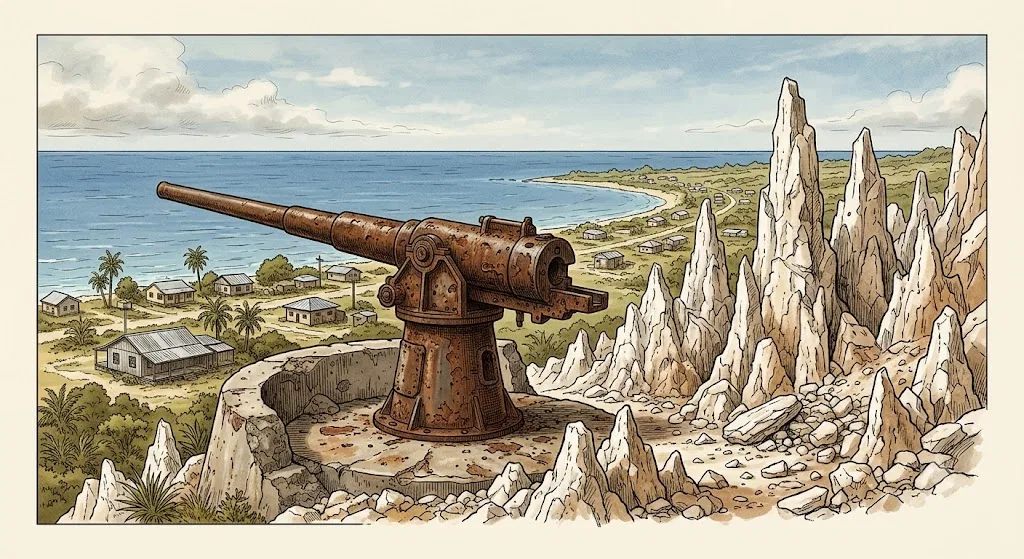
Nauru’s Second World War material cannot be separated from the island itself. Japanese forces occupied Nauru in August 1942, constructed defensive positions and used the island as a fortified base. Today, guns, bunkers, concrete structures and other remnants remain around Command Ridge and elsewhere. Nauru’s heritage law specifically recognises war relics as a protected category, defining them broadly as objects or artefacts brought into the country for use by combatants during the war.[nauru-data.sprep.org]nauru-data.sprep.orgHistorical sites and World War 2 relics | Nauru Environment Data PortalJanuary 22, 2022 — Historical sites and World War 2 relics * Culture and Heritage… In August 1942, Nauru……
Command Ridge, the island’s highest area, functions almost like an unstaffed open-air military museum. Rusting guns and defensive remains survive in the tropical landscape rather than behind glass. This makes the site compelling to visitors interested in abandoned fortifications, but it also means interpretation may be limited and access conditions uncertain. It should not be treated as a conventional attraction with guaranteed paths, barriers or explanatory panels.[Lonely Planet]lonelyplanet.comLonely Planet Command Ridge | AttractionsLonely Planet Command Ridge | Attractions
The machinery can appear adventurous or picturesque in travel photographs, yet the history it represents is severe. Nauruans experienced occupation, forced labour, bombardment and deportation. The war relics matter not simply because they are dramatic objects, but because they anchor events that might otherwise seem remote in a country whose role in the wider Pacific war is often overlooked.
The museum provides the safer and more intelligible starting point: weapons and fragments can be viewed alongside photographs and historical material. Command Ridge then shows how those objects relate to terrain. Together, the indoor collection and the surviving fortifications form Nauru’s strongest curiosity trail, although it is closer to dark heritage than entertainment.
The island’s strangest object is a rock
The most consequential curiosity associated with Nauru is not a ritual object or military weapon, but an unremarkable-looking stone. In the late nineteenth century, a rock taken from Nauru reportedly ended up in the Sydney office of the Pacific Islands Company, where it was used as a doorstop and believed to be petrified wood. Albert Ellis recognised its possible mineral value and had it tested. It proved to contain high-grade phosphate.[Te Ara Encyclopedia of New Zealand]teara.govt.nzOpen source on govt.nz.
That discovery began a chain of industrial development that transformed Nauru. Phosphate extraction supplied fertiliser to Australia and New Zealand, generated great wealth and removed much of the usable surface of the island’s interior. The resulting landscape of pale limestone pinnacles, pits, abandoned machinery and stripped ground is one of the Pacific’s most extraordinary examples of extractive industrial heritage.[openedition.org]journals.openedition.orgOpen source on openedition.org.
The doorstop story has acquired the neat shape of a parable: a disregarded object is recognised as treasure, then the treasure destroys the landscape from which it came. Its broad outline is supported by historical accounts, although retellings differ over dates and minor details. Visitors should therefore understand it as a well-established episode that has also been polished through repetition.
A strong museum display could use a single phosphate specimen to connect geology, colonial administration, agricultural history, personal wealth, ecological damage and national sovereignty. That is why phosphate material belongs within Nauru’s curiosity culture. The rock is not visually spectacular, but few museum objects can claim to have altered so much of an entire country.
When the landscape becomes the collection
Nauru’s interior, commonly called Topside, is a difficult kind of heritage site. It is neither a preserved industrial museum nor simply an abandoned zone. Mining created fields of jagged limestone pinnacles, while conveyors, rail structures and other remnants record the systems used to remove and export phosphate. Scholars studying the industrial heritage of Nauru and nearby Angaur have warned that much of this infrastructure is deteriorating.[Heidelberg University AHNP]ahnp.ub.uni-heidelberg.deOpen source on uni-heidelberg.de.
For the curious traveller, the effect can be uncanny. The island’s coastal strip remains inhabited, while the centre bears the physical imprint of extraction on a nearly country-wide scale. Machinery and geology merge into one enormous accidental exhibit. Yet it would be misleading to romanticise the terrain as a “lunar landscape” without acknowledging that it represents lost land, restricted development and an unresolved rehabilitation challenge.
Photographs are essential to understanding that change. Te Papa’s online holdings include images of loading structures, early mining works, roads through the mined interior, rail remains and limestone pinnacles. Such collections allow viewers to study Nauru’s industrial transformation even when access to sites on the island is difficult.[Te Papa Collections]collections.tepapa.govt.nzTe Papa Collections Nauru## Collection Objects (50Object Nauru (loading conveyer, beach edge)Wayne Barrar1991O.013046 Object Nauru (tree, early mining works)Wayne Barrar1991O.013048 Objec…
This is where Nauru differs from countries that have converted mines into ticketed museums. Its extractive heritage is still embedded in national life. The ruins are not merely reminders of a completed industry; they occupy land whose future remains politically, environmentally and economically significant.

Why so many Nauruan objects are overseas
One of the most important facts about Nauru’s museum landscape is that the national collection does not contain the whole material record of Nauruan culture. Objects and photographs collected during colonial and scientific expeditions entered institutions in Australia, New Zealand, Britain, Germany and elsewhere. A regional museum database identifies Nauru-related holdings including ornaments, mats, water carriers, cords, photographs and other ethnographic material across several overseas collections.[pacific-studies.net]pacific-studies.netOpen source on pacific-studies.net.
The British Museum, for example, catalogues a woven mat or garment acquired from Nauru, wooden implements and historical photographs. One photograph shows a frigate bird on a wooden perch with a larger bird platform in the background, preserving visual evidence of a highly distinctive Nauruan practice involving the keeping and training of frigate birds.[British Museum]britishmuseum.orgOpen source on britishmuseum.org.
Te Papa in New Zealand lists dozens of Nauru-associated records, many of them photographs documenting the landscape before, during and after mining. Such digital access is useful, but it also exposes an imbalance: a reader abroad may be able to search more Nauruan historical material online than a visitor can see physically in Nauru.[Te Papa Collections]collections.tepapa.govt.nzTe Papa Collections Nauru## Collection Objects (50Object Nauru (loading conveyer, beach edge)Wayne Barrar1991O.013046 Object Nauru (tree, early mining works)Wayne Barrar1991O.013048 Objec…
Not every overseas object should automatically be described as stolen. Acquisition histories differ, and some objects were traded, donated or collected under circumstances that require individual research. Nevertheless, colonial power shaped who could collect, classify and export material, and overseas catalogues often preserve more detailed provenance records than are readily available to the Nauruan public. For Naoero Museum, identifying, digitising and reconnecting these dispersed holdings may be as important as acquiring new physical objects.
Is there folklore or supernatural material?
There is no well-documented public museum in Nauru devoted specifically to witchcraft, ghosts, cryptids, UFOs, death rituals or paranormal investigation. Claims for such an attraction should be treated cautiously unless supported by current local evidence. Nauru’s unusual collection culture is grounded far more firmly in war, extraction, colonial photography, traditional material culture and community memory.
This does not mean folklore is absent. Stories, oral histories and customary knowledge remain part of Nauru’s heritage, and published collections of Nauruan stories preserve narratives relating to origins, places and community experience. However, accessible evidence does not show these traditions being organised into a permanent visitor-facing “museum of legends” comparable to folklore museums elsewhere.[natlib.govt.nz]natlib.govt.nzOpen source on govt.nz.
The frigate-bird material offers the closest example of something that may look mysterious to an outsider but has a clear cultural basis. Historical photographs of birds tethered to specialised perches document a local practice, not a supernatural cult or fabricated oddity. This distinction matters: unusual cultural objects should be explained through their own social setting rather than presented as exotic curiosities.
Nauru’s strongest folklore-related opportunity would be interpretation rather than spectacle—oral histories linked to places, photographs, fishing knowledge, bird keeping and family collections. Without that local voice, foreign catalogue descriptions risk reducing living traditions to disconnected ethnographic specimens.
How credible and accessible are the displays?
The Naoero Museum is an official national institution within Nauru’s government structure, not a commercial oddity attraction. Government notices continue to recognise a department responsible for national heritage, culture, tourism and the museum, indicating that it remains part of the state’s administrative framework.[Nauru Government]nauru.gov.nrNauru Government REPUBLIC OF NAURU GOVERNMENT GAZETTENauru Government REPUBLIC OF NAURU GOVERNMENT GAZETTE
Its collection nevertheless appears to have grown through several different channels: private wartime collecting, government preservation, public donations and the assembly of photographs and everyday historical material. That can produce vivid displays, but it may also lead to uneven labels or limited object histories. Specialist visitor accounts praise the museum’s photographs and personal quality while acknowledging its small scale and relatively simple presentation.[dark-tourism.com]dark-tourism.comNaoero MuseumThe museum was once funded by Nauru's phosphate industry but now appears… Nauru by the Germans showing the then settlemen…
Visitors should distinguish between three levels of evidence:
- Officially documented facts, such as the museum’s national status, location, opening date and legal heritage framework.
- Specialist collection records, which provide useful details about weapons, donors and overseas objects but may not represent a complete institutional catalogue.
- Travel accounts, which help describe the visitor experience but may contain outdated hours, uncertain dates or promotional language.
The museum’s free entry and modest size make it approachable, but prospective visitors should confirm opening times shortly before going. Outdoor relics require greater caution. Command Ridge and other wartime or industrial remains are historic sites, not necessarily maintained museum spaces, and unexploded or unstable military material should never be touched or removed.
Why Nauru matters to strange-museum history
Nauru demonstrates that a country’s most compelling curiosity collection need not be large, theatrical or deliberately eccentric. Its unusual heritage lies in the compression of enormous histories into a very small place. A room of ammunition opens onto the Japanese occupation of the Pacific. A photograph of limestone pinnacles records the disappearance of habitable land. A woven mat overseas raises questions about colonial collecting. A plain phosphate stone leads to the industrial remaking of an island.
The Naoero Museum matters because it gives Nauru a local place in which these stories can meet. Its collection is neither comprehensive nor lavish, but it counters the fragmentation of the country’s heritage between ruined landscapes, private memories and foreign institutions. Nauru’s National Heritage Act reinforces that purpose by protecting not only recognised monuments but also objects, antiquities, scientific material, culturally important places and war relics.[WIPO]wipo.int23 of 2017), Nauru, WIPO LexDetails Details Year of Version 2017 Dates Commenced: September 14, 2017 Type of Text IP-related Laws Subject…
For readers seeking the strange and memorable, Nauru offers no fabricated monster museum and needs none. Its real curiosities are more powerful: weapons slowly rusting above the Pacific, photographs of an island before mining, traditional objects catalogued thousands of miles from home, and the mineral specimen that changed the country’s fate.
Amazon book picks
Further Reading
Books and field guides related to Where Nauru Keeps Its Strangest History. Use these as the next step if you want deeper reading beyond the article.

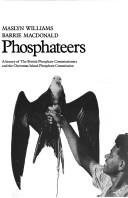
The Phosphateers: A History of the British Phosphate Commissi...
First published 1985. Subjects: British Phosphate Commission, Christmas Island Phosphate Commission, History, Phosphate industry, Phospha...
Nauru: Environmental Damage Under International Trusteeship
Nauru is a small island in the Pacific which was endowed by nature with some of the richest phosphates in the world. Phosphate mining beg...
The Pacific Islands: An Encyclopedia
An encyclopaedia of information on major aspects of Pacific life, including the physical environment, peoples, history, politics, economy...
eBay marketplace picks
Marketplace Samples
Live-tested eBay searches with available results related to this page.
Selected fromWorld War II Pacific poster oneBay.co.uk.

Endnotes
1.
Source: collections.tepapa.govt.nz
Title: Te Papa Collections Nauru## Collection Objects (50)
Link:https://collections.tepapa.govt.nz/place/2078355
Source snippet
Object Nauru (loading conveyer, beach edge)Wayne Barrar1991O.013046 Object Nauru (tree, early mining works)Wayne Barrar1991O.013048 Objec...
2.
Source: dark-tourism.com
Link:https://www.dark-tourism.com/index.php/1583-naoeromuseum
Source snippet
Naoero MuseumThe museum was once funded by Nauru's phosphate industry but now appears... Nauru by the Germans showing the then settlemen...
3.
Source: nauru-data.sprep.org
Title: Historical sites and World War 2 relics | Nauru Environment Data Portal
Link:https://nauru-data.sprep.org/dataset/historical-sites-and-world-war-2-relics
Source snippet
January 22, 2022 — Historical sites and World War 2 relics * Culture and Heritage... In August 1942, Nauru…...
Published: January 22, 2022
4.
Source: wipo.int
Link:https://www.wipo.int/wipolex/en/legislation/details/20507
Source snippet
23 of 2017), Nauru, WIPO LexDetails Details Year of Version 2017 Dates Commenced: September 14, 2017 Type of Text IP-related Laws Subject...
Published: September 14, 2017
5.
Source: nauru-data.sprep.org
Link:https://nauru-data.sprep.org/system/files/Nauru%20Historical%20Cttee%20%28%20-%20%29%20Nauru%20war%20sites%20and%20relics.pdf
6.
Source: teara.govt.nz
Link:https://teara.govt.nz/en/biographies/3e7/ellis-albert-fuller
7.
Source: journals.openedition.org
Link:https://journals.openedition.org/jso/7055?lang=en
8.
Source: teara.govt.nz
Title: nauru after phosphate mining
Link:https://teara.govt.nz/en/photograph/15838/nauru-after-phosphate-mining
9.
Source: collections.tepapa.govt.nz
Link:https://collections.tepapa.govt.nz/object/398167
10.
Source: pacific-studies.net
Link:https://www.pacific-studies.net/ajax_actions.php?action=museum_list&country_id=17
11.
Source: collections.tepapa.govt.nz
Link:https://collections.tepapa.govt.nz/object/1339698
12.
Source: natlib.govt.nz
Link:https://natlib.govt.nz/records/21885335
13.
Source: wipolex-res.wipo.int
Link:https://wipolex-res.wipo.int/edocs/lexdocs/laws/en/nr/nr028en.html
14.
Source: pacific-data.sprep.org
Title: historical sites and world war 2 relics
Link:https://pacific-data.sprep.org/dataset/historical-sites-and-world-war-2-relics
15.
Source: nauru-data.sprep.org
Link:https://nauru-data.sprep.org/system/files/Specht%20%281977%29%20Shell%20artefacts%20from%20Nauru.pdf
16.
Source: collections.tepapa.govt.nz
Link:https://collections.tepapa.govt.nz/object/398172
17.
Source: collections.tepapa.govt.nz
Link:https://collections.tepapa.govt.nz/object/398184
18.
Source: collections.tepapa.govt.nz
Link:https://collections.tepapa.govt.nz/object/398158
19.
Source: collections.tepapa.govt.nz
Link:https://collections.tepapa.govt.nz/object/398175
20.
Source: collections.tepapa.govt.nz
Link:https://collections.tepapa.govt.nz/object/1156293
21.
Source: collections.tepapa.govt.nz
Link:https://collections.tepapa.govt.nz/object/1156299
22.
Source: collections.tepapa.govt.nz
Link:https://collections.tepapa.govt.nz/object/398178
23.
Source: collections.tepapa.govt.nz
Link:https://collections.tepapa.govt.nz/object/325867
24.
Source: collections.tepapa.govt.nz
Link:https://collections.tepapa.govt.nz/category/324999
25.
Source: tepapa.govt.nz
Link:https://tepapa.govt.nz/about/repatriation/international-repatriation
26.
Source: encyclopedia.com
Link:https://www.encyclopedia.com/places/australia-and-oceania/pacific-islands-political-geography/nauru
27.
Source: nauru.gov.nr
Title: Nauru Government Nauru Museum
Link:https://www.nauru.gov.nr/government/departments/nauru-museum.aspx
Source snippet
ernmentNauru Museum - The Government of the Republic of NauruLocated in Yaren, the museum formally opened on 30 January 2019. En...
Published: January 2019
28.
Source: pacificwrecks.com
Link:https://pacificwrecks.com/restore/nauru/index.html
Source snippet
Nearly all the artifacts were collected and donated by Stan Gajda and includes many World War II era artifacts including Japanese rifles...
29.
Source: Wikipedia
Title: Nauru Museum
Link:https://en.wikipedia.org/wiki/Nauru_Museum
30.
Source: lonelyplanet.com
Title: Lonely Planet Command Ridge | Attractions
Link:https://www.lonelyplanet.com/points-of-interest/command-ridge/1045487
31.
Source: slq.qld.gov.au
Title: nauru pleasant island pacific solution
Link:https://www.slq.qld.gov.au/blog/nauru-pleasant-island-pacific-solution
32.
Source: ahnp.ub.uni-heidelberg.de
Link:https://ahnp.ub.uni-heidelberg.de/journals/icomoshefte/article/view/115456/111453
33.
Source: britishmuseum.org
Title: British Museum Collections Online | British Museum Nauru## 63 related objects
Link:https://www.britishmuseum.org/collection/term/x72127
34.
Source: britishmuseum.org
Link:https://www.britishmuseum.org/collection/object/E_Oc1936
35.
Source: britishmuseum.org
Link:https://www.britishmuseum.org/collection/object/EA_Oc-A31-19
36.
Source: britishmuseum.org
Link:https://www.britishmuseum.org/collection/object/E_Oc1944
37.
Source: nauru.gov.nr
Title: Nauru Government REPUBLIC OF NAURU GOVERNMENT GAZETTE
Link:https://www.nauru.gov.nr/media/220952/gazette-184-26.pdf
38.
Source: nauru.gov.nr
Title: gazette 213 26
Link:https://www.nauru.gov.nr/media/221286/gazette-213-26.pdf
39.
Source: varldskulturmuseerna.se
Link:https://www.varldskulturmuseerna.se/en/collections/donations/
40.
Source: britishmuseum.org
Title: Collections Online | British Museum
Link:https://www.britishmuseum.org/collection/term/107789%3A1
41.
Source: nauru.gov.nr
Title: gazette 141 26
Link:https://www.nauru.gov.nr/media/220538/gazette_141-26.pdf
42.
Source: nauru.gov.nr
Link:https://www.nauru.gov.nr/media/207032/gazette-377-25_1.pdf
43.
Source: nauru.gov.nr
Title: gazette 131 26
Link:https://www.nauru.gov.nr/media/220562/gazette_131-26.pdf
44.
Source: nauru.gov.nr
Title: gazette 121 26
Link:https://www.nauru.gov.nr/media/220348/gazette-121-26.pdf
45.
Source: nauru.gov.nr
Title: gazette 311 25
Link:https://www.nauru.gov.nr/media/206067/gazette-311-25.pdf
46.
Source: nauru.gov.nr
Title: gazette 522 25
Link:https://www.nauru.gov.nr/media/209294/gazette-522-25.pdf
47.
Source: nauru.gov.nr
Title: gazette 296 25
Link:https://www.nauru.gov.nr/media/205899/gazette-296-25.pdf
48.
Source: nauru.gov.nr
Title: nauru bulletin 6 31mar2026 308
Link:https://www.nauru.gov.nr/media/220276/nauru_bulletin__631mar2026__308.pdf
49.
Source: facebook.com
Title: The Naoero Museum
Link:https://www.facebook.com/groups/1121279314987574/
50.
Source: britishmuseum.org
Link:https://www.britishmuseum.org/collection/term/BIOG126462
51.
Source: britishmuseum.org
Title: collecting histories
Link:https://www.britishmuseum.org/about-us/british-museum-story/collecting-histories
52.
Source: britishmuseum.org
Link:https://www.britishmuseum.org/collection/object/E_Oc1895-250
53.
Source: britishmuseum.org
Link:https://www.britishmuseum.org/our-work/departments
54.
Source: britishmuseum.org
Title: ancestors artefacts empire mobilising aboriginal objects
Link:https://www.britishmuseum.org/research/projects/ancestors-artefacts-empire-mobilising-aboriginal-objects
55.
Source: britishmuseum.org
Link:https://www.britishmuseum.org/collection/term/BIOG127317
56.
Source: britishmuseum.org
Link:https://www.britishmuseum.org/our-work/departments/africa-oceania-and-americas
57.
Source: pacificwrecks.com
Title: Stan Gajda
Link:https://pacificwrecks.com/people/visitors/gajda/nauru.html
58.
Source: geognos.com
Link:https://www.geognos.com/en/place/nauru
59.
Source: nma.gov.au
Link:https://www.nma.gov.au/about/our-collection/donations
60.
Source: lonelyplanet.es
Title: Qué ver y qué hacer en Nauru
Link:https://www.lonelyplanet.es/oceania/nauru/imprescindible/command-ridge
61.
Source: books.ub.uni-heidelberg.de
Link:https://books.ub.uni-heidelberg.de/arthistoricum/catalog/view/1270/2180/108944
Additional References
62.
Source: youtube.com
Link:https://www.youtube.com/watch?v=WbgmsStBkzY
Source snippet
The $600 Dinosaur Tail That Proved Warm-Blooded Dinosaurs...
63.
Source: youtube.com
Title: Illicit Fossils: The Ethical Dilemma in Protecting the World’s Natural History
Link:https://www.youtube.com/watch?v=PnssaLktiXw
Source snippet
A tale of two papers: ethics of Burmese amber...
64.
Source: returningheritage.com
Link:https://www.returningheritage.com/about-cultural-restitution
65.
Source: mystoric.com
Link:https://mystoric.com/biggest-historical-mysteries-in-nauru/
66.
Source: facebook.com
Link:https://www.facebook.com/BBCSussex/posts/brighton-hove-museums-is-set-to-return-45-artefacts-to-botswana-following-a-2022/1525278672937747/
67.
Source: museumsbund.de
Link:https://www.museumsbund.de/wp-content/uploads/2021/03/mb-leitfaden-en-web.pdf
68.
Source: brill.com
Link:https://brill.com/previewpdf/journals/auso/14/1/article-p299.xml?srsltid=AfmBOor-r754KnBFiUUNYVxt_WoCHN3qrELOY-KH_2qnrGunhXQ60MSa
69.
Source: southpacificislands.travel
Link:https://southpacificislands.travel/exploring-nauru-your-travel-guide-to-one-of-the-least-visited-destinations/
70.
Source: nzgeo.com
Link:https://www.nzgeo.com/stories/fertile-ground-farmers-son-finds-south-pacific-paradise/
71.
Source: geognos.com
Link:https://www.geognos.com/en/place/nauru/history