Within Strange Libya
Why Are Libya's Prehistoric Mummies So Important?
Libya's ancient human remains reveal complex Saharan burial traditions while raising urgent questions about conservation and dignity.
On this page
- The child from Uan Muhuggiag
- Burial customs before Egyptian mummification
- War, storage and the ethics of display
Page outline Jump by section
Introduction
Libya’s prehistoric mummies are among the country’s most remarkable archaeological discoveries because they show that complex funerary traditions existed in the Sahara long before the famous embalming practices of ancient Egypt. Rather than representing an early version of Egyptian mummification, these preserved human remains reveal how prehistoric pastoral communities treated their dead according to their own beliefs and customs. They also offer rare evidence of a Sahara that was once greener, wetter and capable of supporting permanent communities.
Today these ancient bodies are important not only for what they reveal about prehistoric life, but also because they have become symbols of the challenges facing Libya’s cultural heritage. Their survival has depended on exceptional desert preservation, careful archaeological conservation and, more recently, efforts to protect museum collections through years of conflict and institutional disruption.[acacus.org]acacus.orgThe Archaeological Mission in the SaharaPalaeoanthropology…
Why Are Libya’s Prehistoric Mummies So Important?
Few archaeological discoveries challenge popular assumptions as effectively as the prehistoric mummies from Libya’s Sahara. Many people associate deliberate preservation of the dead exclusively with pharaonic Egypt, yet Libya’s discoveries demonstrate that sophisticated treatment of human remains appeared independently among Saharan communities thousands of years before Egyptian royal mummification became established.
The most famous example is the mummified child from Uan Muhuggiag, discovered in the Acacus Mountains of south-western Libya. Radiocarbon dating places the burial at roughly 5,400 years ago, making it significantly older than the earliest well-known Egyptian artificial mummies. Archaeologists emphasise that this does not mean Libya “invented” mummification. Instead, it shows that different prehistoric societies developed their own funerary traditions in response to local beliefs and circumstances.[acacus.org]acacus.orgThe Archaeological Mission in the SaharaPalaeoanthropology…
The find is especially valuable because human remains survive only rarely in the Sahara. Together with rock art, settlements and animal bones, these burials help reconstruct the lives of pastoral peoples who occupied a landscape that was far greener than the desert seen today.
The Child from Uan Muhuggiag
The child discovered at Uan Muhuggiag remains the centrepiece of discussions about Libya’s prehistoric dead. The body belonged to a young child, estimated to have died at around two to three years of age.
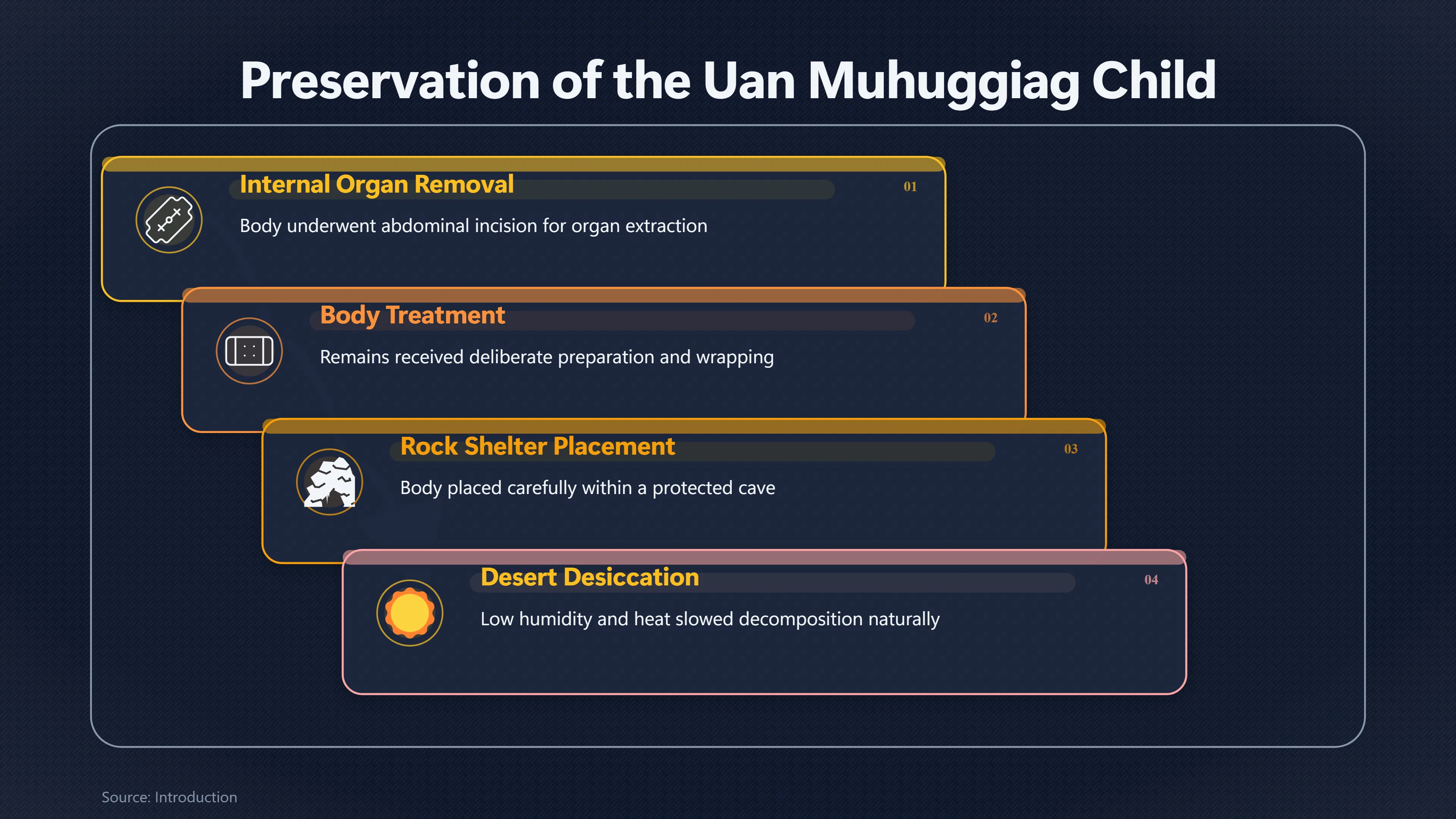
Archaeological examination showed that the burial was not accidental preservation alone. The body appears to have undergone deliberate preparation before burial. Researchers found evidence that internal organs had been removed through an abdominal incision, the body had been treated and wrapped, and it was placed carefully within the rock shelter. Although the exact sequence differs from later Egyptian embalming techniques, the treatment clearly reflects intentional care for the deceased rather than simple disposal.[acacus.org]acacus.orgThe Archaeological Mission in the SaharaPalaeoanthropology…
The burial also provides insight into family life. Rather than belonging to a wealthy royal elite, the child came from an ordinary prehistoric pastoral community. This suggests that careful funerary treatment was not restricted to rulers or exceptional individuals but formed part of broader cultural practice.
Researchers continue to study the remains using modern scientific methods because they preserve information about:
- childhood health and nutrition;
- prehistoric disease;
- diet and environment;
- early Saharan pastoral societies;
- burial rituals and social identity.
Each new analysis adds to understanding of daily life rather than simply the circumstances of death.

Burial Customs Before Egyptian Mummification
One of the most common misunderstandings is that Libya’s prehistoric mummies represent an early Egyptian tradition. Archaeologists generally reject this interpretation.
Instead, the evidence points to a separate Saharan funerary culture that emerged among mobile cattle-herding communities. During the early and middle Holocene, much of today’s Libyan desert consisted of grasslands, lakes and seasonal rivers. Communities buried their dead within this changing landscape while developing distinctive ritual practices that reflected their own beliefs.
The Uan Muhuggiag child demonstrates that deliberate preservation could occur outside the Nile Valley. However, there is no evidence that later Egyptian embalming developed directly from these Libyan practices. The similarities are broad rather than technical, while the differences in methods, chronology and cultural setting remain substantial.[acacus.org]acacus.orgThe Archaeological Mission in the SaharaPalaeoanthropology…
Other human remains recovered from the Acacus region reinforce this picture of diverse prehistoric burial customs. Some skeletons reveal evidence of everyday activities through bone wear and tooth use, helping researchers reconstruct occupations such as fibre working and basket making. These finds remind us that the archaeological value of the burials lies not only in preservation but also in the stories they tell about ordinary prehistoric lives.[PubMed]pubmed.ncbi.nlm.nih.govNonalimentary tooth use in prehistory: an example from early Holocene in Central Sahara (Uan Muhuggiag, Tadrart Acacus, Libya) - Pu…
How Did These Bodies Survive for Millennia?
The remarkable preservation of Libya’s prehistoric mummies resulted from a combination of human action and environmental conditions.
The deliberate preparation of the bodies appears to have slowed decomposition, but equally important was the extremely dry desert environment. Low humidity, stable burial conditions and protected rock shelters reduced bacterial activity and helped preserve soft tissues that would normally disappear.
Survival after excavation has been far more complicated. Once removed from their original environment, ancient human remains become vulnerable to changes in temperature, humidity, handling and transport. Conservation therefore requires specialised storage, environmental monitoring and careful exhibition conditions rather than simply placing the remains in display cases.[acacus.org]acacus.orgThe Archaeological Mission in the SaharaPalaeoanthropology…
War, Storage and the Ethics of Display
The story of Libya’s prehistoric mummies did not end with their excavation. Modern history has introduced new risks.
Following the 2011 conflict and years of political instability, museums faced prolonged closures, disrupted conservation work and concerns about the security of archaeological collections. Libya’s National Museum in Tripoli remained closed for nearly fourteen years before reopening in late 2025 as part of broader efforts to restore cultural institutions. The reopened galleries again include prehistoric material, bringing these important remains back into public interpretation while highlighting the need for continued conservation.[Reuters]reuters.comManaged by the Tripoli-based Government of National Unity (GNU), the museum's renovation began in March 2023 as part of efforts to rebuil…
Displaying prehistoric human remains also raises ethical questions that museums increasingly acknowledge. Curators must balance several responsibilities:
- preserving scientifically valuable evidence;
- respecting the dignity of the deceased;
- educating visitors without sensationalising death;
- protecting fragile remains from unnecessary exposure;
- explaining the cultural context rather than presenting bodies merely as curiosities.
Unlike fictional tales of cursed mummies or dramatic museum attractions, Libya’s prehistoric dead are displayed primarily as archaeological evidence. Their importance lies in what they reveal about ancient communities, environmental change and the development of human belief rather than in spectacle.

What Visitors Can Expect Today
For visitors interested in Libya’s unusual archaeological heritage, the prehistoric mummies are best understood as part of a wider story rather than isolated exhibits. They connect with the rock art of the Acacus Mountains, prehistoric settlements, early pastoral cultures and the transformation of the Sahara from fertile landscape to desert.
Access remains dependent on museum operations and wider security conditions, and independent travel to many archaeological regions can still be difficult. Nevertheless, the reopening of the National Museum has restored one of the country’s most significant public displays of prehistoric archaeology and provides an opportunity to interpret these remarkable remains within the broader history of Libya rather than simply alongside the more familiar civilisation of ancient Egypt.[Reuters]reuters.comManaged by the Tripoli-based Government of National Unity (GNU), the museum's renovation began in March 2023 as part of efforts to rebuil…
Amazon book picks
Further Reading
Books and field guides related to Why Are Libya's Prehistoric Mummies So Important?. Use these as the next step if you want deeper reading beyond the article.
The Mummy in Ancient Egypt
A scholarly examination of burial rites and tomb development explains how Egyptian mummies were preserved, wrapped, decorated, and shelte...
The Oxford History of Ancient Egypt
The Oxford History of Ancient Egypt describes the emergence and development of the distinctive civilization of the ancient Egyptians, fro...
eBay marketplace picks
Marketplace Samples
Example marketplace items related to this page. Use the search link to explore similar finds on eBay.
Selected fromancient artifact replica oneBay.co.uk.
Endnotes
1.
Source: acacus.org
Title: The Archaeological Mission in the Sahara
Link:https://www.acacus.org/research/palaeoanthropology
Source snippet
Palaeoanthropology...
2.
Source: reuters.com
Link:https://www.reuters.com/world/africa/libyas-red-castle-museum-opens-first-time-since-fall-gaddafi-2025-12-13/
Source snippet
Managed by the Tripoli-based Government of National Unity (GNU), the museum's renovation began in March 2023 as part of efforts to rebuil...
Published: March 2023
3.
Source: pubmed.ncbi.nlm.nih.gov
Link:https://pubmed.ncbi.nlm.nih.gov/12567376/
Source snippet
Nonalimentary tooth use in prehistory: an example from early Holocene in Central Sahara (Uan Muhuggiag, Tadrart Acacus, Libya) - Pu...
4.
Source: lana.gov.ly
Title: وكالة الأنباء الليبية
Link:https://lana.gov.ly/post.php?id=359421&lang=ar
Source snippet
مصلحة الأثار تستلم مومياء "تخرخوري" إحدى أهم المكتشفات الأثرية المرتبطة بتاريخ الصحراء الليبيةJune 14, 2026 — مصلحة الأثار تستلم مومياء "...
Published: June 14, 2026
5.
Source: reutersconnect.com
Link:https://www.reutersconnect.com/item/the-libyan-national-museum-reopened-to-visitors-after-14-years/dGFnOnJldXRlcnMuY29tLDIwMjU6bmV3c21sX01UMUFOQURMMDAwNVhCR0pX
6.
Source: reutersconnect.com
Title: Reopening of the National Museum in Tripoli | Reuters Connect
Link:https://www.reutersconnect.com/item/reopening-of-the-national-museum-in-tripoli/dGFnOnJldXRlcnMuY29tLDIwMjU6bmV3c21sX1JDMjVGSUFaRlpMWQ%3D%3D
7.
Source: reutersconnect.com
Title: Licensable picture: Reopening of the National Museum in Tripoli
Link:https://www.reutersconnect.com/item/reopening-of-the-national-museum-in-tripoli/dGFnOnJldXRlcnMuY29tLDIwMjU6bmV3c21sX1JDMjVGSUFaRlpMWQ
8.
Source: reutersconnect.com
Link:https://www.reutersconnect.com/item/reopening-of-the-national-museum-in-tripoli/dGFnOnJldXRlcnMuY29tLDIwMjU6bmV3c21sX1JDMjZGSUFMTjJOSQ
9.
Source: reutersconnect.com
Link:https://www.reutersconnect.com/item/reopening-of-the-national-museum-in-tripoli/dGFnOnJldXRlcnMuY29tLDIwMjU6bmV3c21sX1JDMjZGSUEzWUZWQg
Additional References
10.
Source: theguardian.com
Link:https://www.theguardian.com/world/2025/dec/16/libya-national-museum-reopens
Source snippet
The grand reopening was marked by a lavish celebration including fireworks, performances, and dignitaries. The museum, home to Africa’s r...
11.
Source: gcclub.org
Title: libyas national museum and the secret operation that saved its ancient treasures
Link:https://gcclub.org/2026/01/13/libyas-national-museum-and-the-secret-operation-that-saved-its-ancient-treasures/
Source snippet
Libya’s National Museum and the secret operation that saved its ancient treasures – GCCJanuary 13, 2026 — LIBYA’S NATIONAL MUSEUM AND THE...
Published: January 13, 2026
12.
Source: sahmcapital.com
Title: عمرها 7000 عام عودة المومياء تخرخوري إلى ليبيا بعد أكثر من عقدين 2026 06 15
Link:https://www.sahmcapital.com/news/content/%D8%B9%D9%85%D8%B1%D9%87%D8%A7-7000-%D8%B9%D8%A7%D9%85-%D8%B9%D9%88%D8%AF%D8%A9-%D8%A7%D9%84%D9%85%D9%88%D9%85%D9%8A%D8%A7%D8%A1-%D8%AA%D8%AE%D8%B1%D8%AE%D9%88%D8%B1%D9%8A-%D8%A5%D9%84%D9%89-%D9%84%D9%8A%D8%A8%D9%8A%D8%A7-%D8%A8%D8%B9%D8%AF-%D8%A3%D9%83%D8%AB%D8%B1-%D9%85%D9%86-%D8%B9%D9%82%D8%AF%D9%8A%D9%86
Source snippet
عودة المومياء تخرخوري إلى ليبيا بعد أكثر من عقدينJune 15, 2026 — 7,000 years old... The mummy of Takhrkhuri returns to Libya after more t...
Published: June 15, 2026
13.
Source: diplo.news
Title: Libyan National Museum reopens: signal of cultural diplomacy | diplo.news
Link:https://www.diplo.news/en/articles/libysches-nationalmuseum-nach-14-jahren-wiedereroffnet
Source snippet
January 12, 2026 — LIBYAN NATIONAL MUSEUM REOPENS AFTER 14 YEARS Cultural Diplomacy: Summit of Arab Ambassadors in Berlin January 12, 202...
Published: January 12, 2026
14.
Source: youtube.com
Title: Two extremely well-preserved mummies have been discovered in the Takarkori cave
Link:https://www.youtube.com/watch?v=Wcsb9L4ksXM
Source snippet
Uan Muhuggiag mummy prehistoric Libya Africa’s Oldest Mummy: Uan Muhuggiag Toddler’s 5,400-Year-Old Mystery Unveiled in 2025 | AIgenerate...
15.
Source: youtube.com
Title: Africa’s Oldest Mummy: Uan Muhuggiag Toddler’s 5,400-Year-Old Mystery
Link:https://www.youtube.com/watch?v=Rvccbpq_XQc
Source snippet
The Oldest Mummy in Africa: Libya's 5,600-Year-Old Secret...
16.
Source: youtube.com
Title: Buried for 5,400 Years: Africa’s Oldest Mummy Revealed
Link:https://www.youtube.com/watch?v=Mt1FBLnUoQ8
Source snippet
Two extremely well-preserved mummies have been discovered in the Takarkori cave...
17.
Source: youtube.com
Title: The Mummified Boy: A Mystery Before The Pharaohs
Link:https://www.youtube.com/watch?v=9a0KGsT8S_o
Source snippet
Africa’s Oldest Mummy: Uan Muhuggiag Toddler’s 5,400-Year-Old Mystery...
18.
Source: youtube.com
Title: The Oldest Mummy in Africa: Libya’s 5,600-Year-Old Secret
Link:https://www.youtube.com/watch?v=c4oZDVTWtGc
Source snippet
Buried for 5,400 Years: Africa’s Oldest Mummy Revealed...
19.
Source: smithsonianmag.com
Link:https://www.smithsonianmag.com/history/africas-oldest-mummy-is-a-toddler-who-died-5400-years-ago-nearly-a-millennium-before-the-egyptians-started-mummifying-their-dead-180987227/