Within Bahamas Curiosities
Is Bahamas Shipwreck Treasure Archaeology or Salvage?
The Bahamas Maritime Museum pairs spectacular wreck treasure with the ordinary objects that reveal how people lived and traded at sea.
On this page
- The Maravillas wreck and its recovered objects
- What everyday finds reveal beyond gold
- Ownership, conservation and commercial recovery
Page outline Jump by section
Introduction
The Bahamas is famous for shipwreck treasure, but the most interesting story is not simply one of gold, emeralds and silver. It is the ongoing debate over whether remarkable underwater discoveries are being treated as archaeology or as commercial salvage. That distinction matters because archaeology aims to preserve evidence about the past, while treasure hunting has often focused on recovering valuable objects for sale. Modern work centred on the wreck of the Nuestra Señora de las Maravillas attempts to demonstrate that scientific recording, conservation and public display can coexist with the recovery of spectacular artefacts. At the same time, questions about ownership, commercial involvement and long-term stewardship remain an important part of understanding Bahamian maritime heritage.[WIPO]wipo.intAntiquities, Monuments and Museum Act, 1998 (CH.51), Bahamas, WIPO LexMay 12, 1998…
Is Bahamas Shipwreck Treasure Archaeology or Salvage?
For centuries the reefs and banks surrounding The Bahamas have claimed ships travelling between Europe, the Caribbean and the Americas. Many wrecks were salvaged almost immediately after sinking, while others attracted generations of treasure hunters searching for precious cargo. This long history means that relatively few famous Bahamian wrecks remain untouched archaeological sites.
Modern maritime archaeology differs from earlier treasure recovery in one crucial respect: every object is treated as evidence rather than simply as something valuable. Archaeologists record an artefact’s precise location, its relationship to surrounding material and the condition of the seabed before anything is removed. Those records allow researchers to reconstruct how a ship broke apart, what it carried, how its crew lived and how trade operated across the Atlantic. Once an object loses that context, much of its historical value disappears even if the object itself survives.[Allen Exploration]allenexploration.comOpen source on allenexploration.com.
The Bahamas Maritime Museum presents itself within this archaeological framework. Rather than displaying treasure as isolated curiosities, it places recovered material alongside interpretation of colonial shipping, navigation, piracy and daily life at sea. That approach reflects a wider international shift away from treating wrecks as underwater vaults and towards understanding them as historical sites.[Business Insider]businessinsider.comSince receiving exploration rights in 2019, Carl Allen's company, AllenX, discovered over 10,000 artifacts including gold chains, silver…
The Maravillas Wreck and Its Recovered Objects
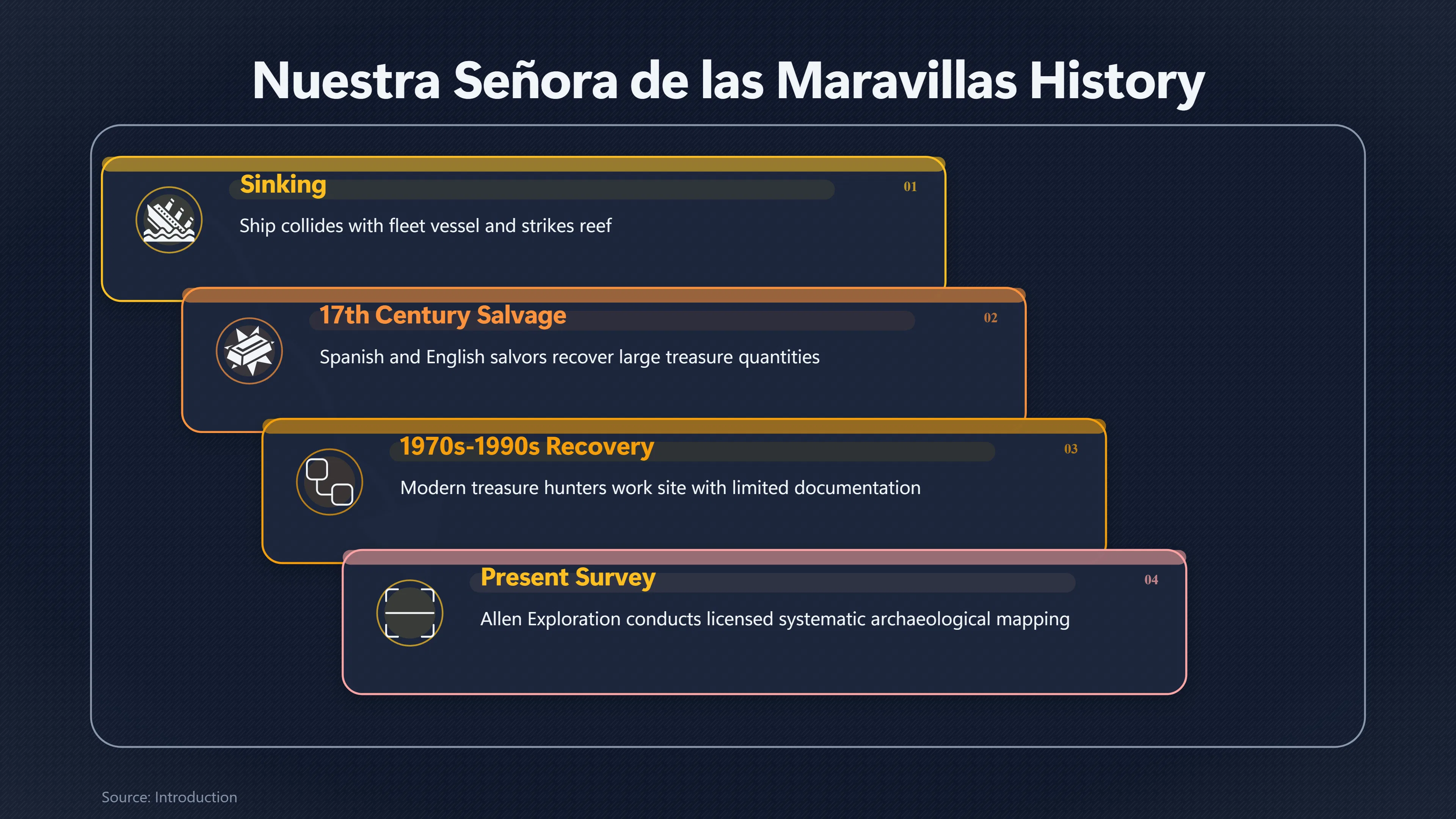
The museum’s defining collection comes from the Spanish galleon Nuestra Señora de las Maravillas, which sank on the Little Bahama Bank in January 1656 after colliding with another vessel in its fleet before striking a reef. The ship carried royal taxes, private cargo and goods recovered from an earlier wreck, making it exceptionally valuable even by the standards of the Spanish treasure fleets.[Allen Exploration]allenexploration.comOpen source on allenexploration.com.
The wreck’s history is unusually complicated because it has been disturbed repeatedly:
- Spanish salvors recovered large quantities of treasure soon after the disaster.
- English and colonial salvors continued recovery during the seventeenth century.
- Modern treasure hunters worked the site extensively between the 1970s and early 1990s, often using techniques that left little published archaeological documentation.
- Since 2019, Allen Exploration has carried out licensed surveys using systematic mapping, magnetometers, side-scan sonar and archaeological recording under permits issued by the Bahamian government.[Allen Exploration]allenexploration.comOpen source on allenexploration.com.
Recent work has recovered thousands of artefacts ranging from spectacular jewellery and silver bars to ceramics, navigational equipment and ship fittings. Researchers have also mapped an extensive debris field stretching several kilometres beyond the previously recognised wreck area, helping explain how storms, salvage operations and the original sinking scattered material across the seabed.[Allen Exploration]allenexploration.comOpen source on allenexploration.com.
The importance of this work lies less in finding more treasure than in reconstructing a site that had already been heavily disturbed by centuries of recovery.
What Everyday Finds Reveal Beyond Gold
The museum’s most eye-catching exhibits are undoubtedly gold chains, emerald pendants, silver coins and precious ornaments. These attract visitors, but archaeologists often regard more ordinary finds as equally valuable because they reveal aspects of life that written records rarely describe.
Ceramics, glass bottles, tobacco pipes, cooking equipment, tools, rigging components and personal possessions help answer questions such as:
- how food was prepared aboard ship;
- where supplies originated;
- differences between officers and ordinary sailors;
- repair techniques used during long voyages;
- trading links between Europe, the Caribbean and the Americas.
These everyday objects also help distinguish official cargo from personal belongings and contraband. Some recently recovered luxury items appear not to match surviving cargo manifests, supporting historical evidence that undeclared goods were routinely transported aboard Spanish treasure ships. Rather than merely increasing the monetary value of the wreck, these discoveries illuminate the realities of seventeenth-century commerce, taxation and smuggling.[Popular Mechanics]popularmechanics.comThe ship went down after a collision with another vessel in its fleet, scattering a debris field over eight miles. Although treasure hunt…
The archaeological value therefore comes from the complete assemblage of objects, not simply from the rarest or most expensive pieces.
Why Archaeological Credibility Still Faces Questions
The Bahamas Maritime Museum occupies an unusual position because it is closely connected with the same private organisation conducting the licensed excavation. This has both strengths and limitations.
On the positive side:
- discoveries are being conserved rather than dispersed immediately through auctions;
- extensive survey technology is being used to document the wreck;
- published reports describe mapping methods and archaeological interpretation;
- recovered material is displayed publicly instead of remaining in private collections.[Allen Exploration]allenexploration.comOpen source on allenexploration.com.
However, heritage specialists have long distinguished archaeology from commercial salvage because financial incentives can influence excavation priorities. The Maravillas site also illustrates how difficult objective interpretation becomes after centuries of previous disturbance. Modern archaeologists must separate original wreck deposits from debris moved by earlier salvors, storms and treasure hunters, making the reconstruction of the ship’s final moments unusually challenging.[Allen Exploration]allenexploration.comOpen source on allenexploration.com.
This does not invalidate the research, but it means claims about the wreck are strongest when supported by published survey data, mapped find locations and peer-reviewed interpretation rather than by the market value of recovered objects.
Ownership, Conservation and Commercial Recovery
The legal framework is an important reason the Bahamian situation differs from the treasure hunting of previous decades.
The Antiquities, Monuments and Museum Act provides protection for archaeological material and establishes government responsibility for preserving antiquities and regulating excavation. Finds from historic wrecks are therefore subject to national heritage law rather than being treated simply as abandoned property.[WIPO]wipo.intAntiquities, Monuments and Museum Act, 1998 (CH.51), Bahamas, WIPO LexMay 12, 1998…
In practice, The Bahamas has chosen a partnership model in which licensed private exploration works alongside government oversight and museum display. Supporters argue that private investment supplies expensive survey vessels, remote-sensing technology and conservation resources that would otherwise be difficult to fund. Critics caution that commercial involvement requires particularly strong transparency, documentation and independent oversight to ensure archaeological priorities remain paramount.[Allen Exploration]allenexploration.comOpen source on allenexploration.com.
The existence of ongoing contractual disputes connected with the Maravillas project also demonstrates that commercial interests continue to intersect with archaeological work, even when recovery is conducted under official licence.[Chron]chron.comThe Spanish galleon sank off the Bahamas in the 17th century while transporting gold, silver, jewels, and other treasures to Spain. The l…

Why This Matters in The Bahamas’ Curiosity Landscape
Shipwreck treasure occupies a distinctive place within Bahamian curiosity culture because it combines genuine archaeological research with the enduring romance of lost riches. Visitors naturally arrive expecting gold and emeralds, yet the most lasting impression often comes from understanding how a submerged archaeological site is investigated and interpreted.
The Bahamas Maritime Museum therefore represents more than a display of valuable objects. It illustrates the evolution from poorly documented treasure hunting towards evidence-led marine archaeology, while openly reflecting the continuing tensions between heritage protection, tourism and commercial recovery. That balance—rather than the treasure alone—is what makes Bahamian shipwreck collections one of the country’s most unusual and thought-provoking heritage attractions.
Amazon book picks
Further Reading
Books and field guides related to Is Bahamas Shipwreck Treasure Archaeology or Salvage?. Use these as the next step if you want deeper reading beyond the article.
Under the Black Flag
Rating: 4.0/5 from 5 Google Books ratings
Examines the popular image of pirates in modern times and compares it with the real world of pirates, who were more often murderers and t...
Treasure Hunt: Shipwrecks, Salvage and the Law
First published 2007. Subjects: Shipwrecks, Treasure troves, History, Salvage, Explorers.
eBay marketplace picks
Marketplace Samples
Live-tested eBay searches with available results related to this page.
Selected fromnautical collectible oneBay.co.uk.
Endnotes
1.
Source: wipo.int
Link:https://www.wipo.int/wipolex/en/legislation/details/8932
Source snippet
Antiquities, Monuments and Museum Act, 1998 (CH.51), Bahamas, WIPO LexMay 12, 1998...
Published: May 12, 1998
2.
Source: chron.com
Link:https://www.chron.com/news/article/treasure-hunt-maravillas-bahamas-22222846.php
Source snippet
The Spanish galleon sank off the Bahamas in the 17th century while transporting gold, silver, jewels, and other treasures to Spain. The l...
3.
Source: wipo.int
Title: قانون الآثار والمعالم والمتاحف (الفصل 51), جزر البهاما, WIPO Lex
Link:https://www.wipo.int/wipolex/ar/legislation/details/8932
4.
Source: allenexploration.com
Link:https://www.allenexploration.com/_files/ugd/fe4493_6417b1206c5f4682b00a762ae57f470e.pdf
5.
Source: businessinsider.com
Link:https://www.businessinsider.com/maravillas-shipwreck-treasures-worth-millions-sparked-pirates-bahamas
Source snippet
Since receiving exploration rights in 2019, Carl Allen's company, AllenX, discovered over 10,000 artifacts including gold chains, silver...
6.
Source: popularmechanics.com
Link:https://www.popularmechanics.com/culture/a70801873/explorers-found-treasure-on-spanish-shipwreck-crime/
Source snippet
The ship went down after a collision with another vessel in its fleet, scattering a debris field over eight miles. Although treasure hunt...
Additional References
7.
Source: cbsnews.com
Link:https://www.cbsnews.com/news/maravillas-treasure-mapped-legendary-shipwreck-bahamas/
Source snippet
CBS NewsDecember 4, 2023 — Major exploration and recovery projects continued over the ensuing centuries, with the wealth of relics found...
Published: December 4, 2023
8.
Source: unesco.org
Title: IN SITU PRESERVATION AS A PREFERRED OPTION (ARTICLE 2.5) The in situ pres
Link:https://www.unesco.org/en/underwater-heritage/principles-2001
Source snippet
Principles of the 2001 Convention | UNESCOAugust 20, 2024 — Similarly, the 2001 Convention requires that all human remains dumped in mari...
Published: August 20, 2024
9.
Source: whc.unesco.org
Title: World Heritage Centre Bahamas Laws
Link:https://whc.unesco.org/en/statesparties/bs/laws/
Source snippet
UNESCO World Heritage CentreBahamas Laws - UNESCO World Heritage Convention...
10.
Source: smithsonianmag.com
Link:https://www.smithsonianmag.com/history/inside-the-race-to-preserve-treasures-from-a-legendary-17th-century-shipwreck-in-the-bahamas-180980492/
11.
Source: livescience.com
Link:https://www.livescience.com/bahamas-shipwreck-gold-jewels
12.
Source: bahamaslocal.com
Link:https://www.bahamaslocal.com/newsitem/278542/Treasure_share_must_favour_us.html
13.
Source: youtube.com
Title: Bahama Banks: Recovering Lost Legacies
Link:https://www.youtube.com/watch?v=-EhWR-BqYk4
Source snippet
The Texan Treasure Hunter of the Bahamas...
14.
Source: thearchaeologist.org
Title: The Race to Preserve Treasures From a Legendary 17th-Century Shipwreck
Link:https://www.thearchaeologist.org/blog/the-race-to-preserve-treasures-from-a-legendary-17th-century-shipwreck
15.
Source: youtube.com
Title: Treasure of the Maravillas
Link:https://www.youtube.com/watch?v=5SV9jAOTsrU
Source snippet
The Hunt for a 17th Century Sunken Treasure...
16.
Source: tribune242.com
Title: Treasure hunter fears ‘loot and scoot’ return | The Tribune
Link:https://www.tribune242.com/news/2023/jun/19/treasure-hunter-fears-loot-and-scoot-return/