Within Curious Botswana
Who Should Control Botswana's Human Remains?
The Tuli mummy and the repatriation of the man called El Negro reveal how museums balance research, dignity, provenance and restitution.
On this page
- The Tuli mummy and natural preservation
- El Negro and the legacy of colonial display
- Research, repatriation and respectful treatment
Page outline Jump by section
Introduction
Botswana’s debate over human remains is not centred on sensational displays or famous mummy galleries. Instead, it revolves around a small number of powerful cases that have shaped thinking about dignity, scientific research and the legacy of colonial collecting. The country’s best-known examples are the naturally preserved Tuli mummy and the repatriation of the man widely known as “El Negro”, whose body was displayed in a Spanish museum for decades before being returned to Botswana for burial in 2000. Together, these cases have helped redefine how museums, archaeologists and governments balance public education with respect for the dead, placing provenance, consent and cultural sensitivity ahead of curiosity alone.[UBrisa]ubrisa.ub.bwUniversity of Botswana Research, Innovation and Scholarship Archive: One body playing many parts-Ie Betjouana, el Negro, and il Bos…
The Tuli mummy and the limits of scientific display
One of Botswana’s most unusual archaeological discoveries is the so-called Tuli mummy, a naturally preserved human body found in the country’s eastern Tuli Block. Unlike the deliberately embalmed mummies of Egypt, this individual appears to have been preserved by local environmental conditions rather than by human intervention. Such naturally mummified remains are exceptionally rare in southern Africa, making the discovery scientifically valuable for understanding ancient health, burial practices and environmental history.[Wikipedia]WikipediaBotswana National MuseumBotswana National Museum
What makes the Tuli mummy significant today is not simply its rarity but the way it illustrates changing museum ethics. Earlier generations of museums often treated unusual human remains as spectacular exhibits. Contemporary practice increasingly asks different questions:
- What research can legitimately be carried out?
- Is permanent public display justified?
- Should remains be exhibited at all, or primarily conserved for research?
- How should descendant communities be involved in decisions?
Botswana’s museum sector has generally moved towards careful conservation and contextual interpretation rather than presenting archaeological bodies as curiosities. Human remains are treated primarily as archaeological and cultural evidence, not entertainment. This reflects broader international museum practice, where displays of the dead increasingly require clear educational purpose and careful ethical review.[Wikipedia]WikipediaBotswana National MuseumBotswana National Museum
El Negro and the legacy of colonial display
The most influential case in Botswana’s museum history concerns the individual long known internationally as “El Negro”.
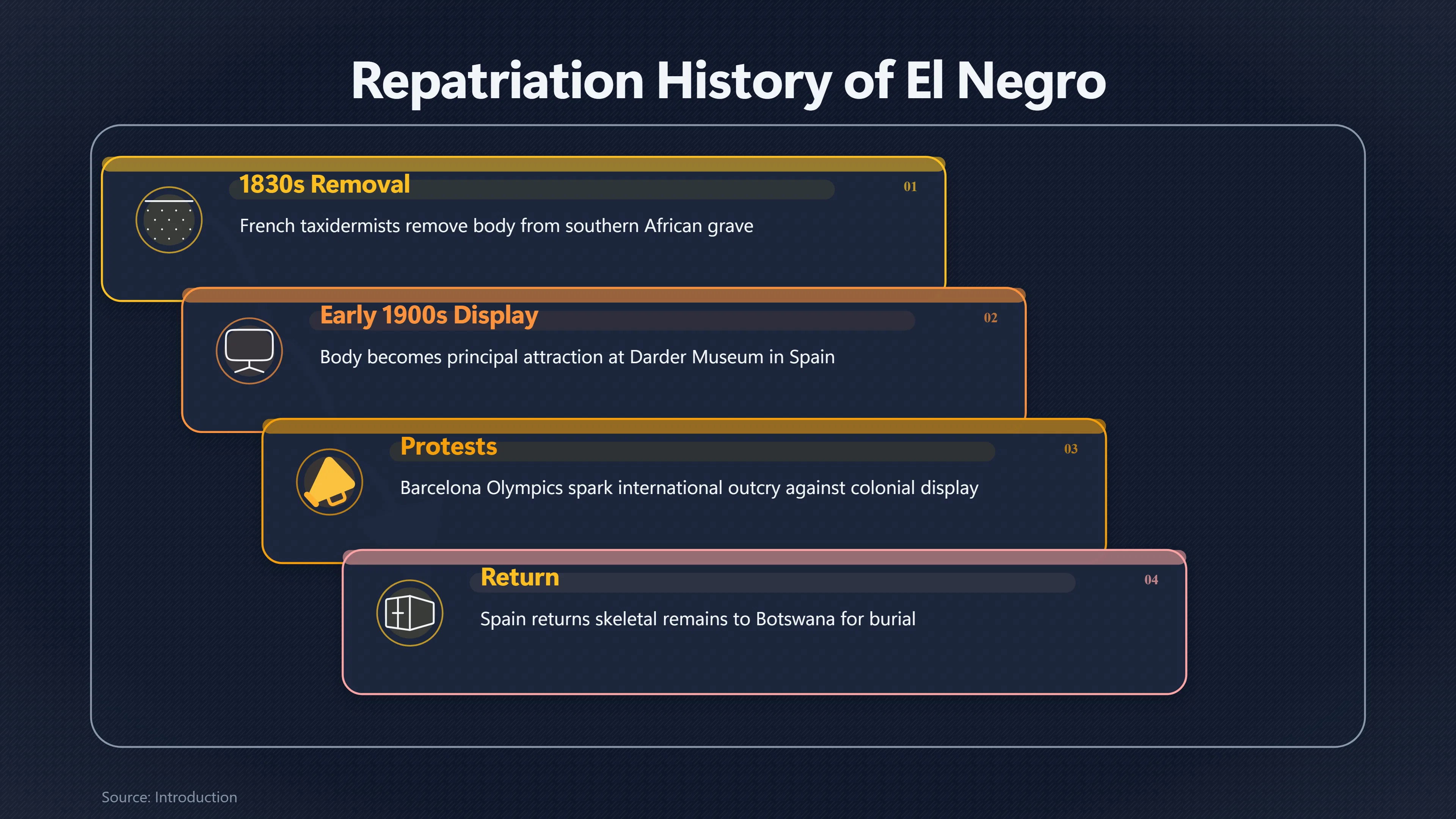
The man probably died in southern Africa around the early nineteenth century. According to research led by historians at the University of Botswana, his body was removed from its grave by French taxidermists during the 1830s, preserved using taxidermy techniques and eventually displayed in Europe as an ethnographic specimen. By the early twentieth century he had become the principal attraction of the Darder Museum in Banyoles, Spain, where visitors viewed him for decades as an exotic curiosity.[UBrisa]ubrisa.ub.bwUniversity of Botswana Research, Innovation and Scholarship Archive: One body playing many parts-Ie Betjouana, el Negro, and il Bos…
The display attracted relatively little international attention until protests gathered momentum around the 1992 Barcelona Olympic Games. Critics argued that exhibiting the preserved body of an African man perpetuated scientific racism and colonial ideas that reduced human beings to museum objects. Campaigns by African governments, scholars and anti-racism organisations eventually led to the removal of the display and negotiations over repatriation.[Thuto]thuto.orgEl Negro Index PageEl Negro Index Page…
Research undertaken in Botswana challenged earlier assumptions about the man’s identity. Rather than belonging to a vaguely defined “Bushman” population, historians concluded that he was probably a young Tswana-speaking man associated with the Batlhaping people living near the Orange and Vaal rivers in the early nineteenth century. This work demonstrated how colonial collecting practices had distorted both identity and provenance for generations.[UBrisa]ubrisa.ub.bwUniversity of Botswana Research, Innovation and Scholarship Archive: One body playing many parts-Ie Betjouana, el Negro, and il Bos…
Why the repatriation remained controversial
Although Spain agreed to return the remains in 2000, the process itself became another ethical lesson.
By the time the remains reached Botswana, much of the taxidermied material had been removed in Spain. Instead of receiving the preserved body that had stood in the museum for decades, Botswana received mainly skeletal remains packed in a small container. Many observers regarded this as another act of disrespect because decisions about what constituted the “museum object” had been made without meaningful African participation.[Thuto]thuto.orgEl Negro Index PageEl Negro Index Page…
The remains were buried in Gaborone, transforming a former museum exhibit into a recognised human burial. Rather than becoming a permanent attraction in Botswana, the case became an example of restitution and ethical responsibility. The emphasis shifted from ownership to dignity.[Thuto]thuto.orgEl Negro Index PageEl Negro Index Page…
The controversy also highlighted several wider questions that museums around the world continue to face:
- Whether scientific value can justify displaying human remains.[britishmuseum.org]britishmuseum.orgSource details in endnotes.
- How to establish the true identity and origin of historical individuals.
- Who has authority to decide the future of contested remains.
- Whether restitution should include associated artefacts and historical documentation, not simply the body itself.
Research, repatriation and respectful treatment
Botswana’s experience reflects a broader international movement away from treating human remains as collectible specimens and towards recognising them as people whose bodies deserve respectful handling.
For archaeologists, human remains remain an important source of evidence about diet, disease, migration and ancient lifeways. Scientific investigation can produce valuable knowledge that cannot easily be obtained elsewhere. At the same time, museums increasingly accept that research must be balanced against cultural values, religious beliefs and the wishes of communities connected to the deceased.[MSU Digital Library]d.lib.msu.eduMSU Digital LibraryMissing persons, stolen bodies and issues of patrimony: the El Negro story…
In practical terms, this has encouraged several principles:
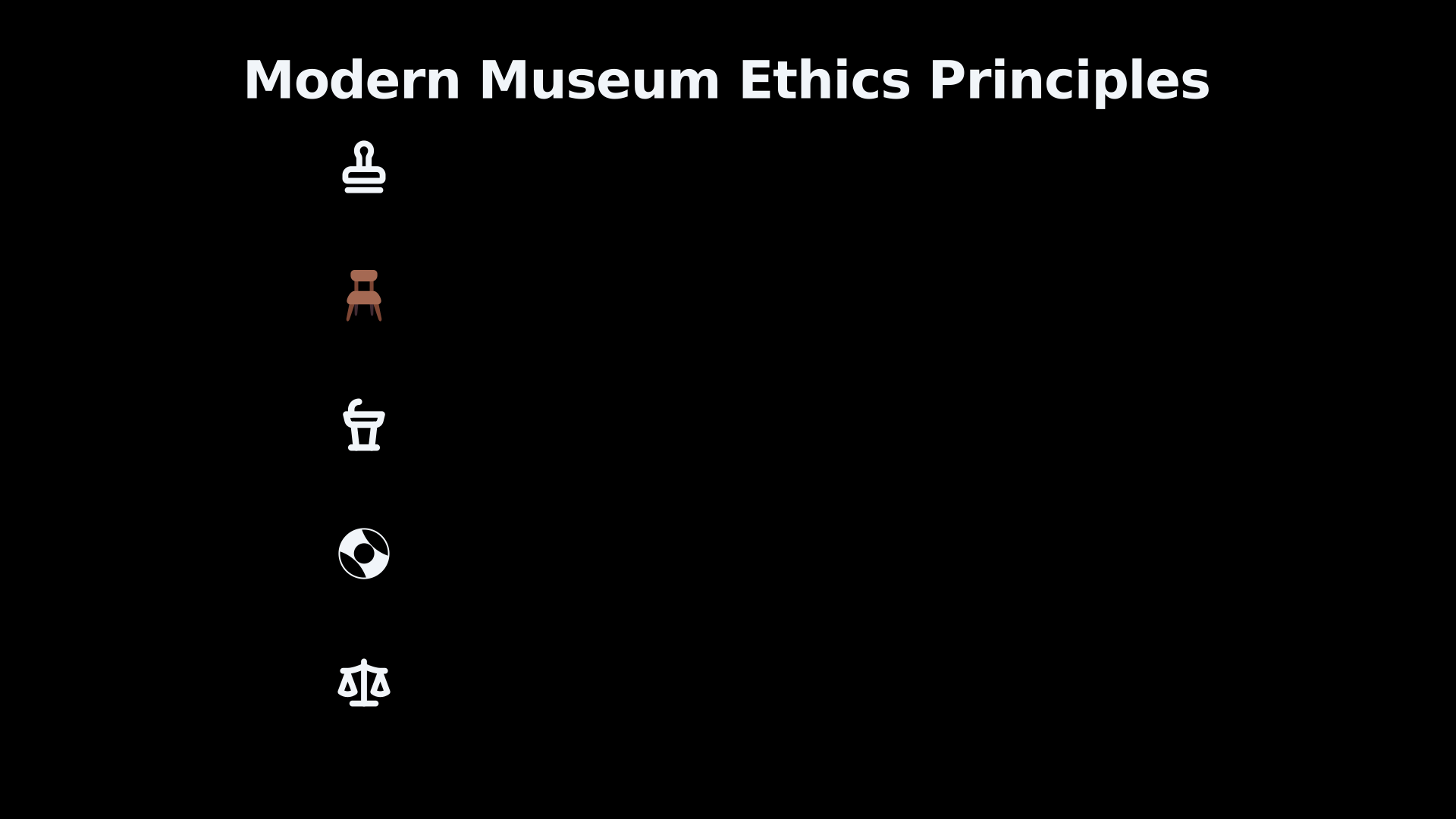
- establish clear provenance before acquisition or display;
- involve relevant communities whenever identities or cultural affiliations can be established;
- distinguish educational interpretation from spectacle;
- consider repatriation where remains were acquired through colonial exploitation or grave robbery;
- recognise that some remains may be better preserved in research collections or reburied rather than permanently exhibited.
These principles are now widely reflected in international museum ethics and have shaped how Botswana presents its own archaeological heritage.
What these cases mean for Botswana’s curiosity culture
Within Botswana’s landscape of unusual heritage, human remains occupy a distinctive place. They are not celebrated as macabre attractions but used to explore difficult questions about colonialism, archaeology, identity and museum responsibility.
The Tuli mummy demonstrates how rare archaeological discoveries can advance scientific understanding while still demanding restraint in public presentation. The story of El Negro shows how an object once treated as an exhibit can become a symbol of restitution, historical correction and human dignity.
Together, they illustrate that Botswana’s most compelling museum stories are often not about strange objects themselves, but about changing ideas of who has the right to collect, display and ultimately care for the dead.
Amazon book picks
Further Reading
Books and field guides related to Who Should Control Botswana's Human Remains?. Use these as the next step if you want deeper reading beyond the article.
The No. 1 Ladies' Detective Agency
The first book in the multi-million copy bestselling No. 1 Ladies' Detective Agency series The one where it all begins Mma Ramotswe is th...
The Museum of Other People: From Colonial Acquisitions to Cos...
A TLS BEST BOOK OF 2023 'A formidable work' Nigel Barley, author of The Innocent Anthropologist 'Should be required reading' Richard Lamb...

Plundered Skulls and Stolen Spirits: Inside the Fight to Recl...
First published 2017. Subjects: Material culture, Indians of North America, Museums and Indians, Human remains (Archaeology), Antiquities.
eBay marketplace picks
Marketplace Samples
Live-tested eBay searches with available results related to this page.
Selected fromAfrican history print oneBay.co.uk.

Endnotes
1.
Source: d.lib.msu.edu
Link:https://d.lib.msu.edu/pula/342
Source snippet
MSU Digital LibraryMissing persons, stolen bodies and issues of patrimony: the El Negro story...
2.
Source: Wikipedia
Title: Botswana National Museum
Link:https://en.wikipedia.org/wiki/Botswana_National_Museum
3.
Source: thuto.org
Title: El Negro Index Page
Link:https://www.thuto.org/ubh/afhist/elnegro/eln0.htm
Source snippet
El Negro Index Page...
4.
Source: thuto.org
Link:https://www.thuto.org/ubh/afhist/elnegro/banyol3.htm
Source snippet
El Negro: update April 2000...
Published: April 2000
5.
Source: thuto.org
Title: Origins of modern hu
Link:https://www.thuto.org/ubh/h-index.htm
Source snippet
Botswana History: site indexJuly 5, 2022 — [No description] Headings: -The Early Prehistory of Modern People in Africa --Notes for course...
Published: July 5, 2022
6.
Source: thuto.org
Title: El Negro: further comments from the press
Link:https://www.thuto.org/ubh/afhist/elnegro/eln08.htm
7.
Source: thuto.org
Title: El Negro: arrival and burial
Link:https://www.thuto.org/ubh/afhist/elnegro/eln06.htm
8.
Source: thuto.org
Title: “El Negro” of Banyoles
Link:https://www.thuto.org/ubh/afhist/elnegro/banyol.htm
9.
Source: ubrisa.ub.bw
Link:https://ubrisa.ub.bw/jspui/handle/10311/507
Source snippet
University of Botswana Research, Innovation and Scholarship Archive: One body playing many parts-Ie Betjouana, el Negro, and il Bos...
10.
Source: britishmuseum.org
Link:https://www.britishmuseum.org/our-work/departments/human-remains
11.
Source: africanrockart.britishmuseum.org
Link:https://africanrockart.britishmuseum.org/country/botswana/
12.
Source: ub.bw
Link:https://www.ub.bw/user/11509
Additional References
13.
Source: mmegi.bw
Title: The humiliating and haunting return of El Negro to Africa:: Mmegi Online
Link:https://www.mmegi.bw/opinion-analysis/the-humiliating-and-haunting-return-of-el-negro-to-africa/news
Source snippet
March 22, 2019 — THE HUMILIATING AND HAUNTING RETURN OF EL NEGRO TO AFRICA Friday, March 22, 2019 Image: El Negro received a warm welcome...
Published: March 22, 2019
14.
Source: mmegi.bw
Title: The humiliating and haunting return of El Negro to Africa
Link:https://www.mmegi.bw/ampArticle/199544
Source snippet
March 22, 2019 — THE HUMILIATING AND HAUNTING RETURN OF EL NEGRO TO AFRICA Jeff Ramsay | Friday March 22, 2019 12:50 El Negro received a...
Published: March 22, 2019
15.
Source: museums1.com
Title: Contact us The Director Depa
Link:https://www.museums1.com/BW/Gaborone/102370652449341/Botswana-National-Museum
Source snippet
Botswana National Museum, 311 Independence Avenue, Gaborone (2026)May 22, 2025 — BOTSWANA NATIONAL MUSEUM * Home * Botswana * Gaborone *...
Published: May 22, 2025
16.
Source: youtube.com
Title: Should human remains be displayed in museums? | Stuff The British Stole
Link:https://www.youtube.com/watch?v=HpF6P8SDzYk
Source snippet
Don't Display Skeletons and Other Human Remains in Museums Without the Deceased's Prior Consent...
17.
Source: youtube.com
Title: Ethical issues, study and display of human remains | Ancient History
Link:https://www.youtube.com/watch?v=5Q-AnHMQ1k8
Source snippet
Should human remains be displayed in museums? | Stuff The British Stole...
18.
Source: youtube.com
Title: Ethical considerations for caring and managing human remains in museums
Link:https://www.youtube.com/watch?v=lml7S5-teqc
Source snippet
Mummies and Other Human Remains Removed From Some Museums...
19.
Source: youtube.com
Title: Mummies and Other Human Remains Removed From Some Museums
Link:https://www.youtube.com/watch?v=fY6_eU-qQm0
Source snippet
Ethical issues, study and display of human remains | Ancient History...
20.
Source: researchgate.net
Link:https://www.researchgate.net/publication/327579626_A_Review_of_Statutes_and_Administrative_Jurisdictions_on_Graves_Burial_Grounds_and_Human_Remains_in_Botswana
21.
Source: nma.gov.au
Link:https://www.nma.gov.au/about/publications/repatriation-handbook/chapter-5
22.
Source: botswanatourism.co.bw
Link:https://botswanatourism.co.bw/explore/northern-tuli-game-reserve