Where El Salvador Keeps Its Strangest History
El Salvador does not appear to have a large, established circuit of occult museums, medical-oddity collections or commercial cabinets of curiosity.
Page outline Jump by section
Introduction
The clearest unusual museums are the Museum of the Salvadoran Revolution in Perquín and the Museum of the Word and Image in San Salvador. Beyond them, the country’s archaeological parks, military collections and community heritage displays reward visitors who are interested in unsettling history rather than staged horror. Izalco’s reputation for witchcraft is culturally important, but it is best understood as living folklore and tourism narrative, not as evidence of a formal witchcraft museum.
The revolution preserved as material evidence
The Museum of the Salvadoran Revolution in Perquín is El Salvador’s strongest example of a genuinely unusual public collection. It is not a neutral national war gallery filled with polished uniforms and ceremonial portraits. It grew from the memory culture of Morazán, a region that was a major guerrilla stronghold during the Salvadoran Civil War of 1979–92, and its interpretation is openly shaped by the experiences and ideals of former revolutionaries. The museum describes its purpose in terms of preserving the values and sacrifices of those who fought against repression. Museo de la Revolución Salvadoreña[museodelarevolucionsalvadorena.org]museodelarevolucionsalvadorena.orgMuseo de la Revolución SalvadoreñaMuseo de la Revolución SalvadoreñaDesde el Museo tratamos de recopilar los valores de cada una de esas…
Its exhibits combine photographs, documents and weapons with larger remnants of conflict. Visitor accounts and specialist travel descriptions refer to damaged aircraft, military equipment, improvised guerrilla material and reconstructions or remains of shelters and tunnels used during bombardment. The setting extends the exhibition beyond conventional display cases: the surrounding landscape contains traces of aerial warfare and clandestine organisation.[Tripadvisor]tripadvisor.co.ukMuseo de la Revolucion Salvadorena, PerquinThe museum is both indoor and outdoor, featuring actual weapons and equipment used…
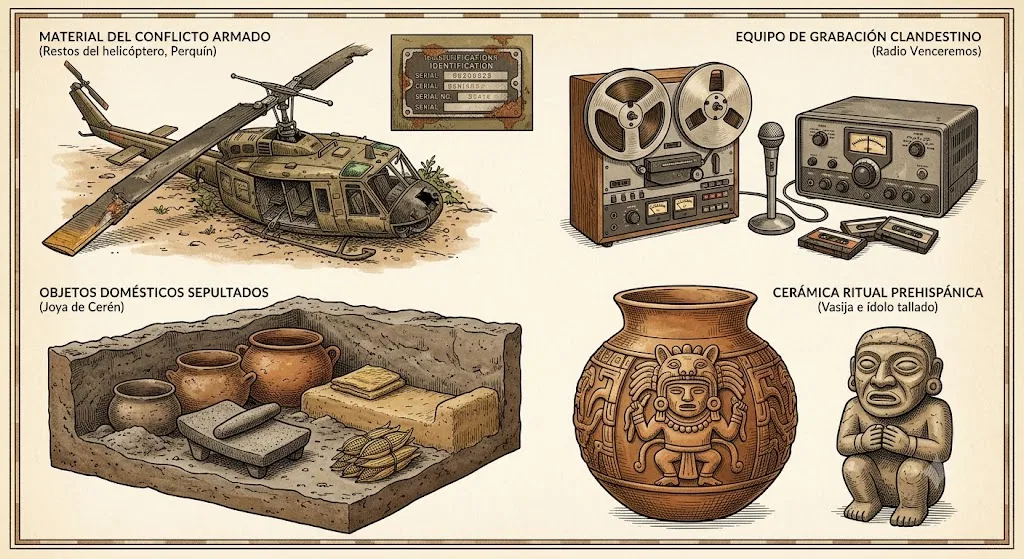
Among its most memorable objects are remains associated with the helicopter crash that killed Lieutenant Colonel Domingo Monterrosa in 1984. Monterrosa commanded the Atlacatl Battalion, the unit identified by United Nations investigators as responsible for the 1981 massacre at El Mozote. The museum’s display therefore carries several layers of meaning at once: wreckage, revolutionary trophy, evidence of a military episode and an object linked to one of the civil war’s most notorious atrocities.[AccessTravel]accesstravel.comNearby, another site has hand-dugMuseum of the Revolution San Salvador | History - AccessTravelit also housed the influential Radio Venceremos, which helped t…
The collection also connects with Radio Venceremos, the clandestine guerrilla broadcaster founded during the conflict. Radios, recording equipment, testimonies and related archives matter because the war was fought through information as well as weapons. Broadcasting from difficult terrain, the station transmitted news, propaganda, satire and reports that challenged government accounts.[Wikipedia]WikipediaRadio VenceremosJuly 26, 2006 — Radio Venceremos was an 'underground' radio network of the anti-government Farabundo Martí National Liberation Front (FML…
Visitors should not mistake the museum for a comprehensive or politically detached account of the war. Its value lies precisely in its viewpoint: it preserves a local revolutionary memory that might otherwise have disappeared. A fuller understanding requires comparison with the national military museum, human-rights documentation and the memorial landscape around El Mozote. Perquín is unusual because its relics remain close to the communities, hills and contested stories that gave them meaning.
An archive of voices, visions and uncomfortable memory
San Salvador’s Museum of the Word and Image is less visually macabre, but arguably stranger in its range. It operates as a museum, archive and cultural-memory organisation, preserving photographs, films, sound recordings, personal papers, artworks and testimonies connected with modern Salvadoran history. Its collections include material from the civil war, exile, social movements, indigenous history and major writers and artists.[museo.com.sv]museo.com.svOpen source on com.sv.
The museum emerged from an effort to recover audiovisual records created during the armed conflict, including material connected with Radio Venceremos. This gives it the character of a rescued counter-archive: voices and images produced outside official institutions have been gathered, catalogued and returned to public view. Rather than presenting history solely through state documents, it treats recordings, domestic objects, embroidered memories and personal testimony as evidence.
Its archive of Salvador Salazar Arrué, usually known as Salarrué, is particularly relevant to the country’s curiosity culture. Salarrué was a writer and painter whose work moved between rural observation, mythology, spiritual speculation and invented worlds. The museum preserves both his literary papers and visual art, allowing visitors and researchers to encounter a more esoteric side of Salvadoran modernism than his best-known village stories might suggest.[museomarte.org]museomarte.orgOpen source on museomarte.org.
Recent exhibitions drawn from this collection have explored his artistic and spiritual imagination and displayed works not previously familiar to the wider public. A 2026 exhibition organised with the Cultural Centre of Spain presented paintings and intimate material intended to deepen understanding of his visual thought and spirituality.[El Salvador News]elsalvador.comEl Salvador News“Salarrué. El viaje eterno”: revela la faceta más íntimaEl Salvador News“Salarrué. El viaje eterno”: revela la faceta más íntima
The museum also uses ordinary handmade objects to communicate extraordinary experiences. Its exhibition on women from Chalatenango, for example, combined more than 30 embroideries with documentary photographs and objects connected with exile and return. Such displays blur the boundary between archive, folk art and testimony: decorative cloth becomes a map of displacement, violence and survival.[museo.com.sv]museo.com.svOpen source on com.sv.
This is a professionally curated public institution rather than an eccentric private hoard. Its strangeness comes from the survival of fragile evidence: voices broadcast from hiding, artworks shaped by mystical ideas, family collections and objects whose importance depends on the stories attached to them.

The village stopped by a volcano
Joya de Cerén is often compared with Pompeii because volcanic ash preserved a settlement, but the comparison can obscure what makes the Salvadoran site so distinctive. It was not an elite city of monuments and statues. It was a farming community whose buildings, tools, stored food and domestic spaces were abruptly buried after a volcanic eruption in about the seventh century.
That ordinariness is the source of its uncanny power. Archaeological museums often present isolated ceremonial objects removed from their original surroundings. At Joya de Cerén, the visitor encounters households, kitchens, storage areas, cultivated plants and working spaces in relation to one another. The site preserves patterns of daily life that are normally lost because common buildings and organic materials decay.
The preserved settlement is a UNESCO World Heritage Site, recognised for providing exceptional evidence of everyday life in a pre-Hispanic Mesoamerican farming community. Excavations revealed domestic and communal structures beneath several metres of volcanic material, while the absence of discovered human remains has encouraged the interpretation that residents escaped before the settlement was engulfed. The precise experiences of individual inhabitants, however, cannot be reconstructed with certainty.
Joya de Cerén is not a museum of supernatural objects, yet it belongs in an account of El Salvador’s unusual collections because the entire place functions like an archaeological time capsule. Its most affecting exhibits are not treasures but traces of interrupted routine. A vessel, sleeping platform or stored crop becomes memorable because it appears to have been left only moments before disaster.
Visitors should distinguish the site’s evidence from the dramatic language sometimes used to market it. Archaeologists can infer how buildings were used and how food was produced, but they cannot identify every ritual, intention or event that preceded the eruption. The strength of Joya de Cerén lies in unusually rich material context, not in mystery for its own sake.
Ritual objects without an occult museum
The National Museum of Anthropology in San Salvador provides the main institutional setting for archaeological and ethnographic objects associated with ancient religion, death, authority and supernatural belief. It is a broad national museum rather than a museum of magic, but its collections can include ceramic figures, funerary material, carved objects and vessels whose imagery reflects transformed beings, ancestors, deities and ritual practices.
Such objects need careful interpretation. Colonial writers frequently described indigenous healing, divination and political ritual using European categories such as witchcraft or sorcery. Modern scholarship treats these labels cautiously because spiritual authority, medicine, rulership and relations with ancestors were not necessarily separate fields in pre-Hispanic Central American societies. A Smithsonian educational study of ancestral Central America notes that illness could be understood through moral or supernatural causes and that knowledge Europeans called magical might be exercised by healers as well as powerful rulers.[Smithsonian Learning Lab]learninglab.si.eduSmithsonian Learning Lab Revealing Ancestral Central AmericaSmithsonian Learning Lab Revealing Ancestral Central America
This matters when viewing unusual archaeological objects. A distorted face, animal-human figure or vessel associated with burial is not automatically evidence of an occult cult. It may represent a deity, ritual costume, ancestor, altered state, protective being or political identity. Museum labels and archaeological context are generally more reliable than modern supernatural speculation.
The same caution applies to supposed anomalies. El Salvador’s collections are sometimes discussed online through broad claims about mysterious Maya technology or unexplained artefacts. Established museums instead interpret objects through excavation records, comparative archaeology and conservation research. The mystery is often genuine in the limited sense that an object’s exact use remains unknown; it does not follow that conventional archaeological explanations have failed.
Izalco’s witches: folklore rather than a fixed collection
Izalco is widely presented in popular travel culture as El Salvador’s “town of witches”. Stories associate the area with healers, sorcerers, weather workers, shape-shifting women and supernatural beings linked to water, caves and the volcano. These traditions form part of a much wider Salvadoran folklore that includes spectral women, enchanted places, protective or monstrous dogs, dwarfish tricksters and strange hybrid creatures.[mythfolks.com]mythfolks.comsalvadoran folkloresalvadoran folklore
There is, however, little strong evidence for a permanent, professionally documented witchcraft museum in Izalco. Online descriptions often repeat one another, mix recent tourism storytelling with older oral tradition, or present legends as straightforward historical fact. Visitors expecting an organised occult collection comparable with specialist witchcraft museums in Europe are likely to be disappointed.
Izalco is better approached as a folklore landscape. Its reputation is attached to local identity, indigenous history, religious brotherhoods, volcanic geography and stories told about particular people and places. The town was also one of the centres of the 1932 indigenous and peasant uprising and subsequent state massacre, an event that devastated local communities and encouraged many indigenous people to conceal language, clothing and practices. Any treatment of Izalco as merely a picturesque “witch town” risks turning a complicated history into tourist decoration.[Wikipedia]WikipediaOpen source on wikipedia.org.
One of the region’s distinctive legendary beings is the Cuyancúa, described in oral tradition as a huge creature combining serpentine and pig-like features and associated with rivers, underground noises and the coming of rain. Accounts collected from Izalco connect it with control of water and rainfall.[Wikipedia]WikipediaOpen source on wikipedia.org.
This is precisely the kind of folklore that would suit a carefully researched local museum, but the story currently survives more clearly through oral accounts, books, public sculpture and popular retellings than through a single authoritative collection. The absence of a major museum is itself revealing: El Salvador’s supernatural heritage often remains embedded in communities and landscapes rather than separated into glass cases.
Folklore in public space
Atecozol, a recreational park near Izalco, offers one of the more tangible ways to encounter Salvadoran legendary figures. The grounds are known for sculptures by Valentín Estrada representing myths and characters from national folklore. Although the site is primarily a leisure attraction rather than a museum, the sculptures turn shared stories into an outdoor visual collection.[Wikipedia]WikipediaOpen source on wikipedia.org.
This type of display is important in a country where folklore museums are limited. Legendary beings appear in parks, festival imagery, children’s culture, murals, handicrafts and roadside attractions. The result is a dispersed popular museum: no single institution owns the complete narrative, but recognisable figures recur across public life.
The interpretation is usually accessible and theatrical rather than academic. Sculptures may establish what a creature is supposed to look like even when oral versions disagree. They can also make frightening beings suitable for family tourism. That process preserves folklore while changing it, turning warnings once told at night into colourful characters photographed during a day out.
Weapons, aircraft and the state’s version of war
The Military Museum of the Armed Forces occupies the former El Zapote barracks in San Salvador. The site became a museum in 1993, immediately after the civil war era, and remains controlled by the Ministry of National Defence. Its setting and ownership distinguish it sharply from the community-founded revolutionary museum in Perquín.[El Salvador Travel]elsalvador.travelOpen source on elsalvador.travel.
The displays include weapons, documents, uniforms, military vehicles and aircraft. Outdoor exhibits reportedly feature tanks and helicopters, while the museum’s broader purpose is to present national history through the institutional viewpoint of the armed forces.[Kupi]kupi.comOpen source on kupi.com.
For enthusiasts of unusual collections, the appeal lies in the physical scale of the objects and in the conversion of a working barracks into a heritage site. Military machines that were once instruments of state power become static exhibits, photographed by families and tourists. A large relief map and collections of decommissioned equipment make the museum part archive, part arsenal and part patriotic display.
Its interpretation should be read critically. Military museums often emphasise organisational history, leaders, campaigns and technical equipment, while giving less attention to civilian experience or institutional abuses. In El Salvador, where the armed forces were implicated in massacres and other serious human-rights violations during the civil war, the contrast with Perquín is especially instructive. Visiting both reveals not merely different objects but competing systems for organising national memory.
What counts as an unusual museum in El Salvador?
El Salvador’s curiosity culture is shaped less by private collectors of monsters or medical specimens than by the preservation of disputed history. Its most unusual displays repeatedly cross the boundary between evidence and memory:
- The Museum of the Salvadoran Revolution is community-rooted, political and openly interpretive. Its aircraft fragments, weapons and clandestine broadcasting material are authentic conflict relics, but they are arranged within a revolutionary narrative.
- The Museum of the Word and Image is an archival institution whose oddities are fragile voices, rescued films, mystical artworks and personal objects that official history might have ignored.
- Joya de Cerén is an archaeological site where the collection is effectively an entire interrupted settlement rather than a room of detached treasures.
- The national anthropology collections provide the best context for ritual and funerary objects, although they should not be mislabelled as evidence of witchcraft.
- Izalco and Atecozol preserve supernatural culture through place, sculpture and storytelling rather than through a dedicated occult museum.
- The military museum at El Zapote presents large-scale machines and state memory inside a former military compound.
This mixture makes El Salvador rewarding for visitors prepared to look beyond the conventional idea of a strange museum. The country’s most haunting objects are often politically charged or deceptively ordinary: a damaged radio, an embroidered memory of exile, a helicopter fragment or a household vessel left beneath ash.
Credibility and visiting expectations
Information about smaller Salvadoran museums and heritage displays can be fragmented, and opening arrangements may change. Official institutional pages are the best starting point, but even these may announce temporary exhibitions more consistently than permanent visiting details. The Museum of the Word and Image continues to organise public exhibitions and archival projects, while the Museum of the Salvadoran Revolution maintains its own institutional presence online.[museo.com.sv]museo.com.svOpen source on com.sv.
A sensible credibility test is to ask what kind of claim is being made. A museum can reliably display an artefact’s documented provenance or an interviewee’s recorded testimony. It cannot prove that a legendary creature exists or that every story told about an object is historically accurate. In folklore settings, the belief and its social history are the evidence; the supernatural event remains a matter of tradition.
The country’s war museums require a similar distinction. Aircraft wreckage and weapons may be materially authentic, while the story constructed around them reflects the institution’s political position. Comparing collections is therefore more revealing than looking for a supposedly neutral display. Perquín, El Zapote, the Museum of the Word and Image and the memorial sites of Morazán preserve different fragments of the same violent past.
Why these collections matter
El Salvador’s unusual museums show how a small country with a history of colonial disruption, volcanic disaster, political violence and cultural suppression decides what can be saved. Institutions have collected material that was once dangerous to possess, too ordinary to value or too politically awkward for official narratives.
They also demonstrate that “strange” heritage does not have to mean fabricated monsters or sensational curiosities. A clandestine transmitter can be stranger than a staged ghost exhibit because it once spoke to listeners from a hidden wartime location. A buried kitchen can be more affecting than royal treasure because volcanic ash preserved the pattern of a meal and the shape of a household. An embroidery can function simultaneously as art, map, testimony and memorial.
El Salvador’s curiosity landscape is therefore dispersed but coherent. Its central themes are interrupted lives, contested memory and the uneasy transformation of trauma, belief and everyday objects into public heritage.

Amazon book picks
Further Reading
Books and field guides related to Where El Salvador Keeps Its Strangest History. Use these as the next step if you want deeper reading beyond the article.
Silencing the Past
Rating: 4.5/5 from 5 Google Books ratings
Silencing the Past is a thought-provoking analysis of historical narrative. Taking examples ranging from the Haitian Revolution to Columb...
The Massacre at El Mozote
The story of the 1989 massacre of civilians in El Salvadore by US-trained soldiers.
Salvador
El Salvador, 1982, is the height of a ghastly civil war. The author travels from battlefields to body dumps, interviews a puppet presiden...
eBay marketplace picks
Marketplace Samples
Live-tested eBay searches with available results related to this page.
Selected fromLatin American art print oneBay.co.uk.

Endnotes
1.
Source: accesstravel.com
Title: Nearby, another site has hand-dug
Link:https://www.accesstravel.com/en-US/viatorattraction/index/5585/24134
Source snippet
Museum of the Revolution San Salvador | History - AccessTravelit also housed the influential Radio Venceremos, which helped t...
2.
Source: Wikipedia
Title: Radio Venceremos
Link:https://en.wikipedia.org/wiki/Radio_Venceremos
Source snippet
July 26, 2006 — Radio Venceremos was an 'underground' radio network of the anti-government Farabundo Martí National Liberation Front (FML...
Published: July 26, 2006
3.
Source: museo.com.sv
Link:https://museo.com.sv/
4.
Source: museomarte.org
Link:https://museomarte.org/exposiciones/salarrue/
5.
Source: mythfolks.com
Title: salvadoran folklore
Link:https://www.mythfolks.com/salvadoran-folklore
6.
Source: Wikipedia
Title: Salvadoran folklore
Link:https://en.wikipedia.org/wiki/Salvadoran_folklore
7.
Source: Wikipedia
Link:https://en.wikipedia.org/wiki/Izalco
8.
Source: Wikipedia
Link:https://es.wikipedia.org/wiki/Izalco
9.
Source: Wikipedia
Link:https://es.wikipedia.org/wiki/Cuyanc%C3%BAa
10.
Source: Wikipedia
Title: Military Museum of the Armed Forces of El Salvador
Link:https://en.wikipedia.org/wiki/Military_Museum_of_the_Armed_Forces_of_El_Salvador
11.
Source: kupi.com
Link:https://www.kupi.com/en/explore/el-salvador/san-salvador/military-museum-of-the-armed-forces-of-el-salvador
12.
Source: tripadvisor.com
Title: Museo Nacional de Antropología
Link:https://www.tripadvisor.com/Attraction_Review-g294476-d3703533-Reviews-Museo_Nacional_de_Antropologia-San_Salvador_San_Salvador_Department.html
13.
Source: Wikipedia
Title: Timeless Stories of El Salvador
Link:https://en.wikipedia.org/wiki/Timeless_Stories_of_El_Salvador
14.
Source: museo.com.sv
Link:https://museo.com.sv/exposiciones-new/
15.
Source: youtube.com
Title: Joya de Cerén: The Pompeii of the Americas | El Salvador
Link:https://www.youtube.com/watch?v=IMdg0b-zL3c
Source snippet
Joya De Cerén...
16.
Source: youtube.com
Title: Joya De Cerén
Link:https://www.youtube.com/watch?v=gOZn9d4QxvA
Source snippet
El Salvador: Perquin: Restoration of Former Rebel Stronghold...
17.
Source: museodelarevolucionsalvadorena.org
Link:https://museodelarevolucionsalvadorena.org/
Source snippet
Museo de la Revolución SalvadoreñaMuseo de la Revolución SalvadoreñaDesde el Museo tratamos de recopilar los valores de cada una de esas...
18.
Source: tripadvisor.co.uk
Link:https://www.tripadvisor.co.uk/Attraction_Review-g1092073-d1633443-Reviews-Museo_de_la_Revolucion_Salvadorena-Perquin_Morazan_Department.html
Source snippet
Museo de la Revolucion Salvadorena, PerquinThe museum is both indoor and outdoor, featuring actual weapons and equipment used...
19.
Source: elsalvador.com
Title: El Salvador News“Salarrué. El viaje eterno”: revela la faceta más íntima
Link:https://www.elsalvador.com/turismo/cultura-viva/-salarrue-el-viaje-eterno-exposicion-centro-cultural-espana-salvador-arte-artes-pinturas/1274081/2026/
20.
Source: learninglab.si.edu
Title: Smithsonian Learning Lab Revealing Ancestral Central America
Link:https://learninglab.si.edu/cabinet/file/c34fb997-feb7-4ff6-bf8a-caa53023424d/Revealing_Ancestral_Central_America.pdf
21.
Source: elsalvador.travel
Link:https://elsalvador.travel/article/museo-de-historia-militar-referente-social-y-cultural-en-san-salvador/en/
22.
Source: facebook.com
Title: Museo de la
Link:https://www.facebook.com/MuseodelaPalabraylaImagen/photos/1409980584505296/
23.
Source: tripadvisor.co.uk
Title: Attractions g294475 Activities c49 El Salvador
Link:https://www.tripadvisor.co.uk/Attractions-g294475-Activities-c49-El_Salvador.html
24.
Source: instagram.com
Link:https://www.instagram.com/explore/locations/645020485886339/museo-de-la-revolucion-salvadorena-perquin-morazan/
25.
Source: flickr.com
Link:https://www.flickr.com/photos/alexseander/16052799919
Additional References
26.
Source: cultura.gob.sv
Title: Ministerio de Cultura Revista identidades 19-Digital_c
Link:https://www.cultura.gob.sv/wp-content/uploads/2025/02/Revista-identidades-19-Digital_c.pdf
Source snippet
Sur, n.o 430, San Salvador Teléfono: 2222-0665. Museo Regional de Arqueología. Colección Salvador Salazar Arrué, Museo de la Palabra … de...
27.
Source: atlasobscura.com
Title: museo de la revolucion salvadorena
Link:https://www.atlasobscura.com/places/museo-de-la-revolucion-salvadorena
Source snippet
Atlas ObscuraMuseo de la Revolución Salvadoreña (Museum of the...12 Jul 2019 — Museo de la Revolución Salvadoreña, also known as the Mus...
28.
Source: youtube.com
Title: El Salvador’s Silent Strength — The Museum That Refuses to Forget
Link:https://www.youtube.com/watch?v=Vtt2i9jL3x0
Source snippet
Massacre in El Salvador (full documentary) | FRONTLINE...
29.
Source: youtube.com
Title: Massacre in El Salvador (full documentary) | FRONTLINE
Link:https://www.youtube.com/watch?v=03XyXFHCMQM
Source snippet
Joya de Cerén: The Pompeii of the Americas | El Salvador...
30.
Source: academia.edu
Link:https://www.academia.edu/4210425/Revealing_Ancestral_Central_America
31.
Source: atlasobscura.com
Link:https://www.atlasobscura.com/things-to-do/el-salvador/museums
32.
Source: atlasobscura.com
Link:https://www.atlasobscura.com/things-to-do/el-salvador
33.
Source: facebook.com
Link:https://www.facebook.com/CantorArts/posts/a-little-under-one-month-to-see-the-bewitching-exhibition-cunning-folk-before-it/1479854540806308/
34.
Source: facebook.com
Link:https://www.facebook.com/KOMONews/videos/ancient-artifacts-dating-back-to-100-ad-found-in-seattle-to-be-returned/1229109308466956/
35.
Source: britishmuseum.org
Link:https://www.britishmuseum.org/collection/term/x56062