Where Central Africa Keeps Its Strangest Treasures
The Central African Republic does not have a well-developed circuit of strange museums, occult attractions or commercial cabinets of curiosity.
Page outline Jump by section
Introduction
For readers interested in uncanny heritage, the country’s strongest material lies at the meeting point of belief, music, archaeology and survival. Ceremonial objects cannot responsibly be reduced to “witchcraft curios”, while ancient standing stones and rock engravings remain archaeological sites rather than mystery attractions. The unusual character of Central African collecting therefore comes not from theatrical presentation, but from fragmentary evidence, disputed interpretation and the struggle to preserve objects through war and neglect.
The national museum is the essential starting point
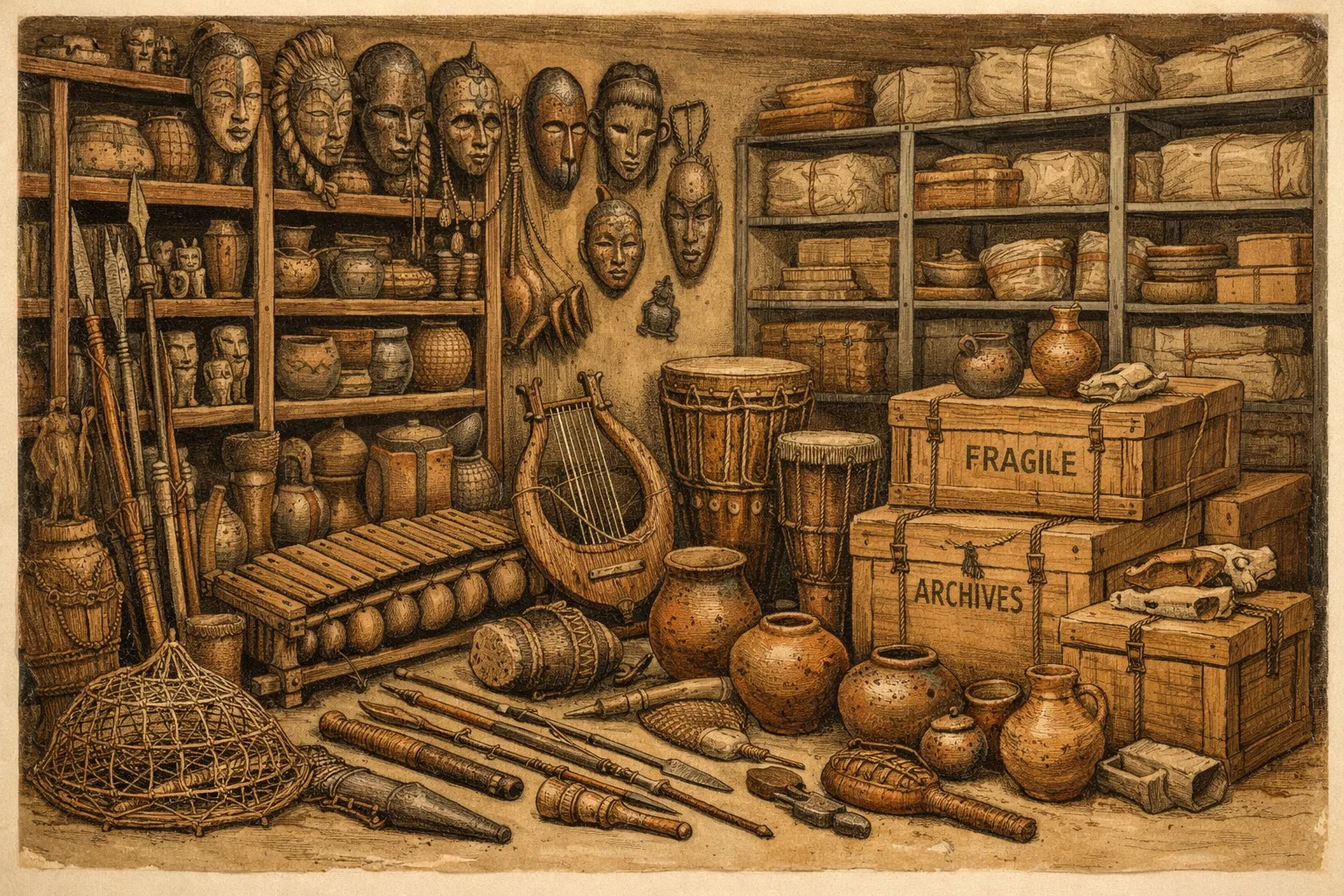
The Barthélémy Boganda National Museum was established in Bangui during the 1960s and named after the independence leader Barthélémy Boganda. An early account describes a modest institution occupying several rooms of a small two-storey building, rather than a grand purpose-built museum. Its mission was unusually broad: to gather material from across the country and represent archaeology, history, artistic production, everyday technology and cultural traditions within one national collection.[Taylor & Francis Online]tandfonline.comj.1468 0033.1969.tb01729.xTaylor & Francis OnlineThe creation of the Barthélemy Boganda Museum, Banguiby G Dournon‐taurelle · 1969 — These premises consisted of th…
The museum’s holdings have been reported to include pottery, coins, masks, musical instruments, weapons, hunting tools, religious objects and material relating to forest communities, alongside archaeological and natural-history specimens. Older descriptions suggest that objects were collected from all of the country’s administrative regions. This makes the museum less a specialist collection of oddities than a national cabinet in which ritual, domestic, musical and scientific objects were historically placed side by side.[Wikipedia]WikipediaBoganda National MuseumBoganda National Museum
That mixture is precisely what may appeal to a curiosity-minded visitor. A carved instrument can be sculpture, a tool and part of a ceremony at the same time. A hunting implement may embody specialist ecological knowledge as well as practical engineering. A mask or protective object may have had a social or spiritual role that disappears when it is presented merely as an eerie artefact. The museum’s value lies in preserving these connections, although the surviving public information does not provide a reliable room-by-room catalogue.
Why access remains uncertain
The national museum was seriously affected by looting and damage during the civil war that began in 2013. The International Alliance for the Protection of Heritage in Conflict Areas, known as ALIPH, says that the remaining archaeological, historical and artistic collections were subsequently kept in unsuitable storage conditions, leaving them vulnerable to further deterioration.[Aliph Foundation]aliph-foundation.orgprotecting heritage at the barthelemy boganda museumAliph FoundationProtecting Heritage at the Barthélémy Boganda MuseumSeverely affected by looting and damage during the 2013 civil war, it…
The public-access story is complicated. The museum held an open day in May 2022 and reportedly displayed more than 3,000 historical objects while rehabilitation was continuing. That event shows that limited public presentation has been possible, but it does not establish regular opening hours or a dependable visitor service. Later heritage listings continued to describe the museum as closed to the public.[Radio Ndeke Luka]radiondekeluka.orgRadio Ndeke Luka Centrafrique: le Musée Barthélémy Boganda rouvre sesRadio Ndeke LukaCentrafrique: le Musée Barthélémy Boganda rouvre ses…May 21, 2022 — 21 May 2022 — a exposé plus de 3.000 objets histo…
A striking development came in 2024, when roughly ten crates containing about a thousand objects were brought back into view after having been concealed inside the museum during the worst of the crisis. Reports said that hiding the crates had protected their contents while other parts of the institution were looted. The episode gives the museum an unusual recent history: its “hidden collection” was not a promotional secret room but an emergency survival measure.[allAfrica.fr]fr.allafrica.comall Africa.fr Des caisses du musée Barthélémy Boganda retrouvent laall Africa.fr Des caisses du musée Barthélémy Boganda retrouvent la
In 2025, the African Heritage School began professional work to clean, stabilise, document and rehouse the collections, with support involving ALIPH and UNESCO’s regional office. The programme included moving objects out of degraded storage, installing suitable shelving and training museum personnel. This is strong evidence of active conservation, but not confirmation that the museum has returned to normal daily operation.[aliph-foundation.org]aliph-foundation.orgOpen source on aliph-foundation.org.
For practical purposes, travellers should treat the museum as an institution under recovery rather than a guaranteed walk-in attraction. Online travel listings are inconsistent and sometimes label it permanently closed, while dated reports describe exceptional openings. Direct local verification is therefore essential.[Tripadvisor]tripadvisor.co.ukTripadvisor MUSÉE DE BOGANDA (BOGANDA MUSEUMTripadvisor MUSÉE DE BOGANDA (BOGANDA MUSEUM
Ritual objects without the “witchcraft museum” label
There is no well-documented public museum of witchcraft or magic in the Central African Republic. The national museum’s references to religious objects and masks should not be taken as evidence of a themed occult collection. Such material is more accurately understood within local systems of healing, protection, initiation, authority, performance and relations with ancestors or spirits.
This distinction matters because objects from African societies have often been detached from their original names and uses and marketed abroad as “fetishes”, “spirit traps” or “tribal magic”. Those labels can make an object sound sensational while concealing uncertainty about who made it, whether it was ever used ceremonially, and how it left its community. Even specialist museums outside Africa sometimes retain vaguely identified objects that were once grouped into generic displays of “African magic”.[Museum of Witchcraft and Magic]museumofwitchcraftandmagic.co.ukspirit trap demon trapspirit trap demon trap
At the Boganda museum, the most credible interpretation would therefore depend on documentation: the object’s community of origin, material, collector, date, local name and recorded purpose. The conservation work begun in 2025 is important partly because cleaning and cataloguing can recover these associations. Without them, a ritual object risks becoming merely a mysterious-looking thing in a box.
Visitors seeking tales of curses, sorcery or supernatural powers should be cautious. Beliefs concerning harmful magic and spiritual protection are socially real and historically important, but museum objects do not prove supernatural claims. The meaningful question is not whether an artefact is “genuinely magical”, but how people understood it, who was authorised to use it and how museum classification changed its meaning.
Musical instruments as sculptural curiosities
One of the richest routes into the country’s unusual material culture is music. Historical descriptions of the national museum mention musical instruments, while older research on Central African collections identifies carved harps and wooden drums as especially important examples of sculpture as well as sound-producing technology.[Tripadvisor]tripadvisor.comOpen source on tripadvisor.com.
This double identity makes such objects ideal curiosity pieces. A harp may carry a carved human head or abstract form, yet its significance cannot be understood from appearance alone. Its sound, player, repertoire and ceremonial setting are part of the object. Collections that preserve only the instrument risk turning a living practice into silent decorative art.
The country’s musical heritage is particularly associated with the complex polyphonic singing of the Aka forest communities in the south-west. UNESCO describes this tradition as a form of interlocking four-part singing learned across the community and used in hunting, funeral and camp ceremonies. Performances may include drums, a harp-like instrument and a single-string musical bow.[ICH UNESCO]ich.unesco.orgICH UNESCOPolyphonic singing of the Aka Pygmies of Central AfricaICH UNESCOPolyphonic singing of the Aka Pygmies of Central Africa
Historical sound archives reveal a direct connection with the national museum. Recordings of forest-community music made in 1965 were gathered during research organised by the museum’s department concerned with folk art and tradition. The surviving collection is now held in a French research sound archive.[archives.crem-cnrs.fr]archives.crem-cnrs.frOpen source on crem-cnrs.fr.
This creates a dispersed museum experience. Physical instruments may remain in Bangui or in foreign ethnographic collections, while recorded performances and research notes are preserved overseas. For the modern reader, the most complete “collection” is therefore not contained within one building. It must be reconstructed across objects, recordings and community knowledge.
Bouar’s standing stones are the country’s great archaeological curiosity
Around Bouar in the west of the country are groups of upright stones commonly known in scholarship by a local expression meaning standing stones. They are among the Central African Republic’s most distinctive archaeological remains and have been placed on the country’s UNESCO World Heritage Tentative List. Some appear to be associated with burials, although the monuments vary and should not all be assigned a single purpose without further investigation.[UNESCO World Heritage Centre]whc.unesco.orgWorld Heritage Centre Les mégalithes de BouarWorld Heritage Centre Les mégalithes de Bouar
Their visual simplicity invites speculation. Rows or clusters of stones can easily be presented as an African Stonehenge, a lost civilisation or an astronomical mystery. The available archaeological framing is more restrained: the monuments belong to regional traditions of building with stone and are valuable evidence of communities whose history was not recorded in writing.
Research continues. A field mission reported in June 2026 examined the monuments and warned that, although many remain intact, the sites face threats. This recent work reinforces two points: the stones are a serious archaeological resource, and their interpretation is still developing.[congubangi.ugent.be]congubangi.ugent.beOpen source on ugent.be.
Bouar has also been associated in secondary references with a local museum, but dependable current visitor information and authoritative collection details are scarce. It should not be presented as a fully documented museum attraction without local confirmation. The megalithic landscape itself is better established than the status or contents of any nearby exhibition.
For strange-history travellers, the appeal lies in seeing monuments that resist easy explanation. Their credibility does not depend on legends of giants or vanished advanced cultures. The genuine mystery is archaeological: who erected particular groups, over what period, for which communities, and how burial, territory and commemoration may have overlapped.
Rock engravings and an abandoned railway
The country’s broader curiosity landscape includes heritage sites that function like open-air collections. At Lengo, near Bakouma, engravings have been recorded across a long rock surface. UNESCO’s Tentative List identifies the site as an important example of rock art while also placing it within the wider, still incompletely studied traditions of neighbouring parts of Africa.[UNESCO World Heritage Centre]whc.unesco.orgWorld Heritage Centre Les gravures rupestres de LengoWorld Heritage Centre Les gravures rupestres de Lengo
Rock engravings often attract confident claims about ancient maps, coded messages or extraterrestrial visitors. Nothing in the UNESCO documentation supports such interpretations at Lengo. The responsible fascination comes from the difficulty of dating and contextualising marks made by people whose symbolic systems may be only partly recoverable.
At Zinga are the remains of the only railway known to have operated within the territory of the present-day Central African Republic. The surviving track and equipment were placed on the UNESCO Tentative List as industrial heritage, although the listing also warned that deterioration had begun.[UNESCO World Heritage Centre]whc.unesco.orgWorld Heritage Centre Les vestiges du train de ZingaWorld Heritage Centre Les vestiges du train de Zinga
These remains form an accidental outdoor museum of colonial infrastructure. Rusting railway material in a forested or riverside setting may feel like an abandoned-world attraction, but it also records systems of transport, extraction and administration. Its value is historical rather than paranormal. There is no evidence of a formal, regularly interpreted visitor centre comparable to a railway museum.
Lengo and Zinga demonstrate why the country’s unusual heritage cannot be confined to display cases. Some of its most memorable “collections” are fixed in the landscape: engraved rock surfaces, standing stones and decaying industrial structures whose preservation is far less controlled than that of objects inside a museum.
Collections abroad and the problem of missing context
A considerable amount of Central African cultural material is held outside the country. European museums and research archives preserve musical instruments, recordings and ethnographic objects collected during colonial and post-colonial fieldwork. The Musée de l’Homme’s historical holdings, for example, became the subject of specialist research into instruments from the Central African Republic and the collectors who acquired them.[AfricaBib]africabib.orgOpen source on africabib.org.
Foreign collections can provide conservation facilities, digitised catalogues and scholarly access that are difficult to sustain in a conflict-affected national institution. They may also preserve the only accessible recording or specimen of a particular practice. Yet they create serious problems of distance and authority. An object may be well protected physically while remaining separated from the descendants of its makers and from people able to correct its catalogue description.
Provenance is especially important with ritual and curiosity material. Colonial collectors frequently classified objects according to European categories such as “religion”, “magic”, “weapon” or “primitive art”. Contemporary interpretation increasingly asks how an item was acquired, whether consent was meaningful and whether communities of origin should help decide its future.
The Central African Republic’s case is complicated by the fragile condition of its national museum. Arguments that objects cannot return because local facilities are weak can become self-reinforcing: collections remain abroad, while the institutions that might receive them struggle for investment. Conservation initiatives in Bangui therefore matter beyond the objects currently in storage. They strengthen the possibility of future research partnerships, loans, digital reunification and, where evidence supports it, restitution.
What visitors can realistically expect
The Central African Republic should not presently be approached as a conventional oddity-museum destination. Reliable opening information is limited, travel conditions may change rapidly, and many heritage places lack the visitor infrastructure, labels and conservation controls found at established tourist sites.
The most realistic expectations are:
- A recovering national collection: the Boganda museum contains the country’s most important concentration of archaeological, historical, artistic and ethnographic material, but regular public access should not be assumed.[Aliph Foundation]aliph-foundation.orgprotecting heritage at the barthelemy boganda museumAliph FoundationProtecting Heritage at the Barthélémy Boganda MuseumSeverely affected by looting and damage during the 2013 civil war, it…
- Objects whose meanings overlap: masks, instruments, hunting tools and religious items may be practical, artistic and ceremonial at once. Treating them simply as macabre or magical curiosities loses much of their significance.
- Archaeology in the landscape: Bouar’s standing stones and Lengo’s engravings offer genuine unanswered questions, but not evidence for sensational alternative histories.[UNESCO World Heritage Centre]whc.unesco.orgWorld Heritage Centre Les mégalithes de BouarWorld Heritage Centre Les mégalithes de Bouar
- Fragile industrial remains: the abandoned Zinga railway is an unusual colonial-era survival rather than a developed railway attraction.[UNESCO World Heritage Centre]whc.unesco.orgWorld Heritage Centre Les vestiges du train de ZingaWorld Heritage Centre Les vestiges du train de Zinga
- Fragmented documentation: some of the best supporting material is found in overseas sound archives, museum databases and research publications rather than at the original sites.[archives.crem-cnrs.fr]archives.crem-cnrs.frOpen source on crem-cnrs.fr.
Why this small museum landscape matters
The Central African Republic’s curiosity culture is compelling precisely because it has not been packaged into a polished trail of supernatural attractions. Its unusual heritage survives in a national museum recovering from looting, in crates hidden during conflict, in silent instruments separated from their recorded music, and in archaeological monuments whose builders left no written explanation.
The Barthélémy Boganda National Museum is central to that story. It is simultaneously a historical house, an ethnographic collection, an archaeological repository and evidence of the risks faced by cultural institutions during war. The discovery of protected crates and the recent work to document their contents turn conservation itself into part of the museum’s history.[allAfrica.fr]fr.allafrica.comall Africa.fr Des caisses du musée Barthélémy Boganda retrouvent laall Africa.fr Des caisses du musée Barthélémy Boganda retrouvent la
The country’s strangest collections are therefore not strange because they confirm monsters, curses or ancient conspiracies. They are strange because their meanings have been disrupted: objects separated from performances, sites detached from oral histories, and collections forced into hiding. Understanding them requires curiosity without sensationalism and an acceptance that, in this case, preservation and interpretation remain unfinished work.
Amazon book picks
Further Reading
Books and field guides related to Where Central Africa Keeps Its Strangest Treasures. Use these as the next step if you want deeper reading beyond the article.
The Scramble For Africa
In 1880 the continent of Africa was largely unexplored by Europeans. Less than thirty years later, only Liberia and Ethiopia remained unc...
The Birth of the Museum: History, Theory, Politics
In a series of richly detailed case studies from Britian, Australia and North America, Tony Bennett investigates how nineteenth- and twen...
eBay marketplace picks
Marketplace Samples
Live-tested eBay searches with available results related to this page.
Selected fromafrican mask decor oneBay.co.uk.

Endnotes
1.
Source: aliph-foundation.org
Title: protecting heritage at the barthelemy boganda museum
Link:https://www.aliph-foundation.org/en/projects/protecting-heritage-at-the-barthelemy-boganda-museum
Source snippet
Aliph FoundationProtecting Heritage at the Barthélémy Boganda MuseumSeverely affected by looting and damage during the 2013 civil war, it...
2.
Source: epa-prema.net
Link:https://www.epa-prema.net/chantier-professionnel-des-collections-au-musee-national-barthelemy-boganda-republique-centrafricaine/
Source snippet
Ecole du Patrimoine Africain – EPAChantier professionnel des collections au Musée national...14 Nov 2025 — Depuis le 10 novembre 2025, l...
3.
Source: Wikipedia
Title: Boganda National Museum
Link:https://en.wikipedia.org/wiki/Boganda_National_Museum
4.
Source: fr.allafrica.com
Title: all Africa.fr Des caisses du musée Barthélémy Boganda retrouvent la
Link:https://fr.allafrica.com/stories/202406070560.html
5.
Source: aliph-foundation.org
Link:https://www.aliph-foundation.org/fr/nos-actions/protecting-heritage-at-the-barthelemy-boganda-museum
6.
Source: tripadvisor.com
Link:https://www.tripadvisor.com/Attraction_Review-g293777-d480357-Reviews-Musee_de_Boganda_Boganda_Museum-Bangui.html
7.
Source: africabib.org
Link:https://www.africabib.org/rec.php?RID=120919494
8.
Source: ich.unesco.org
Title: ICH UNESCOPolyphonic singing of the Aka Pygmies of Central Africa
Link:https://ich.unesco.org/en/RL/polyphonic-singing-of-the-aka-pygmies-of-central-africa-00082?RL=00082
9.
Source: archives.crem-cnrs.fr
Link:https://archives.crem-cnrs.fr/archives/collections/CNRSMH_E_1968_001_001/
10.
Source: whc.unesco.org
Title: World Heritage Centre Les mégalithes de Bouar
Link:https://whc.unesco.org/en/tentativelists/4003/
11.
Source: africabib.org
Link:https://www.africabib.org/rec.php?RID=153590009
12.
Source: congubangi.ugent.be
Link:https://www.congubangi.ugent.be/2026/06/12/archaeological-fieldwork-of-the-bouar-megaliths-central-african-republic/
13.
Source: whc.unesco.org
Title: World Heritage Centre Les gravures rupestres de Lengo
Link:https://whc.unesco.org/en/tentativelists/4006/
14.
Source: whc.unesco.org
Title: World Heritage Centre Les vestiges du train de Zinga
Link:https://whc.unesco.org/en/tentativelists/4007/
15.
Source: Wikipedia
Link:https://en.wikipedia.org/wiki/History_of_rail_transport_in_the_Central_African_Republic
16.
Source: unesco.org
Link:https://www.unesco.org/en/node/66282?hub=417
17.
Source: archives.crem-cnrs.fr
Title: fr Item: Asaka, Version 2
Link:https://archives.crem-cnrs.fr/archives/items/CNRSMH_E_1994_010_001_008/
18.
Source: unesco.org
Title: On official visit to the Central African Republic, Director-General
Link:https://www.unesco.org/en/articles/official-visit-central-african-republic-director-general-irina-bokova-promotes-safeguarding-cultural
19.
Source: unesco.org
Title: The Director-General of UNESCO Expresses Deep Concern at the Rising
Link:https://www.unesco.org/en/articles/director-general-unesco-expresses-deep-concern-rising-violence-central-african-republic-heart-sangha
20.
Source: ich.unesco.org
Title: central african republic CF
Link:https://ich.unesco.org/en/state/central-african-republic-CF
21.
Source: whc.unesco.org
Link:https://whc.unesco.org/fr/listesindicatives/4003/
22.
Source: whc.unesco.org
Link:https://whc.unesco.org/en/tentativelists/action%3Dlisttentative%26order%3Dstates%26state%3Dcf
23.
Source: whc.unesco.org
Link:https://whc.unesco.org/en/tentativelists/4011/
24.
Source: whc.unesco.org
Link:https://whc.unesco.org/fr/listesindicatives/4007/
25.
Source: whc.unesco.org
Link:https://whc.unesco.org/en/statesparties/cf
26.
Source: unesdoc.unesco.org
Link:https://unesdoc.unesco.org/ark%3A/48223/pf0000022327
27.
Source: unesdoc.unesco.org
Link:https://unesdoc.unesco.org/ark%3A/48223/pf0000011728
29.
Source: whc.unesco.org
Link:https://whc.unesco.org/en/statesparties/cf/Laws
30.
Source: whc.unesco.org
Link:https://whc.unesco.org/en/statesparties/cf/documents/
31.
Source: unesco.org
Title: UNESC O Heritage Emergency Fund
Link:https://www.unesco.org/en/culture-emergencies/heritage-emergency-fund/grid?fq%5Bsm_unsc_field_ref_regions_label%5D%5B0%5D=Africa&hub=195868&op=Search&query=&sort=sort_country_desc
32.
Source: whc.unesco.org
Link:https://whc.unesco.org/fr/etatsparties/cf
33.
Source: unesco.org
Title: UNESC O Heritage Emergency Fund
Link:https://www.unesco.org/en/culture-emergencies/heritage-emergency-fund/grid?hub=195868&sort=sort_country_desc
34.
Source: ich.unesco.org
Title: central african republic CF
Link:https://ich.unesco.org/en/state/central-african-republic-CF?cp=CF&info=projects&topic=en-state
35.
Source: whc.unesco.org
Link:https://whc.unesco.org/en/list/475/gallery/
36.
Source: unesdoc.unesco.org
Link:https://unesdoc.unesco.org/ark%3A/48223/pf0000133487
37.
Source: whc.unesco.org
Link:https://whc.unesco.org/en/list/1380/
38.
Source: unesco.org
Link:https://www.unesco.org/fr/countries/cf
39.
Source: Wikipedia
Title: Central London
Link:https://en.wikipedia.org/wiki/Central_London
40.
Source: Wikipedia
Title: Musée national Barthélemy Boganda
Link:https://fr.wikipedia.org/wiki/Mus%C3%A9e_national_Barth%C3%A9lemy-Boganda
41.
Source: Wikipedia
Title: Royal Museum for Central Africa
Link:https://en.wikipedia.org/wiki/Royal_Museum_for_Central_Africa
42.
Source: Wikipedia
Link:https://en.wikipedia.org/wiki/2025
43.
Source: Wikipedia
Title: Project 2025
Link:https://en.wikipedia.org/wiki/Project_2025
44.
Source: archives.crem-cnrs.fr
Title: fr Item: Asaka, Version 1
Link:https://archives.crem-cnrs.fr/archives/items/CNRSMH_E_1994_010_001_007/
45.
Source: africa.com
Title: museums of central african republic
Link:https://africa.com/museums-of-central-african-republic/
46.
Source: africabib.org
Link:https://www.africabib.org/rec.php?RID=064031004
47.
Source: congubangi.ugent.be
Link:https://www.congubangi.ugent.be/author/pcoutros/
48.
Source: unesco.org
Title: 180 du 18 juin 1964 fixant les statuts du musee barthelemy buganda
Link:https://www.unesco.org/fr/cultnatlaws/decret-64/180-du-18-juin-1964-fixant-les-statuts-du-musee-barthelemy-buganda
49.
Source: epa-prema.net
Link:https://www.epa-prema.net/lepa-aliph-et-unesco-contribuent-a-la-conservation-et-a-la-d/
Source snippet
Ecole du Patrimoine Africain – EPAL'EPA, ALIPH et UNESCO Yaoundé contribuent à la...3 Dec 2025 — L'EPA, ALIPH et UNESCO Yaoundé contribu...
50.
Source: tandfonline.com
Title: j.1468 0033.1969.tb01729.x
Link:https://www.tandfonline.com/doi/abs/10.1111/j.1468-0033.1969.tb01729.x
Source snippet
Taylor & Francis OnlineThe creation of the Barthélemy Boganda Museum, Banguiby G Dournon‐taurelle · 1969 — These premises consisted of th...
51.
Source: radiondekeluka.org
Title: Radio Ndeke Luka Centrafrique: le Musée Barthélémy Boganda rouvre ses
Link:https://www.radiondekeluka.org/38720-centrafrique-le-musee-barthelemy-boganda-rouvre-ses-portes-au-public
Source snippet
Radio Ndeke LukaCentrafrique: le Musée Barthélémy Boganda rouvre ses...May 21, 2022 — 21 May 2022 — a exposé plus de 3.000 objets histo...
Published: May 21, 2022
52.
Source: musee-foaa.com
Link:https://www.musee-foaa.com/centrafrique/
Source snippet
Musée FOAACentrafrique0.3 #Musée national Barthélémy Boganda Musée fermé au public. Dépêche de 06/2024 RFI: En Centrafrique, une dizaine...
53.
Source: tripadvisor.co.uk
Title: Tripadvisor MUSÉE DE BOGANDA (BOGANDA MUSEUM)
Link:https://www.tripadvisor.co.uk/Attraction_Review-g293777-d480357-Reviews-Musee_de_Boganda_Boganda_Museum-Bangui.html
54.
Source: museumofwitchcraftandmagic.co.uk
Title: spirit trap demon trap
Link:https://museumofwitchcraftandmagic.co.uk/object/spirit-trap-demon-trap/
55.
Source: museumofwitchcraftandmagic.co.uk
Title: 4126 african shamanic amulet
Link:https://museumofwitchcraftandmagic.co.uk/object/4126-african-shamanic-amulet/
56.
Source: en.wikivoyage.org
Title: Central African Republic
Link:https://en.wikivoyage.org/wiki/Central_African_Republic
57.
Source: radiondekeluka.org
Title: Musée B. Boganda: “J’ai pris l’initiative de créer les fresques murales”
Link:https://www.radiondekeluka.org/81337-musee-b-boganda-jai-pris-linitiative-de-creer-les-fresques-murales
58.
Source: dictionary.cambridge.org
Link:https://dictionary.cambridge.org/zht/%E8%A9%9E%E5%85%B8/%E8%8B%B1%E8%AA%9E-%E6%BC%A2%E8%AA%9E-%E7%B9%81%E9%AB%94/central
59.
Source: dictionary.cambridge.org
Link:https://dictionary.cambridge.org/dictionary/english/central
60.
Source: africamuseum.be
Title: Collections | Royal Museum for Central Africa
Link:https://www.africamuseum.be/en/research/collections_libraries/biology/collections
61.
Source: momaa.org
Title: boganda national museum
Link:https://momaa.org/directory/boganda-national-museum/?srsltid=AfmBOoqKGUiU0eSlChMom0oFTWEQh_VauBvaRxfa_EIkmKOFhq_aBPu0
62.
Source: ehanlin.com.tw
Link:https://www.ehanlin.com.tw/app/keyword/%E5%9C%8B%E4%B8%AD/%E8%8B%B1%E8%AA%9E/central.html
63.
Source: youtube.com
Link:https://www.youtube.com/watch?v=jlKIiR64BV8
64.
Source: museumofwitchcraftandmagic.co.uk
Title: african shamanic amulet 2
Link:https://museumofwitchcraftandmagic.co.uk/object/african-shamanic-amulet-2/
65.
Source: museumofwitchcraftandmagic.co.uk
Title: african shamanic amulet 4
Link:https://museumofwitchcraftandmagic.co.uk/object/african-shamanic-amulet-4/
66.
Source: museumofwitchcraftandmagic.co.uk
Title: african shamanic amulet 3
Link:https://museumofwitchcraftandmagic.co.uk/object/african-shamanic-amulet-3/
67.
Source: petitfute.com
Link:https://www.petitfute.com/v57193-bouar/
68.
Source: traveldojo.com
Link:https://www.traveldojo.com/bouar/
69.
Source: collections.lacma.org
Link:https://collections.lacma.org/object/282166
70.
Source: hal.science
Link:https://hal.science/hal-03913876/document
Additional References
71.
Source: youtube.com
Link:https://www.youtube.com/watch?v=qZJaBuigPmU
Source snippet
The polyphonic songs of the Aka pygmies of Central Africa...
72.
Source: youtube.com
Title: Top 10 Must-See Attractions in Bangui, Central African Republic
Link:https://www.youtube.com/watch?v=HbM_Dn9BoTE
Source snippet
The Aka Voices Vol.1 – Deep Forest Awakening | Pygmy Polyphony & Hindewhu...
73.
Source: youtube.com
Title: The polyphonic songs of the Aka pygmies of Central Africa
Link:https://www.youtube.com/watch?v=ApZVPIP1uhg
Source snippet
Top 10 Must-See Attractions in Bangui, Central African Republic...
74.
Source: researchgate.net
Link:https://www.researchgate.net/publication/348873900_Agonie_perte_ou_renouveau_d%27une_esthetique_oubanguienne_A_propos_de_certains_artefacts_anciens_et_de_leurs_avatars_recents_en_Centrafrique
75.
Source: facebook.com
Link:https://www.facebook.com/groups/275114380263865/posts/1445346759907282/
76.
Source: diocesebouar.org
Link:https://www.diocesebouar.org/le-diocese/archives-photographiques
77.
Source: mapy.com
Link:https://mapy.com/en/?id=1033854697&source=osm
78.
Source: momaa.org
Link:https://momaa.org/directory/boganda-national-museum/?srsltid=AfmBOorZ-Y6ppqcfwVlBS3uY_FzabkF2KdEq1V0vWLqPGlJydyz9VwI4
79.
Source: africacommons.net
Link:https://africacommons.net/collections/33455/boganda-national-museum/
80.
Source: momaa.org
Link:https://momaa.org/directory/boganda-national-museum/?srsltid=AfmBOopBVO8cN1Tzfmqo2GRlgzGDEffTGuqZXwcI2_LFcdfa1N5ZRRy6