Where Gabon's Strangest Collections Keep Memory Alive
Gabon does not have a large circuit of purpose-built “weird museums” devoted to monsters, witchcraft, crime or medical oddities.
Page outline Jump by section
Introduction
The result is less a conventional oddity trail than a landscape of objects once intended to guard bones, embody spirits, accompany initiation or preserve memory. Visitors should approach these collections as cultural and religious heritage, not as displays of exotic superstition.
Where Gabon’s strangest collections are found
The National Museum in Libreville
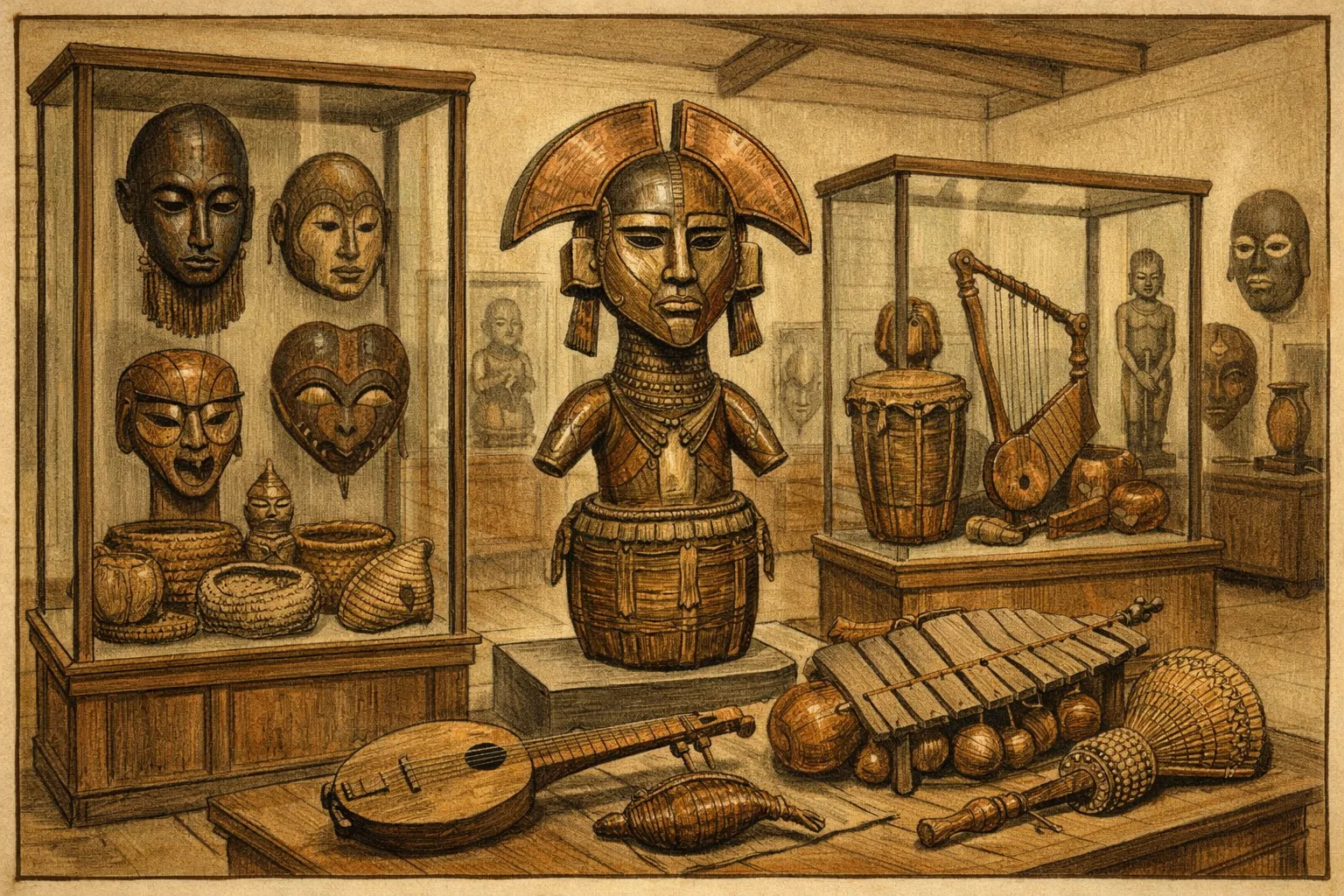
The National Museum of Arts, Rites and Traditions is Gabon’s central public repository for material culture. Its origins lie in research conducted from the early 1960s by Gabonese collaborators and specialists connected with France’s overseas research organisation, including the ethnomusicologists Herbert Pepper and Pierre Sallée and the ethnologist Louis Perrois. An early museum occupied Pepper’s former residence before the institution moved and eventually gained a purpose-designed central Libreville building.[unesco.org]unesdoc.unesco.orgThe Musée des Arts et Traditions is still a small museum working on limited resources and…
Published descriptions put the collection at about 2,500 ethnographic objects. The holdings include masks, carved figures, ancestor reliquaries, musical instruments, ritual canes, pottery, metalwork, baskets, hunting and fishing equipment, jewellery, archaeological material and carved stone from Mbigou. The institution also holds more than 1,100 catalogued sound and audiovisual recordings covering stories, dances, songs and instruments.[Wikipedia]WikipediaMusée national des Arts, Rites et Traditions du GabonMusée national des Arts, Rites et Traditions du Gabon
For a reader interested in strange museums, the most compelling material is not necessarily the most grotesque. It is the material whose original purpose is least compatible with the idea of a silent art object in a glass case. Many Gabonese masks and figures were designed to appear during ceremonies, guard ancestral remains or make invisible powers socially present. Removed from music, movement, restricted knowledge and ritual space, they can easily be misread as decorative sculpture. Scholarship on Gabonese art repeatedly stresses that such objects communicated with ancestor or nature spirits and were associated with fertility, prosperity, protection and collective authority.[ird.fr]horizon.documentation.ird.frHorizon Documentationancestral art ofgabonHorizon Documentationancestral art ofgabon
The museum has also mounted exhibitions devoted to masks, rites, belief and Gabon’s Bwiti religious traditions. This matters because it shows the institution attempting to interpret objects as parts of living systems rather than simply presenting them as anonymous “tribal art”. It has additionally hosted contemporary creative work, making it more than a frozen storehouse of precolonial culture.[Wikipedia]WikipediaMusée national des Arts, Rites et Traditions du GabonMusée national des Arts, Rites et Traditions du Gabon
Current visitor information should be checked shortly before travelling. A local directory lists the museum at 51 Avenue Augustin Boumah and gives regular opening hours of Tuesday to Saturday, 10am to 5pm, but older travel listings sometimes refer to a former site, describe closures or warn that stated hours have not always been reliable.[lepratiquedugabon.com]lepratiquedugabon.comOpen source on lepratiquedugabon.com.
Reliquaries that once guarded human remains
Gabon’s ancestor reliquaries are among the country’s most arresting contributions to world museum collections. They are often displayed abroad as polished masterpieces of modern-looking sculpture, but their original function was inseparable from death, lineage and spiritual protection.
Among Fang communities, carved heads or full figures were mounted above containers holding ancestral relics. The sculpture acted as a guardian rather than as a portrait in the ordinary Western sense. The Metropolitan Museum of Art notes that surviving figures were commonly separated from the reliquary containers they originally protected when removed from Africa. A museum display containing only the carved guardian can therefore present an incomplete object: visually powerful, but physically detached from the bones, container and ritual setting that gave it meaning.[The Metropolitan Museum of Art]metmuseum.orgThe Metropolitan Museum of Art Okak-Fang artistThe Metropolitan Museum of Art Okak-Fang artist
Kota and related communities produced another distinctive form: a wooden guardian faced with sheets or strips of copper alloy. These figures were fixed to baskets or bundles containing the remains of important ancestors. Their gleaming metal surfaces, flattened faces and highly controlled geometry later appealed strongly to European collectors and modernist tastes, but their original force came from their role in maintaining relations between living communities and the dead.[kimbellart.org]kimbellart.orgkimbell reliquary guardian figure and kwele maskkimbell reliquary guardian figure and kwele mask
This creates one of the central tensions in Gabon’s strange-collection landscape. Abroad, such figures are routinely isolated, named by artistic “type” and admired for abstraction. Within their original context, they were components of restricted ritual assemblages that could include relics, baskets, offerings, songs and rules governing who was permitted to see them. The unsettling quality does not come from an invented story about cursed objects; it comes from the documented transformation of sacred guardians into detached collector pieces.
Masks, spirits and the problem of spectacle
Gabonese masks are internationally famous, but “mask” is an incomplete description. A carved face was often only one part of a performance involving costume, dance, rhythm, controlled access and a recognised social or spiritual role. Different traditions used masks in funerary observances, initiation, social regulation, healing, entertainment and the manifestation of ancestors or spirits.
White-faced masks associated with Punu and neighbouring traditions are especially recognisable. Their composed features, raised hairstyles and pale surfaces have made them desirable art-market objects, sometimes overshadowing their connections with performance, femininity, ancestry and death. Fang and Kwele masks likewise circulate widely in museums and private collections, where formal beauty may receive more attention than the societies, ceremonies and collecting histories behind them.[kimbellart.org]kimbellart.orgOpen source on kimbellart.org.
Visitors should be cautious of simplified labels describing every mask as a fetish, witchcraft object or secret-society relic. Gabon contains numerous cultural and religious traditions, and similar-looking objects may have served very different purposes. Even specialists have warned about uncertain dating and provenance: Louis Perrois observed that relatively few supposedly old Fang masks in museums and private collections were securely documented.[Horizon Documentation]horizon.documentation.ird.frHorizon Documentationancestral art ofgabonHorizon Documentationancestral art ofgabon
That uncertainty is not a minor academic footnote. It affects whether an object can be tied to a named maker, community, ceremony or moment of collection. It also makes the field vulnerable to copies, objects made for sale and confident stories added after an artefact entered the market. A convincing museum interpretation should distinguish between securely documented ceremonial pieces, later tourist production and objects whose histories remain unknown.
Bwiti displays: religion, initiation and iboga
Bwiti is often presented to foreign audiences through its most dramatic feature: ritual use of the iboga plant. That emphasis can turn a complex religious field into a psychedelic curiosity. In Gabon, Bwiti traditions encompass initiation, moral teaching, healing, music, community membership and relationships with ancestors. Practices vary substantially between communities and may incorporate Indigenous religious ideas, Christianity or both.[ixtheo.de]ixtheo.deOpen source on ixtheo.de.
Objects connected with Bwiti can include carved figures, decorated architectural panels, musical instruments and other ceremonial equipment. A Tsogho door held by the Metropolitan Museum, for example, carries imagery interpreted in relation to birth, death and the spiritual journey of initiates. Such an object is better understood as part of a religious environment than as an isolated example of “occult art”.[The Metropolitan Museum of Art]metmuseum.orgThe Metropolitan Museum of Art Tsogho artistThe Metropolitan Museum of Art Tsogho artist
The National Museum’s exhibition history includes a show centred on Gabon as a land of Bwiti. For visitors interested in unusual religious collections, this is potentially more valuable than a sensational commercial attraction because it places the subject within Gabonese national heritage. At the same time, no museum display can reproduce an initiation, and some knowledge is deliberately restricted. Museum labels, tourist accounts and foreign retreats should not be treated as equivalent to the explanations of practitioners themselves.[Wikipedia]WikipediaMusée national des Arts, Rites et Traditions du GabonMusée national des Arts, Rites et Traditions du Gabon
Iboga also attracts international medical and recreational interest, which has encouraged forms of spiritual tourism. That modern trade can blur the boundary between living religion, therapeutic marketing and staged experience. A responsible curiosity guide should therefore avoid presenting participation in a ceremony as simply another museum-like attraction.
A preserved hospital with a difficult legacy
The former Albert Schweitzer hospital at Lambaréné is Gabon’s clearest example of a medical-history curiosity site. Schweitzer established his first hospital in 1913, when Gabon was part of French Equatorial Africa. The surviving complex preserves early hospital buildings, treatment spaces, equipment, domestic rooms and the graves of Schweitzer and several associates. The historic hospital is on Gabon’s UNESCO tentative list, meaning it has been identified by the state as a possible future World Heritage nomination but is not presently an inscribed World Heritage Site.[schweitzer.org]schweitzer.org1913 first hospital1913 first hospital
For visitors, the atmosphere is closer to a preserved mission settlement than to a modern medical museum. Former wards and staff rooms help communicate the physical conditions of tropical medicine before antibiotics, reliable electricity and modern transport. The site also connects with the continuing hospital and medical research tradition at Lambaréné rather than representing a wholly abandoned institution.[Mauritius Images]mauritius-images.comOpen source on mauritius-images.com.
Its interpretation requires care. Schweitzer received the 1952 Nobel Peace Prize and became an international humanitarian symbol, but his paternalistic attitudes towards Africans and the colonial structure surrounding his work have faced sustained criticism. Later reporting on the hospital has also documented disputes over funding, management and allegations of racial inequality. A credible visit should therefore present both the medical work and the power relations within which it operated.[The Guardian]theguardian.comThe Guardian Crisis engulfs Gabon hospital founded to atone for colonialThe Guardian Crisis engulfs Gabon hospital founded to atone for colonial
The site matters to Gabon’s unusual-collection history precisely because it is not a neutral shrine. It preserves a material record of missionary medicine, European celebrity humanitarianism and colonial encounter in one place. The unanswered question is not whether Schweitzer was simply a hero or a villain, but whose experiences the museum foregrounds: those of the famous doctor, the European staff, Gabonese employees or the patients who passed through the wards.
Lopé-Okanda as an open-air cabinet of archaeology
Lopé-Okanda is usually promoted for rainforest, savannah and wildlife, yet it is also one of Gabon’s richest collections of human traces. UNESCO inscribed the landscape in 2007 for both natural and cultural values. Archaeological evidence records a long sequence of occupation and movement through the middle Ogooué valley, including stone tools, settlement remains, pottery, ironworking sites and rock art.[World Heritage Datasheets]world-heritage-datasheets.unep-wcmc.orgOpen source on unep-wcmc.org.
Researchers have recorded approximately 1,680 engraved images in the wider landscape. Many are geometric—circles, concentric forms and other repeated designs—while others depict animals, tools or less easily identified shapes. Their precise meanings are uncertain. They should not be advertised as proof of lost civilisations, ancient astronauts or cryptic supernatural messages: the honest fascination lies in the survival of a visual system whose makers left no written explanation.[Horizon Documentation]horizon.documentation.ird.frOpen source on ird.fr.
Unlike an indoor museum, the collection cannot be separated cleanly from its setting. Rivers, hills, migration routes, former settlements and vegetation are all part of the archaeological record. UNESCO has supported ecotourism development in Lopé, but access to particular archaeological areas may depend on local arrangements, guides, weather and conservation rules.[UNESCO World Heritage Centre]whc.unesco.orgOpen source on unesco.org.
For strange-history travellers, Lopé is Gabon’s strongest mystery-object landscape. The carvings are real and documented; many interpretations are not. That distinction makes the site more interesting, rather than less.
Looting, collecting and objects coming home
A large proportion of Gabon’s best-known ritual art is held outside the country. European and North American museums contain Fang heads, Kota reliquary guardians, Punu masks, Kwele masks, doors, instruments and other objects acquired through missionaries, administrators, expeditions, dealers and private collectors. Some have detailed collecting histories; others do not.[brooklynmuseum.org]brooklynmuseum.orgOpen source on brooklynmuseum.org.
In 2025, Gabon received a group of masks, reliquaries, drums, books and other cultural items that had spent more than six decades in a private collection in Sanremo, Italy. Reports described the return as a recovery of national heritage and stated that the material would be housed at the national museum.[TRT Afrika]trtafrika.comTRT Afrika Gabon recovers cultural artefacts from Italy more than 60TRT Afrika Gabon recovers cultural artefacts from Italy more than 60
Restitution does not automatically solve every problem. Returned objects still need provenance research, conservation, secure storage and interpretation. Nor can every artefact abroad be assumed to have been stolen: acquisition circumstances range from documented purchase and commissioned production to coercion, illicit export and outright removal. The useful question is not merely where an object sits today, but whether its history is known and whether the communities connected with it have a voice in its interpretation.
Gabon has also been involved in a high-profile dispute over a rare Fang mask discovered in France after being sold cheaply by its former owners and later auctioned for millions of euros. A French court allowed the sale to stand and rejected Gabon’s attempt to intervene. The episode exposed several overlapping issues: colonial-era removal, inadequate provenance, unequal knowledge between sellers and specialists, and the enormous commercial value attached to objects that may once have held restricted ceremonial meaning.[Restitution Matters]restitutionmatters.orgOpen source on restitutionmatters.org.
What visitors should realistically expect
Gabon’s unusual collections are concentrated rather than numerous. There is no well-documented public museum devoted specifically to UFOs, cryptids, witch trials, prisons, crime, mummies or anatomical specimens. Claims for small private museums or occult attractions should be treated cautiously unless current opening information and institutional details can be verified.
The strongest itinerary combines three very different forms of collection:
- Libreville: the National Museum for masks, reliquaries, ritual arts, sound archives and material from everyday life.
- Lambaréné: the former Schweitzer hospital for preserved medical rooms, mission history and debates about colonial humanitarianism.
- Lopé-Okanda: archaeological sites and rock engravings preserved within a living natural landscape.
The most important practical habit is to verify access locally. Published hours and addresses for Gabonese cultural sites are sometimes inconsistent, older listings may refer to former buildings, and archaeological visits can require guides or advance arrangements.[lepratiquedugabon.com]lepratiquedugabon.comOpen source on lepratiquedugabon.com.
What makes Gabon distinctive is not a collection of manufactured oddities. It is the survival—and partial dispersal—of objects that once mediated between the living and the dead, visible society and restricted ritual, local memory and international collecting. Its strangest museums are therefore also places where visitors must ask who made an object, who was permitted to see it, what was removed from it and how much of its original meaning can still be recovered.

Amazon book picks
Further Reading
Books and field guides related to Where Gabon's Strangest Collections Keep Memory Alive. Use these as the next step if you want deeper reading beyond the article.


African Religions and Philosophy
First published 1970. Subjects: Religion, African Philosophy.
The Forest of Symbols: Aspects of Ndembu Ritual
First published 1967. Subjects: Ndembu (African tribe), Ndembu (African people), Ndembu, Rites and ceremonies, Ethnology.
eBay marketplace picks
Marketplace Samples
Live-tested eBay searches with available results related to this page.
Selected fromAfrican wall art oneBay.co.uk.
Current eBay listing
African Woman, Wall Art, Beautiful detail, wall hanging, decor,


Current eBay listing
Black & White African Elephant Canvas Wall Art Picture Print

Endnotes
1.
Source: Wikipedia
Title: Musée national des Arts, Rites et Traditions du Gabon
Link:https://fr.wikipedia.org/wiki/Mus%C3%A9e_national_des_Arts%2C_Rites_et_Traditions_du_Gabon
2.
Source: whc.unesco.org
Link:https://whc.unesco.org/en/activities/1157/
Source snippet
UNESCO World Heritage CentreInventory of Cultural Heritage in Gabon8 Dec 2021 — Its tentative list includes six properties: one cultural...
3.
Source: unesdoc.unesco.org
Link:https://unesdoc.unesco.org/ark%3A/48223/pf0000003003
Source snippet
The Musée des Arts et Traditions is still a small museum working on limited resources and...
4.
Source: kimbellart.org
Title: kimbell reliquary guardian figure and kwele mask
Link:https://kimbellart.org/news-and-stories/kimbell-reliquary-guardian-figure-and-kwele-mask
5.
Source: kimbellart.org
Link:https://kimbellart.org/content/kimbell-adds-masterful-kota-reliquary-guardian-figure-and-rare-kwele-mask-its-collection
6.
Source: Wikipedia
Title: Punu-Lumbo mask
Link:https://en.wikipedia.org/wiki/Punu-Lumbo_mask
7.
Source: ixtheo.de
Link:https://ixtheo.de/Record/1839004037
8.
Source: antrocom.net
Title: samorini iboga cults vii traditional bwiti
Link:https://antrocom.net/wp/wp-content/uploads/2025/11/samorini-iboga-cults-vii-traditional-bwiti.pdf
9.
Source: schweitzer.org
Title: 1913 first hospital
Link:https://www.schweitzer.org/en/discover/timeline/1913-first-hospital/
10.
Source: mauritius-images.com
Link:https://www.mauritius-images.com/en/asset/ME-PI-17818488_mauritius_images_image_number_15919398_gabon-moyen-ogooue-province-lambarene-the-former-albert-schweitzer-hospital-now-a-museum-the-former-nurses-room-now-exhibition-room
11.
Source: Wikipedia
Title: List of World Heritage Sites in Gabon
Link:https://en.wikipedia.org/wiki/List_of_World_Heritage_Sites_in_Gabon
12.
Source: whc.unesco.org
Link:https://whc.unesco.org/en/news/2440
13.
Source: unesdoc.unesco.org
Link:https://unesdoc.unesco.org/ark%3A/48223/pf0000392370
14.
Source: unesdoc.unesco.org
Link:https://unesdoc.unesco.org/ark%3A/48223/pf0000079729
15.
Source: unesdoc.unesco.org
Link:https://unesdoc.unesco.org/ark%3A/48223/pf0000076271
16.
Source: unesdoc.unesco.org
Link:https://unesdoc.unesco.org/ark%3A/48223/pf0000127347
17.
Source: unesdoc.unesco.org
Link:https://unesdoc.unesco.org/ark%3A/48223/pf0000071181
18.
Source: unesdoc.unesco.org
Title: pf0000079728 fre
Link:https://unesdoc.unesco.org/ark%3A/48223/pf0000079728_fre
19.
Source: unesdoc.unesco.org
Title: pf0000068379 fre
Link:https://unesdoc.unesco.org/ark%3A/48223/pf0000068379_fre
20.
Source: unesdoc.unesco.org
Link:https://unesdoc.unesco.org/ark%3A/48223/pf0000061135
21.
Source: unesdoc.unesco.org
Link:https://unesdoc.unesco.org/ark%3A/48223/pf0000060753
22.
Source: whc.unesco.org
Link:https://whc.unesco.org/en/tentativelists/
23.
Source: Wikipedia
Link:https://en.wikipedia.org/wiki/Gabon
24.
Source: Wikipedia
Title: Albert Einstein
Link:https://en.wikipedia.org/wiki/Albert_Einstein
25.
Source: Wikipedia
Link:https://simple.wikipedia.org/wiki/Gabon
26.
Source: albert.io
Link:https://www.albert.io/
27.
Source: 2009-2017.state.gov
Link:https://2009-2017.state.gov/outofdate/bgn/gabon/131846.htm
28.
Source: albert.com
Link:https://albert.com/
29.
Source: horizon.documentation.ird.fr
Link:https://horizon.documentation.ird.fr/exl-doc/pleins_textes/divers20-04/010077692.pdf
30.
Source: lepratiquedugabon.com
Title: Le Pratique du Gabon Le Musée National
Link:https://lepratiquedugabon.com/a-la-decouverte-du-gabon/le-musee-national/
Source snippet
Le Pratique du GabonLe Musée National - Le Pratique du...Le Musée National du Gabon est le fruit d'une convention passée entre l'Etat ga...
31.
Source: horizon.documentation.ird.fr
Title: Horizon Documentationancestral art ofgabon
Link:https://horizon.documentation.ird.fr/exl-doc/pleins_textes/divers18-08/23103.pdf
32.
Source: metmuseum.org
Title: The Metropolitan Museum of Art Okak-Fang artist
Link:https://www.metmuseum.org/art/collection/search/310870
33.
Source: si.edu
Link:https://www.si.edu/object/nmafa
34.
Source: lepratiquedugabon.com
Link:https://lepratiquedugabon.com/culture/musee/musee-national-des-arts-rites-et-traditions-du-gabon
35.
Source: lonelyplanet.com
Link:https://www.lonelyplanet.com/points-of-interest/musee-nationale-des-arts-et-traditions-du-gabon/421495
36.
Source: brooklynmuseum.org
Link:https://www.brooklynmuseum.org/search/collection?place=Gabon
37.
Source: metmuseum.org
Title: The Metropolitan Museum of Art Tsogho artist
Link:https://www.metmuseum.org/art/collection/search/844671
38.
Source: theguardian.com
Title: The Guardian Crisis engulfs Gabon hospital founded to atone for colonial
Link:https://www.theguardian.com/world/2016/sep/07/gabon-hospital-albert-schweitzer-atone-colonial-crimes-funding-racism-allegations?page=with%3Aimg-3
39.
Source: world-heritage-datasheets.unep-wcmc.org
Link:https://world-heritage-datasheets.unep-wcmc.org/datasheet/output/site/ecosystem-relict-cultural-landscape-of-lope-okanda
40.
Source: trtafrika.com
Title: TRT Afrika Gabon recovers cultural artefacts from Italy more than 60
Link:https://www.trtafrika.com/english/article/194e7baed993
41.
Source: restitutionmatters.org
Link:https://restitutionmatters.org/origin/africa/gabon/
42.
Source: thingstodoinlibreville.com
Title: Things to Do in Libreville National Museum of Arts and Traditions
Link:https://thingstodoinlibreville.com/landmark/national-museum-of-arts-and-traditions/
43.
Source: re-entanglements.net
Link:https://re-entanglements.net/tag/museums/
44.
Source: thelasttuesdaysociety.org
Link:https://thelasttuesdaysociety.org/expedition/gabon-bwiti-ceremonies-gorilla/
45.
Source: lonelyplanet.com
Title: Gabon travel
Link:https://www.lonelyplanet.com/destinations/gabon
46.
Source: opentravelguide.com
Link:https://opentravelguide.com/gabon/history/
47.
Source: GOV.UK
Link:https://www.gov.uk/foreign-travel-advice/gabon
48.
Source: nationsonline.org
Link:https://www.nationsonline.org/oneworld/gabon.htm
49.
Source: globaledge.msu.edu
Link:https://globaledge.msu.edu/countries/gabon
Additional References
50.
Source: academieoutremer.fr
Link:https://www.academieoutremer.fr/wp-content/uploads/2025/09/TEXTE-DE-MONSIEUR-DAVY-WILLIS-1.pdf
Source snippet
Académie des sciences dʼoutre-merRepenser la valorisation des patrimoines africains:...Nous sommes passé du centre de recherche au Musé...
51.
Source: youtube.com
Link:https://www.youtube.com/watch?v=tw0nMMh5hMU
Source snippet
These videos provide relevant context on Gabon's cultural heritage, including its primary ethnographic museum, traditional reliquary art...
52.
Source: aroundus.com
Link:https://aroundus.com/p/174809296-musee-national-des-arts-et-traditions-du-gabon
Source snippet
Around UsMusée National des Arts et Traditions du Gabon - Around Us6 Dec 2025 — Musée National des Arts et Traditions du Gabon, Art museu...
53.
Source: researchgate.net
Link:https://www.researchgate.net/publication/365964412_The_Holy_Spirit_of_Iboga_and_a_Contemporary_Perspective_on_Africa%27s_Spiritual_Renaissance_Focus_on_Gabonese_Bwiti_Tradition
54.
Source: instagram.com
Link:https://www.instagram.com/reel/DTeiicFAnHI/?hl=en
55.
Source: trtworld.com
Link:https://www.trtworld.com/europe/a-reckoning-with-colonial-past-italy-to-give-up-stolen-artifacts-13183294
56.
Source: africabriefing.com
Link:https://africabriefing.com/gabon-stolen-heritage-return-2025/
57.
Source: rietberg.ch
Link:https://rietberg.ch/en/stories/41
58.
Source: muzeum.szczecin.pl
Link:https://muzeum.szczecin.pl/en/exhibitions/permanent/art-of-africa-between-a-mask-and-a-fetish.html
59.
Source: tripadvisor.com
Link:https://www.tripadvisor.com/Attraction_Review-g480195-d8608165-Reviews-Museum_Albert_Schweitzer-Lambarene_Moyen_Ogooue_Province.html