Within Sierra Leone Curiosities
Why Sierra Leone's Charms Are Overseas
Protective charms collected under colonial rule now raise difficult questions about belief, access, provenance and cultural return.
On this page
- Protective objects and everyday belief
- How colonial collectors classified unfamiliar things
- Digital access, provenance and return
Page outline Jump by section
Introduction
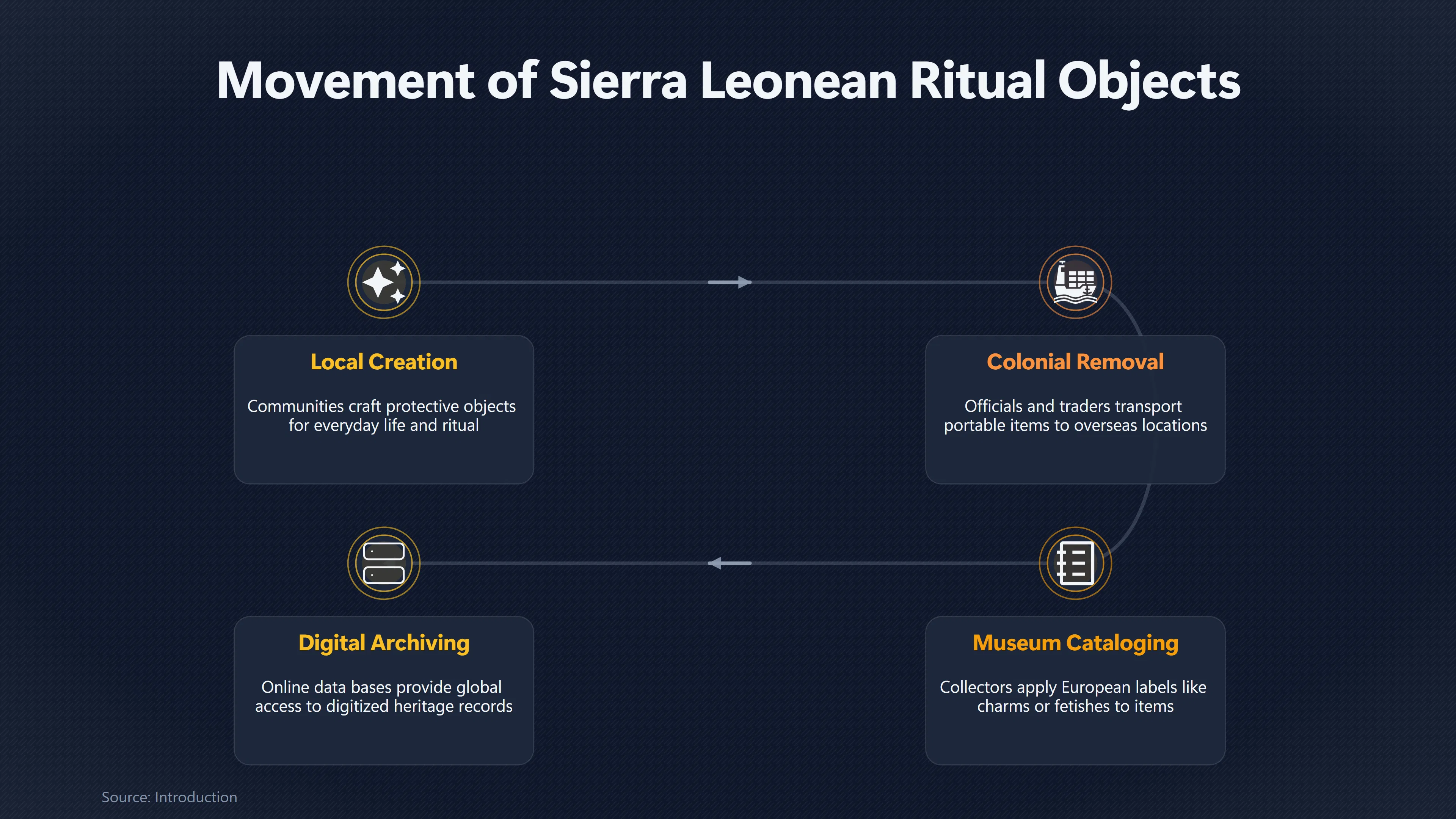
Many of Sierra Leone’s protective charms and ritual objects are no longer in the places where they were originally made, worn or understood. Instead, they are scattered across museums, universities and private collections in Britain and elsewhere, where they were acquired during the colonial period by administrators, missionaries, soldiers, traders and early anthropologists. This “object diaspora” is one of the country’s most important heritage stories because it changes who has access to these objects, how they are interpreted, and who has authority to explain them.
For visitors interested in Sierra Leone’s unusual collections, this is less a story about mysterious magical artefacts than about the movement of culturally significant objects across continents. Many collections now available through overseas museum databases preserve objects that would otherwise have been lost. At the same time, they also preserve colonial assumptions about religion, healing and everyday belief that modern researchers increasingly question.[Sierra Leone Heritage]sierraleoneheritage.orgOpen source on sierraleoneheritage.org.
Protective objects were part of everyday life, not simply “magic”
Colonial catalogues frequently described Sierra Leonean artefacts as “charms”, “fetishes”, “medicine” or “superstitious objects”. Those labels often compressed a wide variety of practices into a single category. In reality, protective objects served many different purposes.
Some were carried on the body to seek protection during travel, hunting or conflict. Others were associated with healing, family welfare or membership of particular communities. Some contained carefully selected natural materials, while others consisted of carved objects, leather packets or containers whose significance depended upon knowledge that was never intended for outsiders.
This matters because many museum records preserve only the collector’s description. A catalogue entry reading simply “charm” may reveal almost nothing about how an object was actually used or understood within its original community. Modern scholarship increasingly treats these labels as historical evidence about colonial collecting practices rather than as complete descriptions of Sierra Leonean belief systems.[Sierra Leone Heritage]sierraleoneheritage.orgOpen source on sierraleoneheritage.org.
How colonial collectors classified unfamiliar things
During the late nineteenth and early twentieth centuries, colonial officials frequently collected objects while travelling through Sierra Leone. Their priorities were often administrative or ethnographic rather than collaborative. Artefacts were removed because they appeared unusual, visually striking or representative of what collectors believed were “native customs”.
Museum databases still preserve this history. The British Museum, for example, lists numerous Sierra Leonean objects under categories such as “charm”, “medicine (protection)”, “charm-holder” and related terms, many collected from Mende-speaking regions or other communities during the colonial era. These records often identify the place of acquisition and the collector but provide relatively little information about the object’s cultural context.[British Museum]britishmuseum.orgBritish Museum Collections Online | British MuseumBritish Museum Collections Online | British Museum
The language used in older catalogues also reflects colonial assumptions. Words such as “fetish” once appeared routinely in museum documentation across West Africa but are now widely recognised as misleading because they imposed European ideas onto diverse African religious and social practices. Contemporary curators increasingly revise catalogue records to use more culturally specific descriptions where evidence allows.
Why so many Sierra Leonean charms are overseas
Unlike monumental architecture, portable ritual objects were relatively easy to transport. Small protective packets, carved figures, medicine containers and related objects travelled with colonial officials returning to Britain, entered missionary collections or were donated to museums.
As a result, researchers today often discover more digitised examples of Sierra Leonean protective objects in overseas institutions than in public displays within Sierra Leone itself. Collections are spread across multiple institutions rather than concentrated in one location, making the heritage difficult to view as a coherent whole.
The object diaspora also reflects historical inequalities in collecting. Communities that created these objects rarely controlled how they were documented, interpreted or exhibited after they left Sierra Leone. Instead, much of the surviving written information comes from the collectors themselves, whose understanding was often incomplete.[Sierra Leone Heritage]sierraleoneheritage.orgOpen source on sierraleoneheritage.org.
Digital access has changed the conversation
One important development is the rapid growth of online museum catalogues. Large institutions increasingly publish photographs, accession records and provenance information that can be viewed from anywhere.
For Sierra Leone, this has significant practical value. The Sierra Leone Heritage digital collections and similar online resources allow researchers, students and members of the public to compare objects held in different museums without travelling internationally. Digital catalogues also make it easier to identify relationships between objects that were separated decades ago through different collecting expeditions.[Sierra Leone Heritage]sierraleoneheritage.orgOpen source on sierraleoneheritage.org.
Digital access, however, is not the same as cultural return. A high-resolution photograph cannot replace an object’s ceremonial, historical or community significance. Online records also inherit many of the limitations of older catalogues, including uncertain dates, outdated terminology and incomplete provenance.
Provenance, ownership and cultural return
The movement of Sierra Leonean ritual objects into overseas collections now raises broader questions shared across African museum heritage.
The central issues include:
- How were objects acquired? Some were purchased, others exchanged, donated or collected under colonial power relationships that are difficult to evaluate today.
- How complete are the records? Provenance documentation varies greatly, particularly for nineteenth-century collections.
- Who should interpret the objects? Increasingly, museums seek collaboration with scholars and communities connected to the collections rather than relying solely on historic catalogue descriptions.
- Should objects be returned? Repatriation debates differ from case to case. Some discussions focus on permanent return, others on long-term loans, shared custodianship, improved documentation or collaborative exhibitions.
Unlike internationally famous disputes over monumental bronzes or royal treasures, Sierra Leone’s protective charms have generally attracted less public attention. Nevertheless, they raise many of the same ethical questions about consent, cultural authority and the legacy of colonial collecting.

Why the object diaspora matters to Sierra Leone’s curiosity culture
For anyone exploring Sierra Leone’s unusual heritage, the fascination lies not in treating protective objects as mysterious relics of “magic”, but in understanding how their meanings changed once they entered museums.
A charm that originally functioned within a living network of belief became an ethnographic specimen. A protective object worn in everyday life became an accession number in a catalogue. In some cases, the object’s practical or spiritual purpose disappeared from the written record altogether, leaving only the collector’s interpretation.
This transformation is itself part of Sierra Leone’s strange museum history. The country’s most intriguing collections are often divided between local museums and far-flung international institutions, creating a dispersed archive that reflects colonial history as much as the objects themselves. Understanding that journey helps visitors read museum labels more critically, recognising that the history of collecting can be as revealing as the artefacts on display.
Amazon book picks
Further Reading
Books and field guides related to Why Sierra Leone's Charms Are Overseas. Use these as the next step if you want deeper reading beyond the article.
The Brutish Museums
New York Times 'Best Art Books' 2020 'Essential' – Sunday Times 'Brilliantly enraged' - New York Review of Books 'A real game-changer'– E...
The Predicament of Culture
The Predicament of Culture is a critical ethnography of the West in its changing relations with other societies. Analyzing cultural pract...
The Invention of Africa
"What is the meaning of Africa and being an African? What is and what is not African philosophy? Is philosophy part of Africanism? These...
eBay marketplace picks
Marketplace Samples
Live-tested eBay searches with available results related to this page.
Selected fromAfrican collectible oneBay.co.uk.
Endnotes
1.
Source: sierraleoneheritage.org
Link:https://sierraleoneheritage.org/search/search_db
2.
Source: britishmuseum.org
Title: British Museum Collections Online | British Museum
Link:https://www.britishmuseum.org/collection/term/x84289
3.
Source: britishmuseum.org
Title: British Museum Collections Online | British Museum
Link:https://www.britishmuseum.org/collection/term/BIOG120615
Source snippet
Collections Online | British Museum70 RELATED OBJECTS ARMLET Af1886,1126.2 | 1886 | Made in:Sierra Leone | Found/Acquired:Sherbro, River...
4.
Source: britishmuseum.org
Title: Carved wooden helmet mask, janus-faced and stained black. The mask has small f
Link:https://www.britishmuseum.org/collection/object/E_Af1886-1126-1-a-b
Source snippet
helmet mask | British MuseumHELMET MASK Object Type helmet mask Museum number Af1886,1126.1.a-b Description Sowei mask (a) and raffia fri...
5.
Source: britishmuseum.org
Link:https://www.britishmuseum.org/collection/object/E_Af1954
Source snippet
Carved wooden helmet mask in the form of a human face. Facial features set within flat excavated area...
6.
Source: britishmuseum.org
Link:https://www.britishmuseum.org/collection/object/E_Af1938
7.
Source: britishmuseum.org
Link:https://www.britishmuseum.org/collection/object/E_Af1972-01-1?selectedImageId=695523001
8.
Source: britishmuseum.org
Link:https://www.britishmuseum.org/collection/object/E_Af1874
9.
Source: sierraleoneheritage.org
Link:https://www.sierraleoneheritage.org/item/BM%3AAf.1908.1013.1.b/amulet
10.
Source: sierraleoneheritage.org
Link:https://www.sierraleoneheritage.org/item/BM%3AAf.1931.1120.9/amulet
11.
Source: sierraleoneheritage.org
Link:https://sierraleoneheritage.org/item/BM%3AAf.1931.1120.2/amulet
12.
Source: sierraleoneheritage.org
Link:https://sierraleoneheritage.org/item/SLNM.1967.10.02/amulet
13.
Source: sierraleoneheritage.org
Link:https://sierraleoneheritage.org/item/BM%3AAf.1931.1120.8/amulet
14.
Source: sierraleoneheritage.org
Link:https://www.sierraleoneheritage.org/item/LIVCM.23.2.95.1/charm
15.
Source: sierraleoneheritage.org
Link:https://www.sierraleoneheritage.org/museum
16.
Source: sierraleoneheritage.org
Link:https://www.sierraleoneheritage.org/item/SLNM.1969.03.02/charm
17.
Source: sierraleoneheritage.org
Link:https://www.sierraleoneheritage.org/item/GLAMG%3AA.1985.13.bo/amuletcharm
18.
Source: sierraleoneheritage.org
Link:https://sierraleoneheritage.org/item/GLAMG%3AA.1985.13.bl/amuletcharm
19.
Source: sierraleoneheritage.org
Link:https://sierraleoneheritage.org/search/search_db/find?ot%5B0%5D=18
20.
Source: sierraleoneheritage.org
Link:https://sierraleoneheritage.org/item/BMAG%3AE5_59_70/amulet
21.
Source: sierraleoneheritage.org
Link:https://sierraleoneheritage.org/item/LIVCM.17.12.10.24/tongo-players-item
22.
Source: collections.maa.cam.ac.uk
Link:https://collections.maa.cam.ac.uk/objects/530434/
Additional References
23.
Source: anthrosource.onlinelibrary.wiley.com
Title: j.1548 1379.2010.01105.x
Link:https://anthrosource.onlinelibrary.wiley.com/doi/abs/10.1111/j.1548-1379.2010.01105.x
Source snippet
28-42 OBJECT DIASPORAS, RESOURCING COMMUNITIES: SIERRA LEONEAN COLLECTIONS IN THE GLOBAL MUSEUMSCAPE Paul Basu, Paul Basu University Coll...
24.
Source: academic.oup.com
Link:https://academic.oup.com/jhc/article-abstract/35/1/155/6568057
Source snippet
J. Alldridge’s Sierra Leone collections | Journal of the History of Collections | Oxford AcademicApril 13, 2022 — T. J. ALLDRIDGE’S SIERR...
Published: April 13, 2022
25.
Source: youtube.com
Title: Sowei mask: Spirit of Sierra Leone
Link:https://www.youtube.com/watch?v=HBeH9KhQPww
Source snippet
Inside Sierra Leone National Museum | Icons Exhibit | Authentic African History...
26.
Source: academic.oup.com
Link:https://academic.oup.com/jhc/article/35/1/155/6568057
Source snippet
J. Alldridge’s Sierra Leone collections | Journal of the History of Collections | Oxford AcademicApril 13, 2022 — Journal Article T. J. A...
Published: April 13, 2022
27.
Source: youtube.com
Title: Inside Sierra Leone National Museum | Icons Exhibit | Authentic African History
Link:https://www.youtube.com/watch?v=dAWSmw91ijY
Source snippet
Chiefly Regalia...
28.
Source: digitalcollections.amnh.org
Title: Mende cloth Mende people of Sierra Leone Africa 2URM1TH7KI8R
Link:https://digitalcollections.amnh.org/archive/Mende-cloth–Mende-people-of-Sierra-Leone–Africa-2URM1TH7KI8R.html
29.
Source: youtube.com
Title: Colonial Heritage and Knowledge Production in Conflict
Link:https://www.youtube.com/watch?v=MoG9BgX_lkI
Source snippet
Sowei Mask Naming Ceremony...
30.
Source: youtube.com
Title: Sowei Mask Naming Ceremony
Link:https://www.youtube.com/watch?v=0o2dFzaR7QU
Source snippet
Sowei mask: Spirit of Sierra Leone...
31.
Source: collections.si.edu
Link:https://collections.si.edu/search/detail/edanmdm%3Anmafa
32.
Source: si.edu
Title: sova naa ms2008 18
Link:https://www.si.edu/object/archives/sova-naa-ms2008-18