Within Britain's Strange Museums
How Curiosity Cabinets Shaped Britain's Weird Museums
Britain's strange museums grew from elite wonder rooms, scientific classification, folklore collecting and popular showmanship.
On this page
- From private wonder rooms to public institutions
- Classification, empire and collecting power
- Scholarship, spectacle and modern reinvention
Page outline Jump by section
Introduction
Britain’s modern landscape of strange museums did not appear by accident. It grew from a centuries-old collecting tradition in which wealthy scholars, travellers, physicians, gardeners and aristocrats assembled “cabinets of curiosity” or wonder rooms filled with natural specimens, antiquities, scientific instruments, religious relics, ethnographic objects and alleged marvels. These collections blurred the boundaries between science, entertainment and belief, encouraging visitors to see the world as something that could be gathered, organised and interpreted in a single room. Many of Britain’s most distinctive museums—from dense ethnographic displays to collections of folklore, witchcraft and medical oddities—still reflect this intellectual inheritance, even when they now question the assumptions on which it was built.[rct.uk]rct.ukRoyal Collection Trust Wunderkammer: Cabinet of CuriositiesRoyal Collection Trust Wunderkammer: Cabinet of Curiosities
Understanding Britain’s cabinets of curiosity helps explain why the country’s unusual museums often combine genuine scholarship with theatrical presentation. They are not simply repositories of strange objects; they are descendants of a collecting culture shaped by scientific ambition, imperial expansion, commercial spectacle and changing ideas about knowledge itself.
From private wonder rooms to public institutions
The cabinet of curiosity emerged across Renaissance Europe as a way for wealthy collectors to display remarkable objects from every imaginable category. Rather than separating art from science or archaeology from folklore, collectors deliberately mixed shells with carved ivories, fossils beside religious relics, mechanical inventions next to preserved animals and objects brought from distant societies. The goal was to present the diversity of creation in miniature rather than according to modern academic disciplines.[Royal Collection Trust]rct.ukRoyal Collection Trust Wunderkammer: Cabinet of CuriositiesRoyal Collection Trust Wunderkammer: Cabinet of Curiosities
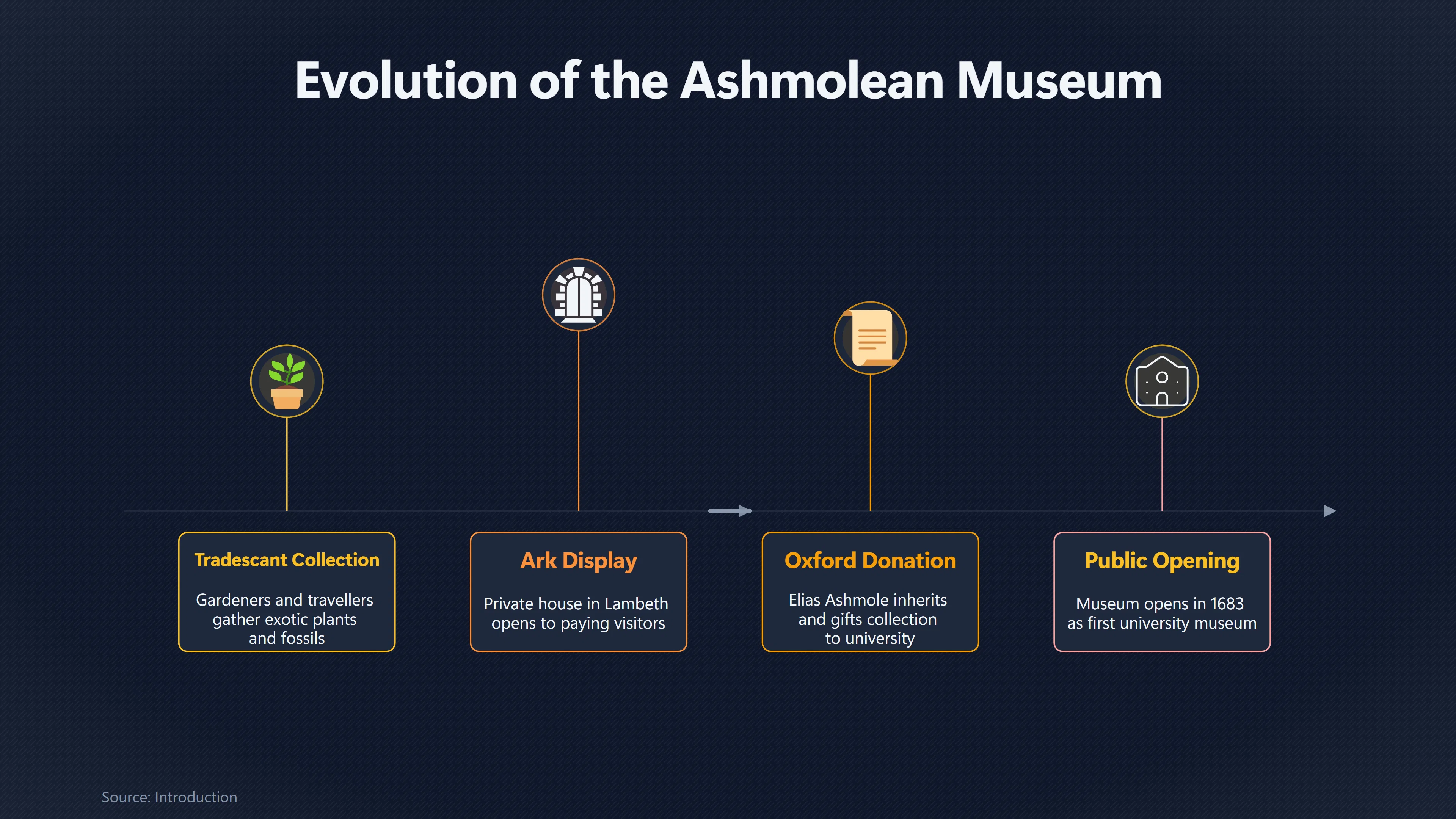
Britain adapted this tradition enthusiastically during the seventeenth century. The most influential English example was the collection of John Tradescant the Elder and John Tradescant the Younger, gardeners, travellers and collectors whose house in Lambeth became known as “The Ark”. Visitors who paid an entrance fee could inspect an extraordinary assortment of plants, fossils, stuffed animals, archaeological finds, ethnographic artefacts and exotic curiosities gathered through travel and exchange. Although still privately owned, it represented one of England’s earliest public displays of a cabinet of curiosities.[Ashmolean Museum]ashmolean.orgMuseum HISTORY OF THE ASHMOLEAN | Ashmolean MuseumAshmolean MuseumHISTORY OF THE ASHMOLEAN | Ashmolean Museum…
When Elias Ashmole inherited the Tradescant collections and donated them to the University of Oxford, they became the foundation of the Ashmolean Museum. Opening in 1683, the Ashmolean is recognised as Britain’s first public museum and the world’s first university museum. The move marked an important shift: curiosity cabinets were no longer simply expressions of personal prestige but increasingly became institutions intended for study, preservation and public education.[Ashmolean Museum]ashmolean.orgMuseum HISTORY OF THE ASHMOLEAN | Ashmolean MuseumAshmolean MuseumHISTORY OF THE ASHMOLEAN | Ashmolean Museum…
This transition also changed expectations about collections. Instead of remaining idiosyncratic personal assemblages, museums gradually developed catalogues, conservation methods and educational purposes. Nevertheless, many retained the visual density and sense of surprise that had made early cabinets so memorable.
Why collectors wanted everything in one room
Modern visitors sometimes assume cabinets existed simply because collectors enjoyed unusual objects. In reality, they reflected a distinctive philosophy of knowledge.
Collectors believed that understanding the world required bringing together diverse evidence. A rare shell, a carved idol, a fossil, an astronomical instrument and an alleged unicorn horn could all contribute to a larger picture of creation. Before scientific disciplines became specialised, such juxtapositions seemed intellectually productive rather than eccentric.[Royal Collection Trust]rct.ukRoyal Collection Trust Wunderkammer: Cabinet of CuriositiesRoyal Collection Trust Wunderkammer: Cabinet of Curiosities
Several motives often overlapped:
- Scientific investigation, through comparing natural specimens and unusual phenomena.
- Religious reflection, interpreting natural wonders as evidence of divine creation.
- Social prestige, demonstrating education, wealth and international connections.
- Commercial curiosity, attracting paying visitors and wealthy patrons.
- Personal fascination, preserving objects considered rare, beautiful or mysterious.
Because these aims coexisted, cabinets frequently contained both genuine scientific specimens and objects whose authenticity was doubtful. Fabricated “mermaids”, alleged dragon remains or supposed relics might sit beside authentic fossils and botanical collections. The collector’s task was often to provoke investigation rather than guarantee certainty.
Classification, empire and collecting power
Britain’s expanding overseas trade and imperial networks dramatically increased the range of objects available to collectors from the seventeenth century onwards. Plants, minerals, weapons, ceremonial objects, textiles, animals and antiquities flowed into British collections through exploration, diplomacy, commerce, missionary activity, military campaigns and colonial administration.[Ashmolean Museum]ashmolean.orgMuseum HISTORY OF THE ASHMOLEAN | Ashmolean MuseumAshmolean MuseumHISTORY OF THE ASHMOLEAN | Ashmolean Museum…
This expansion transformed cabinets of curiosity in two important ways.
First, collections became increasingly global. A visitor might encounter Pacific artefacts, African carvings, Egyptian antiquities and South American natural specimens within a single room, reinforcing the idea that Britain could assemble the world’s diversity under one roof.
Second, collecting became entangled with unequal power relationships. Many objects entered British collections through colonial systems that offered local communities little control over how their cultural heritage was removed, interpreted or displayed. Modern museums increasingly acknowledge that curiosity and scholarship cannot be separated from these historical realities. The Ashmolean explicitly recognises that parts of its early collections were assembled within colonial contexts, while current research at the Victoria and Albert Museum examines links between nineteenth-century collecting and wealth derived from slavery.[ashmolean.org]ashmolean.orgMuseum HISTORY OF THE ASHMOLEAN | Ashmolean MuseumAshmolean MuseumHISTORY OF THE ASHMOLEAN | Ashmolean Museum…
These debates do not erase the historical importance of curiosity cabinets. Instead, they encourage museums to explain both the intellectual achievements and the ethical problems embedded within Britain’s collecting traditions.

How curiosity became scientific order
As collections expanded during the eighteenth and nineteenth centuries, many British museums shifted away from the original cabinet model towards systematic classification.
Instead of arranging objects primarily for surprise, curators increasingly grouped them according to species, function, chronology or geographical origin. This reflected broader developments in natural history, archaeology and anthropology, where comparison and classification became central research methods.
Yet the older cabinet aesthetic never entirely disappeared. Some museums deliberately retained densely packed cases because they communicated the excitement of discovery that had characterised early collecting. Visitors to institutions such as the Pitt Rivers Museum can still experience displays whose visual richness echoes historical wonder rooms, even though the objects are now interpreted within far more rigorous scholarly frameworks and increasingly accompanied by critical discussion of colonial collecting practices.[Victoria and Albert Museum]vam.ac.ukOpen source on vam.ac.uk.
The result is a distinctive British museum experience in which historical display methods survive alongside contemporary interpretation.
Scholarship, spectacle and modern reinvention
Today’s strange museums inherit more than the objects collected by earlier generations; they inherit the cabinet’s mixture of education, entertainment and mystery.
Museums devoted to witchcraft, folklore, medical history, crime or unusual technologies often present eclectic displays that deliberately evoke historical curiosity cabinets. Visitors encounter shelves crowded with ritual objects, preserved specimens, handwritten documents, mechanical devices and enigmatic artefacts, encouraging close observation rather than a single linear narrative.
Modern curators, however, usually make clearer distinctions than their predecessors between different kinds of evidence:
- Objects documenting historical beliefs are not presented as proof that those beliefs were true.
- Forged or fabricated artefacts become evidence of deception, craftsmanship or popular entertainment rather than authentic marvels.
- Medical specimens illustrate changing scientific practice while prompting discussion about ethics, consent and human dignity.
- Folklore collections preserve cultural traditions without requiring visitors to accept supernatural explanations.
Contemporary artists have also revived the cabinet format as a way of exploring memory, collecting and classification. Research projects at the Victoria and Albert Museum examine how the cabinet of curiosity continues to influence museum design, artistic practice and collecting today, demonstrating that the form remains intellectually productive rather than merely antiquarian.[Victoria and Albert Museum]vam.ac.ukOpen source on vam.ac.uk.

Why curiosity cabinets still matter to Britain’s weird museums
Many of Britain’s most memorable museums are best understood not as isolated attractions but as descendants of the cabinet of curiosity tradition.
The emphasis on dense displays, unexpected juxtapositions and unusual objects reflects an older belief that wonder itself can stimulate learning. At the same time, modern institutions increasingly explain how those collections were assembled, who benefited from them and whose perspectives were historically overlooked.
This combination of fascination and self-examination gives Britain’s collecting culture much of its distinctive character. A visitor may still encounter shrunken heads, ceremonial masks, magical charms, preserved animals, anatomical preparations or ingenious automata within a single day’s travel, but these objects are now more often interpreted through multiple lenses: scientific, historical, folkloric, artistic and ethical.
Britain’s curiosity cabinets therefore survive not as frozen relics of the past, but as living influences on how unusual collections are displayed, debated and understood. They continue to shape the country’s weird museums by preserving the cabinet’s original impulse—to gather remarkable things together—while replacing unquestioning wonder with informed curiosity.
Amazon book picks
Further Reading
Books and field guides related to How Curiosity Cabinets Shaped Britain's Weird Museums. Use these as the next step if you want deeper reading beyond the article.
The book of general ignorance
Rating: 4.3/5 from 6 Google Books ratings
First published 2007. Subjects: Nonfiction, Questions and answers, Humor (Nonfiction), Wonders And Curiosities, Reference.
A History of the World in 100 Objects
This book takes a dramatically original approach to the history of humanity, using objects which previous civilisations have left behind...
Stuff: Compulsive Hoarding and the Meaning of Things
The New York Times bestseller. "Gripping . . . By turns fascinating and heartbreaking . . . Stuff invites readers to reevaluate their des...
eBay marketplace picks
Marketplace Samples
Live-tested eBay searches with available results related to this page.
Selected fromantique display case oneBay.co.uk.
Endnotes
1.
Source: ashmolean.org
Title: Museum HISTORY OF THE ASHMOLEAN | Ashmolean Museum
Link:https://ashmolean.org/history-ashmolean
Source snippet
Ashmolean MuseumHISTORY OF THE ASHMOLEAN | Ashmolean Museum...
2.
Source: ashmole.com
Link:https://ashmole.com/ashmole-museum/
3.
Source: ashmolean.org
Link:https://www.ashmolean.org/the-ashmolean-story-gallery
4.
Source: ashmolean.org
Link:https://www.ashmolean.org/research
5.
Source: rct.uk
Title: Royal Collection Trust Wunderkammer: Cabinet of Curiosities
Link:https://www.rct.uk/collection/stories/wunderkammer-cabinet-of-curiosities
6.
Source: vam.ac.uk
Link:https://www.vam.ac.uk/research/projects/opening-the-cabinet-of-curiosities
7.
Source: vam.ac.uk
Link:https://www.vam.ac.uk/research/projects/opening-the-cabinet-of-curiosities-part-ii/
9.
Source: chr.org.uk
Title: Flude The Ashmolean is a lovely museum. It’s like a miniature c
Link:https://chr.org.uk/anddidthosefeet/the-ashmolean-museum-first-opened-may-24th-1683/
Source snippet
The Ashmolean Museum First Opened May 24th 1683 - And Did Those FeetMay 24, 2025 — 6th June 20266th June 2026 by Kevin Flude THE ASHMOLEA...
Published: May 24, 2025
10.
Source: britishhistories.com
Title: 373 the ashmolean museum
Link:https://britishhistories.com/f/373-the-ashmolean-museum
Source snippet
The Ashmolean MuseumJune 12, 2026 — 373. THE ASHMOLEAN MUSEUM 12 June 2026|Antiquarians & Historians, Education, Five Fast Facts, Free To...
Published: June 12, 2026
11.
Source: youtube.com
Title: Sir Hans Sloane and the Foundation of Science at the British Museum
Link:https://www.youtube.com/watch?v=3Xdg9WdlGZs
Source snippet
The World in a Box: Cabinets of Curiosity...
12.
Source: broadwaymuseum.org.uk
Title: Broadway Museum Cabinet of Curiosities
Link:https://www.broadwaymuseum.org.uk/product/cabinet-of-curiosities-exhibition/
Source snippet
Broadway MuseumCabinet of Curiosities - Broadway Museum...
13.
Source: academic.oup.com
Link:https://academic.oup.com/book/51727/chapter/419836372
Source snippet
Empire: Curiosity, Power, and Prestige | Confronting Colonial Objects: Histories, Legalities, and Access to Culture | Oxford AcademicOcto...
14.
Source: caareviews.org
Link:https://www.caareviews.org/reviews/3865
15.
Source: escholarship.org
Link:https://escholarship.org/uc/item/4n01z71q
16.
Source: cabinet.ox.ac.uk
Link:https://www.cabinet.ox.ac.uk/node/3477
17.
Source: prm.ox.ac.uk
Link:https://prm.ox.ac.uk/ethnography-archaeology