Within Strange Spain
When Does a Mummy Become a Museum Attraction?
Quinto and Tenerife reveal how preserved bodies can be studied, exhibited and contested without reducing people to curiosities.
On this page
- Natural mummification and burial context at Quinto
- Guanche remains, science and Indigenous identity
- Display ethics, repatriation and respectful interpretation
Page outline Jump by section
Introduction
Spain’s mummy collections are unusual not because they imitate Egypt, but because they raise difficult questions about how human remains should be presented to the public. Two very different examples illustrate the debate. In the Aragon town of Quinto, naturally preserved bodies remain on display in the same church where they were buried, offering an archaeological window into everyday life in the eighteenth and nineteenth centuries. In Tenerife and Madrid, the preserved remains of the Indigenous Guanche people have become the focus of wider discussions about scientific research, cultural identity, colonial history and whether museums should continue displaying ancestral human remains at all.[Cultura de Aragón]culturadearagon.esCultura de Aragón Museo de las Momias de Quinto | Cultura de AragónCultura de Aragón Museo de las Momias de Quinto | Cultura de Aragón
Rather than treating mummies simply as curiosities, modern Spanish museums increasingly frame them as people with biographies, burial traditions and descendants who may hold strong views about their treatment. That shift reflects broader international museum ethics, where the central question is no longer whether visitors are fascinated by mummies, but under what circumstances displaying them can be justified.
When does a mummy become a museum attraction?
Human remains have always attracted public attention, yet museums today face competing responsibilities. They must preserve fragile archaeological evidence, explain past societies and educate visitors while also respecting the dignity of the dead.
Spain demonstrates how different contexts produce different ethical questions.
- Quinto concerns relatively recent Christian burials accidentally discovered during restoration work.
- The Guanche collections concern the remains of Tenerife’s Indigenous inhabitants, whose descendants and regional institutions increasingly view them as ancestral heritage rather than museum specimens.
- National museums must balance scientific access, public education and evolving ethical standards, including international museum guidance on the treatment of human remains.[Cultura de Aragón]culturadearagon.esCultura de Aragón Museo de las Momias de Quinto | Cultura de AragónCultura de Aragón Museo de las Momias de Quinto | Cultura de Aragón
The result is not a simple argument for or against display, but an ongoing discussion about context, consent, interpretation and cultural ownership.
Natural mummification and burial context at Quinto
The Museum of the Mummies of Quinto occupies the former Church of the Assumption, locally known as El Piquete, in Zaragoza province. During restoration work, archaeologists uncovered numerous burials beneath the church floor. Around fifteen bodies from the eighteenth and early nineteenth centuries had undergone exceptional natural preservation because of the building’s dry environmental conditions rather than deliberate embalming.[Cultura de Aragón]culturadearagon.esCultura de Aragón Museo de las Momias de Quinto | Cultura de AragónCultura de Aragón Museo de las Momias de Quinto | Cultura de Aragón
What makes Quinto distinctive is that the bodies remain displayed where they were originally buried. Rather than transferring them into a detached museum collection, the exhibition preserves the relationship between the deceased, the church architecture and the archaeological evidence surrounding them.
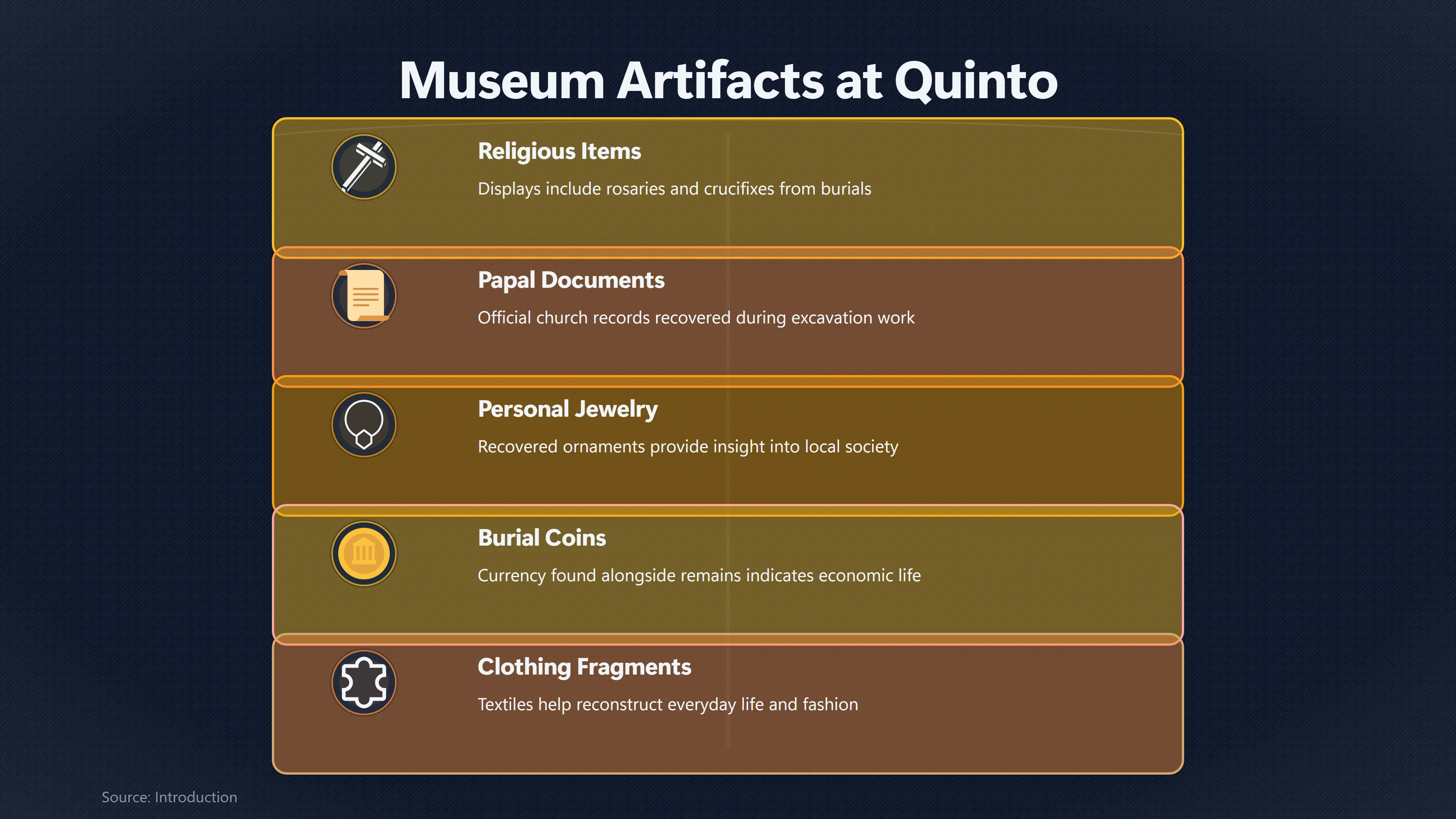
Visitors encounter far more than preserved bodies. The museum also displays clothing, rosaries, crucifixes, papal documents, jewellery, coins and other grave goods recovered during excavation, allowing archaeologists to reconstruct aspects of everyday religious life, burial customs and local society. Excavations additionally revealed earlier Iberian, Roman and Islamic occupation, placing the church within a much longer history of settlement.[Momias de Quinto]momiasdequinto.esMomias de Quinto CollectionMomias de QuintoCollection - Momias de QuintoNovember 21, 2024…
The museum consciously explains why preservation occurred. Geological conditions, burial environment and conservation methods form part of the guided visit, helping visitors understand that these are archaeological discoveries rather than intentionally created exhibits. Guided tours also reduce the atmosphere of casual spectacle by placing interpretation ahead of photography or shock value.[Momias de Quinto]momiasdequinto.esMomias de Quinto SpacesMomias de QuintoSpaces - Momias de QuintoSeptember 19, 2024…
Guanche remains, science and Indigenous identity
The ethical landscape changes dramatically in the Canary Islands.
Before the Castilian conquest in the fifteenth century, Tenerife was inhabited by the Guanche people, whose burial practices sometimes produced remarkably preserved bodies through careful wrapping, drying and placement within caves. These mummies became important archaeological evidence for understanding Indigenous Canarian society, health, diet and funerary customs.
For much of the nineteenth and twentieth centuries, Guanche mummies were collected and displayed primarily as scientific specimens. Some entered Spanish national collections, including the National Archaeological Museum in Madrid, while others remained in Tenerife. During this period, the emphasis largely fell on physical anthropology rather than Indigenous cultural identity.
That perspective has shifted considerably. Today many Canarians regard Guanche remains as ancestors rather than research material. The debate therefore extends beyond archaeology into questions of colonial history, regional identity and who should decide how ancestral remains are treated.[The Times]thetimes.co.ukThe Times Canaries furious as Madrid removes mummy to 'decolonise' museumThe Guanche mummy, dating back to the 11th century, and originally discovered in 1763, has been relocated to a warehouse as part of a new…
Scientific research continues to provide important information through techniques such as CT scanning, radiocarbon dating and ancient DNA analysis. However, many museums now try to minimise unnecessary handling or invasive sampling, recognising that scientific value must be balanced against ethical responsibilities.
Display ethics, repatriation and respectful interpretation
Spain’s discussion forms part of a wider international reassessment of museum practice.
Following updated ethical commitments adopted across Spain’s state museums, including guidance aligned with the International Council of Museums (ICOM), the National Archaeological Museum removed the famous Guanche mummy and other human remains from public exhibition. The decision reflected a commitment to treating human remains with greater dignity and considering the beliefs of communities connected to them. The remains remain available for authorised research but are no longer ordinary exhibition objects.[ElHuffPost]huffingtonpost.esEste compromiso, basado en el Código Deontológico del Consejo Internacional de Museos (ICOM), busca garantizar el respeto y dignidad de l…
The decision immediately generated disagreement.
Some archaeologists and museum professionals argue that carefully interpreted displays help the public understand ancient cultures while encouraging respect rather than sensationalism. They point out that removing all human remains may reduce opportunities for public education and weaken appreciation of archaeological evidence.
Others argue that people who never consented to public exhibition should not become permanent attractions. For Guanche remains especially, critics emphasise that colonial collecting practices complicate traditional ideas of museum ownership. Some political leaders and cultural organisations in the Canary Islands have therefore renewed calls for important Guanche mummies to return permanently to Tenerife, where they would be interpreted within their own cultural landscape rather than as part of a national archaeological collection.[The Times]thetimes.co.ukThe Times Canaries furious as Madrid removes mummy to 'decolonise' museumThe Guanche mummy, dating back to the 11th century, and originally discovered in 1763, has been relocated to a warehouse as part of a new…
These disagreements are not simply about geography. They concern who has authority to interpret the past and whether scientific institutions should retain remains collected under very different historical assumptions.
Why Quinto and Tenerife represent different ethical models
Although both involve preserved human bodies, Quinto and the Guanche collections illustrate contrasting museum philosophies.
Quinto emphasises archaeological context. The individuals remain within their original burial place, accompanied by evidence explaining local history, religious practice and natural preservation. The exhibition is closely tied to a specific building and community.[Cultura de Aragón]culturadearagon.esCultura de Aragón Museo de las Momias de Quinto | Cultura de AragónCultura de Aragón Museo de las Momias de Quinto | Cultura de Aragón
The Guanche collections raise broader issues of Indigenous heritage. Here the debate extends beyond conservation into questions of historical injustice, cultural representation, regional identity and whether ancestral remains belong in museum displays at all.[The Times]thetimes.co.ukThe Times Canaries furious as Madrid removes mummy to 'decolonise' museumThe Guanche mummy, dating back to the 11th century, and originally discovered in 1763, has been relocated to a warehouse as part of a new…
The contrast demonstrates that ethical display depends on more than preservation techniques. The age of the remains, their cultural significance, how they were acquired, the wishes of descendant communities and the purpose of exhibition all influence whether public display is considered appropriate.
What visitors should expect
Visitors interested in Spain’s unusual heritage should not expect either site to function as a horror attraction.
At Quinto, the emphasis is increasingly archaeological and educational, using the preserved bodies to explain burial customs, architecture and local history rather than encouraging morbid fascination. Guided interpretation encourages visitors to understand the deceased as members of a historical community instead of anonymous curiosities.[Momias de Quinto]momiasdequinto.esMomias de Quinto SpacesMomias de QuintoSpaces - Momias de QuintoSeptember 19, 2024…
In the Canary Islands, visitors are increasingly likely to encounter exhibitions that explain Guanche society through artefacts, digital interpretation and scientific evidence rather than relying on extensive public display of human remains. The debate itself has become part of the story, illustrating how museums continue to rethink the relationship between scholarship, public interest and respect for the dead.[ElHuffPost]huffingtonpost.esEste compromiso, basado en el Código Deontológico del Consejo Internacional de Museos (ICOM), busca garantizar el respeto y dignidad de l…
Amazon book picks
Further Reading
Books and field guides related to When Does a Mummy Become a Museum Attraction?. Use these as the next step if you want deeper reading beyond the article.
Mummies, Cannibals and Vampires: The History of Corpse Medici...
Mummies, Cannibals and Vampires charts in vivid detail the largely forgotten history of European corpse medicine, when kings, ladies, gen...
The Museum Experience Revisited
The first book to take a "visitor's eye view" of the museum visit when it was first published in 1992, The Museum Experience revolutioniz...
The Body: A Guide for Occupants
NATIONAL BESTSELLER NEW YORK TIMES BESTSELLER INTERNATIONAL BESTSELLER A NEW YORK TIMES EDITORS' CHOICE NAMED ONE OF THE BEST BOOKS OF 20...

The Cultures of Collecting
First published 1994. Subjects: Social aspects, Miscellanea, Collectors and collecting, Geschichte, Sammeln.
eBay marketplace picks
Marketplace Samples
Live-tested eBay searches with available results related to this page.
Selected frommummy museum poster oneBay.co.uk.
Current eBay listing
British Museum Shaped Mummy Poster Egyptian Art Exhibit Decor
Endnotes
1.
Source: quinto.es
Title: Museo de las Momias de Quinto | Quinto
Link:https://www.quinto.es/tu-municipio/museo-de-las-momias-de-quinto/
2.
Source: opendata.aragon.es
Link:https://opendata.aragon.es/describe/?url=http%3A%2F%2Fopendata.aragon.es%2Frecurso%2Fcultura-ocio%2Forganizacion%2Fmuseo%2Fmuseo-las-momias-quinto
3.
Source: culturadearagon.es
Title: Cultura de Aragón Museo de las Momias de Quinto | Cultura de Aragón
Link:https://culturadearagon.es/museos/museo-de-las-momias-de-quinto/
4.
Source: huffingtonpost.es
Link:https://www.huffingtonpost.es/life/cultura/el-arqueologico-retira-momia-guanche-otros-restos-humanos-indicacion-cultura.html
Source snippet
Este compromiso, basado en el Código Deontológico del Consejo Internacional de Museos (ICOM), busca garantizar el respeto y dignidad de l...
5.
Source: momiasdequinto.es
Title: Momias de Quinto MUSEUM
Link:https://momiasdequinto.es/en/museo/
Source snippet
Momias de QuintoMUSEUM - Momias de Quinto...
6.
Source: momiasdequinto.es
Title: Momias de Quinto Collection
Link:https://momiasdequinto.es/en/museo/coleccion/
Source snippet
Momias de QuintoCollection - Momias de QuintoNovember 21, 2024...
Published: November 21, 2024
7.
Source: momiasdequinto.es
Title: Momias de Quinto Spaces
Link:https://momiasdequinto.es/en/museo/espacios/
Source snippet
Momias de QuintoSpaces - Momias de QuintoSeptember 19, 2024...
Published: September 19, 2024
8.
Source: thetimes.co.uk
Title: The Times Canaries furious as Madrid removes mummy to ‘decolonise’ museum
Link:https://www.thetimes.co.uk/article/canaries-furious-as-madrid-removes-mummy-to-decolonise-museum-0kzhvdrxz
Source snippet
The Guanche mummy, dating back to the 11th century, and originally discovered in 1763, has been relocated to a warehouse as part of a new...
9.
Source: momiasdequinto.es
Link:https://momiasdequinto.es/en/
10.
Source: momiasdequinto.es
Title: Previo a su restauración
Link:https://momiasdequinto.es/en/edificio/sin-restaurar/
11.
Source: momiasdequinto.es
Link:https://momiasdequinto.es/en/museo/coleccion/momias/
12.
Source: momiasdequinto.es
Title: La colección
Link:https://momiasdequinto.es/museo/coleccion/momias/
13.
Source: momiasdequinto.es
Title: BUILDIN G
Link:https://momiasdequinto.es/en/edificio/
14.
Source: momiasdequinto.es
Link:https://momiasdequinto.es/en/museo/historia/
15.
Source: momiasdequinto.es
Title: E L MUSEO
Link:https://momiasdequinto.es/museo/
Additional References
16.
Source: elpais.com
Link:https://elpais.com/cultura/2025-04-14/la-momia-guanche-no-pero-si-las-egipcias-cultura-retira-10-restos-humanos-de-museos-nacionales-aunque-mantiene-otros.html
Source snippet
April 14, 2025 — LA MOMIA GUANCHE NO, PERO SÍ LAS EGIPCIAS: CULTURA RETIRA 10 RESTOS HUMANOS DE MUSEOS ESTATALES AUNQUE MANTIENE OTROS La...
Published: April 14, 2025
17.
Source: cadenaser.com
Link:https://cadenaser.com/canarias/2025/02/25/sin-momias-no-hay-paraiso-radio-club-tenerife/
Source snippet
Sin embargo, todavía no está claro si esto ocurrirá. Mientras la presidenta del Cabildo, Rosa Dávila, es optimista, la diputada Cristina...
18.
Source: goaragon.es
Title: Museo de las Momias de Quinto, una manera única de viajar al pasado
Link:https://www.goaragon.es/museo-de-las-momias-de-quinto-una-manera-unica-en-espana-de-viajar-al-pasado/
Source snippet
Go AragónJuly 8, 2026 — MUSEO DE LAS MOMIAS DE QUINTO, UNA MANERA ÚNICA DE VIAJAR AL PASADO EN EL MUSEO DE LAS MOMIAS DE QUINTO (ARAGÓN)...
Published: July 8, 2026
19.
Source: youtube.com
Title: Should Human Remains Be Displayed in Museums?
Link:https://www.youtube.com/watch?v=HpF6P8SDzYk
Source snippet
Quinto mummies Spain museum This mummy of Rosalia Lombardo is called the Sleeping Beauty #history #archeology #mummies Deva Picks...
20.
Source: youtube.com
Title: Ethical Considerations for Caring and Managing Human Remains in Museums
Link:https://www.youtube.com/watch?v=lml7S5-teqc
Source snippet
The Ethics of Museum Mummies with Angela Stienne...
21.
Source: youtube.com
Title: THE GUANCHE MUMMIES (Canary Islands)
Link:https://www.youtube.com/watch?v=ShfRHFOIMc4
Source snippet
Ethical Considerations for Caring and Managing Human Remains in Museums...
22.
Source: youtube.com
Title: The Guanche Mummies — Part 3: Silence, Memory, and Restitution
Link:https://www.youtube.com/watch?v=oqyUtZBiUdg
Source snippet
THE GUANCHE MUMMIES (Canary Islands) - RTVE Documentary...
23.
Source: elpais.com
Link:https://elpais.com/cultura/2025-02-24/el-ministerio-de-cultura-retira-la-momia-guanche-del-museo-arqueologico-nacional-para-no-exhibir-restos-humanos.html
24.
Source: lavozdelanzarote.com
Link:https://www.lavozdelanzarote.com/en/canary-islands/is-it-ethical-to-exhibit-mummies-museums-in-the-canary-islands-prefer-it-to-relegating-them-to-a-warehouse_233134_102.html
25.
Source: museosdetenerife.org
Link:https://www.museosdetenerife.org/muna-museo-de-naturaleza-y-arqueologia/nuevo-modulo-expositivo-en-el-muna-exodo-y-restitucion-de-las-momias-guanches-a-tenerife/