Within Strange Honduras
Why Do Talgua's Ancient Skulls Seem to Glow?
Talgua's glittering human remains are a natural calcite effect, but the burial cave remains one of Honduras's most uncanny archaeological sites.
On this page
- What visitors can actually see
- How calcite created the glowing effect
- What the burials reveal about ancient ritual
Page outline Jump by section
Introduction
The Talgua Caves, near Catacamas in Honduras’s Olancho department, are best known as the home of the so-called “Glowing Skulls”—one of the country’s most enduring archaeological mysteries. The name sounds supernatural, but the remarkable appearance of the human remains has a straightforward natural explanation. Over centuries, mineral-rich water deposited a crystalline coating of calcite on ancient bones, causing them to sparkle brilliantly when illuminated rather than emit light of their own. This combination of genuine scientific importance, striking visual effect and unresolved questions about the people who created the burial cave has made Talgua one of Honduras’s most unusual heritage attractions. Far from being a horror-themed destination, it is a protected archaeological landscape where geology, ritual and conservation intersect.[Wikipedia]WikipediaTalgua CavesTalgua Caves
What visitors can actually see
The Talgua Caves form part of a protected eco-archaeological park rather than a conventional museum. A visit typically combines several elements:
- A guided walk through the limestone cave system, including passages shaped by an underground river.
- Interpretive displays explaining the archaeological discoveries and the history of excavation.
- A small visitor museum introducing the ancient burials, local geology and the significance of the site.
- Protected viewpoints rather than unrestricted access to the most sensitive burial areas.
This controlled approach reflects the site’s dual importance as both a natural cave and an ancient cemetery. The human remains are not presented as spectacle. Instead, the emphasis is on explaining how the cave was used and why it remains one of the most significant prehistoric mortuary sites discovered in Honduras.[RedHonduras]redhonduras.hnRed Honduras Talgua Caves Natural MonumentTalgua Caves Natural Monument - RedHonduras…
Visitors expecting rooms filled with glowing skeletons are often surprised. The famous “Glowing Skulls” nickname arose from early photographs and dramatic descriptions, but modern site management carefully balances public access with the protection of fragile archaeological deposits.
Why do the ancient skulls seem to glow?
The mystery behind the glowing appearance is geological rather than supernatural.
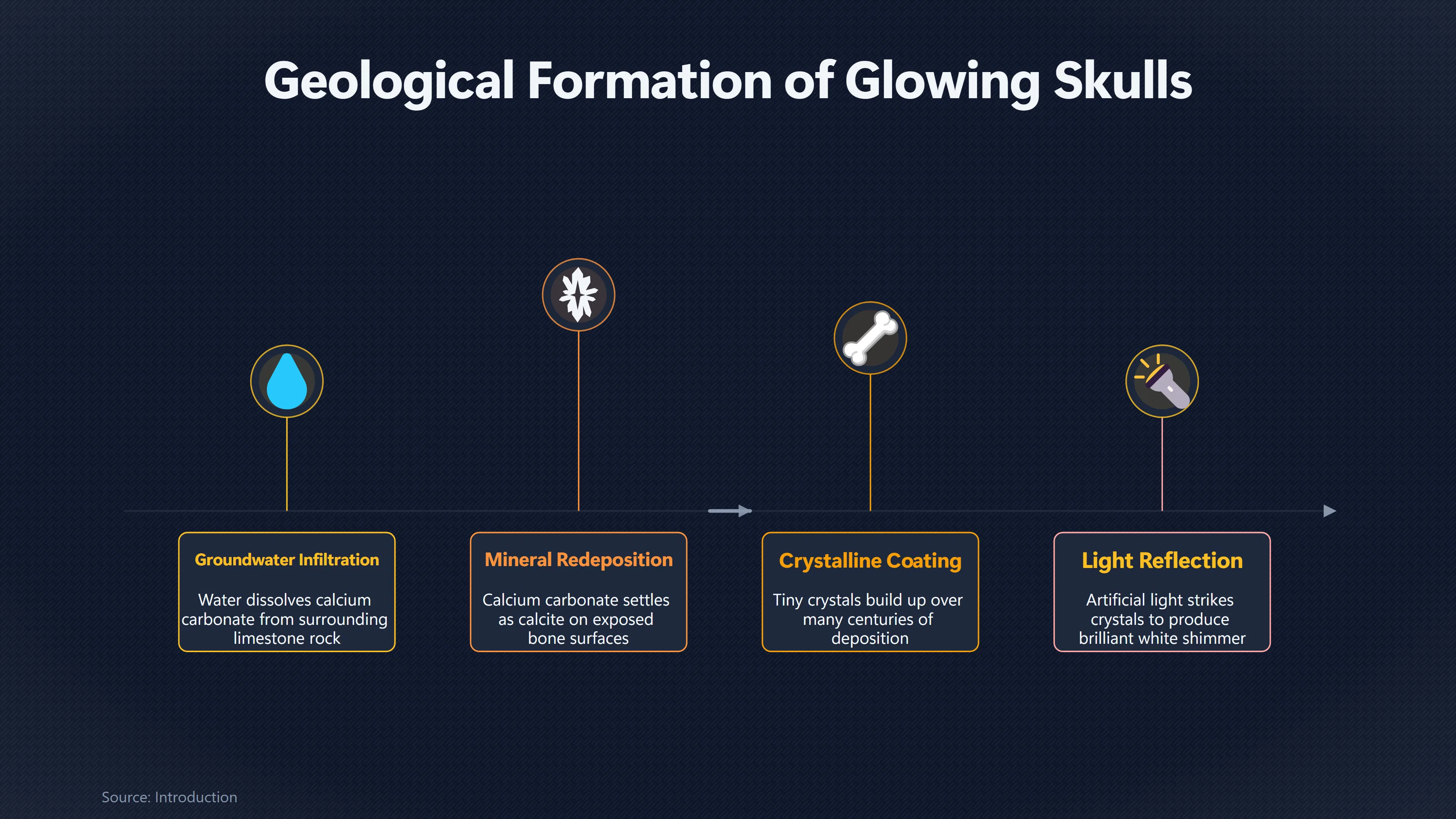
The cave lies within limestone, through which groundwater slowly dissolves calcium carbonate before redepositing it as calcite. Over many centuries this process coated exposed bones with countless tiny calcite crystals. When artificial light strikes these crystals they reflect and scatter it, producing a brilliant white shimmer that appears almost luminous in the darkness of the cave. The effect is especially striking because the surrounding chamber is otherwise almost completely dark.[RedHonduras]redhonduras.hnRed Honduras Talgua Caves Natural MonumentTalgua Caves Natural Monument - RedHonduras…
Importantly, the bones do not generate light. They are neither phosphorescent nor radioactive. Their appearance depends entirely on reflected illumination from torches or electric lighting.
The same mineral processes that created the visual effect also helped preserve many of the remains. Calcite gradually cemented bones into the cave floor, reducing movement and protecting parts of the deposit from natural decay, although other remains suffered damage from water, earlier visitors and disturbance before the site’s archaeological importance became fully recognised.[Wikipedia]WikipediaTalgua CavesTalgua Caves

What the burials reveal about ancient ritual
The scientific importance of Talgua extends well beyond its glittering bones.
Archaeological investigations indicate that the cave served as a ceremonial burial place during the Early to Middle Preclassic period, with radiocarbon dating placing much of the activity around 1000 BC. This makes the site considerably older than the famous Classic-period monuments at Copán.[Wikipedia]WikipediaTalgua CavesTalgua Caves
One of the most significant discoveries is that the cave mainly contains secondary burials. Instead of entire bodies being placed directly inside the cave, evidence suggests that people were initially buried elsewhere. After decomposition, selected bones were gathered into bundles and ceremonially transferred into the cave.
Researchers have identified numerous deposits containing the remains of multiple individuals together with pottery offerings. Several vessels appear to have been intentionally damaged before deposition—a practice archaeologists often describe as “ceremonially killed”, symbolically ending an object’s everyday use before dedicating it to ritual purposes. Many of the bones also carried traces of red ochre pigment, suggesting carefully organised funerary ceremonies rather than casual disposal of the dead.[Wikipedia]WikipediaTalgua CavesTalgua Caves
These discoveries indicate a community with established ritual traditions and considerable social organisation, even though many questions remain about its political structure and cultural identity.
Who were the people buried here?
This remains one of the genuine mysteries surrounding Talgua.
Unlike Copán, where inscriptions identify rulers and historical events, Talgua offers no written record. Archaeologists therefore reconstruct its history through pottery, burial practices, radiocarbon dating and comparisons with neighbouring regions.
Excavations have also uncovered a substantial prehistoric settlement close to the cave. Ceramic styles found there closely resemble those recovered from the burial chamber, strongly suggesting that its inhabitants used Talgua as their ceremonial cemetery. The settlement appears to have been one of the largest known in Honduras for its period, hinting that the cave served an important regional population rather than an isolated village.[Wikipedia]WikipediaTalgua CavesTalgua Caves
Researchers continue to debate how closely these communities were connected with emerging Maya societies to the west. Current evidence suggests cultural interaction without simply treating the cave’s occupants as part of the Classic Maya civilisation familiar from southern Honduras and Guatemala.[Wikipedia]WikipediaTalgua CavesTalgua Caves

From local discovery to international archaeological site
Although local residents had long known of the cave itself, the burial chamber was only brought to archaeological attention in 1994 after explorers encountered human remains deep inside the system. The discovery prompted investigations led by the Honduran Institute of Anthropology and History in collaboration with international researchers.
Subsequent excavations transformed Talgua from a little-known cave into one of Central America’s most important prehistoric mortuary sites. Archaeologists documented more than twenty burial deposits, numerous ceramic offerings and evidence of sophisticated funerary practices that significantly expanded understanding of early societies in northeastern Honduras.[Wikipedia]WikipediaTalgua CavesTalgua Caves
The discovery also highlighted the vulnerability of cave archaeology. Some remains had already been disturbed before systematic protection began, reinforcing the need for controlled access and careful conservation.
Why Talgua matters in Honduras’s curiosity culture
The enduring appeal of the “Glowing Skulls” lies in the way an entirely natural process creates an effect that feels almost supernatural.
Many unusual attractions rely on folklore, legends or modern storytelling. Talgua is different because its uncanny reputation grows directly from authentic archaeology. The sparkling bones genuinely exist, yet the explanation—slow mineral deposition over centuries—is every bit as fascinating as the original mystery.
Within Honduras’s landscape of unusual heritage, Talgua stands apart because it combines three distinct experiences in one place: a spectacular limestone cave, an ancient ceremonial cemetery and a visitor centre explaining one of the country’s most significant archaeological discoveries. Rather than diminishing the site’s atmosphere, the scientific explanation deepens appreciation of how geology preserved an extraordinary glimpse into the ritual life of a little-understood prehistoric society.
Amazon book picks
Further Reading
Books and field guides related to Why Do Talgua's Ancient Skulls Seem to Glow?. Use these as the next step if you want deeper reading beyond the article.
The Lost City of the Monkey God
Since the days of conquistador Hernán Cortés, rumours have circulated about a lost city of immense wealth hidden deep in the Honduran int...
The Archaeology of Death and Burial
The archaeology of death and burial is central to our attempts to understand vanished societies. Through the remains of funerary rituals...
Bones, Rocks and Stars
What is the Turin Shroud? When were the Pyramids built? Why did the dinosaurs die out? How did the Earth take shape? With questions like...
eBay marketplace picks
Marketplace Samples
Live-tested eBay searches with available results related to this page.
Selected fromcave art print oneBay.co.uk.




Endnotes
1.
Source: Wikipedia
Title: Talgua Caves
Link:https://en.wikipedia.org/wiki/Talgua_Caves
2.
Source: redhonduras.hn
Title: Red Honduras Talgua Caves Natural Monument
Link:https://redhonduras.hn/en/tourism/talgua-caves-natural-monument/
Source snippet
Talgua Caves Natural Monument - RedHonduras...
3.
Source: caves.org
Title: National Speleological Societyv64n1.qxd
Link:https://caves.org/wp-content/uploads/Publications/JCKS/v64/cave_64-01-fullr.pdf
Additional References
4.
Source: ijih.org
Link:https://www.ijih.org/volumes/article/987
5.
Source: atlasobscura.com
Title: HONDURAS Added By nickylopez24 Image Inside the Talgua Cave Amareto_ on F
Link:https://www.atlasobscura.com/places/the-cave-of-the-glowing-skulls-honduras
Source snippet
The Cave of the Glowing Skulls in OlanchoNovember 9, 2015 — THE CAVE OF THE GLOWING SKULLS THESE HONDURAN CAVES EARNED THEIR MAGICAL NICK...
Published: November 9, 2015
6.
Source: docslib.org
Title: Journal of Cave and Karst Studies Editor Louise D
Link:https://docslib.org/doc/7328940/journal-of-cave-and-karst-studies-editor-louise-d
Source snippet
April 1, 2002 — GIS APPLIED TO BIOARCHAEOLOGY: AN EXAMPLE FROM THE RÍO TALGUA CAVES IN NORTHEAST HONDURAS Nicholas Herrmann - GIS...
Published: April 1, 2002
7.
Source: pubmed.ncbi.nlm.nih.gov
Link:https://pubmed.ncbi.nlm.nih.gov/33657148/
Source snippet
an odd fate after death: The isolated Eneolithic cranium discovered in the Marcel Loubens Cave (Bologna, Northern Italy) - PubMedMarch 3...
8.
Source: youtube.com
Title: LOST CITY of the Monkey God | Ancient Civilizations
Link:https://www.youtube.com/watch?v=AfKoJReyAMg
Source snippet
Cave of the Glowing Skulls Dean Love Films · 18K views A mysterious cave in Honduras 🇭🇳 - The cave of the GLOWING SKULLS |S6-E53 Itchy Bo...
9.
Source: youtube.com
Title: I discovered an ancient burial site inside a Honduran cave | Cuevas de Talgua
Link:https://www.youtube.com/watch?v=u5JbSzNLlIY
Source snippet
LOST CITY of the Monkey God | Ancient Civilizations...
10.
Source: whc.unesco.org
Title: orgĦal Saflieni Hypogeum
Link:https://whc.unesco.org/en/list/130
Source snippet
2500 B.C., using cyclopean rigging to lift huge blocks of coralline limestone. Perhaps or...
11.
Source: youtube.com
Title: The Amazing Talgua Caves near Catacamas, Honduras
Link:https://www.youtube.com/watch?v=358PkraCgn0
Source snippet
I discovered an ancient burial site inside a Honduran cave | Cuevas de Talgua...
12.
Source: whc.unesco.org
Link:https://whc.unesco.org/en/tentativelists/6547
Source snippet
sites of the Azykh and Taghlar caves - UNESCO World Heritage CentreAugust 23, 2021 — PREHISTORIC SITES OF THE AZYKH AND TAGHLAR CAVES Aze...
Published: August 23, 2021
13.
Source: whc.unesco.org
Link:https://whc.unesco.org/en/tentativelists/6892/
Source snippet
Age Caves - UNESCO World Heritage CentreAugust 27, 2025 — MEGHALAYAN AGE CAVES India Date of Submission: 27/08/2025 Criteria: (vii)(viii)...
Published: August 27, 2025