Within Strange Norway
Who Should Own Norway's Sacred Sami Objects?
Confiscated drums and repatriated collections show how museums can preserve Indigenous heritage while also carrying the legacy of suppression.
On this page
- Drums, sacred objects and religious suppression
- The return of Anders Poulsen's drum
- How repatriation changes museum authority
Page outline Jump by section
Introduction
The story of Norway’s sacred Sámi objects is not simply about rare museum pieces. It is about who has the right to own, interpret and care for objects that were often seized during campaigns to suppress Indigenous religion. Among the most significant are ceremonial drums, many of which were confiscated by church and state authorities during the seventeenth and eighteenth centuries as Norway and Denmark enforced Christianisation across Sápmi. Today these drums are valued not only as historic artefacts but as living elements of Sámi cultural identity, making debates over ownership far more than routine museum disputes. They raise difficult questions about justice, historical accountability and whether museums should remain custodians of contested collections or return them to the communities from which they were taken.[University of Helsinki Research Portal]researchportal.helsinki.fiUniversity of Helsinki Research PortalAn Indigenous Sámi museum and repatriation on a Sámi drum from the XVII century - University of Hel…
Unlike many unusual museum collections, the fascination here lies less in the objects themselves than in the changing meanings attached to them. Collections once assembled to document or even celebrate the disappearance of Sámi religious traditions are increasingly being reinterpreted through Indigenous authority, with repatriation becoming part of the story visitors encounter.
Drums, sacred objects and religious suppression
Ceremonial drums occupy a unique place within Sámi cultural heritage. Traditionally used by spiritual specialists for healing, divination and communication within a broader Indigenous belief system, they became primary targets during missionary campaigns. Authorities regarded the drums as evidence of forbidden religious practice, confiscating them during trials, inspections and forced conversions. Many were destroyed, while others entered royal cabinets, university collections and national museums across Scandinavia and Europe.[University of Helsinki Research Portal]researchportal.helsinki.fiUniversity of Helsinki Research PortalAn Indigenous Sámi museum and repatriation on a Sámi drum from the XVII century - University of Hel…
This history means that surviving drums are exceptionally rare. Their scarcity is not accidental but the direct consequence of religious suppression. For museums, they have long represented valuable ethnographic objects. For many Sámi communities, however, they represent ancestors, interrupted traditions and cultural survival rather than detached historical specimens.
The debate extends beyond drums alone. Sacred objects, ritual equipment and other culturally significant belongings collected during periods of colonial administration are increasingly examined through the circumstances of their acquisition. Modern museum practice therefore asks not only whether an object was legally obtained under historical law, but whether it was taken under conditions that today would be recognised as coercive or unjust.[Siida]siida.fiSámi museum objects returning home – repatriation work with Sámi communities awarded a grant of €850,000 – SiidaJune 9, 2025…
The return of Anders Poulsen’s drum
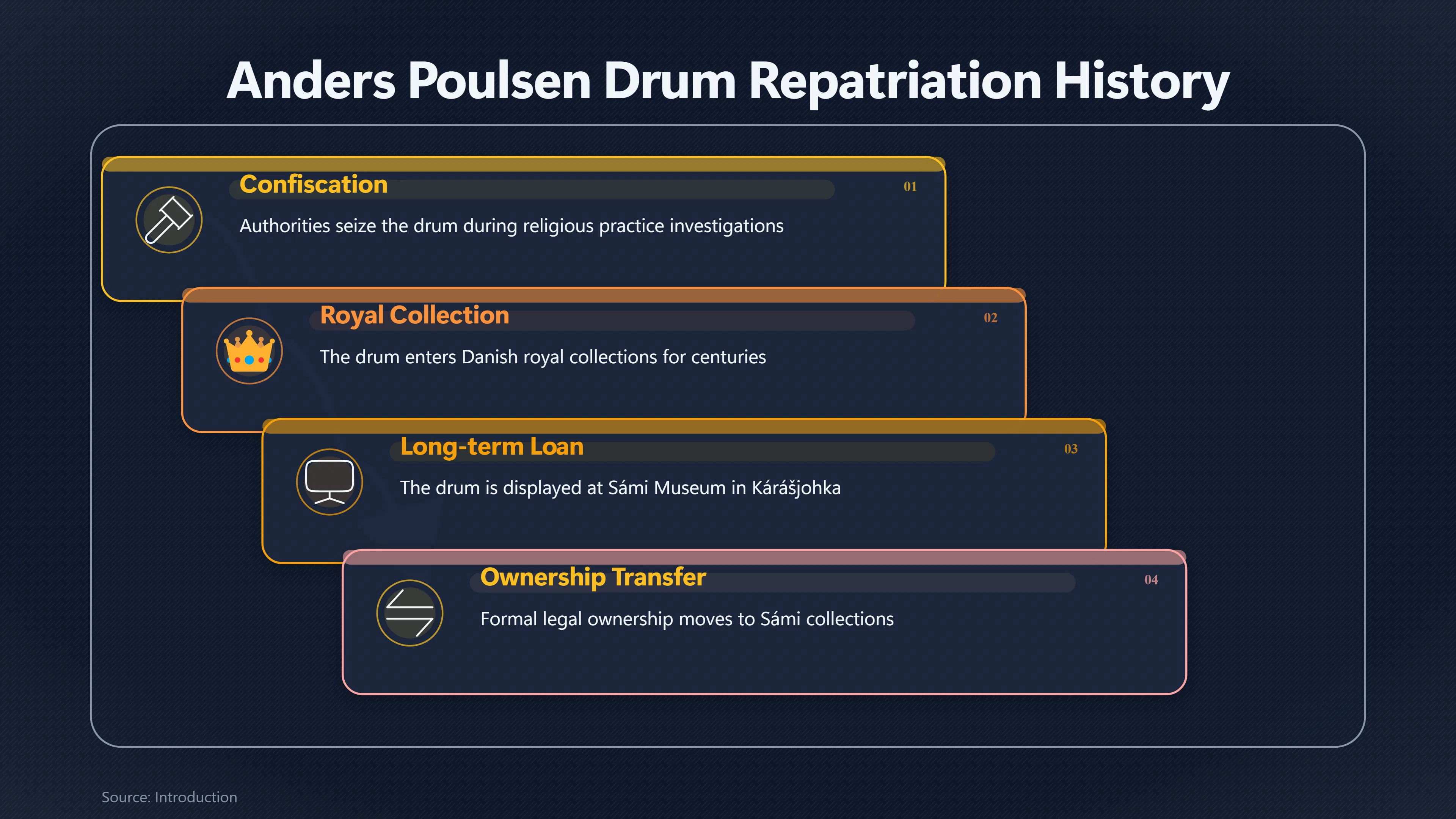
No single object illustrates these questions more clearly than the ceremonial drum belonging to Anders Poulsen (also known as Poala-Ánde), a Sámi man prosecuted in Finnmark in 1692 after authorities confiscated his drum during investigations into Indigenous religious practices.
Court records preserved an unusually detailed account of how Poulsen explained the drum’s purpose. Rather than presenting it as an instrument of harmful magic, he described it as a tool for helping people, understanding the world and seeking guidance. Before his trial concluded, he was murdered, while the confiscated drum entered the Danish royal collections and eventually became part of the National Museum of Denmark.[University of Helsinki Research Portal]researchportal.helsinki.fiUniversity of Helsinki Research PortalAn Indigenous Sámi museum and repatriation on a Sámi drum from the XVII century - University of Hel…
For decades the drum was displayed on long-term loan at the Sámi Museum in Kárášjohka (Karasjok), but ownership remained with Denmark. That distinction became increasingly important as Sámi cultural institutions argued that true repatriation required legal ownership, not merely physical access.
After years of negotiation, ownership was formally transferred in 2022 to the Sámi collections managed by RiddoDuottarMuseat. The decision marked the first international transfer of ownership of a major Sámi ceremonial object from another country’s national museum to a Sámi institution, making it an important precedent rather than simply another museum loan agreement.[rdm.no]rdm.noOpen source on rdm.no.
The significance was symbolic as well as practical. For museum professionals it demonstrated a new approach to Indigenous heritage. For many Sámi people it represented the return of an object that had never ceased to belong culturally to its community despite centuries spent elsewhere.
How repatriation changes museum authority
The return of Anders Poulsen’s drum has influenced wider thinking about museum authority throughout the Nordic region.
Historically, national museums often claimed legitimacy through conservation expertise, arguing that they could provide the best physical care for fragile artefacts. Repatriation introduces another principle: that cultural authority may belong with the community that created the object, even if another institution has preserved it for centuries.
This shift changes several assumptions:
- Ownership is distinguished from custody. Museums may conserve an object while recognising another institution or community as its rightful owner.
- Interpretation becomes collaborative. Indigenous historians, language experts and cultural practitioners increasingly shape how collections are explained to visitors.
- Collections become living heritage. Sacred objects are no longer treated solely as archaeological evidence but as parts of continuing cultural traditions.
- Museums acknowledge difficult histories. Labels increasingly explain how objects entered collections rather than presenting acquisitions as neutral or inevitable.[helsinki.fi]researchportal.helsinki.fiUniversity of Helsinki Research PortalAn Indigenous Sámi museum and repatriation on a Sámi drum from the XVII century - University of Hel…
Rather than weakening museums, many institutions argue that these changes strengthen public trust by making collection histories more transparent.
Beyond one drum: a wider movement
The Anders Poulsen case is part of a broader reassessment of Sámi cultural heritage held across Europe.
Museums in Norway, Sweden and Finland have collaborated on projects examining dispersed Sámi collections, while Sámi museums have developed exhibitions focused specifically on repatriation. One example is Ruoktot (“Returning Home”), a travelling exhibition using digital reconstructions and historical interpretation to tell the stories of ceremonial drums that have returned, alongside others that remain in foreign collections. The exhibition deliberately shifts attention from the physical artefacts alone to the journeys, negotiations and historical injustices behind them.[RiddoDuottarMuseat]rdm.noOpen source on rdm.no.
The movement has also extended beyond Scandinavia. In 2023, a South Sámi ceremonial drum confiscated around 300 years earlier was returned from a German museum to the Sámi community, recognised internationally as the first repatriation of a Sámi object from outside Scandinavia. That return demonstrated that debates over ownership now involve European museums well beyond Norway itself.[UNESCO]unesco.orgHistoric Repatriation: German Museum Returns Sacred Drum to Norway'sHistoric Repatriation: German Museum Returns Sacred Drum to Norway's…
Why these collections matter within Norway’s curiosity culture
Among Norway’s most unusual museum stories, the struggle over Sámi sacred objects stands apart because the objects themselves are not merely rare curiosities. Their significance comes from the lives they continue to shape.
Visitors expecting to see unusual artefacts instead encounter questions about colonial collecting, religious persecution and Indigenous rights. A ceremonial drum can simultaneously be a beautiful museum object, a historical document, legal evidence, a sacred cultural possession and a symbol of survival.
That complexity explains why repatriation has become part of the exhibition itself. The most compelling story is no longer simply how these remarkable objects survived, but how museums are reconsidering who has the authority to own, interpret and care for them in the future.
Amazon book picks
Further Reading
Books and field guides related to Who Should Own Norway's Sacred Sami Objects?. Use these as the next step if you want deeper reading beyond the article.
Decolonizing Museums: Representing Native America in National...
Museum exhibitions focusing on Native American history have long been curator controlled. However, a shift is occurring, giving Indigenou...
Sámi Musical Performance and the Politics of Indigeneity in N...
The Sámi are Europe’s only recognized indigenous people living across regions of Norway, Sweden, Finland and the Russian Kola peninsula....
The Indigenous World
"This yearbook contains a comprehensive update on the current situation of indigenous peoples and their human rights, and provides an ove...
eBay marketplace picks
Marketplace Samples
Live-tested eBay searches with available results related to this page.
Selected fromScandinavian collectible oneBay.co.uk.

Endnotes
1.
Source: researchportal.helsinki.fi
Link:https://researchportal.helsinki.fi/en/publications/an-indigenous-s%C3%A1mi-museum-and-repatriation-on-a-s%C3%A1mi-drum-from-th/
Source snippet
University of Helsinki Research PortalAn Indigenous Sámi museum and repatriation on a Sámi drum from the XVII century - University of Hel...
2.
Source: unesco.org
Title: Historic Repatriation: German Museum Returns Sacred Drum to Norway’s
Link:https://www.unesco.org/en/articles/historic-repatriation-german-museum-returns-sacred-drum-norways-sami-people?hub=686
Source snippet
Historic Repatriation: German Museum Returns Sacred Drum to Norway's...
3.
Source: siida.fi
Link:https://siida.fi/en/releases/sami-museum-objects-returning-home-repatriation-work-with-sami-communities-awarded-a-grant-of-e850000/
Source snippet
Sámi museum objects returning home – repatriation work with Sámi communities awarded a grant of €850,000 – SiidaJune 9, 2025...
Published: June 9, 2025
4.
Source: researchportal.helsinki.fi
Link:https://researchportal.helsinki.fi/en/publications/le-rapatriement-dun-tambour-s%C3%A1mi-du-xviie-si%C3%A8cle-dans-un-mus%C3%A9e-au/
5.
Source: rdm.no
Link:https://rdm.no/en/de_samiske_samlinger-2/ruoktot-50ars-jubileumsutstilling-til-de-samiske-samlinger/
6.
Source: rdm.no
Link:https://rdm.no/no/de_samiske_samlinger/ruoktot-50ars-jubileumsutstilling-til-de-samiske-samlinger/
Additional References
7.
Source: theguardian.com
Link:https://www.theguardian.com/commentisfree/2022/apr/15/the-guardian-view-on-returning-a-sami-shamans-drum-a-sign-of-hope
Source snippet
The drum, confiscated in 1691 during a period of forced Christianization, belonged to a shaman named Poala-Ánde, who used it for spiritua...
8.
Source: visitnorway.com
Title: Visit Norway Ruoktot – The Return of Sámi Drums (Saemiene)
Link:https://www.visitnorway.com/events//ruoktot-the-return-of-sami-drums-saemiene/504253/
Source snippet
Ruoktot – The Return of Sámi Drums (Saemiene)February 27, 2025 — RUOKTOT – THE RETURN OF SÁMI DRUMS (SAEMIENE) February 27, 2025 - May 23...
Published: February 27, 2025
9.
Source: youtube.com
Title: The Drum That No One Was Allowed to Strike | Apocryphal File 005
Link:https://www.youtube.com/watch?v=6tzppX94Grw
Source snippet
Sami drum repatriation museum Sápmi Norway Why You Could Die If You Played This Drum #sami #samipeople #sapmi #indigenouseurope #repatria...
10.
Source: visitnorway.de
Title: Ruoktot – The Return of Sámi Drums (Saemiene)
Link:https://www.visitnorway.de/events//ruoktot-the-return-of-sami-drums-saemiene/504253
Source snippet
Februar 2025 - 23. Mai 2027 * Image Kontakt * 27. Februar 2025 - 23. Mai 2027 * Senden Sie uns eine E-Mail * 74 13 80 00 Saemien Sijte, S...
11.
Source: sametinget.no
Title: Innlegg på seminaret Ruoktot
Link:https://sametinget.no/politikk/taler-og-innlegg/innlegg-pa-seminaret-ruoktot-tilbakeforing-av-samiske-trommer.49094.aspx
Source snippet
tilbakeføring av samiske trommer - SametingetJune 11, 2026 — INNLEGG PÅ SEMINARET RUOKTOT - TILBAKEFØRING AV SAMISKE TROMMER INNLEGG PÅ S...
Published: June 11, 2026
12.
Source: youtube.com
Title: From Lapland To Sápmi — Book Talk with Barbara Sjoholm
Link:https://www.youtube.com/watch?v=nRD_gW8zjrM
Source snippet
The Drum That No One Was Allowed to Strike | Apocryphal File 005...
13.
Source: erudit.org
Link:https://www.erudit.org/en/journals/reauto/2021-v51-n1-reauto07273/
14.
Source: nordlandsmuseet.no
Link:https://www.nordlandsmuseet.no/en/samling-1/samisk-tromme
15.
Source: theguardian.com
Link:https://www.theguardian.com/world/2021/oct/13/sami-people-norway-ask-danish-queen-to-return-sacred-witchcraft-trial-drum
16.
Source: researchgate.net
Link:https://www.researchgate.net/publication/329584426_The_Disappearance_of_the_Sacred_Swedish_Sami_Drum_and_the_Protection_of_Sami_Cultural_Heritage_Research_into_Sami_History_and_Cultural_Heritage