Where Bosnia Keeps Its Strangest Histories
Bosnia and Herzegovina does not have a well-documented national network of witchcraft museums, cryptid collections or purpose-built cabinets of medical horrors.
Page outline Jump by section
Introduction
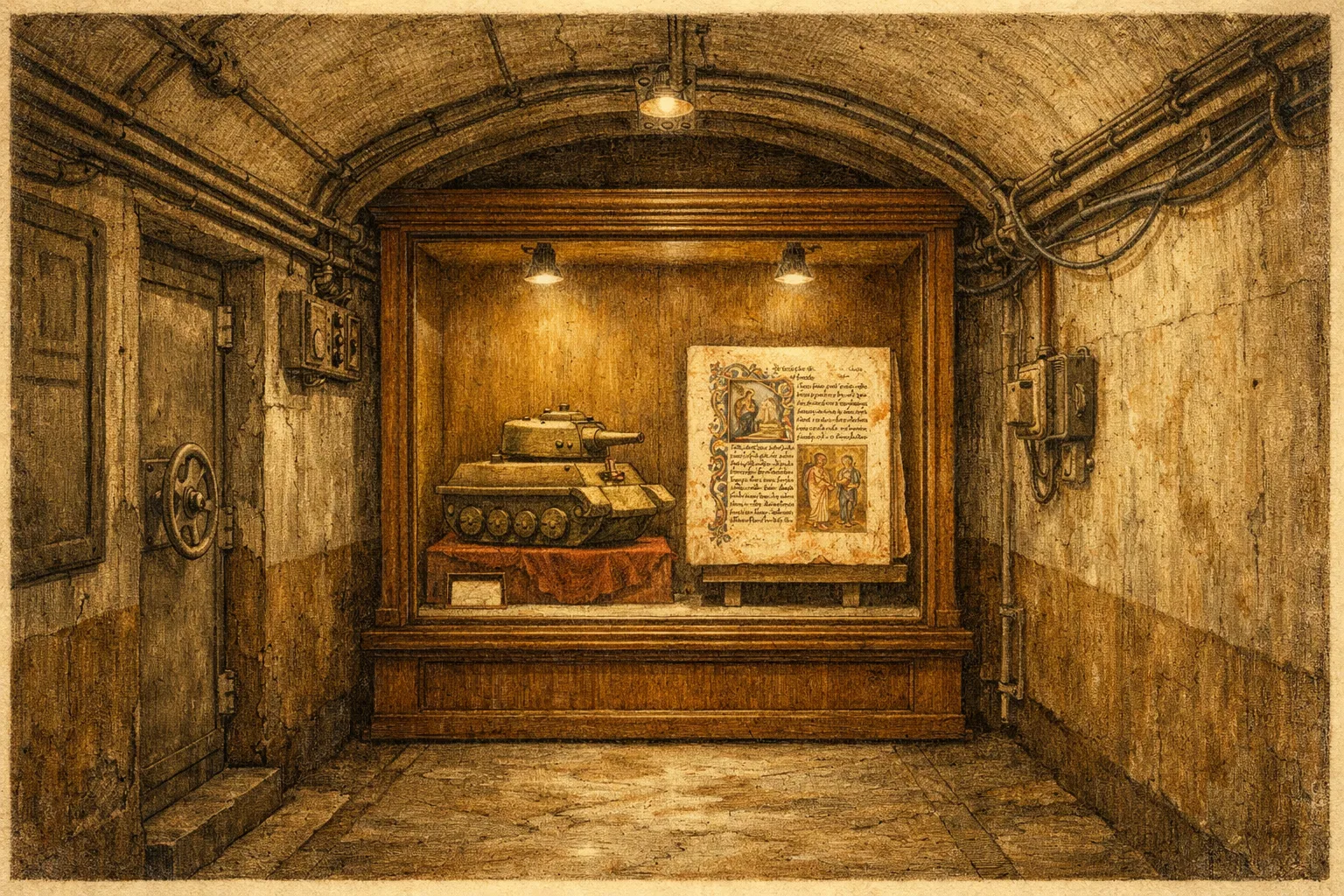
For visitors, the strongest examples fall into four groups: Cold War and siege structures preserved almost in place; personal-object museums built around testimony; religious treasuries whose manuscripts and relic-like documents have acquired near-symbolic status; and pilgrimage landscapes where faith, tourism and unresolved supernatural claims overlap. These institutions vary greatly in authority. Some are state or academically curated museums, some remain connected to religious communities or military property, and others are visitor-facing attractions built around living belief.[unesco.org]unesco.orgProject D-0 ARKAn artistic collaboration turns…23 Jun 2021 — The publication is a ten-year retrospective of the “Project D – 0 Ark”, known today as t…
The nuclear bunker that became an art museum
The clearest answer to “What is Bosnia and Herzegovina’s strangest museum?” is ARK D-0 near Konjic, commonly called Tito’s bunker. Constructed by the Yugoslav military between 1953 and 1979, the vast underground command shelter was intended to protect President Josip Broz Tito and senior military and political personnel during a nuclear attack. Its roughly 6,500 square metres contain interconnected residential, communications, command and technical areas, creating the impression of a sealed subterranean settlement rather than a conventional exhibition building.[biennialfoundation.org]biennialfoundation.orgBiennial FoundationD-0 ARK Biennial (Bosnia and Herzegovina)The Project Biennial of Contemporary Art, D-0 ARK Underground was organized i…
What makes ARK D-0 unusual is that its machinery, corridors, conference rooms and private quarters are not merely backdrops. The bunker itself is the principal artefact. Visitors move through an environment designed around secrecy, hierarchy and anticipated apocalypse, with much of its original military character still legible. Public access is normally organised through guided visits, reflecting both the complexity of the site and its continuing status as controlled heritage rather than an abandoned ruin open for casual exploration.[wikipedia.org]WikipediaArmijska Ratna Komanda D-0Armijska Ratna Komanda D-0
The bunker also operates as a hybrid contemporary-art and military museum. Beginning in 2011, the D-0 ARK Underground project brought artists and curators into the complex, installing works that respond to Cold War power, surveillance, confinement and collective memory. UNESCO has described the project as an international artistic collaboration that turned the nuclear shelter into an art gallery, while the project itself presents the bunker as a combined military museum and contemporary exhibition space.[unesco.org]unesco.orgProject D-0 ARKAn artistic collaboration turns…23 Jun 2021 — The publication is a ten-year retrospective of the “Project D – 0 Ark”, known today as t…
That artistic layer changes the visit. A purely technical museum might celebrate engineering ingenuity; an untouched bunker might invite Cold War nostalgia or simple astonishment. The installations instead encourage visitors to question why such enormous resources were devoted to protecting a political elite, what sort of future the bunker imagined, and how a secret state facility should be interpreted after the state that built it has disappeared. The result is credible as preserved military heritage, but deliberately unsettled as historical storytelling: the art prevents the rooms from becoming neutral scenery.
Sarajevo’s underground museum of survival
Sarajevo’s Tunnel of Hope is another museum in which the location carries more force than any detachable object. During the siege of Sarajevo, a tunnel was dug beneath the airport to connect the encircled city with territory outside the siege lines. A preserved section, associated buildings, photographs, equipment and interpretive displays now form the Tunnel D-B Memorial Complex, administered by the Sarajevo Memorial Centre.[mcsarajevo.ba]tunelspasa.baOpen source on tunelspasa.ba.
The museum is unusual because an improvised piece of wartime infrastructure has become both evidence and exhibition. Visitors are not simply shown maps of the siege; they enter part of the narrow passage through which people, food, medicine, weapons, fuel and information moved. Its low ceiling and confined dimensions make the physical reality of the route immediately understandable, although the accessible portion is only a fragment of the original tunnel.
This is neither an eccentric private collection nor a theatrical haunted attraction. It is a public memorial site interpreting a recent conflict whose causes, terminology and political legacy remain sensitive. Its strongest exhibits are practical objects: tools, containers, communications equipment and photographs showing how an extraordinary underground system functioned. The curatorial challenge is to preserve the ingenuity of civilian survival without turning the siege into an adventure story. The site matters within Bosnia and Herzegovina’s curiosity landscape because it reveals how an apparently mundane structure can become one of a city’s most charged historical objects.
ARK D-0 and the Tunnel of Hope make a revealing pair. The Konjic bunker was secret, expensive and designed from above to shelter state leadership from a hypothetical catastrophe. The Sarajevo tunnel was improvised under siege to sustain a city during an actual catastrophe. One embodies planned elite survival; the other, collective endurance. Seen together, they form an unusually powerful underground history of twentieth-century Bosnia and Herzegovina.

When toys and small belongings become evidence
The War Childhood Museum in Sarajevo takes a very different approach. Rather than reconstructing military operations, it collects personal belongings and recorded testimony from people whose childhoods were affected by war. Its Bosnian collection includes more than 5,000 objects, among them toys, books, letters, photographs, improvised clothing and other possessions whose significance comes from the story attached to them.[War Childhood]warchildhood.orgOpen source on warchildhood.org.
A single object may appear ordinary until its owner explains how it was used during shelling, displacement, bereavement or prolonged scarcity. This pairing of material evidence with first-person memory gives the museum the intimate atmosphere of a collective memory box. Accounts are generally presented without overwhelming visitors with military chronology, shifting attention from commanders and territorial changes towards the routines, inventions and fears of children.
The museum is professionally curated rather than merely sentimental. Objects and audio-visual testimony are preserved for exhibition, education and research, and the collection has expanded beyond Bosnia and Herzegovina to include childhood experiences from other conflicts. That broader scope allows comparison without erasing the institution’s origins in the Bosnian war.[warchildhood.org]warchildhood.orgOpen source on warchildhood.org.
Its strangeness is ethical rather than sensational. A toy, diary or scrap of cloth becomes museum-worthy not because it is rare or beautiful, but because it carries an experience that official records may fail to preserve. For visitors interested in unusual collections, this is an important corrective to the traditional cabinet of curiosities: the value of the object rests not in exoticism but in testimony.
The Sarajevo Haggadah and the power of a single object
The National Museum of Bosnia and Herzegovina is a large scholarly institution covering archaeology, ethnology and natural history, but its most famous object has the aura of a treasure kept apart from the ordinary flow of the galleries. The Sarajevo Haggadah is an illuminated Jewish manuscript made on parchment, containing 142 leaves and a remarkable cycle of biblical miniatures. It was probably produced in medieval Spain and later travelled through Jewish exile and migration before reaching Sarajevo.[Zemaljski muzej BiH]zemaljskimuzej.baOpen source on zemaljskimuzej.ba.
Its appeal is partly visual, but its modern history has made it a symbol of survival. The manuscript endured the expulsion of Jews from Iberia, later persecution and the upheavals of twentieth-century Bosnia. It has consequently accumulated stories of rescue, concealment and intercommunal protection. The museum itself presents the book as evidence of a society capable of preserving the heritage of religious communities other than the majority.[Zemaljski muzej BiH]zemaljskimuzej.baZemaljski muzej Bi HNew Edition of the Sarajevo Haggadah Reprint and StudyZemaljski muzej Bi HNew Edition of the Sarajevo Haggadah Reprint and Study
Visitors should not assume that the original is continuously displayed like an ordinary book. Because of its fragility and value, access is restricted to scheduled viewing periods in a protected room; the museum publishes specific days and times for seeing it. Current arrangements should be checked directly before travelling.[Zemaljski muzej BiH]zemaljskimuzej.baOpen source on zemaljskimuzej.ba.
The Haggadah is unusual not because its provenance is paranormal or unexplained, but because one small manuscript has become a container for several histories at once: medieval Jewish art, Sephardic displacement, Sarajevo’s multicultural identity and the repeated danger of cultural destruction. It also demonstrates how the country’s most compelling curiosity objects often gain meaning through survival rather than mystery.
Franciscan monasteries as living cabinets of memory
Some of Bosnia and Herzegovina’s richest collections remain inside functioning Franciscan monasteries. These institutions combine church, archive, library and museum, often preserving objects accumulated over centuries rather than assembled according to a modern collecting plan. Their displays can therefore feel closer to historic treasuries or cabinets of memory than to streamlined national museums.
The Franciscan monastery at Fojnica is the leading example. Its holdings include early printed books, manuscripts, Ottoman documents, coins, weapons, paintings, church objects and regional costume. Sources describe a library of thousands of volumes, including incunabula—books printed in Europe before 1501—and works written in historic Bosnian scripts. The archive also preserves thousands of Ottoman-era documents.[resilience-ri.eu]resilience-ri.eutreasures from eastern europe franciscan monastery fojnicatreasures from eastern europe franciscan monastery fojnica
The best-known object is a charter traditionally associated with Sultan Mehmed II’s conquest of Bosnia in 1463, granting protection and religious freedom to the Franciscans. Within the monastery, it functions as far more than an administrative document: it is treated as a foundational witness to the community’s survival under Ottoman rule. The collection also contains the Fojnica Armorial, a heraldic manuscript whose dating and historical reliability require care. Later copies and competing interpretations mean it should not be treated as a straightforward medieval register of noble families.[go-bosnia.com]go-bosnia.comGo Bosnia – Bosna na dlanu!Franciscan Monastery in FojnicaGo Bosnia – Bosna na dlanu!Franciscan Monastery in Fojnica
That mixture of devotional importance, political symbolism and scholarly uncertainty is precisely what makes Fojnica valuable to curiosity-minded visitors. The monastery is not presenting a hoax collection, yet some objects have acquired reputations larger and cleaner than their documented provenance allows. A responsible visit distinguishes the physical manuscript from later claims made about it.
Other Franciscan museums extend this pattern. The museum at Humac, established in the nineteenth century, preserves archaeological material gathered around the monastery and is often described as the country’s oldest museum. Its identity is inseparable from local collecting by friars, showing how religious houses served as early archaeological repositories before modern state institutions were fully developed.[Museums.EU]museums.euOpen source on museums.eu.
These monastery museums are public-facing but remain living religious environments. Opening arrangements may be more limited or less standardised than at major city museums, and interpretation may reflect both academic research and the spiritual identity of the custodians. Visitors should approach them neither as neutral archaeological stores nor as mere collections of sacred relics, but as institutions where scholarship, communal memory and devotion overlap.

Icons, reliquaries and sacred craftsmanship
Sarajevo’s Museum of the Old Orthodox Church offers another concentrated religious collection. Its holdings include icons, liturgical vestments and gold and silver church objects, with works from both local traditions and wider Orthodox artistic networks, including icons associated with Crete.[Museums.EU]museums.euOpen source on museums.eu.
To a visitor accustomed to secular galleries, such a treasury may resemble a cabinet of precious and mysterious objects. Yet the exhibits were not originally made as curiosities. Icons are devotional images, and vessels, garments and metalwork were created for worship. Their unusual power in a museum setting comes from the tension between religious function and art-historical display.
The collection also helps explain why Bosnia and Herzegovina’s curiosity culture cannot be separated neatly into ethnic or religious compartments. Manuscripts, icons, Catholic archives, Islamic documents and Jewish books survived through overlapping systems of custody, trade and protection. Their meanings today are shaped by both the communities that venerate them and the museums that catalogue them.
Medjugorje: belief, souvenirs and an unresolved apparition
Medjugorje, in western Herzegovina, is not primarily a museum. It is a pilgrimage centre built around claims that six young people began seeing the Virgin Mary in 1981. The reported apparitions transformed a relatively small settlement into an international religious destination of churches, prayer sites, devotional businesses, hotels and shops selling rosaries, statues, medals, bottles and printed messages.[Wikipedia]WikipediaOpen source on wikipedia.org.
For a project concerned with strange public collections, Medjugorje matters because the entire town operates as a living economy of sacred objects and testimony. Devotional items are purchased, blessed, carried home and incorporated into private collections. Written messages attributed to the apparition circulate as spiritual texts. Stones, photographs and objects associated with pilgrimage journeys may acquire personal relic-like status even when they have no formal standing as church relics.
The credibility question requires precision. In September 2024, the Vatican authorised devotion and pilgrimages connected with Medjugorje by issuing a favourable pastoral judgement. It did not authenticate the alleged apparitions as supernatural. The decision recognised positive spiritual effects associated with the site while advising caution towards purported messages and claims. Catholics may participate in the devotion, but they are not required to accept the visions as genuine appearances of Mary.[reuters.com]reuters.comWhile the pope has not confirmed the authenticity of the apparitions, he highlights the positive spiritual outcomes for Catholics from th…
This distinction is often blurred by pilgrimage marketing. Believers may speak of the apparitions as fact; sceptics may treat the whole landscape as commercialised folklore; the Catholic authorities occupy a more careful position, permitting devotion without confirming the supernatural explanation. For visitors interested in unusual religion, Medjugorje is therefore less a museum of an established miracle than a vast, still-developing archive of belief, testimony, objects and commerce.
Medieval tombstones and speculative meanings
Bosnia and Herzegovina is also known for its medieval carved tombstones, many decorated with figures, animals, weapons, geometric patterns and celestial motifs. Large groups survive in open-air burial grounds, making the landscape itself a dispersed archaeological collection. The stones are firmly established historical monuments, but their imagery has encouraged interpretations ranging from cautious art history to claims about secret religions, ancient astronomical knowledge or coded symbolism.
One particularly speculative proposal suggests that motifs on some tombstones might preserve a European memory of the supernova observed in 1054. The researchers involved present the carvings as possible evidence rather than proof, attempting to compare celestial designs with reconstructed historical skies. The hypothesis is intriguing but should not be presented as a settled reading of the stones.[arXiv]arxiv.orgOpen source on arxiv.org.
This is a useful example of how archaeological anomalies are created. The objects themselves are authentic; the uncertainty lies in interpretation. Repeated symbols do not automatically form a decipherable code, and later viewers may impose astronomical or esoteric systems that the makers never intended. For curiosity travellers, the rewarding approach is to enjoy the strange imagery while separating documented archaeological context from modern speculation.
Smaller curiosities beyond the main museums
Not every unusual Bosnian collection occupies a formal gallery. Trebinje preserves a rare Austro-Hungarian pigeon post office, now associated with the Museum of Herzegovina. Built for military communications, it once housed messenger pigeons linking the area with wider administrative networks. The birds have gone, but the restored structure survives as a monument to an obsolete communications system.[WIRED]wired.comDead Media Beat: a pigeon post-office building standing in BosniaDead Media Beat: a pigeon post-office building standing in Bosnia
Its appeal is modest but genuine: it is an architectural remnant of “dead media”, preserving the physical infrastructure of a technology that has almost vanished from public memory. Unlike Tito’s bunker, it was not designed for nuclear command; unlike the Sarajevo tunnel, it did not arise from emergency improvisation. It represents the quieter oddity of a system that was once practical and is now difficult to imagine as routine.
Commercial attractions also exist, including illusion-based and immersive visitor experiences in Sarajevo. These can be entertaining, but they should be distinguished from collections with historic provenance. An optical-illusion attraction generally presents designed perceptual effects rather than preserving Bosnian scientific instruments, folk magic or historical anomalies. It belongs to tourist entertainment more than to the country’s museum heritage.
What Bosnia and Herzegovina does not currently offer
Reliable public evidence for a permanent Bosnian museum devoted specifically to witchcraft, occult practice, cryptids, UFOs, spiritualism, medical deformities or criminal curiosities is sparse. Individual ethnographic collections may contain amulets, ritual objects, folk beliefs or protective practices, but they are usually embedded within broader displays of domestic life, religion and regional custom rather than framed as museums of the supernatural.
That absence should not be filled with invented attractions or inflated claims. Bosnia and Herzegovina has abundant folklore, sacred landscapes and stories of supernatural beings, but folklore traditions are not automatically represented by dedicated museums. Visitors searching for a “Bosnian monster museum” or “Sarajevo witchcraft museum” should be wary of recycled travel listings, temporary exhibitions and attractions whose names have been mistranslated or exaggerated.
The stronger route into the country’s uncanny heritage is through ethnology, religious collections and place-based storytelling. Protective objects, legends, funerary customs and beliefs about illness or misfortune are more likely to appear within regional museums, monastery treasuries and historic houses than in a single specialist institution. This fragmented model is less immediately marketable, but it more accurately reflects how unusual beliefs have been preserved.
How to judge the collections
Bosnia and Herzegovina’s unusual sites reward visitors who ask what kind of authority each institution possesses. The following distinctions are especially useful:
- Preserved historic environment: ARK D-0 and the Tunnel of Hope are powerful because the structure itself survives. Interpretation may change, but the physical setting provides unusually direct evidence.
- Testimony-based collection: The War Childhood Museum depends on the relationship between donated objects and personal accounts. The story is part of the artefact’s meaning.
- Academic museum: The National Museum uses professional conservation and archaeological or art-historical research, although individual objects such as the Sarajevo Haggadah also carry powerful public symbolism.
- Religious treasury: Franciscan and Orthodox collections preserve authentic historical material, but displays may combine scholarly description with devotional or communal interpretation.
- Living pilgrimage culture: Medjugorje is public, commercial and religious at once. Its importance is undeniable, while the supernatural explanation remains unconfirmed.
- Speculative interpretation: Claims about coded tombstone imagery or other archaeological mysteries should be presented as hypotheses unless supported by a broad scholarly consensus.
These categories can overlap. Tito’s bunker is simultaneously military heritage, an art venue and a tourist attraction. Fojnica is a monastery, archive, museum and symbol of communal continuity. Medjugorje is both a place of prayer and an international souvenir economy. The overlap is not a flaw; it is one of the defining features of the country’s curiosity landscape.
Why these collections matter
Bosnia and Herzegovina’s strangest museums are not united by monsters, magic or theatrical horror. They are united by preservation under pressure. A manuscript survives expulsion and war. A monastery archive safeguards documents across changing empires. A nuclear shelter outlives the political system that commissioned it. A child’s toy becomes evidence of life under siege. A pilgrimage town develops around claims that remain neither formally authenticated nor simply dismissed.
This gives the country a distinctive place in European curiosity culture. Its unusual collections are often serious, emotionally demanding and politically layered. They ask visitors to examine who was expected to survive, whose memories enter museums, which sacred claims receive institutional approval, and how ordinary objects become symbols after catastrophe.
For the offbeat traveller, the most memorable itinerary is therefore not a conventional list of “weird museums”. It is a route through different forms of belief and evidence: from the engineered paranoia of ARK D-0, through Sarajevo’s intimate records of siege and childhood, to the guarded Haggadah, monastery treasuries and the unresolved devotional landscape of Medjugorje. Together they show a country where curiosity is inseparable from secrecy, survival and the contested ownership of the past.
Amazon book picks
Further Reading
Books and field guides related to Where Bosnia Keeps Its Strangest Histories. Use these as the next step if you want deeper reading beyond the article.
Bosnia: A Short History
This work aims to set the war in the Balkans in its full historical and political context. This edition includes a chapter covering the e...
The Cellist of Sarajevo
The Top 10 International Bestseller Snipers in the hills overlook the shattered streets of Sarajevo. Knowing that the next bullet could s...
The Cold War
Rating: 4.0/5 from 10 Google Books ratings
Beginning with World War II and ending with the collapse of the Soviet Union, the author provides a thrilling account of the strategic dy...
eBay marketplace picks
Marketplace Samples
Live-tested eBay searches with available results related to this page.
Selected fromBosnia art print oneBay.co.uk.
Endnotes
1.
Source: unesco.org
Title: Project D-0 ARK 1-2-3-4-5
Link:https://www.unesco.org/en/articles/project-d-0-ark-1-2-3-4-5-artistic-collaboration-turns-nuclear-bunker-art-gallery
Source snippet
An artistic collaboration turns...23 Jun 2021 — The publication is a ten-year retrospective of the “Project D – 0 Ark”, known today as t...
2.
Source: reuters.com
Link:https://www.reuters.com/world/europe/pope-francis-allows-devotion-medjugorje-where-virgin-mary-said-appear-2024-09-19/
Source snippet
While the pope has not confirmed the authenticity of the apparitions, he highlights the positive spiritual outcomes for Catholics from th...
3.
Source: Wikipedia
Title: Armijska Ratna Komanda D-0
Link:https://en.wikipedia.org/wiki/Armijska_Ratna_Komanda_D-0
4.
Source: bijenale.ba
Title: Project D-0 ARKProject Description
Link:https://bijenale.ba/
5.
Source: resilience-ri.eu
Title: treasures from eastern europe franciscan monastery fojnica
Link:https://www.resilience-ri.eu/blog/treasures-from-eastern-europe-franciscan-monastery-fojnica/
6.
Source: Wikipedia
Title: Franciscan friary, Fojnica
Link:https://en.wikipedia.org/wiki/Franciscan_friary%2C_Fojnica
7.
Source: museums.eu
Link:https://museums.eu/museum/details/300
8.
Source: museums.eu
Link:https://museums.eu/museum/details/290
9.
Source: Wikipedia
Link:https://en.wikipedia.org/wiki/Medjugorje
10.
Source: arxiv.org
Link:https://arxiv.org/abs/2105.02119
11.
Source: wired.com
Title: Dead Media Beat: a pigeon post-office building standing in Bosnia
Link:https://www.wired.com/beyond-the-beyond/2019/08/dead-media-beat-pigeon-post-office-building-standing-bosnia
12.
Source: Wikipedia
Title: Bosnia and Herzegovina
Link:https://en.wikipedia.org/wiki/Bosnia_and_Herzegovina
13.
Source: Wikipedia
Title: List of museums in Bosnia and Herzegovina
Link:https://en.wikipedia.org/wiki/List_of_museums_in_Bosnia_and_Herzegovina
14.
Source: Wikipedia
Title: Josip Broz Tito
Link:https://en.wikipedia.org/wiki/Josip_Broz_Tito
15.
Source: museums.eu
Link:https://museums.eu/museum/details/292
16.
Source: museums.eu
Link:https://museums.eu/collection/object/243207?pDashed=emo&pUnitId=31
17.
Source: museums.eu
Link:https://museums.eu/collection/object/283775/10-lir?pUnitId=31
18.
Source: museums.eu
Link:https://museums.eu/collection/object/243221/znacka
19.
Source: museums.eu
Link:https://museums.eu/museum/details/6323
20.
Source: museums.eu
Link:https://museums.eu/museum/details/296
21.
Source: museums.eu
Link:https://museums.eu/collection/object/241694/edigs-romi?pUnitId=31
22.
Source: museums.eu
Link:https://museums.eu/collection/object/283105/mbozic-linhartova-ulica?pUnitId=31
23.
Source: museums.eu
Link:https://museums.eu/collection/object/7705/cedilo
24.
Source: medjugorje.org
Title: The Medjugorje Web
Link:https://www.medjugorje.org/
25.
Source: muzej.ba
Link:https://muzej.ba/en/
26.
Source: medjugorje.ws
Title: Web Site
Link:https://www.medjugorje.ws/
27.
Source: bunker.ba
Title: TITO V BUNKER (ARK D-0) je OTVOREN za posjete
Link:https://www.bunker.ba/
28.
Source: zemaljskimuzej.ba
Title: Zemaljski muzej Bi HHome
Link:https://zemaljskimuzej.ba/en/
Source snippet
Zemaljski muzej BiHHome - Zemaljski muzej BiHThe Sarajevo Haggadah Available for Visits Again. Opening hours Tuesday to Friday: 10:00 – 1...
29.
Source: warchildhood.org
Link:https://warchildhood.org/bosnian-collection/
Source snippet
War ChildhoodWar Childhood Museum Bosnian Collectionincludes over 5,000 objects. This growing collection, that consists of objects such a...
30.
Source: biennialfoundation.org
Link:https://biennialfoundation.org/biennials/d-0-ark-biennial-bosnia-and-herzegovina/
Source snippet
Biennial FoundationD-0 ARK Biennial (Bosnia and Herzegovina)The Project Biennial of Contemporary Art, D-0 ARK Underground was organized i...
31.
Source: exploremostar.com
Title: ark d 0
Link:https://exploremostar.com/ark-d-0/
32.
Source: tunelspasa.ba
Link:https://tunelspasa.ba/
33.
Source: warchildhood.org
Link:https://warchildhood.org/global-collection/
34.
Source: routedmagazine.com
Title: stories war childhood museum
Link:https://www.routedmagazine.com/stories-war-childhood-museum
35.
Source: zemaljskimuzej.ba
Link:https://zemaljskimuzej.ba/en/item/sarajevo-haggadah/
36.
Source: zemaljskimuzej.ba
Title: Zemaljski muzej Bi HArchaeology Department
Link:https://zemaljskimuzej.ba/en/departments/archaeology-department/
37.
Source: zemaljskimuzej.ba
Title: Zemaljski muzej Bi HNew Edition of the Sarajevo Haggadah Reprint and Study
Link:https://zemaljskimuzej.ba/en/new-edition-of-the-sarajevo-haggadah-reprint-and-study-available/
38.
Source: zemaljskimuzej.ba
Title: visit the national museum of bh and see original manuscript of sarajevo haggadah
Link:https://zemaljskimuzej.ba/en/visit-the-national-museum-of-bh-and-see-original-manuscript-of-sarajevo-haggadah/
39.
Source: zemaljskimuzej.ba
Link:https://zemaljskimuzej.ba/en/admission/
40.
Source: balkaninsight.com
Title: bosnia and herzegovina
Link:https://balkaninsight.com/2017/04/14/fojnica-monks-stand-guard-over-bosnia-s-rich-history-04-13-2017/bi/bosnia-and-herzegovina/
41.
Source: vlada.gov.hr
Link:https://vlada.gov.hr/croatian-pm-opens-reconstructed-museum-in-franciscan-monastery-in-bosnia/16058
42.
Source: go-bosnia.com
Title: Go Bosnia – Bosna na dlanu!Franciscan Monastery in Fojnica
Link:https://go-bosnia.com/en/entity/franciscan-monastery-fojnica/
43.
Source: apnews.com
Link:https://apnews.com/article/be65969f636c3055cd3b7b260e1fc412
Source snippet
1. Our Lady of Guadalupe in Mexico (1531), where Juan Diego's visions led to the creation of an image of the Virgin on his cloak. 2. Lour...
44.
Source: apnews.com
Link:https://apnews.com/article/f9b5659e2947e7eb966db2e491e17267
45.
Source: zemaljskimuzej.ba
Link:https://zemaljskimuzej.ba/en/information-for-visitors/tickets/
46.
Source: zemaljskimuzej.ba
Title: celebrating the 133rd birthday of the national museum of bosnia and herzegovina
Link:https://zemaljskimuzej.ba/en/event/celebrating-the-133rd-birthday-of-the-national-museum-of-bosnia-and-herzegovina/
47.
Source: zemaljskimuzej.ba
Link:https://zemaljskimuzej.ba/en/author/lejlabecargmail-com/
48.
Source: zemaljskimuzej.ba
Title: commemoration of international students day
Link:https://zemaljskimuzej.ba/en/commemoration-of-international-students-day/
49.
Source: tripadvisor.co.uk
Title: WA R CHILDHOOD MUSEUM
Link:https://www.tripadvisor.co.uk/Attraction_Review-g294450-d12116442-Reviews-War_Childhood_Museum-Sarajevo_Sarajevo_Canton_Federation_of_Bosnia_and_Herzegovi.html
50.
Source: dark-tourism.com
Link:https://dark-tourism.com/index.php/1596-warchildhoodmuseum
51.
Source: kupi.com
Link:https://www.kupi.com/en/explore/bosnia-and-herzegovina/sarajevo/war-childhood-museum
52.
Source: visit-croatia.info
Link:https://www.visit-croatia.info/bosnia-herzegovina/medjugorje/
53.
Source: go-bosnia.com
Link:https://go-bosnia.com/en/
Additional References
54.
Source: lemonde.fr
Link:https://www.lemonde.fr/en/lifestyle/article/2025/07/07/in-bosnia-and-herzegovina-stone-treasures-canyons-and-cypress-trees-await_6743092_37.html
Source snippet
Beyond Sarajevo, the village of Lukomir offers remote hiking trails with stunning views of the Rakitnica Canyon. In southern Herzegovina...
55.
Source: welcometokonjic.ba
Link:https://welcometokonjic.ba/en/titos-bunker-d-0-ark/
Source snippet
Welcome to KonjicTito's bunker/D-0 ARKThe facility known as ARK D-0/Tito's bunker with codename ”Istanbul”, is located in the Herzegovini...
56.
Source: youtube.com
Title: Bosnia: The Secret Tunnel That Saved Sarajevo
Link:https://www.youtube.com/watch?v=9VVa64qvhVQ
Source snippet
The suffering of children in war is universal | Jasminko Halilovic...
57.
Source: komoot.com
Link:https://www.komoot.com/highlight/5967251
58.
Source: espn.com
Link:https://www.espn.com/soccer/team/_/id/452/bosnia-herzegovina
59.
Source: spottinghistory.com
Link:https://www.spottinghistory.com/view/12556/fojnica-franciscan-friary/
60.
Source: tripadvisor.co.uk
Link:https://www.tripadvisor.co.uk/Attraction_Review-g1826220-d1825768-Reviews-Franciscan_Monastery_of_the_Holy_Spirit_in_Fojnica-Fojnica_Central_Bosnia_Canton.html
61.
Source: getyourguide.com
Link:https://www.getyourguide.com/sarajevo-l2281/from-sarajevo-tito-s-bunker-konjic-city-tour-t455346/
62.
Source: artfund.org
Link:https://www.artfund.org/explore/guides/london
63.
Source: islington.gov.uk
Link:https://www.islington.gov.uk/libraries-arts-and-heritage/heritage/islington-museum