Within Curious Lebanon
What Lies Beneath Beirut's National Museum?
The National Museum's basement reveals medieval mummies, painted tombs and sarcophagi without reducing the dead to spectacle.
On this page
- The Qadisha Valley mummies
- Sarcophagi, tombs and funerary objects
- War damage and the survival of the collection
Page outline Jump by section
Introduction
Beneath Beirut’s National Museum lies one of Lebanon’s most unusual public archaeological spaces: an underground gallery devoted to death, burial and remembrance rather than kings, battles or monumental architecture. Reopened in 2016 after decades of closure, the basement brings together naturally preserved medieval mummies from the Qadisha Valley, Phoenician stone sarcophagi, reconstructed Roman tombs and thousands of years of funerary objects.[Art Newspaper]theartnewspaper.comArt NewspaperNational Museum of Beirut opens basement for first time since civil war - The Art Newspaper - International art news and eve…
What makes the galleries distinctive is not simply the presence of human remains. The displays explain how different communities across Lebanon prepared for death, honoured the dead and expressed religious belief. Equally striking is the museum itself. During the Lebanese Civil War it stood on Beirut’s Green Line, was occupied by fighters, shelled repeatedly and almost destroyed. The survival of the collection has therefore become part of the story told beneath the museum, where archaeology and modern history meet.
What Lies Beneath Beirut’s National Museum?
The underground galleries cover funerary traditions from prehistory through the Ottoman period. Rather than presenting a chronological history of Lebanon, they focus on what burial practices reveal about changing beliefs, social status, family life and artistic traditions.[Art Newspaper]theartnewspaper.comArt NewspaperNational Museum of Beirut opens basement for first time since civil war - The Art Newspaper - International art news and eve…
Visitors move through a sequence of tomb reconstructions, burial goods, inscriptions and sarcophagi before reaching the museum’s most discussed exhibits: naturally preserved medieval mummies discovered in northern Lebanon. The atmosphere is deliberately subdued, with restrained lighting and archaeological interpretation replacing sensational presentation. Human remains are displayed as historical evidence rather than curiosities, emphasising the lives of ordinary people rather than famous rulers.[The National]thenationalnews.comThe NationalSurviving the test of time, National Museum of Beirut opens its treasure trove | The NationalOctober 23, 2016…
The Qadisha Valley mummies
The museum’s medieval mummies come from a cave near the village of Asi al-Hadath in the Qadisha Valley. Archaeologists and cave researchers uncovered the remains during excavations in 1990 after local traditions pointed to a hidden refuge used during the late thirteenth century. The individuals are generally understood to have belonged to a Maronite Christian community that sheltered in the cave during Mamluk military campaigns.[Wikipedia]WikipediaMaronite mummiesMaronite mummies
Unlike the carefully embalmed bodies of ancient Egypt, these individuals became mummified naturally. The cave’s stable environmental conditions slowed decomposition, preserving not only bodies but also clothing, textiles, footwear, tools and domestic objects. This makes the discovery exceptionally valuable because it records everyday medieval life rather than elite burial customs.[Wikipedia]WikipediaMaronite mummiesMaronite mummies
Researchers have been able to study diet, clothing manufacture, health and family life through the associated artefacts. One of the best-known individuals, often identified as a young woman named Yasmine, was found with remarkably preserved clothing and personal possessions, offering an unusually intimate glimpse of life in medieval rural Lebanon. Although eight mummies were recovered from the cave, only a selection is exhibited, with conservation work carried out before display.[Wikipedia]WikipediaMaronite mummiesMaronite mummies
The importance of the find lies less in dramatic preservation than in context. Because bodies and belongings remained together, archaeologists gained evidence that written sources rarely preserve about ordinary villagers living during a turbulent period of Lebanese history.
Sarcophagi, tombs and funerary objects
The medieval mummies form only one part of a much broader story about burial traditions across Lebanon.
The underground galleries contain one of the world’s largest collections of Phoenician anthropoid sarcophagi: marble coffins carved with stylised human faces dating largely between the sixth and fourth centuries BC. Their blend of Near Eastern traditions with Egyptian artistic influence illustrates how Phoenician communities adapted ideas encountered through Mediterranean trade rather than simply copying foreign customs.[Art Newspaper]theartnewspaper.comArt NewspaperNational Museum of Beirut opens basement for first time since civil war - The Art Newspaper - International art news and eve…
Another highlight is the reconstructed Roman Tomb of Tyre. Excavated and painstakingly transferred into the museum, the painted burial chamber preserves colourful wall paintings, funerary decoration and the arrangement of burial niches. Italian conservators undertook major restoration work before the gallery reopened, allowing visitors to enter a faithful reconstruction without exposing the original archaeological site to constant visitor pressure.[Discover Lebanon]discoverlebanon.comOpen source on discoverlebanon.com.
Throughout the galleries, smaller finds help explain how burial rituals evolved over thousands of years. These include:
- Jewellery placed with the deceased.
- Ceramics and food offerings intended for the afterlife.
- Glass vessels, lamps and personal ornaments.
- Stone funerary stelae and carved inscriptions.
- Coffins, skeletal remains and grave architecture from multiple historical periods.[Art Newspaper]theartnewspaper.comArt NewspaperNational Museum of Beirut opens basement for first time since civil war - The Art Newspaper - International art news and eve…
Taken together, these objects show that burial customs in ancient Lebanon were remarkably diverse. Religious beliefs, foreign influences and local traditions changed repeatedly, yet the practice of equipping the dead with meaningful possessions remained surprisingly consistent.

War damage and the survival of the collection
The basement also carries a second history, one that belongs to twentieth-century Beirut rather than the ancient world.
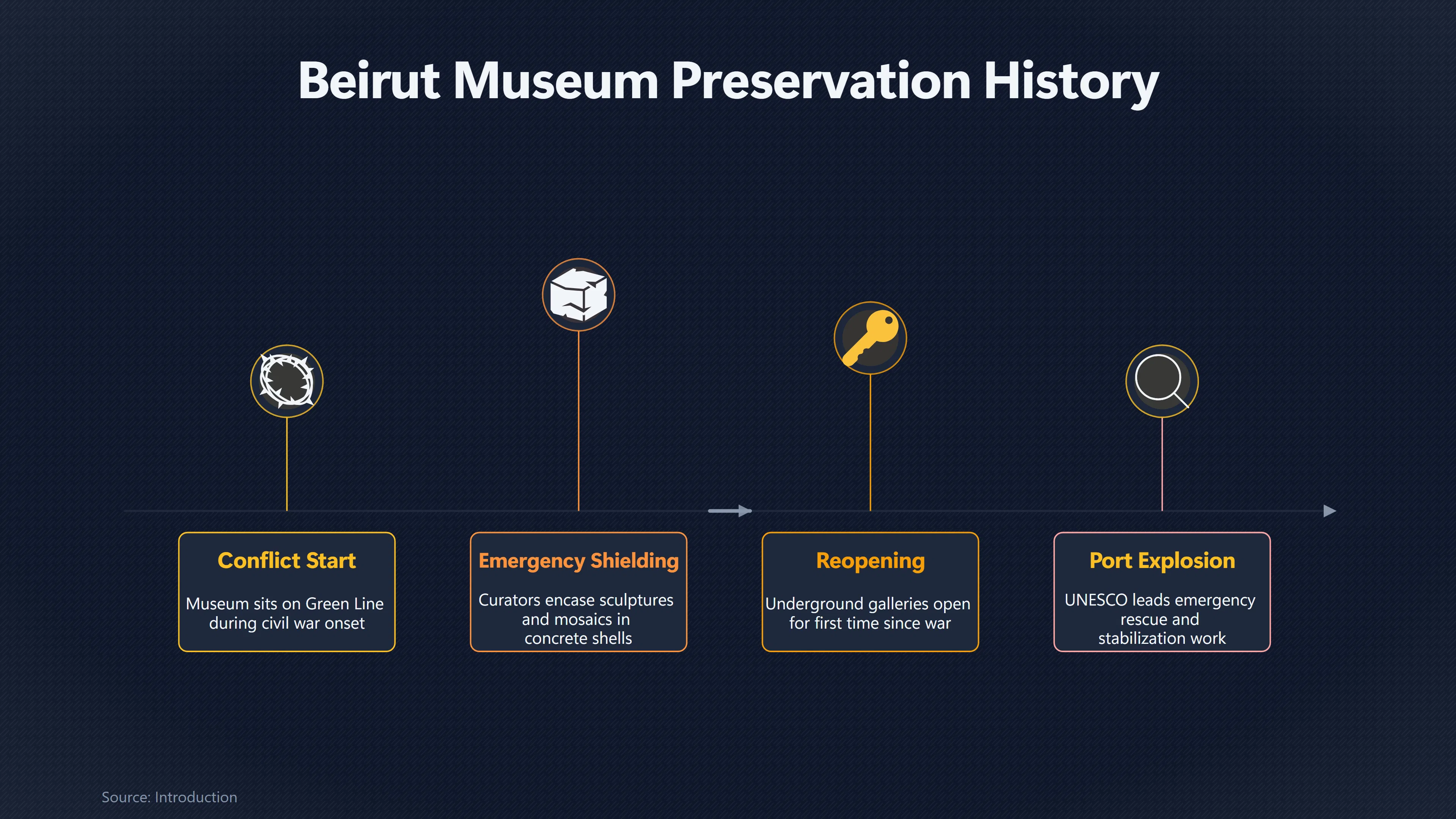
When the Lebanese Civil War began in 1975, the National Museum found itself directly on the Green Line separating opposing forces. The building became a military position, suffered repeated shelling and was occupied by armed groups. Curators, led by Maurice Chehab and colleagues from the Directorate General of Antiquities, undertook extraordinary emergency measures to prevent the permanent loss of Lebanon’s archaeological heritage.[Wikipedia]WikipediaNational Museum of BeirutNational Museum of Beirut
Small artefacts were hidden in basement storerooms and sealed behind masonry walls. Monumental sculptures, mosaics and sarcophagi that could not be moved were enclosed inside thick shells of concrete and timber. Although humidity, flooding and years of neglect damaged some material, these drastic measures saved much of the collection from looting and destruction.[wikipedia.org]WikipediaNational Museum of BeirutNational Museum of Beirut
The basement itself remained inaccessible for decades. Restoration eventually began with significant Italian financial and conservation support, culminating in the reopening of the underground galleries in October 2016.[Art Newspaper]theartnewspaper.comArt NewspaperNational Museum of Beirut opens basement for first time since civil war - The Art Newspaper - International art news and eve…
The museum’s resilience has continued to be tested. Following the 2020 Beirut port explosion, UNESCO coordinated emergency work to stabilise damaged collections, improve storage and continue cataloguing artefacts held in the museum’s extensive underground repositories beyond the public galleries.[UNESCO]unesco.orgleads a rescue mission at the National Museum of BeirutUNESCO leads a rescue mission at the National Museum of BeirutAugust 27, 2021…
Why the underground galleries matter
Many museums display mummies or ancient tombs, but Beirut’s underground galleries stand apart because they combine archaeological interpretation with the museum’s own survival story.
The medieval mummies are important not because they are mysterious, but because they preserve the lives of ordinary villagers. The Phoenician sarcophagi and Roman tomb explain how successive civilisations understood death, identity and remembrance. At the same time, the museum building itself became an archaeological survivor of Lebanon’s modern conflicts, carrying visible traces of war while protecting objects that span several millennia.
Within Lebanon’s landscape of unusual collections, the basement is therefore not a cabinet of horrors or a spectacle of the dead. It is a carefully curated encounter with mortality, memory and cultural endurance, showing how both ancient communities and modern museum professionals sought to preserve what mattered most for future generations.

Amazon book picks
Further Reading
Books and field guides related to What Lies Beneath Beirut's National Museum?. Use these as the next step if you want deeper reading beyond the article.

The Ancient Egyptian Book of the Dead
First published 1985. Subjects: Egyptian Incantations, Future life, Book of the dead.
The Oxford History of Ancient Egypt
The Oxford History of Ancient Egypt describes the emergence and development of the distinctive civilization of the ancient Egyptians, fro...
The Archaeology of Death
The archaeology of death and burial is central to our attempts to understand vanished societies. Through the remains of funerary rituals...
The History of Death: Burial Customs and Funeral Rites
Death is universal, but each culture has found a different way to deal with it. This wide-ranging book examines the compelling subject of...
eBay marketplace picks
Marketplace Samples
Live-tested eBay searches with available results related to this page.
Selected fromancient history collectible oneBay.co.uk.

Endnotes
1.
Source: Wikipedia
Title: National Museum of Beirut
Link:https://en.wikipedia.org/wiki/National_Museum_of_Beirut
2.
Source: Wikipedia
Title: Maronite mummies
Link:https://en.wikipedia.org/wiki/Maronite_mummies
3.
Source: unesco.org
Title: leads a rescue mission at the National Museum of Beirut
Link:https://www.unesco.org/en/articles/unesco-leads-rescue-mission-national-museum-beirut
Source snippet
UNESCO leads a rescue mission at the National Museum of BeirutAugust 27, 2021...
Published: August 27, 2021
4.
Source: archive.archaeology.org
Link:https://archive.archaeology.org/9607/newsbriefs/lebanon.html
5.
Source: theartnewspaper.com
Link:https://www.theartnewspaper.com/2016/10/14/national-museum-of-beirut-opens-basement-for-first-time-since-civil-war
Source snippet
Art NewspaperNational Museum of Beirut opens basement for first time since civil war - The Art Newspaper - International art news and eve...
6.
Source: thenationalnews.com
Link:https://www.thenationalnews.com/arts-culture/surviving-the-test-of-time-national-museum-of-beirut-opens-its-treasure-trove-1.158271
Source snippet
The NationalSurviving the test of time, National Museum of Beirut opens its treasure trove | The NationalOctober 23, 2016...
Published: October 23, 2016
7.
Source: newyorker.com
Link:https://www.newyorker.com/news/news-desk/beiruts-museums-to-war-and-memories
Source snippet
The National Museum, located on the dangerous Green Line, protected its ancient collection during the war by encasing artifacts in concre...
8.
Source: discoverlebanon.com
Link:https://www.discoverlebanon.com/en/panoramic_views/beirut/national_museum.php
9.
Source: thenationalnews.com
Link:https://www.thenationalnews.com/arts-culture/surviving-the-test-of-time-national-museum-of-beirut-opens-its-treasure-trove-1.158271?videoId=5740048750001
Additional References
10.
Source: syriacpress.com
Title: THE RESIDENTS OF HADAT SOUGHT REFUGE IN A REMOTE CAVE, WHICH ULTIMATE
Link:https://syriacpress.com/blog/2025/04/13/the-mummies-of-qadisha-1-2/
Source snippet
The Mummies of Qadisha (1/2) - SyriacPressApril 13, 2025 — 13/04/2025 THE MUMMIES OF QADISHA (1/2) IN THE LATTER HALF OF THE 13TH CENTURY...
Published: April 13, 2025
11.
Source: today.lorientlejour.com
Title: is beiruts national museum in danger amid the financial crisis
Link:https://today.lorientlejour.com/article/1314868/is-beiruts-national-museum-in-danger-amid-the-financial-crisis.html
Source snippet
L'Orient TodayOctober 17, 2022 — ANTIQUITIES IS BEIRUT’S NATIONAL MUSEUM IN DANGER AMID THE FINANCIAL CRISIS? In a bankrupt state plunged...
Published: October 17, 2022
12.
Source: youtube.com
Link:https://www.youtube.com/watch?v=PqBnxnKmHK4
Source snippet
National Museum of Beirut basement tour Lebanon's national museum reveals long-hidden treasures AFP News Agency...
13.
Source: youtube.com
Title: Lebanon’s national museum reveals long-hidden treasures
Link:https://www.youtube.com/watch?v=FrDuSynKP3Q
Source snippet
Mummies Under the Museum | National Museum of Beirut Part 3...
14.
Source: radissonhotels.com
Link:https://www.radissonhotels.com/en-us/destination/lebanon/beirut/beirut-national-museum
15.
Source: mapnook.com
Link:https://mapnook.com/map/d/maronite-mummies-of-the-qadisha-valley
16.
Source: molon.de
Link:https://www.molon.de/galleries/Lebanon/Beirut/Museum/img.php?comm=add&pic=52
17.
Source: molon.de
Link:https://www.molon.de/galleries/Lebanon/Beirut/Museum/img.php?pic=52
18.
Source: my.cybermuseum.art
Link:https://my.cybermuseum.art/en/tour/amtdatp17
19.
Source: abs-cbn.com
Title: Lebanon’s national museum reveals long-hidden treasures | ABS-CBN Lifestyle
Link:https://www.abs-cbn.com/life/11/01/16/lebanons-national-museum-reveals-long-hidden-treasures