Within Curious Gambia
Who Built The Gambia's Ancient Stone Circles?
Wassu and Kerbatch reveal how archaeology can explain ancient graves while leaving the identities and rituals of their builders unresolved.
On this page
- What the circles and burial mounds contain
- What archaeology can establish about their builders
- Why the monuments still resist a complete explanation
Page outline Jump by section
Introduction
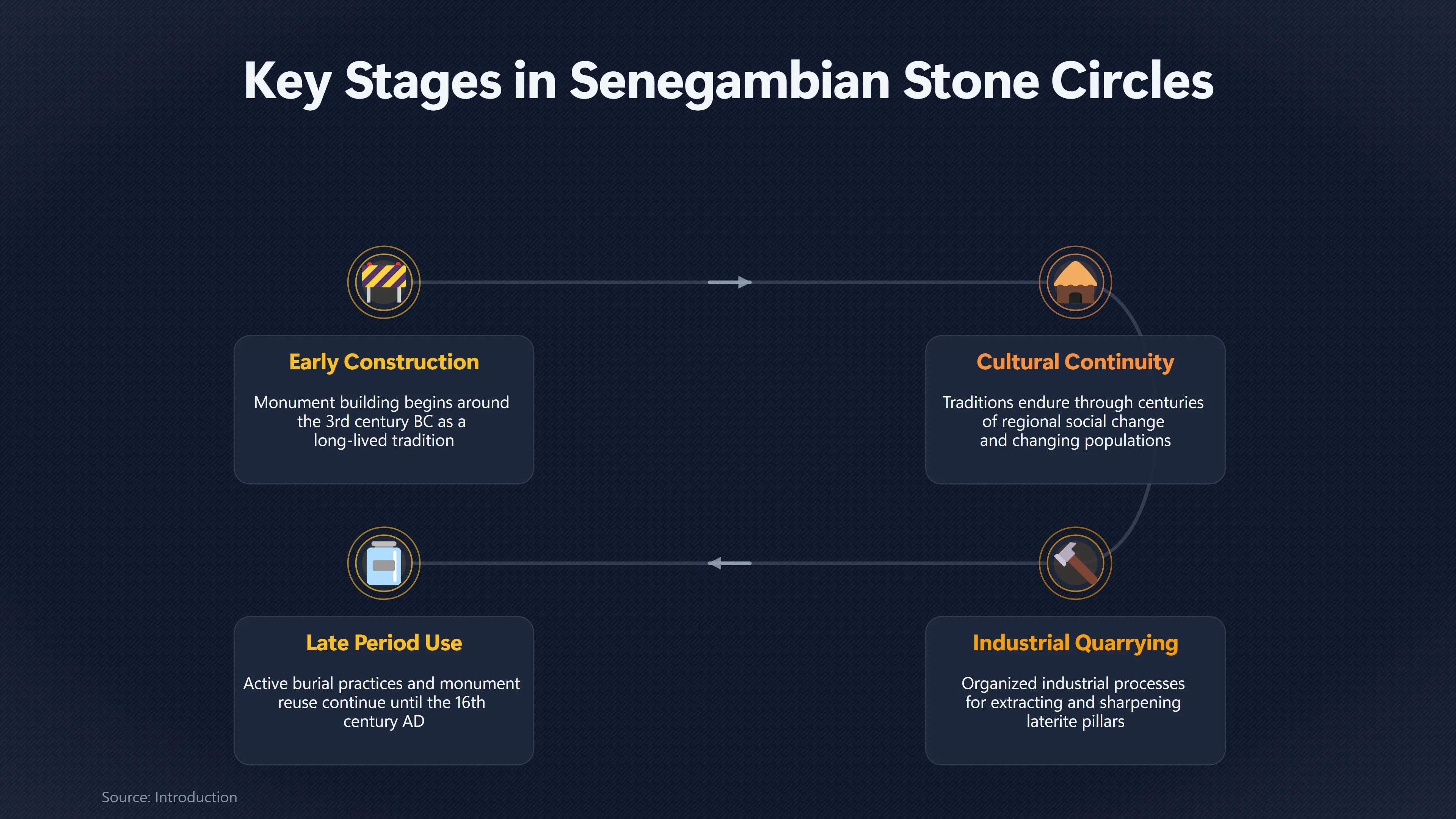
The ancient stone circles at Wassu and Kerbatch are among The Gambia’s most intriguing archaeological sites because they offer clear evidence of sophisticated funerary traditions while leaving one central question unanswered: exactly who built them, and why were these monuments so important for more than a thousand years? Rather than representing a single mysterious civilisation, the evidence points to a long-lived tradition of burial and monument building that developed across the wider Senegambian region between roughly the 3rd century BC and the 16th century AD. Archaeologists have uncovered human burials, pottery, iron objects and personal ornaments, but no written records survive to identify the communities responsible or explain the beliefs that shaped these remarkable landscapes.[UNESCO World Heritage Centre]whc.unesco.orgWorld Heritage Centre Stone Circles of SenegambiaUNESCO World Heritage CentreStone Circles of Senegambia - UNESCO World Heritage CentreJuly 12, 2006…
For visitors, the stone circles are unusual because they combine visible monuments with enduring archaeological uncertainty. The circles themselves can be seen and walked around, while nearby museums explain what excavations have genuinely established and where interpretation must still rely on careful inference rather than legend.
Who Built The Gambia’s Ancient Stone Circles?
The Gambian sites at Wassu and Kerbatch form part of the UNESCO-listed Stone Circles of Senegambia, a cultural landscape stretching across modern-day Gambia and Senegal. More than 1,000 stone monuments survive across this region, arranged in circles and associated with burial mounds, making it the largest known concentration of megalithic monuments in West Africa.[UNESCO World Heritage Centre]whc.unesco.orgWorld Heritage Centre Stone Circles of SenegambiaUNESCO World Heritage CentreStone Circles of Senegambia - UNESCO World Heritage CentreJuly 12, 2006…
Although the monuments are often presented as mysterious, archaeology has ruled out many older speculations. They were not built by Egyptians, Europeans or any lost civilisation. Instead, the monuments belong to indigenous societies that flourished along the River Gambia over many centuries. The builders possessed advanced stone-working skills, iron technology and the social organisation needed to quarry, transport and erect laterite pillars weighing several tonnes.[UNESCO World Heritage Centre]whc.unesco.orgWorld Heritage Centre Wassu Stone Circles Quarry SiteUNESCO World Heritage CentreWassu Stone Circles Quarry Site - UNESCO World Heritage Centre…
What remains unknown is the precise ethnic, linguistic or political identity of those communities. Modern ethnic groups in the region cannot simply be projected backwards across more than a millennium of changing populations, trade networks and political history. Without written documents, archaeologists rely on excavation, dating methods and comparisons with other regional sites rather than direct historical identification.[UNESCO World Heritage Centre]whc.unesco.orgWorld Heritage Centre Stone Circles of SenegambiaUNESCO World Heritage CentreStone Circles of Senegambia - UNESCO World Heritage CentreJuly 12, 2006…
What the circles and burial mounds contain
The stone circles were not isolated monuments standing in empty landscapes. Excavation has shown that they formed part of carefully planned cemeteries centred on burials.
Archaeological investigations have recovered:
- Human skeletal remains within or beneath burial mounds.
- Pottery placed with the dead.
- Iron weapons and tools.
- Copper and iron ornaments.
- Burial deposits indicating repeated use of some sites across long periods.[UNESCO World Heritage Centre]whc.unesco.orgWorld Heritage Centre Stone Circles of SenegambiaUNESCO World Heritage CentreStone Circles of Senegambia - UNESCO World Heritage CentreJuly 12, 2006…
The circles themselves usually consist of tall, carefully shaped laterite pillars surrounding burial areas. Nearby tumuli, or earthen burial mounds, often contain the richest archaeological evidence because they preserve graves and associated objects.
The surviving artefacts suggest that those buried were not randomly selected members of society. Some graves contain richer assemblages than others, hinting at differences in status or social role. However, the evidence is insufficient to reconstruct a complete hierarchy or determine whether these individuals were rulers, priests, warriors or members of influential families.[UNESCO World Heritage Centre]whc.unesco.orgWorld Heritage Centre Stone Circles of SenegambiaUNESCO World Heritage CentreStone Circles of Senegambia - UNESCO World Heritage CentreJuly 12, 2006…

What archaeology can establish about their builders
Modern archaeological research provides a surprisingly detailed picture of how the monuments were created, even if it cannot fully explain their meaning.
The stones were quarried from suitable laterite outcrops where builders selected particularly solid rock. Evidence from the Wassu quarry shows abandoned monoliths, extraction scars and sharpening grooves used for iron tools, demonstrating that quarrying formed an organised industrial process rather than casual stone collection.[UNESCO World Heritage Centre]whc.unesco.orgWorld Heritage Centre Wassu Stone Circles Quarry SiteUNESCO World Heritage CentreWassu Stone Circles Quarry Site - UNESCO World Heritage Centre…
Transporting pillars weighing several tonnes required coordinated labour, planning and engineering. Once moved to their destination, the stones were erected with remarkable consistency into carefully laid-out circles. Such work implies communities capable of organising large construction projects over many generations.[UNESCO World Heritage Centre]whc.unesco.orgWorld Heritage Centre Wassu Stone Circles Quarry SiteUNESCO World Heritage CentreWassu Stone Circles Quarry Site - UNESCO World Heritage Centre…
Dating evidence indicates that construction and reuse continued for well over a thousand years. Rather than representing a single building episode, the monuments accumulated through repeated acts of burial and remembrance across changing societies. This long chronology explains why the archaeological record contains variation in grave goods and burial practices instead of one uniform tradition.[UNESCO World Heritage Centre]whc.unesco.orgWorld Heritage Centre Stone Circles of SenegambiaUNESCO World Heritage CentreStone Circles of Senegambia - UNESCO World Heritage CentreJuly 12, 2006…
Why the monuments still resist a complete explanation
The greatest mystery is not whether the circles were burial monuments—that is now well established—but why this particular architectural form became so important.
Several questions remain unresolved.
Why circles? Archaeologists recognise that circular arrangements were intentional, yet no surviving written tradition explains their symbolic significance.
Who was buried here? Some graves appear wealthier than others, suggesting social distinctions, but there is no reliable way to assign particular identities or occupations to the individuals.
Why did the tradition endure for so long? Monument building continued across many centuries despite wider political and cultural change in West Africa, implying that these places retained deep ceremonial importance over generations. Exactly how those beliefs evolved remains unknown.[UNESCO World Heritage Centre]whc.unesco.orgWorld Heritage Centre Stone Circles of SenegambiaUNESCO World Heritage CentreStone Circles of Senegambia - UNESCO World Heritage CentreJuly 12, 2006…
These uncertainties are genuine gaps in evidence rather than invitations to speculative theories. The archaeological record is substantial enough to reject ideas about alien builders or forgotten empires while still acknowledging that many aspects of ritual life have disappeared beyond recovery.

What visitors experience at Wassu and Kerbatch
Unlike many famous prehistoric monuments, the Gambian stone circles are interpreted through relatively modest visitor facilities rather than dramatic reconstructions.
At Wassu, visitors encounter the preserved circles themselves together with a small museum that explains excavation results, burial discoveries and the wider Senegambian landscape. Kerbatch is quieter but forms part of the same UNESCO World Heritage property, illustrating that the Gambian monuments belong to a much larger regional network extending into neighbouring Senegal.[UNESCO World Heritage Centre]whc.unesco.orgWorld Heritage Centre Stone Circles of SenegambiaUNESCO World Heritage CentreStone Circles of Senegambia - UNESCO World Heritage CentreJuly 12, 2006…
This restrained presentation is part of the appeal. Rather than encouraging supernatural explanations, the interpretation focuses on what archaeology can demonstrate while openly acknowledging what remains unknown. The result is a heritage experience built around evidence instead of myth, allowing the surviving mysteries to emerge naturally from the limits of the archaeological record.
Why the stone circles matter in The Gambia’s curiosity landscape
Within The Gambia’s unusual heritage, the Senegambian stone circles occupy a distinctive place. They are neither folklore attractions nor religious shrines in the modern sense, but archaeological monuments whose unanswered questions continue to fascinate visitors.
Their mystery comes not from sensational claims but from an unusual balance of certainty and uncertainty. Archaeologists know these were monumental cemeteries built by organised indigenous societies using impressive engineering skills over more than 1,500 years. Yet the names, languages, beliefs and identities of the people who created this extraordinary funerary landscape remain largely beyond recovery. That combination of solid evidence and enduring mystery makes Wassu and Kerbatch some of the country’s most compelling archaeological destinations.[UNESCO World Heritage Centre]whc.unesco.orgWorld Heritage Centre Stone Circles of SenegambiaUNESCO World Heritage CentreStone Circles of Senegambia - UNESCO World Heritage CentreJuly 12, 2006…
Amazon book picks
Further Reading
Books and field guides related to Who Built The Gambia's Ancient Stone Circles?. Use these as the next step if you want deeper reading beyond the article.
The Archaeology of Africa
Africa has a vibrant past. It emerges from this book as the proud possessor of a vast and highly complicated interweaving of peoples and...
The Archaeology of Death and Burial
The archaeology of death and burial is central to our attempts to understand vanished societies. Through the remains of funerary rituals...
The Enemies of Rome
"Matyszak writes clearly and engagingly . . . nicely produced, with ample maps and illustrations." —Classical Outlook This engrossing boo...
eBay marketplace picks
Marketplace Samples
Live-tested eBay searches with available results related to this page.
Selected fromarchaeology poster oneBay.co.uk.


Endnotes
1.
Source: whc.unesco.org
Title: World Heritage Centre Stone Circles of Senegambia
Link:https://whc.unesco.org/en/list/1226/
Source snippet
UNESCO World Heritage CentreStone Circles of Senegambia - UNESCO World Heritage CentreJuly 12, 2006...
Published: July 12, 2006
2.
Source: whc.unesco.org
Title: World Heritage Centre Wassu Stone Circles Quarry Site
Link:https://whc.unesco.org/en/tentativelists/6063/
Source snippet
UNESCO World Heritage CentreWassu Stone Circles Quarry Site - UNESCO World Heritage Centre...
3.
Source: whc.unesco.org
Title: World Heritage Centre Stone Circles of Senegambia
Link:https://whc.unesco.org/en/list/1226/documents/
Source snippet
UNESCO World Heritage CentreStone Circles of Senegambia - Documents - UNESCO World Heritage Centre...
4.
Source: whc.unesco.org
Link:https://whc.unesco.org/en/documents/122226
5.
Source: whc.unesco.org
Link:https://whc.unesco.org/fr/list/1226/
6.
Source: whc.unesco.org
Link:https://whc.unesco.org/en/list/514
7.
Source: unesco.org
Title: Mysterious Stone Pillars: Stone Circles of Senegambia | World Heritage
Link:https://www.unesco.org/archives/multimedia/document-927
8.
Source: whc.unesco.org
Link:https://whc.unesco.org/en/list/1226/maps
10.
Source: whc.unesco.org
Link:https://whc.unesco.org/en/decisions/998/
11.
Source: youtube.com
Title: The Mysterious Stone Circles of Senegambia: A Cosmic Legacy?
Link:http://www.youtube.com/watch?v=ZYBvAQ68Vnc
Source snippet
Stone Circles of Senegambia...
12.
Source: youtube.com
Title: Stone Circles of Senegambia
Link:http://www.youtube.com/watch?v=vX-UvzmK01c
Source snippet
blnk - megaliths of Africa...
13.
Source: youtube.com
Link:http://www.youtube.com/watch?v=PHAdOTdfNp4
Source snippet
Stone Circles of Senegambia - Spectacular Places You Must Visit...
14.
Source: youtube.com
Title: Stone Circles of Senegambia
Link:http://www.youtube.com/watch?v=Gx9I5iha9H8
Source snippet
Wassu Kerbatch archaeology Stone Circles of Senegambia (UNESCO/NHK) UNESCO...
15.
Source: worldheritageexplorer.org
Link:https://www.worldheritageexplorer.org/sites/stone_circles_of_senegambia.html
Source snippet
1226 World Heritage since: 2006 Category: Cultural Heritage WHE Type: Archaeological Sites Transboundary Heritage: Yes E...
Additional References
16.
Source: originalpeople.org
Title: Senegambian Stone Circles – Originalpeople.org
Link:https://originalpeople.org/senegambian-stone-circles/
Source snippet
January 10, 2022 — DESCRIPTION AND HISTORY The stone circles and other megaliths found in Senegal and Gambia are sometimes divided into f...
Published: January 10, 2022
17.
Source: smarthistory.org
Title: – Stone circles of Senegambia
Link:https://smarthistory.org/stone-circles-of-senegambia/
Source snippet
May 27, 2021 — STONE CIRCLES OF SENEGAMBIA by UNESCO Artwork Details Stone Circles of Senegambia (UNESCO/NHK) The site consists of four l...
Published: May 27, 2021
18.
Source: tdb.maeasam.org
Link:https://tdb.maeasam.org/report/f150a7f5-af57-4a5d-8f80-3efad5af3667
Source snippet
Resource Report3 days ago — for more documentation, visit arches.readthedocs.io Site - Stone Circles of Senegambia Report Date: July 17...
19.
Source: africabib.org
Link:https://www.africabib.org/rec.php?RID=184916054
20.
Source: english-heritage.org.uk
Link:https://www.english-heritage.org.uk/visit/places/castlerigg-stone-circle/history/
21.
Source: english-heritage.org.uk
Link:https://www.english-heritage.org.uk/visit/places/hurlers-stone-circles/history/
22.
Source: africanworldheritagesites.org
Link:https://www.africanworldheritagesites.org/cultural-places/rock-art-pre-history/stone-circles-of-senegambia.html
23.
Source: ashmolean.org
Link:https://www.ashmolean.org/node/3458391
24.
Source: satyori.com
Link:https://satyori.com/archaeoastronomy/wassu-stone-circles-gambia/
25.
Source: youtube.com
Title: Stone Circles of Senegambia (UNESCO/NHK)
Link:http://www.youtube.com/watch?v=RKlh_hKKUm8
Source snippet
The Mysterious Stone Circles of Senegambia: A Cosmic Legacy?...