Where Are North Macedonia's Most Unusual Collections?
North Macedonia does not have a large, clearly branded network of witchcraft museums, cryptid collections or medical-oddity cabinets.
Page outline Jump by section
Introduction
The best places are not necessarily “weird museums” in the commercial sense. They are institutions where ordinary categories become unstable. A lake becomes an archaeological display case; smoking equipment becomes decorative art; clay plaques sit somewhere between household object and sacred image; wax figures turn contested national history into immersive theatre. Folklore also remains unusually visible outside museums, particularly in masked festivals and living religious sites. Visitors should therefore expect a mixture of academic archaeology, older-style collecting, devotional tradition, political storytelling and tourism-led reconstruction rather than a neat trail of eccentric attractions.
The country’s standout unusual collections
Prilep Tobacco Museum
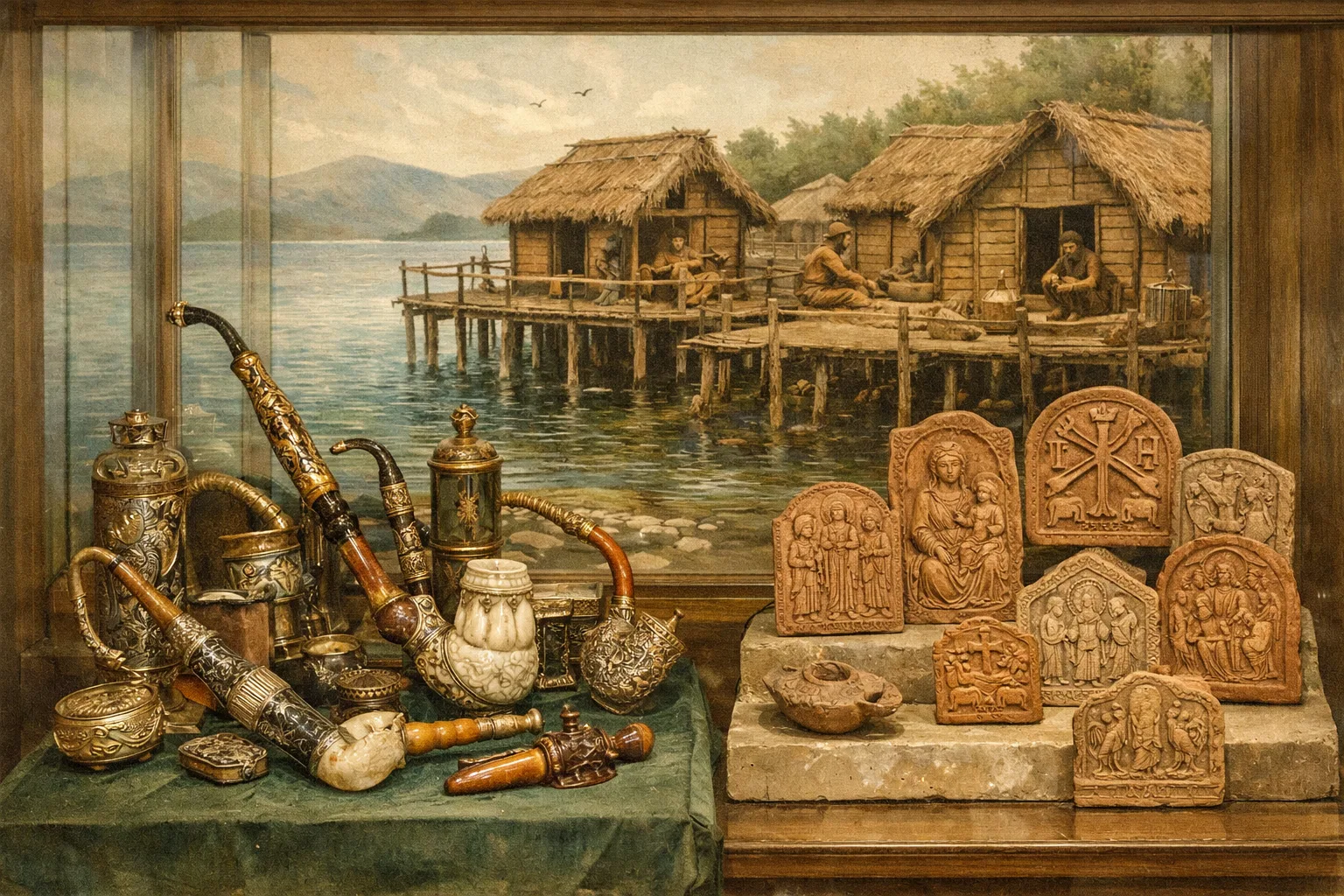
The Tobacco Museum in Prilep is North Macedonia’s clearest example of a genuinely specialised curiosity collection. It belongs to the Scientific Tobacco Institute and presents tobacco not merely as a crop or consumer product, but as an entire material culture of cultivation, trade, manufacture, smoking and social display. The museum’s current exhibition arrangement was renewed for the Tobacco Institute’s sixtieth anniversary.[UKLO Nit]nit.uklo.edu.mktobacco museumUKLO NitTobacco museum – Scientific Institute of Tobacco – Prilep2 Jun 2025 — The present look of Tobacco Museum was set up at the exhibi…
Its most memorable objects are elaborate smoking pipes and pipe stems made with materials including gold, silver, enamel, mother-of-pearl and ivory. Local visitor information singles these pieces out as the pride of the collection. Such objects move the museum well beyond agricultural history: they reveal how tobacco equipment could function as jewellery, status symbol, diplomatic gift and portable craftsmanship.[Prilep Info]prilepinfo.mkPrilep InfoTobacco MuseumThe chibouks are the pride of the Tobacco Museum. Made of gold, silver, enamel, mother of pearl, ivory and bone…
The museum is unusual because of the narrowness and depth of its subject. Prilep’s connection with oriental tobacco gives the collection a strong local reason to exist, while its ornate paraphernalia supplies the cabinet-of-curiosities appeal. It is an institutional and research-linked museum, not a novelty attraction, although its presentation may feel more traditional than interactive. Visitors seeking a polished multimedia experience should moderate their expectations; the interest lies principally in the objects and their social history.
The Museum on Water at the Bay of Bones
On Lake Ohrid, the Museum on Water turns underwater archaeology into a walk-through prehistoric settlement. Built at the Ploča Mićov Grad archaeological site, the complex includes a reconstructed group of pile dwellings above the lake, a display building, remains of a Roman fort on the hillside and provision for underwater tourism.[Ohrid Museum]muzejohrid.mkOhrid MuseumMuseum on Water – NI Institute for protection of monuments of…January 12, 2023 — The site “Plocha Michov Grad” in the Bay…
The name “Bay of Bones” sounds macabre, but it refers to the large quantity of animal bones and bone implements found with pottery and traces of timber structures beneath the water. Visitors cross wooden platforms and enter reconstructed houses intended to suggest how lakeside communities may have lived during the later Bronze and Iron Ages. The museum therefore combines authentic archaeological finds with a modern physical interpretation of a vanished settlement.[Tripadvisor]tripadvisor.co.ukTripadvisor BAY OF THE BONES MUSEUMBAY OF THE BONES MUSEUM - All You SHOULD Know…Reconstructed Village May 2026 … which dates back to the 12th-7th centuries B…
That distinction matters. The buildings are reconstructions, not preserved prehistoric houses raised intact from the lake. They offer a plausible, visitor-friendly model based on excavated evidence, but details such as furnishings, roof forms and domestic atmosphere necessarily involve interpretation. The site is strongest when understood as experimental public archaeology rather than as an untouched ancient village.
The complex opened in 2008 and has undergone subsequent reconstruction work supported by the national heritage authorities. It is among the country’s most explicitly tourist-facing archaeological attractions, yet it remains connected to a real submerged site and to the development of underwater archaeology in North Macedonia.[Discovering Macedonia]discoveringmacedonia.combay of bones museum ohridDiscovering MacedoniaThe Bay of Bones museum near OhridJuly 9, 2018 — The reconstruction process was closely monitored by the director…
The Great Mother and other strange prehistoric figures
The Archaeological Museum in Skopje contains objects that deserve attention from anyone interested in ancient ritual, ambiguous symbolism or archaeological curiosities. The most striking is the terracotta figure known as the Great Mother, excavated at the Neolithic settlement of Tumba Madžari near Skopje.
The figure combines a human female upper body with a hollow, box-like lower section resembling a house. Archaeologists have interpreted this hybrid form as a symbolic union of woman, fertility and household protection. Its unusual design appears to show the figure emerging from, sitting upon or becoming the building itself. The hollow lower portion may have had a ritual function, although suggestions that substances were burnt inside it remain interpretive rather than certain.[Live Science]livescience.comOpen source on livescience.com.
For visitors accustomed to classical statues, the Great Mother can be more arresting than the museum’s grander treasures. It embodies a belief system for which no explanatory texts survive. The curatorial account depends on archaeological context, comparison and informed inference, not on a known myth with identifiable characters. It is therefore a valuable example of how museums present ancient spirituality without being able to recover its exact meanings.
Sacred images, relics and disputed meanings
The terracotta icons of Vinica
The early Christian terracotta plaques found at Vinica Fortress form one of North Macedonia’s most distinctive archaeological collections. Unlike familiar painted wooden icons, these images were moulded in clay and show biblical scenes, saints, animals and symbolic compositions. Examples have been displayed by the Archaeological Museum in Skopje and by the local archaeological museum in Vinica.[World History]worldhistory.orgWorld History Macedonian Terracotta Icon of Daniel in the Lions' DenWorld History Macedonian Terracotta Icon of Daniel in the Lions' Den
Their precise original use has generated discussion. They are often called icons, but that familiar term can make them sound like later devotional panels designed for individual veneration. Their repeated moulded forms and archaeological setting suggest a more complicated function, potentially involving architectural decoration, teaching, protection or communal Christian identity. For a general visitor, their fascination lies in this uncertainty: they look recognisably Christian, yet do not fit comfortably into the standard history of painted icons.
The plaques are academically curated archaeological material rather than occult objects or unexplained anomalies. Even so, their mixture of biblical imagery, military figures, animals and compressed symbolic scenes gives them a cryptic quality. They show how early Christian visual culture in the region could be experimental, locally distinctive and closely tied to buildings and fortified settlements.
Ohrid’s icon collections
Ohrid’s icon holdings offer a different kind of encounter with sacred objects. The city’s heritage institute oversees a large collection of icons dating from the medieval and later periods, with selected works displayed in the Icon Gallery. The Museum of North Macedonia in Skopje likewise identifies the fifteenth-century Virgin of Pelagonia as a highlight of its permanent display.[Wikipedia]WikipediaInstitute for Protection of Cultural Monuments and National MuseumInstitute for Protection of Cultural Monuments and National Museum
These are not “strange” because their provenance is mysterious. Their unusual power comes from the way they operate simultaneously as artworks, historical evidence and religious images. A museum label may discuss pigment, date and style, while a believer may understand the same object through prayer, intercession or sacred presence.
This dual identity is important throughout North Macedonia’s curiosity culture. A secular museum preserves an icon as cultural heritage; a church or monastery may keep a comparable image within an active devotional setting. The visitor’s experience changes accordingly. Photography, behaviour and access may be governed not only by conservation rules but also by religious expectations.
Relics at Bigorski Monastery
Bigorski Monastery preserves numerous relics attributed to Christian saints, alongside an icon of Saint John the Baptist associated in monastery tradition with healing and with the choice of the monastery’s location. The monastery also houses a revered copy of an important image from Mount Athos.[Wikipedia]WikipediaSaint Jovan Bigorski MonasterySaint Jovan Bigorski Monastery
This is a living monastery rather than a museum. Its relics are not presented primarily as archaeological specimens requiring detached proof of identity. They function within Orthodox Christian devotion, where continuity of tradition, liturgical use and communal belief can matter more than the forensic provenance expected in a secular collection.
Visitors should therefore distinguish three questions that are often blurred together:
- Is the object publicly accessible? Some relics and icons may be visible within the church or on particular occasions, but access follows monastic and liturgical practice.
- Is the attribution scientifically demonstrable? Often it is not possible to establish a saint’s identity through modern testing.
- Is the object culturally authentic? Regardless of laboratory verification, a relic may have a long and consequential devotional history.
The interest lies less in proving or disproving a miracle than in understanding how sacred objects are preserved, approached and interpreted by the community that keeps them.
Folklore preserved inside and outside museums
The Museum of North Macedonia in Skopje contains substantial ethnological holdings: folk costume, jewellery, musical instruments, domestic architecture, weaving, crafts and agricultural life. On paper, these categories can sound conventional. In practice, they preserve the material setting in which stories about protection, fertility, illness, luck, death and the supernatural once operated.[Museum With No Frontiers]museumwnf.orgOpen source on museumwnf.org.
A costume, amulet-like ornament or ritual textile rarely explains itself. Older ethnographic displays may emphasise region, technique and date while giving less space to oral testimony or contested meanings. Visitors interested in folk magic should therefore be cautious about treating every symbolic pattern or unusual object as evidence of secret ritual. Some motifs were decorative, some protective, and many could have different meanings in different communities.
North Macedonia’s most vivid masked folklore survives beyond the museum case. The Vevčani Carnival fills the village with handmade disguises representing demons, grotesque figures, social types and topical satire. Accounts of the festival describe beliefs that the masks and associated rituals drive away harmful forces, but the event is also a platform for contemporary political mockery.[balkaninsight.com]balkaninsight.comOpen source on balkaninsight.com.
That combination makes Vevčani more than a reconstructed folk pageant. It is a living, changing tradition in which supernatural language, social licence, comedy and tourism coexist. Masks are created for performance rather than preserved principally as old masterpieces. The village itself temporarily becomes an open-air theatre and an informal, short-lived museum of current anxieties.
For strange-history travellers, this is an important lesson: North Macedonia’s folklore is not confined to labelled antique objects. Some of its most compelling expressions remain seasonal, participatory and intentionally unruly.
Preserved nature and old-style museum atmosphere
The Macedonian Museum of Natural History in Skopje offers a more traditional form of strangeness: halls of classified animals, birds, fish, insects, fossils, plants and geological specimens. Visitor descriptions portray it as an older-style natural history institution, with extensive specimen displays and relatively limited interpretation in English.[Tripadvisor]tripadvisor.co.ukOpen source on tripadvisor.co.uk.
Such museums can resemble scientific cabinets of curiosity, especially when many preserved animals are arranged by type rather than placed within elaborate contemporary narratives. To modern eyes, rows of taxidermy and cases of insects can feel eerie or outdated. Their original purpose, however, is systematic comparison, education and research rather than theatrical shock.
The scientific value of these holdings may exceed what is visible in the public galleries. Specialist collections, including preserved insects, can document species distribution and environmental change over time. Research on dragonfly holdings in North Macedonian natural history collections illustrates how apparently obscure drawers of specimens can remain useful long after they were assembled.[ResearchGate]researchgate.netResearch Gateon the dragonfly collection in the natural history museumResearch Gateon the dragonfly collection in the natural history museum
Visitors should expect a working scientific inheritance rather than a modern entertainment venue. The museum is most rewarding for those who enjoy taxonomy, vintage display styles and the slightly uncanny experience of encountering regional biodiversity indoors.
Waxwork history and political theatre
The Museum of the Macedonian Struggle in Skopje uses wax figures, large paintings, documents and staged historical scenes to narrate revolutionary and national history. Its own institutional material confirms that wax figures form part of the permanent presentation.[mmb.org.mk]mmb.org.mkМузеј на македонската борба за самостојностМузеј на македонската борба за самостојност
This makes it one of the country’s most visually theatrical museums. Instead of viewing only weapons or papers in cases, visitors encounter life-sized tableaux of meetings, arrests, struggles and political personalities. The format resembles a historical wax museum, but the subject matter is serious and closely connected to national identity.
The museum is also a useful case study in curatorial authority. Immersive displays can make one interpretation feel immediate and emotionally complete, even when the history is disputed or could be narrated differently. Some visitors and commentators have described the presentation as strongly nationalist or one-sided. Such judgements should not simply replace the museum’s own account, but they are relevant to understanding how the institution has been received.[Wondering Voyager]wonderingvoyager.comWondering Voyager Skopje's Museums: An Unfortunate Case of Quantity overWondering Voyager Skopje's Museums: An Unfortunate Case of Quantity over
The best approach is to treat the waxworks as an argument in physical form. Ask who is represented, who is absent, which events receive dramatic reconstruction and how political legitimacy is created through costume, lighting and sequence. The unusual collection is not merely the wax itself; it is the conversion of a contested historical narrative into an apparently walkable past.
Commercial oddities and uncertain attractions
Skopje has hosted a privately operated Museum of Illusions, also advertised under the name Illuzium. Descriptions from its active period refer to several floors of optical installations, puzzles and photograph-oriented interactive rooms.[In Your Pocket]inyourpocket.comOpen source on inyourpocket.com.
This belonged to the international style of commercial “museum” built around perception, entertainment and social photography rather than around a permanent heritage collection. It was unusual in experience but not particularly specific to North Macedonian culture.
Its present status requires caution. Some current travel listings continue to display the attraction, while another listing marks it as closed. That conflict suggests that travellers should not assume it is operating without checking directly shortly before visiting.[Tripadvisor]tripadvisor.comMuseum of IllusionsMuseum of Illusions
The uncertainty is typical of small private attractions. They can open, relocate or disappear faster than national institutions, while outdated directory pages remain online. For this reason, poorly documented “museums” should not be given the same confidence as public collections with active institutional websites.

What North Macedonia does not appear to have
There is little strong evidence for a permanent public museum in North Macedonia devoted specifically to witchcraft, UFOs, cryptids, spiritualism, medical pathology, torture instruments or famous hoaxes. Claims for such attractions should be treated sceptically unless they can be traced to an operating institution, current address and recent visitor information.
This absence does not make the country uninteresting. It clarifies the character of its strange collections. North Macedonia’s most compelling material is concentrated in five overlapping areas:
- prehistoric ritual objects whose meanings remain partly unknowable;
- archaeological reconstructions that turn landscapes into museums;
- highly specialised industrial collections, especially tobacco;
- sacred art and relics positioned between heritage and living belief;
- folklore that survives through performance rather than permanent display.
The result is less a catalogue of novelty museums than a landscape of ambiguous objects. The unusual element often comes from interpretation: whether a clay figure is a goddess, altar or household protector; whether a relic is judged by faith or provenance; whether a reconstructed lake dwelling is education, experiment or tourist spectacle; and whether a wax tableau is history or political memory.
Planning an unusual-museum visit
The strongest practical route links Skopje, Prilep and the Ohrid region. Skopje offers the Archaeological Museum, Museum of North Macedonia, Natural History Museum and the waxwork-heavy Museum of the Macedonian Struggle. Prilep supplies the country’s most concentrated specialist collection at the Tobacco Museum. Ohrid combines sacred art, historic houses and the Museum on Water, while Bigorski Monastery can be incorporated into a wider western North Macedonia journey.
Opening information should be checked with the institution, particularly for smaller museums and religious sites. Public museums may change hours seasonally, specialist collections may expect advance contact, and monasteries are active communities rather than conventional attractions. The Museum on Water is straightforwardly visitor-facing, but weather and maintenance can affect an outdoor lakeside site. The former Museum of Illusions should be considered uncertain unless current operation is confirmed.
Photography rules also vary. Restrictions may reflect conservation, copyright, security, devotion or the institution’s preferred visitor experience. In waxwork and political-history museums, a photography ban can substantially shape how the displays are encountered and remembered. In churches and monasteries, visitors should assume that worship takes priority over tourism.
North Macedonia rewards the traveller who looks beyond the label “museum”. Its strange-history landscape is found in clay goddesses, submerged timbers, ornate pipes, preserved insects, masked demons, painted saints and rooms where wax figures turn ideology into scenery. None needs invented mystery. Their genuine interest comes from the unresolved boundary between object and belief, evidence and reconstruction, preservation and performance.
Amazon book picks
Further Reading
Books and field guides related to Where Are North Macedonia's Most Unusual Collections?. Use these as the next step if you want deeper reading beyond the article.
North Macedonia
Bradt's North Macedonia remains the only standalone English-language guidebook to this increasingly popular destination available outside...
The Balkans: A Short History
Examines the causes of ethnic conflict in the Balkans, discussing how the meeting of European and Asian cultural influences and the blend...
Museum Basics
Museums throughout the world have common needs and face common challenges. Keeping up-to-date with new ideas and changing practice is cha...
The Oxford Handbook of the Archaeology of the Contemporary World
It has been clear for many years that the ways in which archaeology is practised have been a direct product of a particular set of social...
eBay marketplace picks
Marketplace Samples
Live-tested eBay searches with available results related to this page.
Selected fromMacedonian art oneBay.co.uk.
Endnotes
1.
Source: Wikipedia
Title: Institute for Protection of Cultural Monuments and National Museum
Link:https://en.wikipedia.org/wiki/Institute_for_Protection_of_Cultural_Monuments_and_National_Museum
2.
Source: Wikipedia
Title: Saint Jovan Bigorski Monastery
Link:https://en.wikipedia.org/wiki/Saint_Jovan_Bigorski_Monastery
3.
Source: researchgate.net
Title: Research Gateon the dragonfly collection in the natural history museum
Link:https://www.researchgate.net/publication/259080488_ON_THE_DRAGONFLY_COLLECTION_IN_THE_NATURAL_HISTORY_MUSEUM_IN_STRUGA_MACEDONIA_INSECTA_ODONATA
4.
Source: mmb.org.mk
Title: Музеј на македонската борба за самостојност
Link:https://mmb.org.mk/
5.
Source: mmb.org.mk
Title: anizational structure
Link:https://mmb.org.mk/en/organizational-structure/
6.
Source: tripadvisor.com
Title: Museum of Illusions
Link:https://www.tripadvisor.com/Attraction_Review-g295110-d14155915-Reviews-Museum_of_Illusions-Skopje_Skopje_Region.html
7.
Source: Wikipedia
Link:https://en.wikipedia.org/wiki/North
8.
Source: Wikipedia
Title: North London
Link:https://en.wikipedia.org/wiki/North_London
9.
Source: Wikipedia
Title: List of natural history museums
Link:https://en.wikipedia.org/wiki/List_of_natural_history_museums
10.
Source: tripadvisor.com
Link:https://www.tripadvisor.com/ShowUserReviews-g295110-d3220824-r359214494-Museum_of_Macedonian_Struggle-Skopje_Skopje_Region.html
11.
Source: north.tech
Link:https://north.tech/
12.
Source: nit.uklo.edu.mk
Title: tobacco museum
Link:https://nit.uklo.edu.mk/about-the-institute/tobacco-museum/?lang=en
Source snippet
UKLO NitTobacco museum – Scientific Institute of Tobacco – Prilep2 Jun 2025 — The present look of Tobacco Museum was set up at the exhibi...
13.
Source: prilepinfo.mk
Link:https://www.prilepinfo.mk/en/museums/tobacco-museum
Source snippet
Prilep InfoTobacco MuseumThe chibouks are the pride of the Tobacco Museum. Made of gold, silver, enamel, mother of pearl, ivory and bone...
14.
Source: muzejohrid.mk
Link:https://muzejohrid.mk/museum-on-water/
Source snippet
Ohrid MuseumMuseum on Water – NI Institute for protection of monuments of...January 12, 2023 — The site “Plocha Michov Grad” in the Bay...
Published: January 12, 2023
15.
Source: tripadvisor.co.uk
Title: Tripadvisor BAY OF THE BONES MUSEUM
Link:https://www.tripadvisor.co.uk/Attraction_Review-g303864-d1829249-Reviews-Bay_of_the_Bones_Museum-Ohrid_Southwestern_Region.html
Source snippet
BAY OF THE BONES MUSEUM - All You SHOULD Know...Reconstructed Village May 2026 … which dates back to the 12th-7th centuries B...
Published: May 2026
16.
Source: discoveringmacedonia.com
Title: bay of bones museum ohrid
Link:https://www.discoveringmacedonia.com/2018/bay-of-bones-museum-ohrid/
Source snippet
Discovering MacedoniaThe Bay of Bones museum near OhridJuly 9, 2018 — The reconstruction process was closely monitored by the director...
Published: July 9, 2018
17.
Source: livescience.com
Link:https://www.livescience.com/archaeology/tumba-madzari-great-mother-a-boxy-goddess-figurine-from-north-macedonia-designed-to-protect-stone-age-houses-7-800-years-ago
18.
Source: worldhistory.org
Title: World History Macedonian Terracotta Icon of Daniel in the Lions’ Den
Link:https://www.worldhistory.org/image/19345/macedonian-terracotta-icon-of-daniel-in-the-lions/
19.
Source: museumwnf.org
Link:https://www.museumwnf.org/partner.php?id=MC_01%3Bmc&theme=AWE&tye=SH
20.
Source: balkaninsight.com
Link:https://balkaninsight.com/2026/01/14/north-macedonia-village-carnival-mixes-ancient-tradition-with-modern-satire/bi/
21.
Source: theguardian.com
Title: vevcani carnival in pictures
Link:https://www.theguardian.com/culture/gallery/2026/jan/16/vevcani-carnival-in-pictures
22.
Source: tripadvisor.co.uk
Link:https://www.tripadvisor.co.uk/Attraction_Review-g295110-d12386968-Reviews-Macedonian_Museum_of_Natural_History-Skopje_Skopje_Region.html
23.
Source: wonderingvoyager.com
Title: Wondering Voyager Skopje’s Museums: An Unfortunate Case of Quantity over
Link:https://wonderingvoyager.com/skopjes-museums-an-unfortunate-case-of-quantity-over-quality/
24.
Source: inyourpocket.com
Link:https://www.inyourpocket.com/skopje/museum-of-illusions_154424v
25.
Source: en.tripadvisor.com.hk
Title: Tripadvisor Best place of illusions in Skopje
Link:https://en.tripadvisor.com.hk/ShowUserReviews-g295110-d14155915-r590921526-Museum_of_Illusions-Skopje_Skopje_Region.html
26.
Source: tripadvisor.co.uk
Link:https://www.tripadvisor.co.uk/Attractions-g295109-Activities-c49-Republic_of_North_Macedonia.html
27.
Source: tripadvisor.co.uk
Link:https://www.tripadvisor.co.uk/Attraction_Review-g612443-d33877587-Reviews-Tobacco_Museum_Prilep-Prilep_Pelagonia_Region.html
28.
Source: northdesign.co.uk
Link:https://www.northdesign.co.uk/
29.
Source: dictionary.cambridge.org
Link:https://dictionary.cambridge.org/dictionary/english/north
30.
Source: macedonia.for91days.com
Title: tobacco museum
Link:https://macedonia.for91days.com/tag/tobacco-museum/
31.
Source: gymglish.com
Link:https://www.gymglish.com/en/gymglish/english-translation/north
32.
Source: zse.edu.pl
Title: pobierz agenda macedonia
Link:https://zse.edu.pl/erasmus-friendship-days/wp-content/uploads/2023/01/pobierz_agenda_macedonia.pdf
33.
Source: tracxn.com
Title: Museum of Illusions
Link:https://tracxn.com/d/companies/museumofillusions/__iPWHL5KV0kt994T5jMvs0d5cNGC3VdWON7WXiWIeAw4
Additional References
34.
Source: myguidemacedonia.com
Link:https://www.myguidemacedonia.com/travel-articles/bay-of-bones
Source snippet
My Guide MacedoniaBay of Bones | My Guide Macedoniaa reconstruction of several semi-open buildings in the castellum, made an official bra...
35.
Source: erih.net
Link:https://www.erih.net/i-want-to-go-there/site/prilep-tobacco-museum
Source snippet
Prilep Tobacco MuseumPrilep Tobacco Museum МУЗЕЈ НА ТУТУН Krusevsko Dzade nn. Prilep North Macedonia (0) 48 - 434011. Homepage · + my...
36.
Source: youtube.com
Title: Vevcani Carnival Lights Up Snowy Villages During North Macedonia Winter Festival
Link:https://www.youtube.com/watch?v=c_g6S5PGSJQ
Source snippet
Skopje Travel Vlog - The Ultimate North Macedonian City Break Itinerary...
37.
Source: youtube.com
Title: The Hidden “Country” In Europe No One Talks About: Vevčani
Link:https://www.youtube.com/watch?v=wWt-BemZaFs
Source snippet
Vevcani Carnival Lights Up Snowy Villages During North Macedonia Winter Festival...
38.
Source: academia.edu
Link:https://www.academia.edu/23870074/Post_natural_troubles_in_a_natural_history_museum
39.
Source: atlasobscura.com
Link:https://www.atlasobscura.com/things-to-do/poland/museums
40.
Source: reddit.com
Link:https://www.reddit.com/r/ArchitecturalRevival/comments/fkg3xb/archaeological_museum_of_macedonia_skopje_north/
41.
Source: alluringworld.com
Link:https://www.alluringworld.com/bay-of-bones/
42.
Source: facebook.com
Link:https://www.facebook.com/TelevisionMalta/posts/children-and-adolescents-visit-imdina-natural-history-museum/1140323682771955/
43.
Source: instagram.com
Link:https://www.instagram.com/p/Daw_olnDO5r/