Where Portugal Keeps Its Strangest Objects
Portugal does not have a single national “museum of the strange”. Its curiosity culture is scattered through university collections, religious sites, regional folklore museums, former prisons, archaeological displays, private specialist projects and institutions whose unusual material sits inside a broader historical collection.
Page outline Jump by section
Introduction
What makes these places distinctive is not simply that they contain eerie objects. They reveal several different Portuguese ways of preserving the extraordinary: the Catholic use of bones and relics to teach spiritual lessons; Enlightenment collecting shaped by science, empire and classification; living rural traditions involving masks and ritual disorder; and modern attempts to document illusion, institutional medicine and political repression. Some are polished visitor attractions, while others remain fragile, specialist or dependent on advance arrangements.

Where Portugal’s strangest collections are found
Portugal’s unusual collections fall into four broad groups.
Historic collections of wonders preserve objects once valued because they were rare, exotic, malformed or difficult to classify. Coimbra’s university collections are the clearest example, combining natural history, scientific material and objects gathered through centuries of teaching and collecting.
Religious displays of mortality and sacred power include bone chapels and elaborate reliquaries. These were not originally created as macabre entertainment. They presented death, sainthood and the fate of the body within a Catholic devotional framework.
Folklore museums preserve masks, costumes and puppets connected with seasonal festivals, performance and local identity. Their unsettling appearance can attract visitors, but their primary meaning lies in communal traditions rather than horror.
Museums of difficult modern history occupy former prisons and psychiatric institutions. Their power comes from authentic buildings, testimony and archives, although access to some collections is less straightforward than to conventional municipal museums.
Together, these sites make Portugal particularly rewarding for travellers interested in the borderlands between museums, sacred spaces, archives and living custom.
Coimbra’s theatre of strange objects
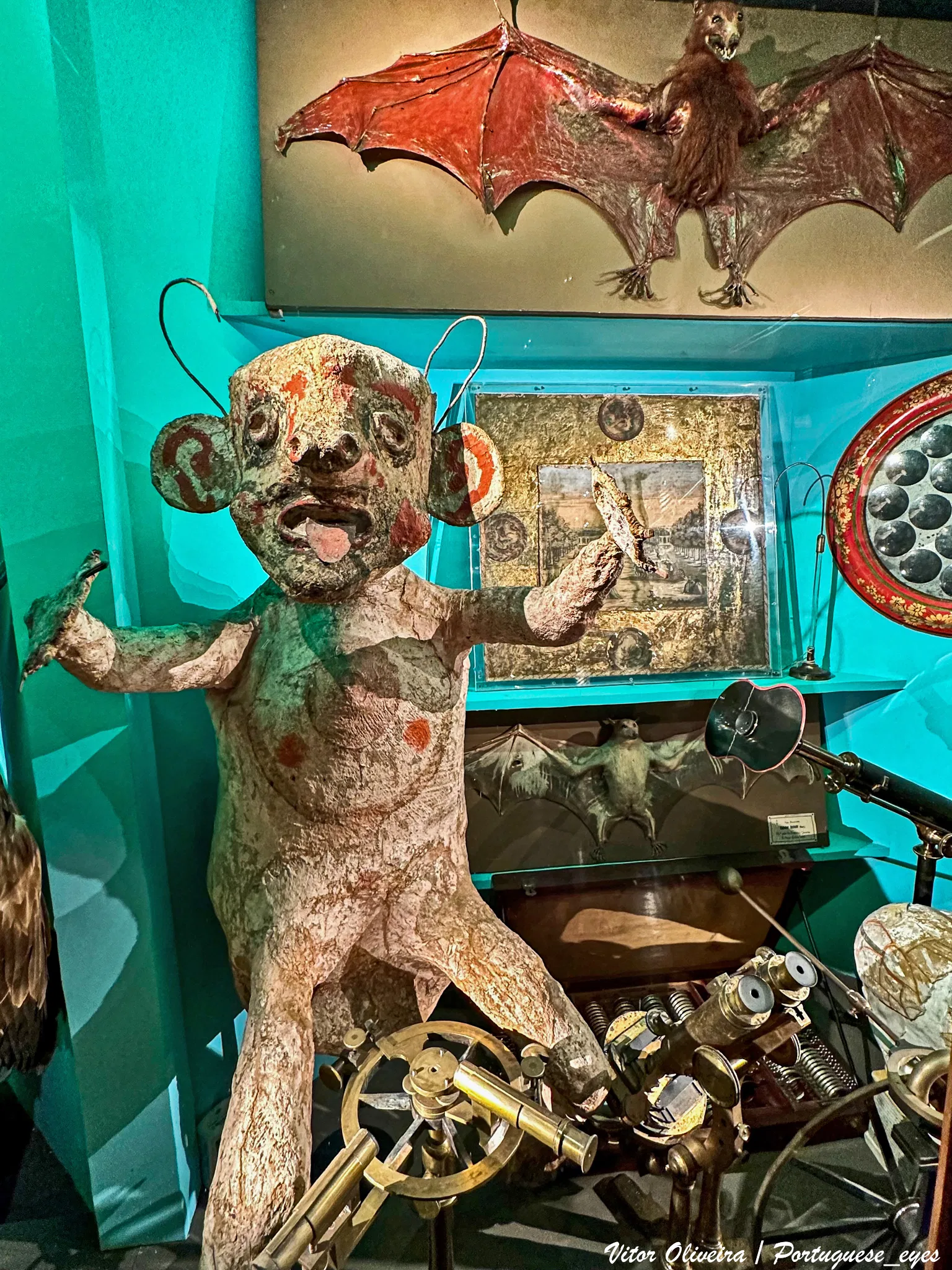
The Cabinet of Curiosities at the University of Coimbra is Portugal’s most direct recreation of the European wonder-room tradition. Rather than arranging everything into conventional scientific categories, it brings together a dense mixture of zoological specimens, skeletons, minerals, preserved animals and cultural objects. The university describes it as an immersive sample of collections developed over roughly 250 years, designed to provoke wonder before visitors move into galleries where scientific organisation and explanation take precedence.[UCtour]visit.uc.pttour Univ CoimbraIn this place where the shifting lights guide the visitor, it is possible to have a sample of the fantastic collection that the Universit…
The display is unusual because it deliberately suspends the normal museum promise that every object will be neatly labelled and interpreted. Its darkness, shifting illumination and crowded arrangement reproduce something of the emotional logic of eighteenth-century cabinets: surprise first, classification later. Reports on the collection describe taxidermied animals, jarred specimens, unusual skeletons and a six-legged donkey among its more memorable exhibits.[Atlas Obscura]atlasobscura.comAtlas Obscura Cabinet of Curiosities at the University of CoimbraAtlas ObscuraCabinet of Curiosities at the University of CoimbraApril 16, 2025 — 16 Apr 2025 — The Cabinet of Curiosities at the Science…
This theatrical approach should not be mistaken for pseudoscience. The cabinet belongs to the University of Coimbra’s Science Museum and uses historical display methods to contrast two ways of understanding collections. The wonder-room arrangement shows how rare objects once accumulated as signs of knowledge, reach and prestige; the surrounding museum demonstrates how later scientific disciplines divided that mixed world into fields such as zoology, anthropology and mineralogy.
The collection also carries a less comfortable history. Portuguese university museums grew through teaching, expeditions, donations and overseas networks, including the unequal structures of empire. Some ethnographic and natural-history objects therefore raise questions about who collected them, under what authority and how they should now be interpreted. The cabinet’s visual abundance is its appeal, but it can also obscure provenance. For a critical visitor, that tension is part of the experience rather than a reason to dismiss it.
Masks that still belong to living festivals
The Iberian Museum of Masks and Costumes in Bragança preserves one of Portugal’s most visually striking bodies of folklore. Opened in 2007 inside Bragança’s citadel, it developed through cooperation between Bragança and the neighbouring Spanish province of Zamora. Its subject is the cycle of winter and carnival festivities found in north-eastern Portugal and across the border.[Eixo Atlántico]vive.eixoatlantico.comEixo AtlánticoIberian Museum of Masks and Costumes – ResourcesMasks and Costumes. The museum, focused on the theme of masks, opened on th…
Visitors encounter brightly coloured costumes, bells, animal features, exaggerated faces and masks that can appear demonic or monstrous when removed from their original setting. The museum presents around 50 festival characters from different communities, each associated with particular dates, roles and local customs.[Google Arts & Culture]artsandculture.google.comGoogle Arts & CultureThe Iberian Museum of the Mask and the CostumeThe Iberian Museum of Mask and Costume, in Bragança, There are about 5…
These figures should not be reduced to generic “Portuguese monsters”. During winter festivals, masked performers may chase spectators, create noise, mock authority, collect offerings or temporarily overturn everyday social rules. Christian feast days, local histories and much older seasonal symbolism have become layered together over time. Precise claims about prehistoric survivals are often difficult to prove, so the museum is most credible when it treats the customs as evolving community traditions rather than untouched remnants of an ancient pagan religion.
The museum’s cross-border scope is important. The cultural landscape of north-eastern Portugal does not stop at the modern boundary with Spain. Similar masked festivities occur on both sides, making the institution a record of regional connections as well as Portuguese identity. For visitors interested in folklore, it is more informative than seeing a mask in isolation: costumes are organised around the people, seasons and performances that give them meaning.
Lisbon’s Puppet Museum offers a complementary route into uncanny performance traditions. It is Portugal’s only museum devoted exclusively to puppets and puppet theatre, with substantial Portuguese holdings alongside African and Asian puppets and masks from the Francisco Capelo collection.[Museu da Marioneta]museudamarioneta.ptMuseu da MarionetaMuseum – Museu da MarionetaIt is the first and only Portuguese museum solely dedicated to the interpretation and dissem… Although less overtly macabre, it helps explain why human-like figures can be simultaneously comic, sacred, political and unsettling.
Bones, relics and the Catholic culture of death
Évora’s Chapel of Bones
The Chapel of Bones in Évora is Portugal’s best-known public display of human remains. Franciscan friars created it in the early modern period, lining its interior with carefully arranged skulls and long bones removed from burial grounds. Its purpose was devotional: the dead were used to remind the living that status, wealth and pleasure end at the grave.[VisitEvora]visitevora.netVisit Evora Bones Chapel in Evora, Sao Francisco ChurchVisit Evora Bones Chapel in Evora, Sao Francisco Church
Modern visitors often approach it as dark tourism, and tourism marketing understandably emphasises its visual shock. Yet the chapel makes more sense as a three-dimensional sermon on mortality. Bones form architectural patterns around columns, arches and walls, while religious imagery directs attention towards judgement, salvation and the shortness of earthly life.
Accounts commonly state that remains from about 5,000 people were used, although such totals should be treated as traditional estimates rather than a modern forensic count.[Insight Vacations]insightvacations.comspotlight on evoraspotlight on evora The attraction is public and heavily visited, but it remains part of a religious complex rather than a purpose-built horror museum. Respectful behaviour is therefore more appropriate than staged fright or novelty photography.
Reliquaries at São Roque
Lisbon’s Museum of São Roque offers a different encounter with the human body. It holds one of Portugal’s most important collections of reliquaries: ornate containers intended to preserve and honour relics associated with saints. A large part of the collection came from a donation made to the Jesuits by João de Borja in 1588.[Museu de São Roque]museusaoroque.scml.ptMuseu de São Roque RELIQUARIESMuseu de São Roque RELIQUARIES
Reliquaries can appear strange to visitors unfamiliar with Catholic practice because tiny fragments of bone or other sacred material are enclosed in gold, silver, crystal, sculpture or miniature architecture. Their value was never supposed to lie in anatomical curiosity alone. Relics were understood as physical links to holy people and as focal points for prayer, institutional prestige and sacred history.
Questions of authenticity have followed relics for centuries. Documentation, tradition and ecclesiastical acceptance vary between objects, and modern scientific verification is rarely the central issue in devotional use. The museum is therefore best approached as a collection about belief, craftsmanship and the social power of sacred matter, not as a laboratory claiming to prove the identity of every fragment.
The contrast with Évora is revealing. The Chapel of Bones uses anonymous remains to stress the common fate of humanity; reliquaries isolate selected remains and assign them exceptional identity. One display says that all bodies become bones, while the other treats particular bodily fragments as enduring vessels of sanctity.
Mummies in an earthquake ruin
The Carmo Archaeological Museum in Lisbon occupies the roofless remains of a medieval convent church damaged in the 1755 earthquake. Its setting already feels like an archaeological curiosity: Gothic arches rise above an open nave before visitors enter rooms filled with tombs, sculpture, tiles and objects from widely separated places and periods.
Among its most unexpected exhibits are two naturally or artificially preserved Andean bodies. They entered the museum through the collection of the Count of São Januário, a nineteenth-century soldier, diplomat and collector whose donations broadened the museum far beyond Portuguese archaeology.[Salterton Arts Review]saltertonartsreview.comSalterton Arts Review Convento do Carmo & Carmo Archaeological MuseumSalterton Arts Review Convento do Carmo & Carmo Archaeological Museum The bodies are often casually described as “Peruvian mummies”, although their precise cultural and geographical histories deserve more careful treatment than a tourist label can provide.
Their presence demonstrates how nineteenth-century museums accumulated human remains through collecting networks that were often poorly documented by modern standards. A body could be treated simultaneously as archaeological evidence, an ethnographic specimen and a spectacular curiosity. Today, museums face harder questions about consent, provenance, cultural affiliation and whether human remains should be displayed at all.
The Carmo Museum remains a public visitor attraction with published opening hours.[Museu Arqueológico do Carmo]museuarqueologicodocarmo.ptOpen source on museuarqueologicodocarmo.pt. Its collection is historically important, but interpretation of the mummies has not always matched the detail now expected in human-remains displays. Visitors should distinguish between what can be observed—the bodies, their display context and their known collecting history—and confident claims about identity, cause of death or ritual status that may rely on incomplete documentation.
Elsewhere in Lisbon, scientific investigation has changed how some preserved bodies are understood. The Lisbon Mummy Project used medical imaging to examine mummified remains in Portuguese collections; one widely publicised case revealed evidence of cancer.[Turismo de Lisboa]visitlisboa.comOpen source on visitlisboa.com. Such work shows the difference between a mummy as a visual oddity and a mummy as a source of carefully tested information about disease, preservation and ancient life.
Magic without claims of the supernatural
Portugal’s Museum of Magic is dedicated to stage illusion rather than witchcraft or occult belief. Its stated purpose is to preserve the history of Portuguese magic, record notable performers and bring together apparatus, documents and other material associated with national and international illusionism. The museum describes itself as Portugal’s only institution of its kind and promotes a collection numbering more than 10,000 items.[Museu da Magia]museudamagia.comOpen source on museudamagia.com.
The distinction matters. “Magic” here means performance: misdirection, mechanical devices, theatrical personas, posters, books and the professional culture of magicians. A visitor should expect entertainment history and technical ingenuity, not evidence for paranormal powers.
The project appears to be privately led rather than a large state museum. Its website presents visits through booking or enquiry arrangements, so access should be confirmed directly rather than assumed to follow regular drop-in hours.[Museu da Magia]museudamagia.comOpen source on museudamagia.com. This more personal model can produce an enthusiastic and unusually specialised collection, but its self-description—including claims about rarity or value—should be read as the voice of the collecting institution rather than independent assessment.
Its importance lies in preserving an ephemeral art. Stage illusions are designed to conceal their mechanisms, and performers’ archives can easily disappear when equipment, correspondence and publicity material are dispersed. A dedicated collection gives Portuguese illusionism a history beyond individual shows and famous names.
Psychiatric art and a collection at risk
The former Miguel Bombarda psychiatric hospital in Lisbon contains one of Portugal’s most significant and difficult unusual collections. From the late nineteenth century, the institution preserved artworks produced by patients alongside medical records, equipment and architectural evidence of psychiatric practice. Supporters describe the holdings as Portugal’s oldest and largest collection of patient or outsider art, comprising thousands of works.[aparteoutsider.org]aparteoutsider.orgOpen source on aparteoutsider.org.
The term “outsider art” generally refers to work made outside established art-world training and institutions, although its application to psychiatric patients is contested. It can recognise creativity that traditional museums ignored, but it can also turn illness and institutional confinement into a marketable label. The most responsible interpretation treats the makers as artists and historical individuals, not anonymous examples of diagnosis.
Miguel Bombarda is also significant as a site. Its wards, treatment spaces and secure pavilion preserve evidence of changing attitudes towards mental illness, custody and therapy. A museum initiative opened parts of the hospital to the public in 2004, but the hospital later closed, creating prolonged uncertainty about the integrity and future of its buildings, archives and collections.[aparteoutsider.org]aparteoutsider.orgOpen source on aparteoutsider.org.
The collection’s status has continued to evolve. In 2026, Portuguese heritage documentation described the “Bombarda Collection” as a representative body of outsider art and historical material connected with life and medical practice at the hospital.[Diário da República]diariodarepublica.ptOpen source on diariodarepublica.pt. This recognition strengthens its cultural standing, but visitors should not assume that it operates like a conventional museum with predictable daily access. It is better understood as a nationally important collection and memory site whose preservation and public presentation have been subjects of advocacy and institutional negotiation.
This is one of the clearest cases in Portugal where “strange museum” tourism needs care. Old psychiatric buildings and patient art can easily be sensationalised. The real story is more compelling: people created complex work within an institution, and that work now challenges the boundary between medical documentation, personal expression and recognised art.
A prison that rejects spectacle
The Aljube Museum of Resistance and Freedom occupies a former Lisbon prison used for political detainees during Portugal’s twentieth-century dictatorship. It preserves testimonies from former prisoners and their families, alongside material concerning surveillance, interrogation, censorship, colonial war and resistance.[Museu do Aljube]museudoaljube.ptOpen source on museudoaljube.pt.
The building served as a political prison from 1928 until 1965. Its confined cells and corridors give the displays an immediacy that a neutral exhibition hall could not reproduce.[Turismo de Lisboa]visitlisboa.commuseum of aljube resistance and freedommuseum of aljube resistance and freedom Yet the museum does not market imprisonment as a thrill. It describes itself as an institution committed to memory, freedom and democracy, making its curatorial position explicit.
That stance is important because prison museums can drift into theatrical cruelty: waxwork prisoners, dramatic sound effects and simplified tales of villains and victims. Aljube instead centres documented state repression and testimony. It is “dark” because the history is dark, not because the museum manufactures an atmosphere of supernatural menace.
For visitors exploring Portugal’s unusual heritage, Aljube provides a useful measure of credibility. Authentic surroundings alone do not guarantee good interpretation. What matters is whether an institution identifies its sources, acknowledges its purpose and treats suffering as history rather than entertainment.
Secret societies and symbolic collections
The Portuguese Museum of Freemasonry in Lisbon represents a quieter form of curiosity culture. Freemasonry has long attracted rumours about hidden rituals, political influence and coded symbols, so its aprons, regalia, documents and ceremonial objects are easily presented as occult mysteries. Lisbon’s official tourism service lists the institution as a specialist museum, but publicly available English-language detail is limited.[Turismo de Lisboa]visitlisboa.comOpen source on visitlisboa.com.
A credible visit requires separating three things: documented Masonic history, the organisation’s own interpretation of its traditions and popular conspiracy stories imposed from outside. Freemasonry uses allegory, initiation and restricted ceremonies, but secrecy does not by itself prove supernatural practice or a hidden system of political control.
Such a museum matters because objects that appear cryptic can be explained as part of a structured fraternal culture. Symbols, clothing and ritual furnishings become evidence about sociability, charity, political identity and changing relations between private associations, Church and state. Practical access and opening arrangements should be checked in advance, particularly for small specialist institutions.
What is genuinely credible?
Portugal’s unusual collections vary greatly in purpose and authority. A useful way to assess them is to ask who controls the display and what kind of claim it makes.
University and municipal museums generally offer the strongest institutional framework. Coimbra’s Science Museum and Bragança’s mask museum preserve documented collections with educational mandates, even when their displays are intentionally theatrical.
Religious sites interpret objects through faith as well as history. Évora’s bones and São Roque’s relics are authentic historical displays, but their meanings cannot be reduced to scientific verification. They are evidence of devotional practice whether or not every traditional attribution can be proven.
Private specialist museums may contain rare material and deep expertise, but promotional claims about uniqueness, size or monetary value need independent confirmation. Visiting arrangements may also be irregular.
Historic human remains require particular caution. Older collecting records can be incomplete, and labels such as “Egyptian” or “Peruvian” may conceal uncertainty. Modern imaging can clarify age, health and preservation, but it does not automatically resolve ownership or ethical questions.
Memory museums are not neutral storehouses. Aljube openly supports democratic remembrance, while the Miguel Bombarda collection sits within debates about psychiatry, authorship and institutional power. Declared purpose is not a weakness; unexplained purpose is more problematic.

Planning an unusual-museum journey
The most effective route depends on the kind of strangeness a visitor wants to understand.
For classic cabinets and scientific curiosities, Coimbra is the essential destination. Its Cabinet of Curiosities can be combined with the wider university science collections so that spectacle and classification are seen together.
For folklore and masked traditions, Bragança offers the strongest museum context. Visiting during the broader winter festival season can add living cultural meaning, although festivals should be approached as community events rather than performances staged solely for tourists.
For death, relics and human remains, Lisbon and Évora form a natural pairing. São Roque explains sacred relics, Carmo exposes the history of archaeological collecting, and Évora’s Chapel of Bones presents mortality through Franciscan devotion.
For difficult twentieth-century history, Aljube is the most dependable public museum. Miguel Bombarda is equally significant but requires closer checking of access, exhibitions and the current location of material.
Opening conditions deserve attention. Major public attractions usually publish clear schedules, but churches may restrict access during worship, small private museums may require reservations and collections connected with former institutions may open only for special visits. Displays involving human remains, patient art or imprisonment also reward slower viewing and a more respectful manner than novelty tourism normally encourages.
Why Portugal’s curiosity culture matters
Portugal’s strange collections are most revealing when viewed together. Coimbra shows the transition from wonder to scientific order. Bragança demonstrates that frightening masks can belong to communal celebration rather than superstition. Évora and São Roque preserve contrasting Catholic ideas about anonymous mortality and exceptional holiness. Carmo exposes the global collecting habits of nineteenth-century elites, while Miguel Bombarda raises questions about who is allowed to become an artist. Aljube turns a place of state confinement into a public argument for democratic memory.
These institutions also show why “weird museum” is an imperfect label. It can help travellers find overlooked places, but it risks flattening profound differences between a stage magician’s apparatus, a saint’s relic, a political prisoner’s cell and the body of a person removed from another continent. Portugal’s best unusual collections do more than surprise. They reveal how objects acquire authority through science, religion, folklore, collecting, tourism and institutional power—and how those meanings can be challenged when a new generation looks at the same display.
Amazon book picks
Further Reading
Books and field guides related to Where Portugal Keeps Its Strangest Objects. Use these as the next step if you want deeper reading beyond the article.
The Past Is a Foreign Country
A completely updated new edition of David Lowenthal's classic account of how we reshape the past to serve present needs.
The Birth of the Museum
In a series of richly detailed case studies from Britian, Australia and North America, Tony Bennett investigates how nineteenth- and twen...
Portugal: A Companion History
Professor Saraiva's multi-volume History of Portugal is a celebrated scholarly standard work. Yet, when he published a one-volume Histori...
eBay marketplace picks
Marketplace Samples
Live-tested eBay searches with available results related to this page.
Selected fromPortugal art print oneBay.co.uk.

Endnotes
1.
Source: artsandculture.google.com
Link:https://artsandculture.google.com/partner/museu-iberico-da-mascara-e-do-traje
Source snippet
Google Arts & CultureThe Iberian Museum of the Mask and the CostumeThe Iberian Museum of Mask and Costume, in Bragança, There are about 5...
2.
Source: visitevora.net
Title: Visit Evora Bones Chapel in Evora, Sao Francisco Church
Link:https://www.visitevora.net/en/bones-chapel-evora/
3.
Source: aparteoutsider.org
Link:https://aparteoutsider.org/?page_id=74
4.
Source: aparteoutsider.org
Link:https://aparteoutsider.org/?page_id=35
5.
Source: aparteoutsider.org
Link:https://aparteoutsider.org/
6.
Source: aparteoutsider.org
Link:https://aparteoutsider.org/?p=489
7.
Source: aparteoutsider.org
Link:https://aparteoutsider.org/?cat=6
8.
Source: dark-tourism.com
Link:https://www.dark-tourism.com/index.php/1590-aljube
9.
Source: lisboa.pt
Link:https://www.lisboa.pt/en/themes/culture/cultural-facilities/museums
10.
Source: bombarda.pt
Link:https://bombarda.pt/en/sobre-n%C3%B3s
11.
Source: bombarda.pt
Title: About Us
Link:https://bombarda.pt/en-US/about-us
12.
Source: bombarda.pt
Link:https://bombarda.pt/en-US/bombarda
13.
Source: bombarda.pt
Link:https://bombarda.pt/en-US/home
14.
Source: visit.uc.pt
Title: tour Univ Coimbra
Link:https://visit.uc.pt/en/space-list/gabinete_curiosidades/
Source snippet
In this place where the shifting lights guide the visitor, it is possible to have a sample of the fantastic collection that the Universit...
16.
Source: atlasobscura.com
Title: Atlas Obscura Cabinet of Curiosities at the University of Coimbra
Link:https://www.atlasobscura.com/places/cabinet-of-curiosities-at-the-university-of-coimbra
Source snippet
Atlas ObscuraCabinet of Curiosities at the University of CoimbraApril 16, 2025 — 16 Apr 2025 — The Cabinet of Curiosities at the Science...
Published: April 16, 2025
17.
Source: vive.eixoatlantico.com
Link:https://vive.eixoatlantico.com/en/recurso/museu-iberico-da-mascara-e-do-traje/
Source snippet
Eixo AtlánticoIberian Museum of Masks and Costumes – ResourcesMasks and Costumes. The museum, focused on the theme of masks, opened on th...
18.
Source: museudamarioneta.pt
Link:https://www.museudamarioneta.pt/en/museum/
Source snippet
Museu da MarionetaMuseum – Museu da MarionetaIt is the first and only Portuguese museum solely dedicated to the interpretation and dissem...
19.
Source: visitlisboa.com
Link:https://www.visitlisboa.com/en/places/museu-da-marioneta-puppet-museum
20.
Source: insightvacations.com
Title: spotlight on evora
Link:https://www.insightvacations.com/blog/spotlight-on-evora/
21.
Source: museusaoroque.scml.pt
Title: Museu de São Roque RELIQUARIES
Link:https://museusaoroque.scml.pt/en/collections/reliquaries/
22.
Source: saltertonartsreview.com
Title: Salterton Arts Review Convento do Carmo & Carmo Archaeological Museum
Link:https://saltertonartsreview.com/2026/06/convento-do-carmo-carmo-archaeological-museum-museu-arqueologico-do-carmo-lisbon/
23.
Source: museuarqueologicodocarmo.pt
Link:https://www.museuarqueologicodocarmo.pt/info_en.html
24.
Source: visitlisboa.com
Link:https://www.visitlisboa.com/en/articles/there-is-a-mummy-with-cancer-in-this-museum
25.
Source: museudamagia.com
Link:https://www.museudamagia.com/en_gb/welcome
26.
Source: museudamagia.com
Link:https://www.museudamagia.com/en_gb/index
27.
Source: museudamagia.com
Link:https://www.museudamagia.com/en_gb/visits
28.
Source: diariodarepublica.pt
Link:https://diariodarepublica.pt/dr/detalhe/portaria/281-2026-1133910849
29.
Source: museudoaljube.pt
Link:https://www.museudoaljube.pt/en/
30.
Source: visitlisboa.com
Title: museum of aljube resistance and freedom
Link:https://www.visitlisboa.com/en/places/museum-of-aljube-resistance-and-freedom
31.
Source: visitlisboa.com
Link:https://www.visitlisboa.com/en/places/portuguese-museum-of-freemasonry
32.
Source: museudoaljube.pt
Title: Demonstration of support for Eurico Figueiredo – Museu do Aljube
Link:https://www.museudoaljube.pt/en/2026/06/20/demonstration-of-support-for-eurico-figueiredo/
33.
Source: museudoaljube.pt
Title: The Aljube Museum and Gavidia in Seville – Museu do Aljube
Link:https://www.museudoaljube.pt/en/2019/03/15/the-aljube-museum-and-gavidia-in-seville/
34.
Source: museudoaljube.pt
Title: “In the Custody of Love” by Castro Guedes – Museu do Aljube
Link:https://www.museudoaljube.pt/en/evento/in-the-custody-of-love-by-castro-guedes/
35.
Source: museudoaljube.pt
Title: Guided Tour to the Museum in English – Museu do Aljube
Link:https://www.museudoaljube.pt/en/evento/guided-tour-to-the-museum-in-english/
36.
Source: museudamagia.com
Link:https://www.museudamagia.com/en_gb/company
37.
Source: museudamagia.com
Link:https://www.museudamagia.com/en_gb/contacts
38.
Source: museudamagia.com
Link:https://www.museudamagia.com/pt_pt/welcome
39.
Source: museudamagia.com
Link:https://www.museudamagia.com/en_gb/library
40.
Source: museudamagia.com
Link:https://www.museudamagia.com/pt_pt/index
41.
Source: museudamagia.com
Link:https://www.museudamagia.com/pt_pt/company
42.
Source: museudamagia.com
Link:https://www.museudamagia.com/pt_pt/visits
43.
Source: museudamagia.com
Link:https://www.museudamagia.com/pt_pt/contacts
44.
Source: museudamagia.com
Link:https://www.museudamagia.com/pt_pt/library
45.
Source: atlasobscura.com
Link:https://www.atlasobscura.com/things-to-do/portugal/museums
46.
Source: atlasobscura.com
Title: gabinete de curiosidades cabinet of curiousities
Link:https://www.atlasobscura.com/places/gabinete-de-curiosidades-cabinet-of-curiousities
47.
Source: atlasobscura.com
Title: iberian museum of masks and costumes
Link:https://www.atlasobscura.com/places/iberian-museum-of-masks-and-costumes
48.
Source: atlasobscura.com
Title: museu da marioneta
Link:https://www.atlasobscura.com/places/museu-da-marioneta
49.
Source: Wikipedia
Link:https://en.wikipedia.org/wiki/Portugal
50.
Source: Wikipedia
Title: Museu da Marioneta
Link:https://en.wikipedia.org/wiki/Museu_da_Marioneta
51.
Source: tripadvisor.com
Title: Museu do Aljube
Link:https://www.tripadvisor.com/Attraction_Review-g189158-d8378896-Reviews-Museu_do_Aljube_Resistencia_e_Liberdade-Lisbon_Lisbon_District_Central_Portugal.html
52.
Source: visit.uc.pt
Title: pt Univ Coimbra
Link:https://visit.uc.pt/en/program-list/30
53.
Source: visit.uc.pt
Title: pt Univ Coimbra
Link:https://visit.uc.pt/en/space-list
54.
Source: visit.uc.pt
Title: pt Univ Coimbra
Link:https://visit.uc.pt/en/info
55.
Source: visit.uc.pt
Title: pt Univ Coimbra
Link:https://visit.uc.pt/pt/space-list/gabinete_curiosidades
56.
Source: uc.pt
Link:https://www.uc.pt/en/herbarium/collections/
57.
Source: visit.uc.pt
Title: pt Univ Coimbra
Link:https://visit.uc.pt/en/
58.
Source: visit.uc.pt
Title: pt Univ Coimbra
Link:https://visit.uc.pt/en/space-list/museu_ciencia-LC
59.
Source: visit.uc.pt
Title: pt Univ Coimbra
Link:https://visit.uc.pt/en/programs/congress/19
60.
Source: tripadvisor.co.uk
Link:https://www.tripadvisor.co.uk/Attraction_Review-g189158-d1996418-Reviews-Museu_Arqueologico_do_Carmo-Lisbon_Lisbon_District_Central_Portugal.html
61.
Source: visitlisboa.com
Link:https://www.visitlisboa.com/en/places/prazeres-cemetery-and-museum
62.
Source: visitlisboa.com
Link:https://www.visitlisboa.com/en/places/carmo-archaeological-museum
63.
Source: visitlisboa.com
Link:https://www.visitlisboa.com/en/places/health-and-pharmacy-museum-lisbon
64.
Source: ricksteves.com
Link:https://www.ricksteves.com/europe/portugal
65.
Source: facebook.com
Link:https://www.facebook.com/1stAMnMotP/photos/the-mummy-of-a-young-16th-century-peruvian-girl-at-the-carmo-monastery-archaeolo/401615372615080/
66.
Source: visitportugal.com
Link:https://www.visitportugal.com/en/content/museu-arqueologico-do-carmo
67.
Source: museuarqueologicodocarmo.pt
Link:https://www.museuarqueologicodocarmo.pt/index.html
68.
Source: museuarqueologicodocarmo.pt
Link:https://museuarqueologicodocarmo.pt/collections.html
69.
Source: museuarqueologicodocarmo.pt
Link:https://www.museuarqueologicodocarmo.pt/mac_en.html
70.
Source: museuarqueologicodocarmo.pt
Link:https://museuarqueologicodocarmo.pt/educational_programme.html
71.
Source: museuarqueologicodocarmo.pt
Link:https://www.museuarqueologicodocarmo.pt/coleccoes.html
72.
Source: museuarqueologicodocarmo.pt
Title: mac structure
Link:https://museuarqueologicodocarmo.pt/mac_structure.html
73.
Source: museuarqueologicodocarmo.pt
Link:https://museuarqueologicodocarmo.pt/library.html
74.
Source: museuarqueologicodocarmo.pt
Link:https://www.museuarqueologicodocarmo.pt/archives%20.html
75.
Source: whichmuseum.co.uk
Title: Museu Arqueológico do Carmo (Lisbon)
Link:https://whichmuseum.co.uk/museum/museu-arqueologico-do-carmo-lisbon-40432
76.
Source: museudoaljube.pt
Link:https://www.museudoaljube.pt/en/educa/guided-tours-to-the-aljube-museum/
77.
Source: museudoaljube.pt
Link:https://www.museudoaljube.pt/en/permanent-exhibition/
78.
Source: museudoaljube.pt
Link:https://www.museudoaljube.pt/en/programme/?ft=past
79.
Source: museudoaljube.pt
Link:https://www.museudoaljube.pt/exposicao-permanente/
80.
Source: museudoaljube.pt
Link:https://www.museudoaljube.pt/
81.
Source: museudoaljube.pt
Link:https://www.museudoaljube.pt/en/documentation-center/
82.
Source: museudoaljube.pt
Title: days of memory
Link:https://www.museudoaljube.pt/en/ciclo/days-of-memory/
83.
Source: museudoaljube.pt
Title: About the Museum
Link:https://www.museudoaljube.pt/en/about-the-museum/
84.
Source: panteaonacional.gov.pt
Link:https://www.panteaonacional.gov.pt/en/visitar
85.
Source: worldhistory.org
Title: the carmo archaeological museum
Link:https://www.worldhistory.org/image/10434/the-carmo-archaeological-museum/
86.
Source: egeac.pt
Link:https://egeac.pt/espacos/museu-do-aljube-resistencia-e-liberdade-2/
87.
Source: airial.travel
Title: Aljube Museum
Link:https://airial.travel/attractions/portugal/lisboa/aljube-museum-resistance-and-freedom-lisbon-9kTQquOn
Additional References
88.
Source: cntraveler.com
Link:https://www.cntraveler.com/stories/2015-03-07/eternal-sunshine-in-portugal-alentejo-where-to-stay
Source snippet
The region's gastronomic offerings are noteworthy, with robust bread, aromatic cheeses, and flavorful Iberian pork as staples. Wine enthu...
89.
Source: theguardian.com
Link:https://www.theguardian.com/travel/2025/nov/05/autumn-alentejo-ancient-city-sites-golden-vineyards-in-portugal
Source snippet
The article also delves into the region’s wine and gastronomy. Just outside the city, the Fitapreta Winery showcases Portugal’s indigenou...
90.
Source: noticias.uc.pt
Link:https://noticias.uc.pt/en/articles/the-mysteries-of-the-world-gathered-in-a-cabinet-of-curiosities/
Source snippet
ects, so as to amaze the visitor and simultaneously show the cosmopolitan vision of...
91.
Source: youtube.com
Title: Step into the 18th Century with Coimbra University’s Cabinet of Curiosities
Link:https://www.youtube.com/watch?v=80hAmEYu1wk
Source snippet
Chapel of Bones Evora Portugal Capela dos Ossos The Chapel of Bones, Portugal: All The Details You Were Afraid To Ask TravelScout...
92.
Source: youtube.com
Title: Evora: The Don’ts of Visiting the Bone Chapel Town of Portugal
Link:https://www.youtube.com/watch?v=SN6bHGUdWX8
Source snippet
Step into the 18th Century with Coimbra University's Cabinet of Curiosities...
93.
Source: youtube.com
Title: The Chapel of Bones, Portugal: All The Details You Were Afraid To Ask
Link:https://www.youtube.com/watch?v=SMtDHmZDjpY
Source snippet
The Ancient Masked Tradition "Caretos" of Northern Portugal...
94.
Source: youtube.com
Title: Political prison becomes museum to far-right resistance
Link:https://www.youtube.com/watch?v=4fyaT0nArmY
Source snippet
Evora: The Don'ts of Visiting the Bone Chapel Town of Portugal...
95.
Source: youtube.com
Title: The Ancient Masked Tradition “Caretos” of Northern Portugal
Link:https://www.youtube.com/watch?v=W8BrjXeUMkM
Source snippet
Political prison becomes museum to far-right resistance...
96.
Source: facebook.com
Link:https://www.facebook.com/MargaretAtwoodAuthor/posts/at-excellent-puppet-museum-in-lisbon-behind-me-are-sancho-panza-and-don-quixote-/1555979175892091/
97.
Source: centerofportugal.com
Link:https://www.centerofportugal.com/poi/cabinet-of-curiosities-of-the-university-of-coimbra