Within Curious Cuba
Why Is Napoleon's Death Mask in Havana?
Havana's Napoleonic Museum turns private collecting into a public display of imperial relics, military objects and a disputed death-mask tradition.
On this page
- How Cuban collectors built the Napoleonic collection
- The death mask and its contested copies
- What the museum reveals about private collecting
Page outline Jump by section
Introduction
Havana’s Napoleonic Museum is one of Cuba’s most unusual cultural collections and among the most significant museums dedicated to Napoleon Bonaparte anywhere in the Americas. Rather than celebrating Cuban history, it preserves the remarkable obsession of one twentieth-century collector whose passion for the French emperor eventually became a national museum. Visitors encounter imperial portraits, military uniforms, furniture, books, medals, weapons and one of the museum’s most discussed objects: a death mask associated with Napoleon’s final physician. The result is not simply a museum about Napoleon, but a rare example of private collecting transformed into public heritage, revealing how European imperial history found an unexpected home in revolutionary Cuba.[napoleon.org]napoleon.orghavanas museo napoleonico reopens 30 march 2011Havana's Museo Napoleonico reopens (30 March, 2011) - napoleon.orgMarch 30, 2011…
Why Is Napoleon’s Death Mask in Havana?
The museum’s best-known object is a plaster death mask linked to Francesco Antommarchi, Napoleon’s personal physician during his exile on Saint Helena. Antommarchi later travelled to the Caribbean and eventually settled in eastern Cuba, where he died in 1838. His connection with the island created an unusual historical bridge between Napoleonic Europe and Cuba, helping explain why objects associated with him entered Cuban collections rather than remaining exclusively in France.[napoleon.org]napoleon.orghavanas museo napoleonico reopens 30 march 2011Havana's Museo Napoleonico reopens (30 March, 2011) - napoleon.orgMarch 30, 2011…
The Havana museum displays two nineteenth-century Antommarchi-model death masks rather than claiming possession of the unique original cast. That distinction matters because the history of Napoleon’s death mask is one of the most disputed episodes in Napoleonic collecting. Historians generally agree that a mould was taken shortly after Napoleon’s death in May 1821, but disagreement continues over exactly who controlled the original cast, which sections survived and how later copies descended from it. Modern scholarship treats the various surviving masks as a complex family of related objects rather than accepting any single example as unquestionably authentic.[napoleon.org]napoleon.orghavanas museo napoleonico reopens 30 march 2011Havana's Museo Napoleonico reopens (30 March, 2011) - napoleon.orgMarch 30, 2011…
This uncertainty actually increases the museum’s interest. Instead of presenting an unquestionable relic, the death mask illustrates how historical memory, collecting and prestige can become intertwined. Visitors are looking not only at a physical object but also at two centuries of debate over provenance, replication and authenticity.[napoleon.org]napoleon.orgs death maskNapoleon's death mask - napoleon.org…
How Cuban Collectors Built the Napoleonic Collection
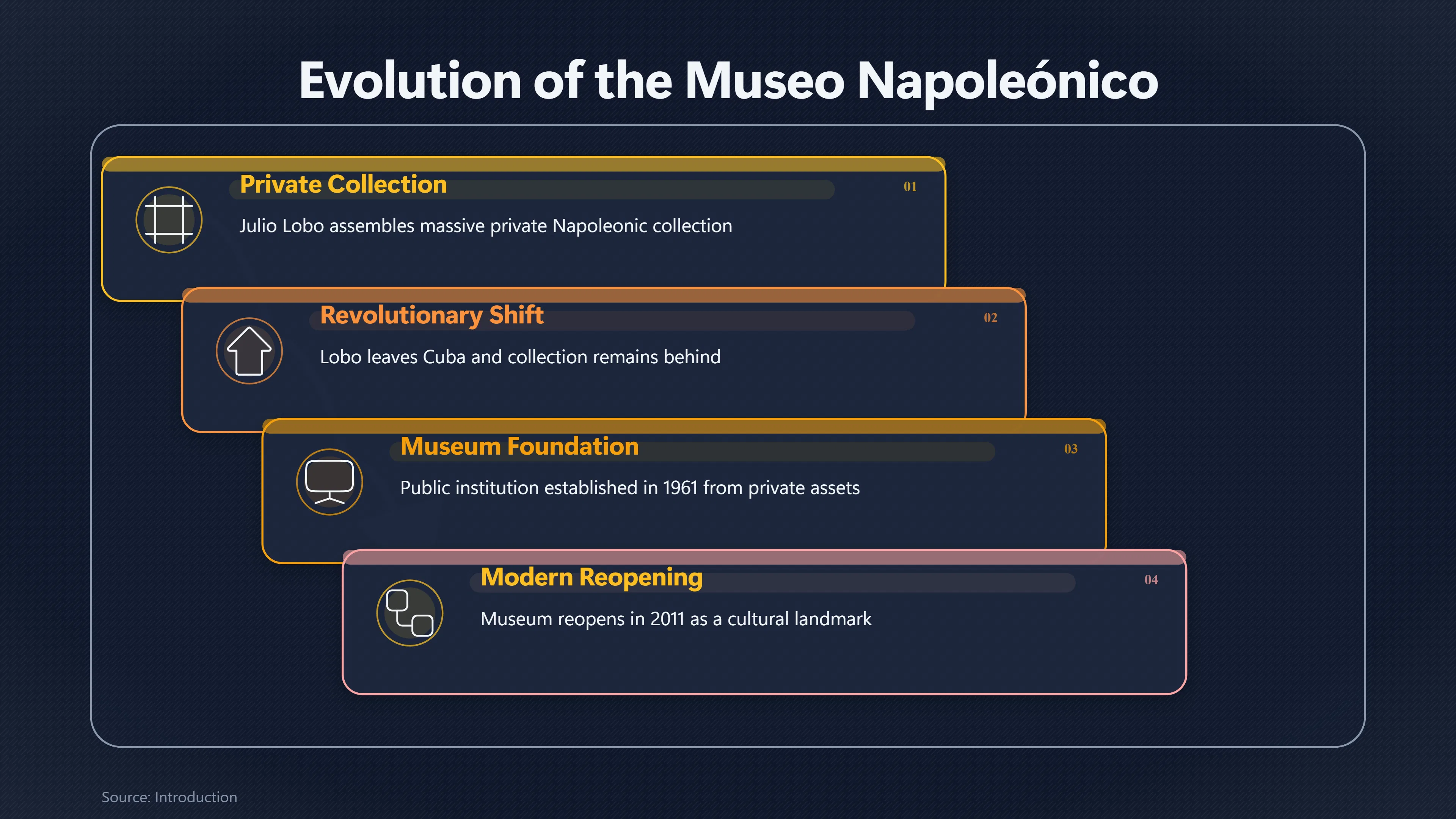
The museum exists largely because of Julio Lobo, the wealthy Cuban sugar entrepreneur often called the “Sugar King”. During the first half of the twentieth century he assembled one of the world’s largest private Napoleonic collections, purchasing paintings, sculptures, books, furniture, medals, military equipment and decorative arts through European dealers and auction houses. His enthusiasm became famous among Parisian antiquarian booksellers and collectors because he pursued Napoleonic material with unusual determination.[napoleon.org]napoleon.orghavanas museo napoleonico reopens 30 march 2011Havana's Museo Napoleonico reopens (30 March, 2011) - napoleon.orgMarch 30, 2011…
Following the Cuban Revolution, Lobo left the country. His collection remained in Cuba and became the foundation of the Museo Napoleónico, established in 1961. Instead of being dispersed through auctions or inherited by private owners, thousands of objects entered a public institution, giving Cuba an internationally distinctive museum despite the country’s limited direct connection with Napoleon himself.[napoleon.org]napoleon.orghavanas museo napoleonico reopens 30 march 2011Havana's Museo Napoleonico reopens (30 March, 2011) - napoleon.orgMarch 30, 2011…
The museum occupies an elaborate Florentine Renaissance-style mansion built during the 1920s, creating another layer of collecting history. Visitors therefore encounter not only Napoleonic artefacts but also a grand Havana residence adapted to display European imperial culture in a Caribbean setting.[napoleon.org]napoleon.orghavanas museo napoleonico reopens 30 march 2011Havana's Museo Napoleonico reopens (30 March, 2011) - napoleon.orgMarch 30, 2011…
The Death Mask and Its Contested Copies
Death masks occupied an important place in nineteenth-century memorial culture, allowing admirers and sculptors to preserve the appearance of famous individuals before photography became widespread. Napoleon’s case became exceptionally controversial because several competing lineages of masks emerged during the nineteenth century.
Current specialist research argues that no single surviving mask can be accepted without qualification as “the” original. Instead, scholars distinguish between different families of casts, including those associated with Dr Francis Burton, Count Bertrand and Antommarchi. Their relationships remain only partly documented, and some later reproductions were commercially produced decades after Napoleon’s death.[napoleon.org]napoleon.orgs death maskNapoleon's death mask - napoleon.org…
For visitors to Havana, this means the museum’s masks should be understood as historically significant Napoleonic artefacts connected to the Antommarchi tradition rather than unquestionable first-generation originals. That careful distinction reflects current historical scholarship more accurately than older descriptions that simply referred to “Napoleon’s death mask”.[napoleon.org]napoleon.orgs death maskNapoleon's death mask - napoleon.org…
What the Museum Reveals About Private Collecting
The Museo Napoleónico demonstrates how private collecting can preserve an entire historical world rather than isolated souvenirs. Lobo did not merely acquire relics. He assembled paintings, furniture, decorative arts, military objects, manuscripts and printed works that collectively recreated the political and cultural universe surrounding Napoleon.
This approach differs from curiosity cabinets built around bizarre objects alone. The museum instead shows how obsession itself can become historically valuable. A collector’s determination to gather every conceivable category of Napoleonic material produced a coherent public collection that later generations could study, even after its original owner disappeared from Cuban public life.[napoleon.org]napoleon.orghavanas museo napoleonico reopens 30 march 2011Havana's Museo Napoleonico reopens (30 March, 2011) - napoleon.orgMarch 30, 2011…
The collection also reflects the international circulation of prestige objects during the twentieth century. French imperial memorabilia travelled through European dealers before reaching a Caribbean collector, only to become part of a state museum after the Revolution. Few museums demonstrate this chain of collecting, politics and cultural preservation so clearly.

What Visitors Can Expect
Visitors should expect an art and history museum rather than a chamber of macabre relics. The atmosphere is formal and scholarly, with galleries devoted to portraits, imperial furniture, decorative arts, military equipment and personal objects associated with Napoleon and his era.
Among the highlights are:
- The Antommarchi-associated death masks that have made the museum internationally known.
- Objects connected with Napoleon’s final physician, whose later life linked him to Cuba.
- Empire-style furniture and decorative arts collected by Julio Lobo.
- Paintings, engravings, sculptures, medals and military artefacts illustrating the French Consulate, First Empire and related periods.[napoleon.org]napoleon.orghavanas museo napoleonico reopens 30 march 2011Havana's Museo Napoleonico reopens (30 March, 2011) - napoleon.orgMarch 30, 2011…
Rather than presenting sensational relics, the museum invites visitors to consider how historical reputation is built through collecting, display and preservation. In Cuba’s wider landscape of unusual museums, it stands out because its curiosity lies not in supernatural folklore or medical oddities, but in the extraordinary survival of one collector’s lifelong fascination with Napoleon and the enduring mysteries surrounding one of history’s most famous death masks.[napoleon.org]napoleon.orghavanas museo napoleonico reopens 30 march 2011Havana's Museo Napoleonico reopens (30 March, 2011) - napoleon.orgMarch 30, 2011…
Amazon book picks
Further Reading
Books and field guides related to Why Is Napoleon's Death Mask in Havana?. Use these as the next step if you want deeper reading beyond the article.
Lonely Planet Cuba
#1 best-selling guide to Cuba* Lonely Planet Cuba is your passport to the most relevant, up-to-date advice on what to see and skip, and w...
Napoleon: The Emperor of Kings
It is 1806 and Napoleon is master of an empire covering half of Europe. He subdues kings, conquers woman and defies the Pope himself over...

Napoleon: A Life
First published 2014. Subjects: Napoleon i, emperor of the french, 1769-1821, Emperors, France, history, 1789-1815.
eBay marketplace picks
Marketplace Samples
Example marketplace items related to this page. Use the search link to explore similar finds on eBay.
Selected fromCongo mask replica oneBay.co.uk.
Current eBay listing
Kuba Congo-Dance Mask "Shine Malula" African Tribal Art 35mm Slide
Current eBay listing
Kwele Congo-mask In Horn Circle- African Tribal Art 35mm Slide
Endnotes
1.
Source: napoleon.org
Title: havanas museo napoleonico reopens 30 march 2011
Link:https://www.napoleon.org/en/history-of-the-two-empires/articles/havanas-museo-napoleonico-reopens-30-march-2011/
Source snippet
Havana's Museo Napoleonico reopens (30 March, 2011) - napoleon.orgMarch 30, 2011...
Published: march 2011
2.
Source: napoleon.org
Title: ‘s death mask
Link:https://www.napoleon.org/en/history-of-the-two-empires/close-up/napoleons-death-mask/
Source snippet
Napoleon's death mask - napoleon.org...
3.
Source: napoleon.org
Title: The Affair of Napoleon’s Death Masks
Link:https://www.napoleon.org/en/history-of-the-two-empires/articles/the-affair-of-napoleons-death-masks/
4.
Source: napoleon.org
Link:https://www.napoleon.org/en/history-of-the-two-empires/articles/inventory-principal-plaster-death-masks-napoleon-public-private-collections/
5.
Source: museums.eu
Title: The story behind the 19th century Death Mask of Napoleon | Museums.EU
Link:https://museums.eu/article/details/107094/the-story-behind-the-19th-century-death-mask-of-napoleon
6.
Source: napoleon.org
Title: reouverture du museo napoleonico de la havane 30 mars 2011
Link:https://www.napoleon.org/histoire-des-2-empires/articles/reouverture-du-museo-napoleonico-de-la-havane-30-mars-2011/
7.
Source: napoleon.org
Title: Death Mask known as the “Bertrand Mask”
Link:https://www.napoleon.org/en/history-of-the-two-empires/objects/death-mask-known-as-the-bertrand-mask/
8.
Source: napoleon.org
Title: Museo Napoleonico
Link:https://www.napoleon.org/en/magazine/places/museo-napoleonico-cuba-2/
9.
Source: napoleon.org
Title: Les masques mortuaires de Napoléon. Résumé des problématiques
Link:https://www.napoleon.org/histoire-des-2-empires/articles/les-masques-mortuaires-de-napoleon-resume-des-problematiques/
10.
Source: napoleon.org
Title: ‘s body is definitely at Invalides!
Link:https://www.napoleon.org/en/history-of-the-two-empires/articles/napoleons-body-is-definitely-at-invalides/
11.
Source: napoleon.org
Title: Museo Napoleonico
Link:https://www.napoleon.org/magazine/lieux/museo-napoleonico-cuba/
Additional References
12.
Source: shs.cairn.info
Title: info The death masks of Napoleon I: a mystery still unsolved | Cairn.info
Link:https://shs.cairn.info/revue-napoleonica-the-journal-2025-1-page-7?lang=en
Source snippet
Antommarchi, ou Les derniers moments de Napoléon, (Paris: Barrois l’aîné, 1825), t. II, p. 159-160 (The Last Days of the Emperor Napoleo...
13.
Source: lonelyplanet.com
Title: The 8 best museums in Havana for art, history and cultural icons
Link:https://www.lonelyplanet.com/articles/best-museums-in-havana
Source snippet
More than 7000 objects associated with France’s erstwhile emperor have been expertly curated by the City Historian’s...
14.
Source: collections.louvre.fr
Title: fr Masque mortuaire de Napoléon Ier
Link:https://collections.louvre.fr/ark%3A/53355/cl010101864
Source snippet
mortuaire de Napoléon Ier - Louvre site des collectionsJuly 7, 2025 — Richard, Louis (1791 - 1879), Fondeur, Attribué à, signature DESCRI...
Published: July 7, 2025
15.
Source: museewellington.be
Title: Le masque mortuaire de Napoléon
Link:https://www.museewellington.be/?p=12098
Source snippet
Musée WellingtonJuly 15, 2024 — LE MASQUE MORTUAIRE DE NAPOLÉON Posted on: 15/07/2024 Last updated on: 15/07/2024 Written by: MuWel Categ...
Published: July 15, 2024
16.
Source: artic.edu
Link:https://www.artic.edu/artworks/69699/death-mask-of-napoleon
17.
Source: tripcuba.org
Link:https://www.tripcuba.org/napoleonic-museum-havana
18.
Source: visitarcuba.org
Link:https://www.visitarcuba.org/museo-napoleonico
19.
Source: napoleon.dallabona.ca
Link:https://napoleon.dallabona.ca/
20.
Source: americanhistory.si.edu
Link:https://americanhistory.si.edu/collections/object/nmah_492232
21.
Source: youtube.com
Title: Cuba, The Napoleonic Museum of Havana
Link:https://www.youtube.com/watch?v=4cdt-GRQGNg
Source snippet
The many Natalia Bolívar. Art, utopia and religion...