Within Strange Luxembourg
Inside Luxembourg's Museums Beneath the Ground
Rumelange and Haut-Martelange turn authentic underground workings, machinery and worker spaces into controlled journeys through Luxembourg's industrial past.
On this page
- The mine train journey at Rumelange
- Slate galleries and preserved workshops at Haut Martelange
- What authentic industrial settings reveal about mining labour
Page outline Jump by section
Introduction
Luxembourg’s preserved mining sites stand apart from conventional industrial museums because the collections are inseparable from the places where the work actually happened. Rather than displaying mining equipment in galleries alone, the country’s best-known mining museums take visitors into authentic underground workings, through former extraction landscapes and alongside original workshops where generations of miners earned their living. The result is an immersive experience that combines engineering, social history and physical atmosphere in a way that conventional museum displays rarely achieve. These sites are unusual not because they invent mystery, but because they preserve genuine industrial environments that still communicate the scale, danger and routine of mining life.[Visit Luxembourg]visitluxembourg.comVisit Luxembourg National Mining MuseumVisit LuxembourgNational Mining Museum - Visit Luxembourg…
The mine-train journey at Rumelange
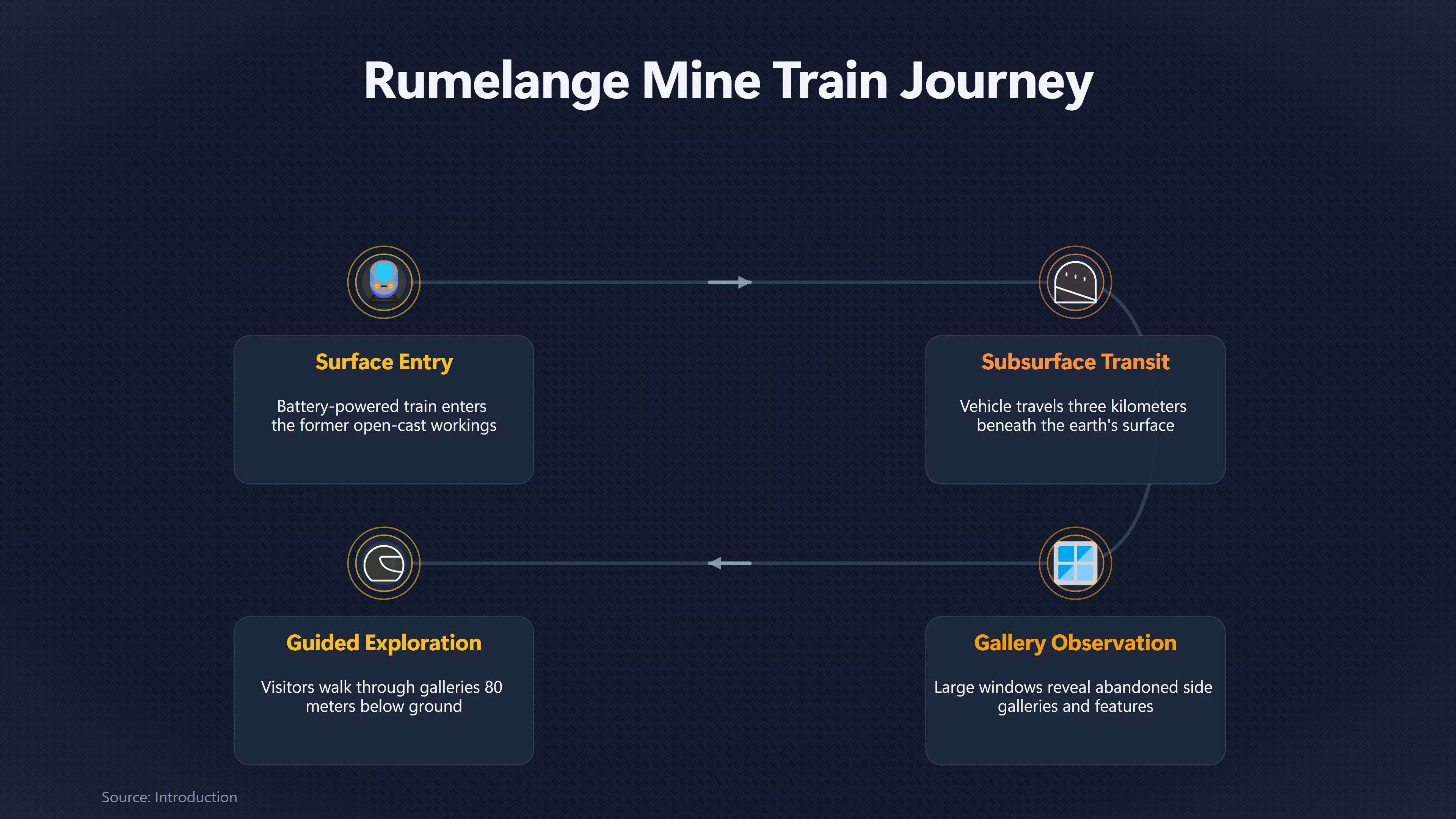
The National Mining Museum at Rumelange occupies the former Walert iron-ore mine in Luxembourg’s historic Minett region, where iron mining shaped the country’s industrial rise from the late nineteenth century until the industry’s gradual decline in the late twentieth century. Instead of beginning with display cases, the visit starts with transport into the landscape itself.
A battery-powered mine train carries visitors through former open-cast workings before disappearing into the main underground tunnel. The journey covers around four kilometres, with roughly three kilometres beneath the surface. Large windows allow passengers to see abandoned side galleries and geological features that working miners would rarely have observed so comfortably. The railway is therefore not simply an attraction but a practical interpretation tool, recreating the essential link between surface installations and underground production.[mnm.lu]mnm.luMine train12, 2018…
After leaving the train, visitors continue on foot with a guide through spacious galleries more than 80 metres below ground. Original extraction machinery, drilling equipment and transport systems remain in situ, allowing the underground spaces to function as a preserved workplace rather than a reconstructed exhibit. Helmets, cool temperatures and uneven tunnel conditions reinforce that this is an authentic industrial environment rather than a theatrical simulation.[mnm.lu]mnm.luGuided mine tour & train12, 2018…
The museum deliberately focuses on how mining was carried out over more than a century. Guides explain changing extraction techniques, technological developments and the practical organisation of underground work rather than presenting the mine as a romantic ruin. Because much of the collection remains underground where it was originally used, visitors encounter machines, tunnels and infrastructure in their working context rather than separated into exhibition halls.[mnm.lu]mnm.luGuided mine tour & train12, 2018…
Slate galleries and preserved workshops at Haut-Martelange
While Rumelange centres on iron ore, the Slate Museum at Haut-Martelange preserves a different industrial landscape. Here the emphasis falls on slate extraction and processing, industries that once dominated parts of north-western Luxembourg and the neighbouring Greater Region.
The museum occupies the historic quarry complex itself, where extraction areas, workshops and industrial buildings have been retained instead of replaced by modern exhibition architecture. Visitors move through preserved production spaces while learning how slate was quarried, split, shaped and prepared for construction. Rather than isolating tools behind glass, the museum demonstrates how each workshop fitted into the wider industrial process.[Luxembourg]luxembourg.public.luLuxembourg The Slate Museum: learning and entertainmentThe Slate Museum: learning and entertainment - Luxembourg…
An industrial railway forms part of the experience, illustrating how heavy stone moved through the site between quarry and processing areas. Combined with demonstrations, workshops and surviving machinery, the museum recreates the rhythm of a working industrial settlement rather than focusing solely on finished products. Food traditions associated with slate workers and regular heritage events further reinforce that the site interprets an entire working community, not just an extraction technology.[Luxembourg]luxembourg.public.luLuxembourg The Slate Museum: learning and entertainmentThe Slate Museum: learning and entertainment - Luxembourg…
Unlike many industrial museums that reconstruct lost environments from photographs and surviving objects, Haut-Martelange benefits from remarkable continuity between landscape, buildings and interpretation. Visitors remain within the authentic quarry complex throughout the experience, making the physical setting itself one of the museum’s most significant exhibits.[Luxembourg]luxembourg.public.luLuxembourg The Slate Museum: learning and entertainmentThe Slate Museum: learning and entertainment - Luxembourg…
What authentic industrial settings reveal about mining labour
The most distinctive feature shared by Rumelange and Haut-Martelange is that neither depends on artificial immersion. The atmosphere comes from preserved infrastructure, confined underground spaces, original machinery and the physical effort required simply to move through the sites.
These environments reveal aspects of mining labour that are difficult to communicate through conventional museum displays:
- The distances miners travelled underground before reaching the working face.
- The confined spaces, constant cool temperatures and limited natural light that shaped everyday working conditions.
- The scale of transport systems needed to move ore or slate rather than just extracting it.
- The close relationship between engineering, geology and human labour.
- The dependence of surrounding communities on a single heavy industry.[cfl.lu]cfl.luCF L | Mining museum in RumelangeCF L | Mining museum in Rumelange
Walking through original tunnels also changes visitors’ understanding of industrial heritage. Machinery appears less as isolated technological artefacts and more as components within an interconnected workplace. The preserved tracks, ventilation systems, loading areas and workshops demonstrate how mining relied on coordinated infrastructure rather than individual machines.
Why these underground museums matter in Luxembourg’s curiosity landscape
Within Luxembourg’s broader landscape of unusual heritage, preserved mines occupy a distinctive position. They are neither conventional museums nor abandoned ruins left for exploration. Instead, they represent carefully managed industrial environments where authenticity is the principal attraction.
This makes them different from the country’s fortified casemates or folklore sites. The underground experience is not intended to evoke supernatural stories or imagined mysteries. Any sense of strangeness comes from entering spaces that once formed hidden workplaces beneath everyday landscapes and from encountering equipment exactly where it was used. The combination of original tunnels, preserved machinery and guided interpretation transforms industrial archaeology into an immersive public experience grounded in documented history rather than spectacle.[visitluxembourg.com]visitluxembourg.comVisit Luxembourg National Mining MuseumVisit LuxembourgNational Mining Museum - Visit Luxembourg…
Amazon book picks
Further Reading
Books and field guides related to Inside Luxembourg's Museums Beneath the Ground. Use these as the next step if you want deeper reading beyond the article.
Coal: A Human History
Coal has transformed societies, and shaped the fate of nations. It launched empires and triggered wars. Above all, it fuelled the Industr...
Underground: A Human History of the Worlds Beneath Our Feet
“[A] winningly obsessive history of our relationship with underground places” (The Guardian), from sacred caves and derelict subway stati...
The Plastic Mind
Is it really possible to change the structure and function of the brain, and in so doing alter how we think and feel? The answer is a res...
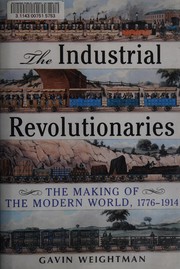
The Industrial Revolutionaries: The Making of the Modern World
First published 2007. Subjects: Industrial revolution, Industrialists, History, Inventions, Inventors.
eBay marketplace picks
Marketplace Samples
Live-tested eBay searches with available results related to this page.
Selected fromindustrial history poster oneBay.co.uk.

Endnotes
1.
Source: luxembourg.public.lu
Title: Luxembourg The Slate Museum: learning and entertainment
Link:https://luxembourg.public.lu/en/visiter/arts-et-culture/musee-ardoise.html
Source snippet
The Slate Museum: learning and entertainment - Luxembourg...
2.
Source: mnm.lu
Title: Mine train
Link:https://mnm.lu/en/visits/mine-train/
Source snippet
12, 2018...
3.
Source: cfl.lu
Title: CF L | Mining museum in Rumelange
Link:https://www.cfl.lu/en-GB/GetAway/Loisirs/Luxembourg/Musee-des-Mines-a-Rumelange
4.
Source: mnm.lu
Title: Guided mine tour & train
Link:https://www.mnm.lu/en/visits/underground-guided-tour/
Source snippet
12, 2018...
6.
Source: inpa.public.lu
Title: lu Rumelange: Musée des mines
Link:https://inpa.public.lu/fr/patrimoine/industriel/conservation_mise_valeur/rumelange_musee_mines.html
Source snippet
Service des sites et monuments nationaux)January 5, 2017 — RUMELANGE: MUSÉE DES MINES * Partager sur Facebook - nouvelle fenêtre * Parta...
Published: January 5, 2017
7.
Source: mnm.lu
Link:https://mnm.lu/en/
Source snippet
US INDIVIDUAL VISITORS Check our opening times for a tour on your own, with your family or friends. More GROUP TOURS For groups, our muse...
9.
Source: visitluxembourg.com
Title: Visit Luxembourg National Mining Museum
Link:https://www.visitluxembourg.com/place/mnm-rumelange
Source snippet
Visit LuxembourgNational Mining Museum - Visit Luxembourg...
10.
Source: ardoise.lu
Title: Exhibitions, underground mine galleries and a traditional bistro
Link:https://www.ardoise.lu/?lang=en
Source snippet
Tourism in Luxembourg | Musée de l'Ardoise | LuxemburgIn the heart of Haut-Martelange, discover the Slate Museum, a unique tourist attrac...
Additional References
11.
Source: icom-luxembourg.lu
Link:https://icom-luxembourg.lu/en/museums/slate-museum-haut-martelange/
Source snippet
During a free visit, a guided tour or during crea(c)tif...
12.
Source: editus.lu
Title: Musée National des Mines de Fer
Link:https://www.editus.lu/en/musee-national-des-mines-de-fer-rumelange-27340
Source snippet
Museum RumelangeMUSÉE NATIONAL DES MINES DE FER Museum 3 Carreau de la Mine Walert L-3714 Rumelange (Rëmeleng) See the number 56 56 88 Em...
13.
Source: youtube.com
Title: Musée National des Mines Rumelange
Link:https://www.youtube.com/watch?v=5rkfa4NpN0U
Source snippet
National Mining Museum Rumelange Luxembourg mine train Minett Tour - National Mining Museum Rumelange (GB) Trailer Visit Minett...
14.
Source: youtube.com
Title: National Mining Museum Rumelange
Link:https://www.youtube.com/watch?v=jq3G9Hy7_A8
Source snippet
Minieresbunn, old 700 mm steel mine railway (Lux.)...
15.
Source: youtube.com
Title: Minett Tour
Link:https://www.youtube.com/watch?v=7aLiOO3babs
Source snippet
National Mining Museum Rumelange...
16.
Source: youtube.com
Title: Minieresbunn, old 700 mm steel mine railway (Lux.)
Link:https://www.youtube.com/watch?v=qfrEWZepjbY
Source snippet
Musée du fer Rumelange Luxembourg...
17.
Source: youtube.com
Title: Musée du fer Rumelange Luxembourg
Link:https://www.youtube.com/watch?v=6buxmZglhXs
Source snippet
Musée National des Mines Rumelange...