Within Uncanny Guatemala
Why Guatemala's Funerary Urns Look Alive
Guatemala's funerary urns turn burial into a vivid world of gods, monsters, ancestors and renewed life.
On this page
- The Museo Popol Vuh collection
- Gods, jaguars and composite beings
- Death, regeneration and museum interpretation
Page outline Jump by section
Introduction
Guatemala’s Maya funerary urns are among the country’s most striking archaeological objects because they make death appear vividly alive. Rather than serving as plain containers for cremated remains or ancestral bones, many are sculptural ceramics covered with supernatural faces, jaguars, gods and hybrid creatures that transform the burial vessel into a powerful religious image. Today, the finest public collection is housed at the Museo Popol Vuh in Guatemala City, where these imposing urns are displayed as archaeological treasures rather than macabre curiosities. Together they offer one of the clearest museum windows into ancient Maya ideas about death, transformation and the continuing relationship between the living, their ancestors and the supernatural world.[Museo Popol Vuh]popolvuh.ufm.eduMuseo Popol Vuh Quiénes somosMuseo Popol VuhQuiénes somos - Museo Popol Vuh…

The Museo Popol Vuh collection
For visitors interested in Guatemala’s stranger cultural heritage, the Museo Popol Vuh is the essential destination. Operated by Universidad Francisco Marroquín as a private, non-profit scientific museum, it is devoted to the conservation, research and interpretation of Guatemalan archaeological and colonial collections. Among its greatest strengths is an extraordinary group of funerary urns from north-western Guatemala, particularly the highlands, which the museum itself identifies as one of its signature collections.[Museo Popol Vuh]popolvuh.ufm.eduMuseo Popol Vuh Quiénes somosMuseo Popol VuhQuiénes somos - Museo Popol Vuh…
These urns date mainly to the Late Classic period (around AD 600–900), when Maya ceramic artists produced highly elaborate funerary vessels for elite burials. Individual examples range from relatively compact containers with a single mythological face to monumental urns more than a metre high, combining sculpted lids, projecting animal heads and richly modelled supernatural beings. Rather than treating them simply as works of art, the museum places them within the wider archaeological story of Guatemala’s ancient societies, helping visitors understand both their craftsmanship and their ceremonial purpose.[Museo Popol Vuh]popolvuh.ufm.eduMuseo Popol Vuh Urna Funeraria con JaguarMuseo Popol VuhUrna Funeraria con Jaguar - Museo Popol Vuh…
The museum’s catalogue illustrates this variety. One urn is described simply as bearing the face of a mythological figure, while another presents what is interpreted as a jaguar deity emerging dramatically from the jaws of an enormous reptilian monster, topped by a naturalistic jaguar effigy. Such combinations are characteristic of Maya religious imagery, where supernatural beings frequently merge human and animal features instead of remaining separate categories.[Museo Popol Vuh]popolvuh.ufm.eduMuseo Popol Vuh Urna FunerariaMuseo Popol VuhUrna Funeraria - Museo Popol Vuh…
Gods, jaguars and composite beings
The first impression many visitors have is that these urns appear animated. Eyes stare outward, mouths gape open, claws emerge from the ceramic surface and animal forms seem to break through the walls of the vessel itself. This effect was intentional. The urn was not merely decorated; it became an image of supernatural transformation.
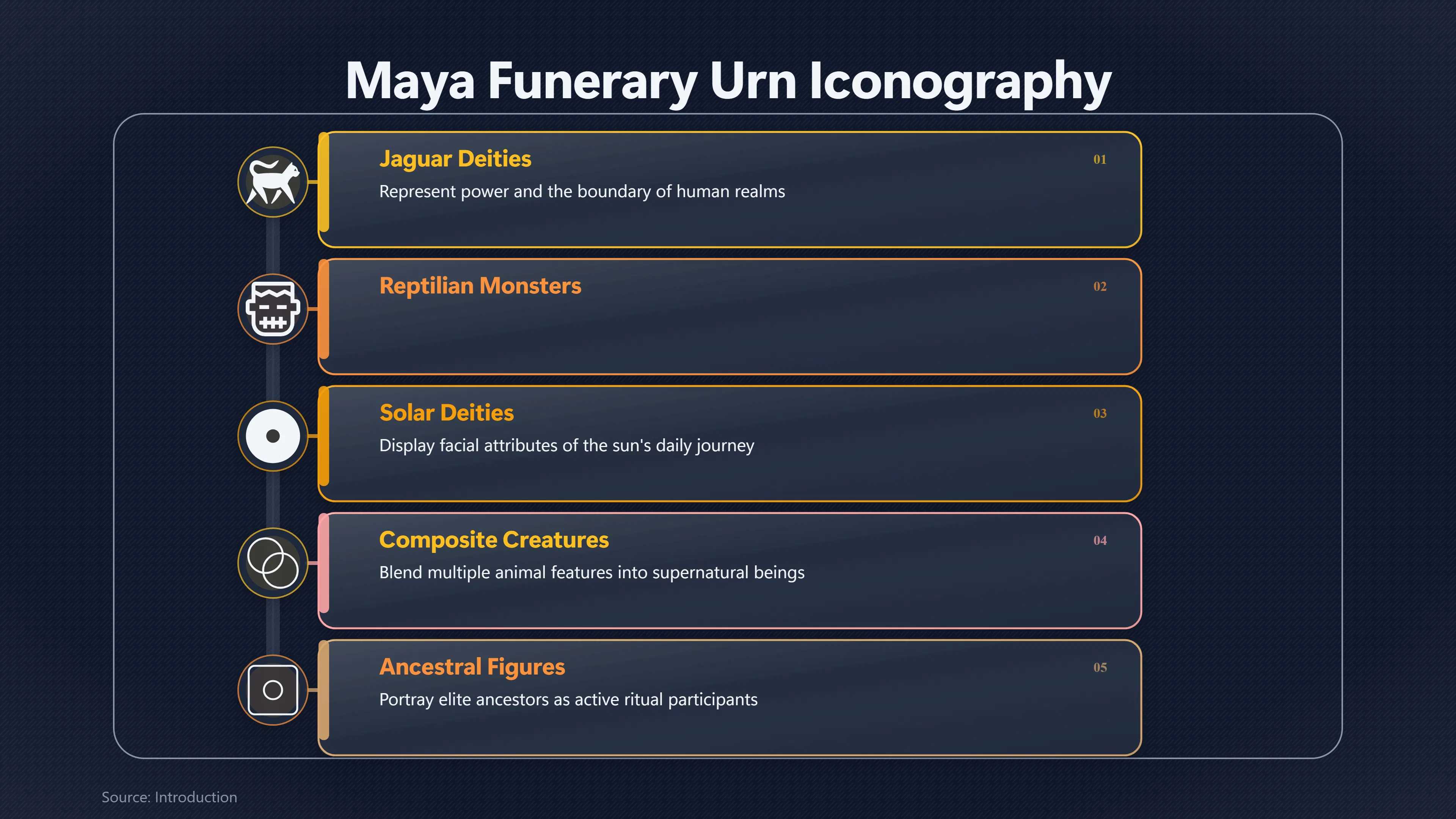
The jaguar appears especially often because it occupied a unique position within Maya belief. As a nocturnal predator capable of moving between forest darkness and daylight, it became associated with royal authority, warfare, night, the underworld and the dangerous boundary between human and divine realms. When a deity or ruler emerges from a jaguar’s jaws, the image is generally understood as representing passage into another state of existence rather than literal consumption.[Museo Popol Vuh]popolvuh.ufm.eduMuseo Popol Vuh Urna Funeraria con JaguarMuseo Popol VuhUrna Funeraria con Jaguar - Museo Popol Vuh…
Other urns combine several symbolic beings into a single composition:
- Jaguars represent power, night and supernatural authority.
- Reptilian monsters often form vast open mouths from which gods or ancestors emerge.
- Solar deities appear with recognisable facial attributes associated with the sun’s daily journey.
- Composite creatures blend features from several animals, expressing forces that transcend the ordinary natural world.[Cultura]cultura.gob.esCultura Funerary urnFunerary urn - Museo de América | Ministerio de Cultura…
Comparable Guatemalan urns now preserved outside the country reinforce these interpretations. A major Late Classic urn from Quiché in the Museo de América in Madrid depicts the sun god emerging from the jaws of a great feline while its lid shows a youthful lord associated with the underworld sun seated upon the sacred ceiba tree. The imagery links death, royal identity and cosmic renewal rather than presenting burial as a final ending.[Cultura]cultura.gob.esCultura Funerary urnFunerary urn - Museo de América | Ministerio de Cultura…

Death, regeneration and museum interpretation
One of the most important ideas behind these urns is that death was understood as transformation rather than annihilation. Archaeological evidence and Maya iconography consistently suggest that elite ancestors remained active participants in the lives of their descendants. Their remains deserved elaborate protection because ancestors continued to influence political legitimacy, ritual authority and relationships with the gods.[Cultura]cultura.gob.esCultura Funerary urnFunerary urn - Museo de América | Ministerio de Cultura…
This explains why so many urns portray emergence rather than decay. Figures rise from monster mouths, plants grow from divine bodies, or solar beings travel through the underworld before returning again. Instead of representing horror, these scenes visualise cyclical renewal. Even frightening creatures serve as gateways between different cosmic realms rather than embodiments of evil in the modern sense.[Cultura]cultura.gob.esCultura Funerary urnFunerary urn - Museo de América | Ministerio de Cultura…
Museums therefore avoid presenting the urns as sinister curiosities. The Museo Popol Vuh interprets them through archaeology, iconography and religious history, emphasising how burial objects reveal Maya understandings of cosmology, rulership and ancestry. Visitors encounter objects that certainly look uncanny to modern eyes, yet whose original purpose was deeply ceremonial and spiritually meaningful.[Museo Popol Vuh]popolvuh.ufm.eduMuseo Popol Vuh Quiénes somosMuseo Popol VuhQuiénes somos - Museo Popol Vuh…
Why they matter within Guatemala’s curiosity culture
Among Guatemala’s unusual public collections, these funerary urns occupy a distinctive position. Unlike commercial displays of mummies or sensational exhibitions about death, they derive their fascination from careful archaeological interpretation combined with extraordinary visual imagination.
They also demonstrate an important feature of Guatemala’s wider heritage. Many of the country’s most memorable “strange” objects were never intended to shock. Their apparent eeriness comes from the survival of an ancient symbolic language in which humans, animals, ancestors and gods constantly overlap. Faces emerge from impossible mouths, predators become sacred intermediaries and burial containers seem almost alive because they were designed to express continuing existence beyond physical death.
For visitors exploring Guatemala through its unusual museums and collections, the Museo Popol Vuh’s funerary urns offer one of the country’s richest encounters with that worldview. They stand not simply as archaeological masterpieces, but as enduring expressions of how the ancient Maya imagined the supernatural landscape that lay beyond the grave.[Museo Popol Vuh]popolvuh.ufm.eduMuseo Popol Vuh Quiénes somosMuseo Popol VuhQuiénes somos - Museo Popol Vuh…
Amazon book picks
Further Reading
Books and field guides related to Why Guatemala's Funerary Urns Look Alive. Use these as the next step if you want deeper reading beyond the article.
Maya Art and Architecture
“In addition to serving as an introduction to Maya art, the book communicates enthusiasm for the art’s aesthetic power and grace.” —Choic...
Death and the Afterlife in Ancient Egypt
Published to coincide with the opening of the refurbished 'mummy' galleries at the British Museum, this book is a highly illustrated intr...
eBay marketplace picks
Marketplace Samples
Live-tested eBay searches with available results related to this page.
Selected fromancient art decor oneBay.co.uk.
Endnotes
1.
Source: popolvuh.ufm.edu
Title: Museo Popol Vuh Quiénes somos
Link:https://popolvuh.ufm.edu/el-museo/quienes-somos/
Source snippet
Museo Popol VuhQuiénes somos - Museo Popol Vuh...
2.
Source: popolvuh.ufm.edu
Title: Museo Popol Vuh Arte prehispánico
Link:https://popolvuh.ufm.edu/coleccion/arte-prehispanico/
Source snippet
Museo Popol VuhArte prehispánico - Museo Popol Vuh...
3.
Source: popolvuh.ufm.edu
Title: Museo Popol Vuh Urna Funeraria con Jaguar
Link:https://popolvuh.ufm.edu/pieza/urna-funeraria-con-jaguar/
Source snippet
Museo Popol VuhUrna Funeraria con Jaguar - Museo Popol Vuh...
4.
Source: popolvuh.ufm.edu
Title: Museo Popol Vuh Urna Funeraria
Link:https://popolvuh.ufm.edu/pieza/urna-funeraria/
Source snippet
Museo Popol VuhUrna Funeraria - Museo Popol Vuh...
5.
Source: cultura.gob.es
Title: Cultura Funerary urn
Link:https://www.cultura.gob.es/museodeamerica/en/coleccion/america-prehispanica/urna-maya.html
Source snippet
Funerary urn - Museo de América | Ministerio de Cultura...
6.
Source: agn.gt
Title: Image: AGN
Link:https://agn.gt/museo-popol-vuh-exalta-los-valores-de-la-civilizacion-maya/
Source snippet
Museo Popol Vuh exalta los valores de la civilización maya - Agencia Guatemalteca de NoticiasMay 30, 2021 — MUSEO POPOL VUH EXALTA LOS VA...
Published: May 30, 2021
7.
Source: ruj.uj.edu.pl
Link:https://ruj.uj.edu.pl/entities/publication/77451e39-abe1-4608-808e-d519d0d2b121
Source snippet
El caso de Nebaj, Región Ixil, departamento de El Quiché.June 27, 2017 — El sistema de enterramientos en urnas en las Tierras Altas de Gu...
Published: June 27, 2017
8.
Source: maya-archaeology.org
Title: Maya Iconography
Link:https://www.maya-archaeology.org/QuicheMayanfuneraryurns/QuicheMayaniconography.php
9.
Source: popolvuh.ufm.edu
Title: urna funeraria 25
Link:https://popolvuh.ufm.edu/inventario/urna-funeraria-25/
10.
Source: popolvuh.ufm.edu
Link:https://popolvuh.ufm.edu/
11.
Source: popolvuh.ufm.edu
Link:https://popolvuh.ufm.edu/el-museo/historia/
12.
Source: popolvuh.ufm.edu
Title: clasico tardio
Link:https://popolvuh.ufm.edu/periodo/clasico-tardio/
13.
Source: maya-archaeology.org
Link:https://www.maya-archaeology.org/museums/popolvuh/mayadeath.php
14.
Source: maya-archaeology.org
Link:https://www.maya-archaeology.org/museums/popolvuh/castillobowl.php
15.
Source: cultura.gob.es
Title: Urna funeraria
Link:https://www.cultura.gob.es/museodeamerica/va/coleccion/america-prehispanica/urna-maya.html
16.
Source: sicultura.gob.gt
Title: Museo Popol Vuh
Link:https://www.sicultura.gob.gt/directory-directorio_c/listing/museo-popol-vuh/
Additional References
17.
Source: estudioslatinoamericanos.pl
Link:https://estudioslatinoamericanos.pl/index.php/estudios/article/view/ES_38_1_Krzemien
Source snippet
September 22, 2019 — CEREMONIAL VASES FROM THE COLLECTION OF MUSEO DE ARQUEOLOGÍA IN NEBAJ, EL QUICHÉ, GUATEMALA * Magdalena Krzemień Ins...
Published: September 22, 2019
18.
Source: youtube.com
Link:https://www.youtube.com/watch?v=HsrhniDEX2M
Source snippet
Lost Tombs and Secrets of the Ancient Maya Kings Revealed...
19.
Source: youtube.com
Title: Mayan Treasures at Popol Vuh Museum in Guatemala City!
Link:https://www.youtube.com/watch?v=Fx1jBh88O_0
Source snippet
Head of INAH presents discovery of funerary urn with image of corn god in Section 7 - Maya Train...
20.
Source: fundacionrutamaya.org
Title: de Registro IDAEH
Link:https://www.fundacionrutamaya.org/coleccion/incensarios/entry/73
Source snippet
Incensarios - La Ruta MayaJanuary 29, 2022 — * Home * * Incensarios INCENSARIOS [Button: ← Volver a la página anterior ] Tabla de Informa...
Published: January 29, 2022
21.
Source: youtube.com
Title: The Greatest Maya Tomb Ever Discovered
Link:https://www.youtube.com/watch?v=4VneRhfg4K8
Source snippet
Zapotec Funerary Urns in Mesoamerica | Inside Ancient Mexican Tombs...
22.
Source: scielo.org.mx
Link:https://www.scielo.org.mx/scielo.php?pid=S0185-25742015000200103&script=sci_arttext
23.
Source: sciencedirect.com
Link:https://www.sciencedirect.com/science/article/pii/S0185257415300150
24.
Source: elsevier.es
Link:https://www.elsevier.es/es-revista-estudios-cultura-maya-96-articulo-el-ajuar-funerario-los-gobernantes-S0185257415300150
25.
Source: researchgate.net
Title: Highland Maya Effigy Funerary Urns: A Study of Genre, Iconography, and Function
Link:https://www.researchgate.net/publication/254672618_Highland_Maya_Effigy_Funerary_Urns_A_Study_of_Genre_Iconography_and_Function
26.
Source: youtube.com
Title: Lost Tombs and Secrets of the Ancient Maya Kings Revealed
Link:https://www.youtube.com/watch?v=2sGZRo5POf8
Source snippet
The Greatest Maya Tomb Ever Discovered...