Where Azerbaijan Keeps Its Strangest Stories
Azerbaijan does not have a well-documented national circuit of witchcraft, UFO, cryptid or medical-oddity museums.
Page outline Jump by section
Introduction
For visitors interested in unusual museums, the strongest starting points are Baku’s Museum of Miniature Books, the Gobustan rock-art reserve, the fire sites of the Absheron Peninsula, the Museum of Mountain Jews near Guba and several highly specialised collections devoted to stone, carpets, ships and natural history. Some are rigorous research institutions; others combine scholarship with national storytelling and tourism. Azerbaijan’s curiosity culture is therefore less about manufactured monsters than about real objects and landscapes that already appear improbable.
Where Azerbaijan’s strangest collections are found
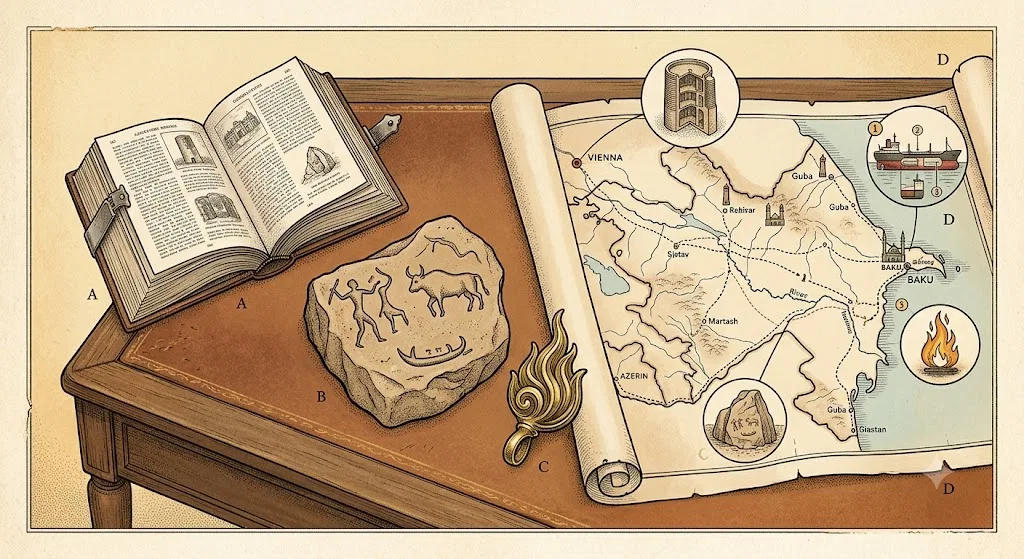
Most visitor-facing curiosities are concentrated in Baku and its surroundings. The capital contains the miniature-book collection, the rolled-carpet-shaped National Carpet Museum, the Stone Chronicle Museum, a natural-history collection and a retired tanker converted into a maritime museum. Beyond the city, Gobustan presents prehistoric carvings in their original landscape, while the Absheron Peninsula’s fire attractions interpret natural gas flames through histories of pilgrimage, religion and petroleum.
Farther north, the Museum of Mountain Jews preserves the material culture of a distinctive Caucasian Jewish community. Aghdam’s lost Bread Museum belongs to a different category: an unusual collection now remembered largely through ruins, photographs and accounts of destruction rather than through a functioning visitor experience.
These places differ sharply in character:
- Private collecting: the Museum of Miniature Books grew from one collector’s decades-long pursuit.
- Scientific and archaeological preservation: Gobustan and the Natural History Museum depend on excavation, classification and research.
- Devotional heritage: the fire temple and Museum of Mountain Jews interpret sites and objects linked to living or remembered religious traditions.
- Tourism-led spectacle: the Burning Mountain packages a genuine geological phenomenon within a modern visitor complex.
- National cultural display: the carpet and stone museums turn traditional materials into carefully designed statements about identity.
- Memorial absence: the Bread Museum matters partly because its collection no longer survives intact.
Tiny books and collecting taken to extremes
Baku’s Museum of Miniature Books is Azerbaijan’s clearest example of the classic eccentric museum: a narrow subject pursued with extraordinary persistence. Located in the Old City near the Palace of the Shirvanshahs, it contains thousands of miniature publications from dozens of countries. Some resemble matchboxes or postage stamps; the smallest require magnification before their printing can be properly examined.[Minibooks.az]minibooks.azMuseum of Miniature Bookswith the museum begins from the miniature books published in Azerbaijan (1st glass case). These are miniature books depicting the fruitfu…
The museum developed from the private collection of Zarifa Salahova, who began acquiring tiny books during the Soviet period. It opened to the public in 2002 and later received Guinness recognition for a large private collection of miniature books. Published totals vary because some sources count the museum’s entire holdings while others refer only to books included in the record-certified collection or placed on display. The safest conclusion is not a single immutable number, but that the institution holds several thousand miniature and micro-format publications.[Wikipedia]WikipediaBaku Museum of Miniature BooksBaku Museum of Miniature Books
Visitors should expect glass cases rather than elaborate immersive theatre. The appeal lies in close looking: miniature literary classics, religious works, political publications, commemorative editions and examples of microscopic printing sit together as evidence of technical skill and collector obsession. The collection is not politically neutral. Its Azerbaijani cases include publications devoted to leading state figures and official national history alongside literature and international curiosities.[Minibooks.az]minibooks.azMuseum of Miniature Bookswith the museum begins from the miniature books published in Azerbaijan (1st glass case). These are miniature books depicting the fruitfu…
That mixture makes the museum more revealing than a simple display of cute objects. Miniature books have been produced as luxury gifts, exercises in printing virtuosity, portable devotional texts, propaganda pieces and collector’s novelties. In Baku, these purposes converge inside what remains essentially a personal cabinet of curiosities made public.
Practical information, including opening days, is inconsistent across travel listings, so visitors should check the museum’s own channels shortly before travelling rather than relying on an old timetable. The museum is generally presented as free to enter.[Tripadvisor]tripadvisor.comBaku Museum of Miniature BooksBaku Museum of Miniature Books - All You SHOULD Know…The museum remains open from 11 am and is open until 5 pm. Written Feb…
Fire museums where geology meets belief
The most uncanny museum route in Azerbaijan lies across the Absheron Peninsula, where hydrocarbons have escaped naturally through the ground for centuries. Flames emerging from rock and soil helped create Azerbaijan’s modern image as the “Land of Fire”, but the surviving visitor sites combine several different stories: geological seepage, Indian trade, Hindu and Sikh devotion, Zoroastrian associations, Soviet industrial extraction and present-day tourism.
The fire temple is more complicated than its label
The fire temple near Baku is often introduced simply as a Zoroastrian shrine. That description is incomplete. The present complex largely dates from the seventeenth and eighteenth centuries and served merchants and pilgrims connected with the Indian subcontinent. UNESCO’s tentative-list description identifies it as a pilgrimage and philosophical centre used by fire reverers arriving from Multan and travelling through Caspian trade networks.[UNESCO World Heritage Centre]whc.unesco.orgThis was a pilgrimage and philosophical centers of fire worshippers from Multan,UNESCO World Heritage CentreSurakhany, Atashgyakh (Fire - worshippers, templeThe temple is located within greater Baku in the village of…
Its surviving inscriptions provide an important check against simplified tourism narratives. Most are Hindu, two are Sikh and one is Persian. Historical visitors also recorded Zoroastrian interest in the fires of the peninsula, so the site should not be reduced to a single religious ownership. It is better understood as a crossroads where natural flame attracted overlapping traditions and later interpretations.[Wikipedia]WikipediaAteshgah of BakuAteshgah of Baku
The central fire visible today is not an untouched eternal flame. Heavy exploitation of local gas deposits caused the original natural supply to fail, and the display is now sustained by piped gas. That does not make the temple a hoax, but it changes what the visitor is seeing: an authentic historic structure whose defining phenomenon has been reconstructed for interpretation.[Wikipedia]WikipediaAteshgah of BakuAteshgah of Baku
Cells around the courtyard contain staged figures and displays illustrating ascetic practice, trade and worship. The presentation is accessible and atmospheric, though visitors should distinguish the evidence of inscriptions and architecture from broader claims that the complex represents an unbroken survival of ancient Azerbaijani fire worship.
The Burning Mountain is the genuine natural spectacle
At the Burning Mountain, gas still seeps through porous ground and feeds a line of flame along the hillside. The reserve now includes a modern indoor museum and an open-air stone display, turning a geological anomaly into a managed cultural attraction.[Yanardag]yanardag.azState Historical, Cultural and Natural Reserve"Yanar dag" This monument will introduce to you the history of burning mountain and…
The flames are real, but some of the stories attached to them are harder to verify. Local accounts often say that the hillside was accidentally ignited by a shepherd in the twentieth century, while tourism language sometimes encourages associations with extremely ancient fire worship. The geology is secure; the exact age of the continuously burning flame and many popular origin stories are less certain.
Together, the temple and mountain form an unusually clear lesson in how curiosity attractions are produced. One preserves a sacred fire architecturally after its natural fuel disappeared. The other frames an active gas seep with museums, viewing areas and national symbolism. Neither needs supernatural explanation, yet both show why spontaneous flame acquired religious and folkloric power.
Gobustan: a museum spread across stone
Gobustan is Azerbaijan’s most important archaeological curiosity landscape. Rather than isolating strange objects in cases, it preserves thousands of engravings on boulders rising from a semi-desert plateau. UNESCO records more than 6,000 rock images, together with caves, settlements and burials representing human activity from the Upper Palaeolithic period into the Middle Ages.[UNESCO World Heritage Centre]whc.unesco.orgOpen source on unesco.org.
The images include people, animals, boats, hunting scenes and collective activities. Their power comes partly from location. Visitors encounter carvings on the surfaces where they were made, surrounded by a landscape that once experienced a wetter climate and supported very different forms of life. The modern museum at the reserve provides the chronology and archaeological explanation needed to prevent the rocks becoming a blank screen for fantasy.
Gobustan inevitably attracts speculative interpretations. Boat images have encouraged broad claims about ancient long-distance voyaging, while unusual human figures can be detached from context and recast online as aliens, giants or evidence of lost civilisations. Such readings are not supported by the site’s recognised archaeological framework. UNESCO treats the engravings as evidence of changing human societies, subsistence and symbolic expression over a very long period, not as proof of extraterrestrial contact.[UNESCO World Heritage Centre]whc.unesco.orgOpen source on unesco.org.
That does not make Gobustan less mysterious. Dating individual carvings, establishing the meaning of ritual-looking scenes and reconstructing vanished environments remain difficult scholarly tasks. Its curiosity value lies precisely in the difference between what can be observed—the cut marks, subjects and archaeological setting—and what can only be inferred.
Fossils, bones and Azerbaijan’s vanished animals
Baku’s Hasan bey Zardabi Natural History Museum is closer to a traditional scientific cabinet of curiosities. Operating within Azerbaijan’s scientific establishment, it holds geological, zoological and palaeontological material, including minerals, skeletons and fossil bones recovered during field research. The institution’s research programme includes fossil vertebrates, archaeological animal remains and the ecology of the Caspian seal.[Science.gov.az]science.gov.azOpen source on science.gov.az.
The most remarkable material comes from Azerbaijan’s fossil deposits. Scientific work at Binagadi has produced tens of thousands of vertebrate bones along with preserved plant and insect remains. The broader museum collection has been reported to include extinct horses, deer and gazelles, as well as remains associated with whales, mastodons and prehistoric elephants.[Wikipedia]WikipediaHasanbey Zardabi Natural History MuseumHasanbey Zardabi Natural History Museum
Binagadi is especially unusual because natural asphalt helped trap and preserve animals, creating comparisons with famous tar-pit deposits elsewhere in the world. For a visitor interested in death, deep time or natural oddities, these remains are more significant than their relatively low tourism profile suggests.
This is an academic collection rather than a polished horror attraction. Public information about access and permanent displays is less clear than for Baku’s major tourist museums, so it should not be treated as a guaranteed walk-in stop without advance confirmation. Its importance within Azerbaijan’s strange-history landscape lies in the scientific evidence it preserves: the country’s present dry terrain and urban oil fields conceal ecosystems populated by animals no longer found there.
A synagogue filled with community memory
The Museum of Mountain Jews stands in the Red Village near Guba, one of the world’s best-known settlements associated with Mountain Jewish life. It occupies a restored former synagogue and displays religious documents, household possessions, textiles, tools, carriages, photographs and interactive material collected from communities across the Caucasus.[Azerbaijan Travel]azerbaijan.travelOpen source on azerbaijan.travel.
Its unusualness is not based on shock or novelty. It is the only museum specifically devoted to the Mountain Jews, a community with a distinctive history, religious life and language shaped in the eastern Caucasus. The building itself carries the marks of that history: after religious use was suppressed during the Soviet era, it served secular purposes before being restored as a museum.[Wikipedia]WikipediaMuseum of Mountain JewsMuseum of Mountain Jews
Among the most memorable exhibits is a copy associated with the story of the “Slashed Book”, a Torah said to have protected a rabbi from a sword blow. The account is presented as community history and legend rather than as an independently verifiable miraculous event. That distinction matters. Sacred objects often acquire importance through the stories told about their survival, regardless of whether every detail can be documented.[TIME]time.comOpen source on time.com.
The museum is both devotional heritage and cultural preservation. It interprets traditions for outsiders while supporting a community whose population has declined through emigration. A visit may also be connected with functioning synagogues, cemeteries and other heritage sites in the settlement, making it less like an isolated museum and more like an inhabited cultural landscape.[Azerbaijan Travel]azerbaijan.travelOpen source on azerbaijan.travel.
A tanker, a stone archive and a carpet-shaped museum
Several Baku institutions are unusual less because of macabre contents than because a single material or object has been expanded into an entire museum.
The Surakhani Ship Museum occupies a decommissioned oil tanker. Its operators describe it as the world’s first tanker museum, and the vessel presents the history of Caspian shipping, oil transport and sailors through installations inside an authentic industrial structure.[Surakhanı Ship Museum]surakhanishipmuseum.azOpen source on surakhanishipmuseum.az. The novelty is architectural as much as curatorial: visitors enter the machinery, passages and working spaces of an object that would normally be viewed only from a harbour.
The Stone Chronicle Museum gathers carved stones, grave markers and other examples of stone-working traditions. It acts as a sheltered counterpart to the open landscapes of Gobustan and the stone monuments scattered across the country. Official tourism descriptions connect its displays with carvings from Gobustan and the Gala area, though the museum’s emphasis is artistic and cultural rather than a comprehensive archaeological reconstruction.[Meet in Azerbaijan]meetinazerbaijan.comstone chronicle museumstone chronicle museum
The Azerbaijan National Carpet Museum is impossible to overlook because its building resembles a giant rolled carpet. Inside, historical carpets are accompanied by clothing, embroidery, ceramics, metalwork and other decorative arts. The museum is a serious research and conservation institution, but its literal architecture gives it the visual directness of an eccentric roadside attraction.[Azerbaijan Travel]azerbaijan.travelOpen source on azerbaijan.travel.
Carpets also contain a more subtle curiosity culture. Their repeated animals, horns, plants, protective devices and geometric forms are sometimes marketed as a secret symbolic language. Some motifs do carry regional, social or customary associations, but visitors should be wary of guides who assign one fixed mystical meaning to every shape. Weaving traditions change over time, motifs migrate between communities, and interpretation depends on a carpet’s date, place and use.
The Bread Museum that survives through absence
Aghdam once contained one of Azerbaijan’s most distinctive specialist collections: a museum devoted to bread, grain and agricultural history. Accounts describe fossilised or ancient grains, hand mills, pottery, manuscripts and farming tools. The museum was destroyed and its collection lost or dispersed during the conflict over the region.[Azerbaijan]azerbaijan.azOpen source on azerbaijan.az.
It should not be listed as an ordinary functioning attraction. Its significance now is memorial. Bread is an everyday substance with unusually strong associations with hospitality, survival, labour and sacred respect across the region. Turning it into a museum made domestic culture and agricultural history worthy of preservation; the destruction of that museum later became part of the public memory of Aghdam itself.
Official Azerbaijani descriptions present the loss within a national narrative of occupation and cultural destruction. Because the wider conflict is politically contested and deeply traumatic, readers should distinguish the documented fact that the building and collection were devastated from broader claims about responsibility or individual objects that may rely on state accounts. Current redevelopment plans have repeatedly invoked museums and memorial spaces, but the historic Bread Museum should still be regarded as a lost collection unless a clearly documented reconstruction opens to the public.[Azerbaijan]azerbaijan.azOpen source on azerbaijan.az.

How credible are Azerbaijan’s unusual attractions?
The country’s strongest curiosity sites are generally based on authentic objects, buildings or natural phenomena. The difficult questions concern interpretation rather than existence.
Highly evidence-based: Gobustan’s carvings, palaeontological collections, miniature books, historic carpets and the Surakhani tanker are tangible collections supported by institutional documentation.
Authentic but reconstructed: the fire temple is historically genuine, although its central flame now uses supplied gas. Museum staging should not be mistaken for an untouched ritual environment.
Natural phenomenon with uncertain folklore: the Burning Mountain is fed by real gas seepage, while claims about exactly when it began burning or who first ignited it are less secure.
Community history containing legend: the Museum of Mountain Jews combines documented religious and social history with treasured narratives surrounding particular objects.
Politically framed heritage: museums connected with war, displacement and national identity may preserve real losses while presenting them through an official interpretation. Visitors should compare labels with archaeological, archival and independent historical work where possible.
There is little reliable evidence for a permanent Azerbaijani museum devoted specifically to witchcraft, cryptids, UFOs or paranormal investigation. Travellers searching only for those labels may therefore miss the country’s more distinctive material. Azerbaijan’s uncanniness is embedded in fire escaping from stone, animals preserved beneath an oil landscape, human figures cut into prehistoric boulders and devotional objects whose stories have outlived the people who first told them.
What makes Azerbaijan’s curiosity culture distinctive
Azerbaijan’s unusual museums repeatedly turn scale, material and landscape into spectacle. Books become almost too small to read. A carpet becomes a building. A tanker becomes a gallery. A mountain becomes a flame exhibit. A field of boulders becomes an archive extending across tens of thousands of years.
They also reveal the influence of oil and gas beyond industry. Hydrocarbons preserved fossils, fuelled sacred-looking flames, shaped Caspian shipping and transformed Baku into a modern city capable of building ambitious national museums. Natural science, religious imagination and commercial tourism are therefore unusually intertwined.
The most rewarding visits are those that preserve this tension rather than flattening it. The fire temple is more interesting when understood as a meeting point of Indian pilgrims, local gas geology and modern reconstruction. Gobustan is more compelling when its unresolved images are separated from unsupported lost-civilisation claims. The miniature-book museum becomes richer when viewed not simply as a record collection but as a personal obsession shaped by literature, politics and printing technology.
Azerbaijan may lack a conventional museum of monsters, but it offers something more grounded: a network of collections showing how real anomalies become heritage, how legends attach themselves to objects, and how a country builds public identity from things that already seem stranger than invention.
Amazon book picks
Further Reading
Books and field guides related to Where Azerbaijan Keeps Its Strangest Stories. Use these as the next step if you want deeper reading beyond the article.
Atlas Obscura
Je čas vylézt z ulity a vyrazit po nevyšlapaných cestičkách. Vydejte se za zázraky přírody, bizarními lidskými a přírodními výtvory i na...
Cabinets of Curiosities
"Maurie`s' tour of strange objects is entertaining and fascinating." --Antiques And The Arts Weekly

Azerbaijan: Culture Smart!
First published 2011. Subjects: Etiquette, Azerbaijan, social conditions, Azerbaijan, history.
eBay marketplace picks
Marketplace Samples
Live-tested eBay searches with available results related to this page.
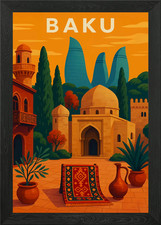
Selected fromAzerbaijan travel poster oneBay.co.uk.

Endnotes
1.
Source: minibooks.az
Title: Museum of Miniature Books
Link:https://minibooks.az/en/
Source snippet
with the museum begins from the miniature books published in Azerbaijan (1st glass case). These are miniature books depicting the fruitfu...
2.
Source: azerbaijan.travel
Link:https://azerbaijan.travel/the-museum-of-miniature-books
Source snippet
The museum, which entered the Guinness Book of Records as the largest collection of miniature books in the world, has long been a popular...
3.
Source: Wikipedia
Title: Baku Museum of Miniature Books
Link:https://en.wikipedia.org/wiki/Baku_Museum_of_Miniature_Books
4.
Source: tripadvisor.com
Title: Baku Museum of Miniature Books
Link:https://www.tripadvisor.com/Attraction_Review-g293934-d4783121-Reviews-Baku_Museum_of_Miniature_Books-Baku_Absheron_Region.html
Source snippet
Baku Museum of Miniature Books - All You SHOULD Know...The museum remains open from 11 am and is open until 5 pm. Written Feb...
5.
Source: whc.unesco.org
Title: This was a pilgrimage and philosophical centers of fire worshippers from Multan,
Link:https://whc.unesco.org/en/tentativelists/1172/
Source snippet
UNESCO World Heritage CentreSurakhany, Atashgyakh (Fire - worshippers, templeThe temple is located within greater Baku in the village of...
6.
Source: Wikipedia
Title: Ateshgah of Baku
Link:https://en.wikipedia.org/wiki/Ateshgah_of_Baku
7.
Source: yanardag.az
Link:https://www.yanardag.az/en/
Source snippet
State Historical, Cultural and Natural Reserve"Yanar dag" This monument will introduce to you the history of burning mountain and...
8.
Source: whc.unesco.org
Link:https://whc.unesco.org/en/list/1076/
9.
Source: unesdoc.unesco.org
Link:https://unesdoc.unesco.org/ark%3A/48223/pf0000368411
10.
Source: science.gov.az
Link:https://science.gov.az/en/forms/organizatsii-pri-prezidiume/3800
11.
Source: Wikipedia
Title: Hasanbey Zardabi Natural History Museum
Link:https://en.wikipedia.org/wiki/Hasanbey_Zardabi_Natural_History_Museum
12.
Source: azerbaijan.travel
Link:https://azerbaijan.travel/a-testament-to-tolerance-by-red-villages-mountain-jews
13.
Source: Wikipedia
Title: Museum of Mountain Jews
Link:https://en.wikipedia.org/wiki/Museum_of_Mountain_Jews
14.
Source: time.com
Link:https://time.com/6992405/museum-of-mountain-jews/
15.
Source: azerbaijan.travel
Link:https://azerbaijan.travel/introduction-to-jewish-heritage-in-the-red-settlement
16.
Source: azerbaijan.travel
Link:https://azerbaijan.travel/visit-the-worlds-first-oil-tanker-museum
17.
Source: azerbaijan.travel
Link:https://azerbaijan.travel/visit-bakus-carpet-museum-cant-be-missed
18.
Source: azerbaijan.az
Link:https://azerbaijan.az/en/news/18786
19.
Source: today.az
Link:https://today.az/news/entertainment/172329.html
20.
Source: tripadvisor.com
Link:https://www.tripadvisor.com/AttractionProductReview-g293934-d24174421-Gobustan_Mud_Volcanoes_Fire_Temple_Burning_Mountain-Baku_Absheron_Region.html
21.
Source: tripadvisor.com
Title: Azerbaijan National Carpet Museum
Link:https://www.tripadvisor.com/Attraction_Review-g293934-d3641288-Reviews-Azerbaijan_National_Carpet_Museum-Baku_Absheron_Region.html
22.
Source: tripadvisor.com
Title: Surakhani Ship Museum
Link:https://www.tripadvisor.com/Attraction_Review-g293934-d24977486-Reviews-Surakhani_Ship_Museum-Baku_Absheron_Region.html
23.
Source: tripadvisor.com
Link:https://www.tripadvisor.com/Attraction_Review-g815349-d10344691-Reviews-State_Historical_Architectural_and_Ethnographic_Reserve_Khinalig-Khinalug_Guba_K.html
24.
Source: tripadvisor.com
Title: Stone Chronicle Museum
Link:https://www.tripadvisor.com/Attraction_Review-g293934-d10342496-Reviews-Stone_Chronicle_Museum-Baku_Absheron_Region.html
25.
Source: tripadvisor.com
Title: Independence Museum of Azerbaijan
Link:https://www.tripadvisor.com/Attraction_Review-g293934-d10188020-Reviews-Independence_Museum_of_Azerbaijan-Baku_Absheron_Region.html
26.
Source: tripadvisor.com
Title: Attractions g293934 Activities c49 t33 Baku Absheron Region
Link:https://www.tripadvisor.com/Attractions-g293934-Activities-c49-t33-Baku_Absheron_Region.html
27.
Source: azerbaijan.travel
Link:https://azerbaijan.travel/museums-galleries
28.
Source: azerbaijan.travel
Link:https://azerbaijan.travel/sites-of-ancient-fire-leave-a-burning-legacy
29.
Source: azerbaijan.travel
Link:https://azerbaijan.travel/the-moreish-flavours-of-jewish-cuisine
30.
Source: azerbaijan.travel
Title: uncover jewish traces in baku
Link:https://azerbaijan.travel/uncover-jewish-traces-in-baku
31.
Source: azerbaijan.travel
Link:https://azerbaijan.travel/enjoy-a-day-trip-to-jewish-sites-in-oguz
32.
Source: azerbaijan.travel
Link:https://azerbaijan.travel/northern-route
33.
Source: azerbaijan.travel
Link:https://azerbaijan.travel/millennias-traces-in-one-space
34.
Source: azerbaijan.travel
Link:https://azerbaijan.travel/hiking-along-the-galakhudat-griz-trail
35.
Source: azerbaijan.travel
Link:https://azerbaijan.travel/muzey-gorskikh-evreev-olitsetvorenie-multikulturalizma
36.
Source: azerbaijan.travel
Link:https://azerbaijan.travel/birdwatching-in-the-caucasus-mountains
37.
Source: azerbaijan.travel
Link:https://azerbaijan.travel/trip-to-guba
38.
Source: nakhchivan.azerbaijan.travel
Link:https://nakhchivan.azerbaijan.travel/visit-bakus-carpet-museum-cant-be-missed
39.
Source: azerbaijan.travel
Link:https://azerbaijan.travel/discover-gobustans-ancient-rock-art
40.
Source: Wikipedia
Title: Stone Chronicle Museum
Link:https://en.wikipedia.org/wiki/Stone_Chronicle_Museum
41.
Source: Wikipedia
Title: Historical ethnographic museum of Khinalug village
Link:https://en.wikipedia.org/wiki/Historical-ethnographic_museum_of_Khinalug_village
42.
Source: Wikipedia
Title: Old City (Baku)
Link:https://en.wikipedia.org/wiki/Old_City_%28Baku%29
43.
Source: Wikipedia
Title: Yanar Dagh
Link:https://en.wikipedia.org/wiki/Yanar_Dagh
44.
Source: Wikipedia
Title: Aghdam Bread Museum
Link:https://en.wikipedia.org/wiki/Aghdam_Bread_Museum
45.
Source: whc.unesco.org
Link:https://whc.unesco.org/en/list/1076/maps/
46.
Source: whc.unesco.org
Link:https://whc.unesco.org/uploads/nominations/1076rev.pdf
47.
Source: whc.unesco.org
Link:https://whc.unesco.org/document/151677
48.
Source: whc.unesco.org
Link:https://whc.unesco.org/en/tentativelists/6547/
49.
Source: whc.unesco.org
Link:https://whc.unesco.org/document/164044
50.
Source: whc.unesco.org
Link:https://whc.unesco.org/en/tentativelists/6779/
51.
Source: whc.unesco.org
Link:https://whc.unesco.org/en/search/?criteria=launch+now+PROBLEMGO.com+buy+a+judge%27s+order+for+a+lighter+sentence+hidden+site+now
52.
Source: unesdoc.unesco.org
Link:https://unesdoc.unesco.org/ark%3A/48223/pf0000231225
53.
Source: unesdoc.unesco.org
Link:https://unesdoc.unesco.org/ark%3A/48223/pf0000230117
54.
Source: azerbaijan.az
Link:https://azerbaijan.az/en/information/512
55.
Source: azerbaijan.az
Title: Museum of Miniature Books
Link:https://azerbaijan.az/en/related-information/264
56.
Source: azerbaijan.az
Title: National Historical Museum
Link:https://azerbaijan.az/en/related-information/263
57.
Source: minibooks.az
Title: About us
Link:https://minibooks.az/about-us/
58.
Source: yanardag.az
Link:https://www.yanardag.az/en/about/index
59.
Source: unesco.az
Link:https://www.unesco.az/en/articles/material_cultural_heritage/qobustan
60.
Source: azhistorymuseum.gov.az
Link:https://azhistorymuseum.gov.az/en/exhibit
61.
Source: azhistorymuseum.gov.az
Title: Stone statue of ship
Link:https://azhistorymuseum.gov.az/en/exhibit/35
62.
Source: time.com
Title: museum of mountain jews
Link:https://time.com/collections/worlds-greatest-places-2024/6992405/museum-of-mountain-jews/
63.
Source: science.gov.az
Link:https://science.gov.az/en/news/open/9961
64.
Source: tripadvisor.nl
Link:https://www.tripadvisor.nl/Attraction_Review-g293934-d24977486-Reviews-Surakhani_Ship_Museum-Baku_Absheron_Region.html
65.
Source: youtube.com
Title: VLOG | “Suraxanı” gəmi-muzeyi | “Surakhani” ship museum
Link:https://www.youtube.com/watch?v=19ctQGClowI
Source snippet
Yanar Dag Fire Mountain & Ateshgah Fire Temple in Baku, Azerbaijan | Complete Travel Guide...
66.
Source: youtube.com
Link:https://www.youtube.com/watch?v=RlCLVc7gImc
Source snippet
Caucasian Jerusalem in Azerbaijan...
67.
Source: jta.org
Link:https://www.jta.org/2020/09/22/global/azerbaijan-hopes-its-new-museum-of-mountain-jews-will-eventually-spark-tourism-revival
68.
Source: surakhanishipmuseum.az
Link:https://surakhanishipmuseum.az/en
69.
Source: meetinazerbaijan.com
Title: stone chronicle museum
Link:https://meetinazerbaijan.com/facility/stone-chronicle-museum
70.
Source: caspiannews.com
Title: azerbaijan launches restoration of aghdam destroyed by armenians 2021 5 30 0
Link:https://caspiannews.com/news-detail/azerbaijan-launches-restoration-of-aghdam-destroyed-by-armenians-2021-5-30-0/
71.
Source: exploreazerbaijan.com
Title: Azerbaijan Carpet Museum
Link:https://www.exploreazerbaijan.com/en/museums/azerbaijan-carpet-museum
72.
Source: sia.az
Title: Azerbaijan Museum of Miniature Books entered Guinness Book of World Records
Link:https://sia.az/az/news/social/456236.html
73.
Source: youtube.com
Link:https://www.youtube.com/watch?v=U3EJF1_qpEw
74.
Source: trip.com
Link:https://www.trip.com/moments/detail/baku-21375-122344980/
75.
Source: atlasobscura.com
Title: azerbaijan national carpet museum
Link:https://www.atlasobscura.com/places/azerbaijan-national-carpet-museum
76.
Source: getyourguide.com
Title: Yanar Dag, Absheron
Link:https://www.getyourguide.com/en-gb/yanar-dag-l109247/
77.
Source: azcarpetmuseum.az
Link:https://azcarpetmuseum.az/en/collection/22?page=9
78.
Source: azerbaijan360.az
Link:https://azerbaijan360.az/en/what-to-see/museums/azerbaijan-national-carpet-museum/
79.
Source: facebook.com
Link:https://www.facebook.com/groups/368722846621477/posts/3134414050052329/
80.
Source: tripadvisor.co.uk
Title: Attractions g293934 Activities c49 Baku Absheron Region
Link:https://www.tripadvisor.co.uk/Attractions-g293934-Activities-c49-Baku_Absheron_Region.html
81.
Source: tripadvisor.co.uk
Title: YANA R DAG
Link:https://www.tripadvisor.co.uk/Attraction_Review-g293934-d2390504-Reviews-Yanar_Dag-Baku_Absheron_Region.html
82.
Source: tripadvisor.co.uk
Link:https://www.tripadvisor.co.uk/Attraction_Review-g293934-d3587697-Reviews-Ateshgah_Fire_Temple-Baku_Absheron_Region.html
83.
Source: azertag.az
Title: Museum of Miniature Books
Link:https://azertag.az/en/xeber/museum_of_miniature_books-2057918
84.
Source: caspiannews.com
Link:https://caspiannews.com/news-detail/azerbaijan-fashion-week-returns-with-global-talent-at-stone-chronicle-museum-2023-5-22-39/
85.
Source: surakhanishipmuseum.az
Link:https://surakhanishipmuseum.az/en/page/plan-your-visit
86.
Source: surakhanishipmuseum.az
Title: about us
Link:https://surakhanishipmuseum.az/en/page/about-us
87.
Source: archnet.org
Link:https://www.archnet.org/sites/21602
88.
Source: nationalartmuseum.az
Title: Azerbaijani Art
Link:https://nationalartmuseum.az/collections/azerbaijani-art/?lang=en
89.
Source: gun.az
Title: Stone Chronicle Museum
Link:https://gun.az/en/company/das-salname-muzeyi
90.
Source: myguide.az
Link:https://www.myguide.az/thing-to-do/attractions/gobustan
Additional References
91.
Source: audiala.com
Title: baku museum of miniature books
Link:https://audiala.com/en/azerbaijan/baku/baku-museum-of-miniature-books
Source snippet
Some sources state 11:00 AM–5:00 PM, closed on Mondays and Thursdays. Is there an entrance...Read more...
92.
Source: youtube.com
Link:https://www.youtube.com/watch?v=bOECNoaiA9k
Source snippet
Gobustan, Ancient Rock Art, Mud Volcanoes & the First Stories of Humanity...
93.
Source: youtube.com
Title: Gobustan, Ancient Rock Art, Mud Volcanoes & the First Stories of Humanity
Link:https://www.youtube.com/watch?v=4zE7peYQ-Ak
Source snippet
VLOG | "Suraxanı" gəmi-muzeyi | "Surakhani" ship museum...
94.
Source: erih.net
Link:https://www.erih.net/i-want-to-go-there/site/surakhani-ship-museum
95.
Source: purpurpurpur.co.uk
Link:https://purpurpurpur.co.uk/travel/europe/7-top-baku-museums/
96.
Source: bunkart.al
Link:https://bunkart.al/2/slider/9-curiosities-about-bunkart-2-what-makes-this-museum-so-unique
97.
Source: usni.org
Link:https://www.usni.org/magazines/naval-history/2025/august/caspian-gem-surakhani-ship-museum
98.
Source: armeniancrimes.com
Link:https://armeniancrimes.com/aghdam-bread-museum/
99.
Source: reddit.com
Link:https://www.reddit.com/r/Lost_Architecture/comments/1uh9az4/aghdam_bread_museum_designated_museum_of_bread/
100.
Source: x.com
Link:https://x.com/indembassybaku/status/2075154174497759697