Within Curious Rwanda
Why Does a Colonial Museum Keep Reptiles?
Kandt House combines German colonial history with snakes and crocodiles left from its earlier life as Rwanda's natural-history museum.
On this page
- From colonial residence to natural history museum
- Snakes and crocodiles as a separate attraction
- What the unusual pairing tells visitors
Page outline Jump by section
Introduction
Kandt House Museum in Kigali is unusual because it combines two experiences that would normally be found in separate institutions. Inside, visitors encounter a museum about Rwanda before colonial rule, German colonial administration and the early history of Kigali. Outside, they find a compact reptile exhibit containing snakes and crocodiles. The result is a museum whose identity has changed several times without entirely abandoning its earlier role as Rwanda’s natural history museum. Rather than being a full zoological collection, the surviving reptile displays act as a living reminder of the building’s previous mission while creating one of Rwanda’s most distinctive museum experiences.[visitrwanda.com]visitrwanda.comVisit Rwanda Kandt House Museum – Visit RwandaVisit Rwanda Kandt House Museum – Visit Rwanda
Why Does a Colonial Museum Keep Reptiles?
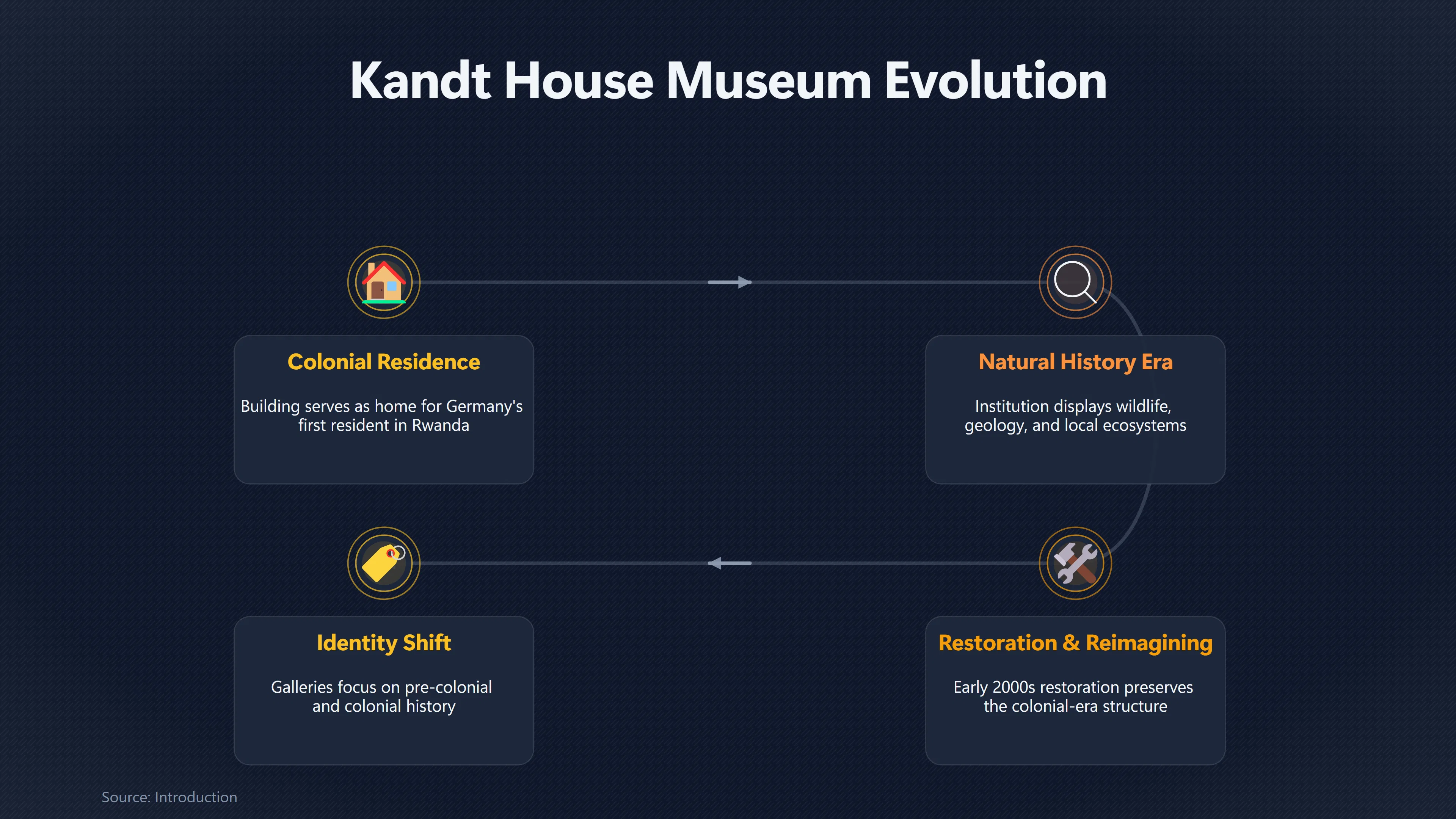
The apparent contradiction is explained by the museum’s history. The building itself dates from 1908 and was the residence of Richard Kandt, Germany’s first colonial resident in Rwanda. After restoration in the early 2000s, it reopened as the Kandt House Museum of Natural History, with exhibitions devoted to Rwanda’s wildlife, geology and ecosystems. Years later, the institution was reimagined to focus primarily on colonial history, pre-colonial Rwanda and the development of Kigali. Instead of removing every trace of its earlier purpose, museum managers retained a small outdoor reptile collection.[wikipedia.org]WikipediaOpen source on wikipedia.org.
This layered identity makes Kandt House different from both a conventional history museum and a conventional natural history museum. Visitors are effectively moving through two different museum philosophies: one centred on historical interpretation and another centred on living animals.
From colonial residence to natural-history museum
The building’s evolution mirrors changing priorities in Rwanda’s heritage sector.
Initially, its significance lay in its association with German colonial administration. Restoration preserved one of the oldest surviving colonial-era buildings in Kigali, preventing its demolition and giving it a new public function. It then became Rwanda’s principal natural history museum, displaying preserved specimens and explaining the country’s wildlife.
Later, much of that natural history role shifted elsewhere, particularly to the Museum of Environment in Karongi (formerly Kibuye). When Kandt House reopened under its current identity in 2017, the permanent galleries concentrated on three broad themes:
- Rwanda before colonial rule.[africangorilla.com]africangorilla.comKandt House Museum Kigali | Rwanda’s Natural History SiteOctober 12, 2025 — KANDT HOUSE MUSEUM KIGALI – DISCOVER RWANDA’S NATURAL & COLONIAL HISTORY Updated at: October 12, 2025 11:13 am.Estimat…
- German colonial administration and Richard Kandt’s activities.
- The history and growth of Kigali.
The reptiles remained as one of the few visible survivals from the earlier museum rather than as the institution’s main purpose.[wikipedia.org]WikipediaOpen source on wikipedia.org.
Snakes and Crocodiles as a Separate Attraction
The reptiles are treated almost as an additional attraction rather than part of the historical galleries. Official museum information even lists the reptile exhibition separately from the main museum visit, with its own ticket category and visitor guidance. This separation reflects the fact that the animals are not simply decorative exhibits but an inherited feature from the museum’s previous natural history identity.[rwandaheritage.gov.rw]rwandaheritage.gov.rwRwanda Heritage Visit National MuseumsRwanda Heritage Visit National Museums
The collection is modest rather than comprehensive. Official descriptions refer to live snakes and a crocodile, while other museum documentation identifies species such as the Nile crocodile alongside several snakes native to Rwanda, including black mambas, cobras and African rock pythons. Unlike a zoo, the aim is educational display rather than maintaining a large animal collection.[wikipedia.org]WikipediaOpen source on wikipedia.org.
For many visitors, this creates an unexpected shift in atmosphere. After galleries devoted to political history and colonial administration, they step into an outdoor area where living reptiles become the focus. The contrast is memorable precisely because it is so unusual.
What the Unusual Pairing Tells Visitors
The reptiles are more than an isolated curiosity. They reveal how museums can accumulate layers of purpose instead of replacing one identity with another.
Many museums completely reinvent themselves by removing earlier displays. Kandt House instead preserves a visible trace of its former natural history mission. The reptiles therefore function almost like living museum artefacts: they are not relics from the colonial period, yet they document an earlier phase in the institution’s own history.
This also reflects wider developments in Rwanda’s museum network. Rather than concentrating every subject in a single institution, the country has gradually distributed different themes across specialised museums. Natural history and environmental interpretation expanded elsewhere, while Kandt House increasingly became the principal site for understanding Rwanda’s early colonial period and the origins of Kigali. The surviving reptile exhibit quietly records that institutional transition.[Rwanda Heritage]rwandaheritage.gov.rwRwanda Heritage FIVE YEARS ROLLINGRwanda Heritage FIVE YEARS ROLLING
A Distinctive Place in Rwanda’s Curiosity Landscape
Within Rwanda’s unusual museum attractions, Kandt House occupies a distinctive niche because its curiosity lies less in exotic animals than in the collision of museum identities.
Visitors do not encounter reptiles inside a dedicated reptile park or zoological garden. Instead, they find them attached to a historic colonial residence whose galleries explore politics, empire and urban history. That combination makes the museum memorable for reasons beyond the animals themselves.
The surviving snakes and crocodiles also demonstrate that museum collections can have histories of their own. In Kandt House, the reptiles are not merely exhibits to observe. They are evidence that the museum itself has changed—from colonial residence, to natural history museum, to historical museum—while deliberately preserving one small, living reminder of what it used to be.
Amazon book picks
Further Reading
Books and field guides related to Why Does a Colonial Museum Keep Reptiles?. Use these as the next step if you want deeper reading beyond the article.
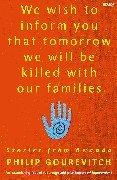
We wish to inform you that tomorrow we will be killed with ou...
Rating: 4.1/5 from 12 Google Books ratings
First published 1998. Subjects: Ethnic relations, Genocide, History, Human rights, Personal narratives.
The Sixth Extinction: An Unnatural History
"Over the last half billion years, there have been five major mass extinctions, when the diversity of life on Earth suddenly and dramatic...
The Diversity of Life
View a collection of videos on Professor Wilson entitled "On the Relation of Science and the Humanities" "In the Amazon Basin the greates...

The Serengeti Rules: The Quest to Discover How Life Works and...
First published 2016. Subjects: Biology, Ecology, Biological control systems, Nature, Biologists.
eBay marketplace picks
Marketplace Samples
Live-tested eBay searches with available results related to this page.
Selected fromnatural history print oneBay.co.uk.
Endnotes
1.
Source: visitrwanda.com
Title: Visit Rwanda Kandt House Museum – Visit Rwanda
Link:https://visitrwanda.com/interests/kandt-house-museum/
2.
Source: rwandaheritage.gov.rw
Title: Rwanda Heritage Museum and Heritages Sites Management Division (copy 1)
Link:https://www.rwandaheritage.gov.rw/en/museum-and-heritages-sites-management-division-1
3.
Source: rwandaheritage.gov.rw
Title: Rwanda Heritage FIVE YEARS ROLLING
Link:https://www.rwandaheritage.gov.rw/fileadmin/user_upload/RCHA/Educational_materials/FIVE_YEARS_ROLLING_STRATEGIC_PLAN__2022-2027_-_A5_Szie_BOOKLET.pdf
4.
Source: Wikipedia
Link:https://de.wikipedia.org/wiki/Kandt-Haus-Museum
5.
Source: rwandaheritage.gov.rw
Title: Rwanda Heritage Visit National Museums
Link:https://www.rwandaheritage.gov.rw/en/visit-national-museums
6.
Source: support.irembo.gov.rw
Title: Irembo Gov FAQ’s about How to apply for Visiting Reptiles: Irembo Gov
Link:https://support.irembo.gov.rw/en/support/solutions/articles/47001256062-faq-s-about-how-to-apply-for-visiting-reptiles
7.
Source: support.irembo.gov.rw
Title: Irembo Gov How to apply for Visiting Reptiles: Irembo Gov
Link:https://support.irembo.gov.rw/en/support/solutions/articles/47001256061-how-to-apply-for-visiting-reptiles
Source snippet
to apply for Visiting Reptiles: IremboGovJune 10, 2025 — HOW TO APPLY FOR VISITING REPTILES Modified on: Tue, 10 Jun, 2025 at 5:26 PM Th...
Published: June 10, 2025
8.
Source: support.irembo.gov.rw
Title: irembo.gov.rw FA Qs sur la visite des reptiles: Irembo Gov
Link:https://support.irembo.gov.rw/fr/support/solutions/articles/47001256062-faqs-sur-la-visite-des-reptiles
Source snippet
sur la visite des reptiles: IremboGovMay 11, 2026 — FAQS SUR LA VISITE DES REPTILES Modifié le: Lun, 11 Mai, 2026 à 3:17 H Ce service d...
Published: May 11, 2026
9.
Source: a.osmarks.net
Title: Kandt House Museum of Natural History
Link:https://a.osmarks.net/content/wikipedia_en_all_maxi_2020-08/A/Kandt_House_Museum_of_Natural_History
10.
Source: beyondkigalitours.com
Link:https://beyondkigalitours.com/kandt-house-museum/
11.
Source: visitrwanda.com
Link:https://visitrwanda.com/interests/museums-and-art-galleries/
Additional References
12.
Source: africangorilla.com
Title: Kandt House Museum Kigali | Rwanda’s Natural History Site
Link:https://www.africangorilla.com/information/the-kandt-house-museum/
Source snippet
October 12, 2025 — KANDT HOUSE MUSEUM KIGALI – DISCOVER RWANDA’S NATURAL & COLONIAL HISTORY Updated at: October 12, 2025 11:13 am.Estimat...
Published: October 12, 2025
13.
Source: commons.wikimedia.org
Title: Other resolutions: 320 × 213 pixel
Link:https://commons.wikimedia.org/wiki/File%3AReptiles_House_at_Kandt_House_Museum_in_Rwanda.jpg
Source snippet
wikimedia.orgFile:Reptiles House at Kandt House Museum in Rwanda.jpg - Wikimedia CommonsSeptember 13, 2024 — FILE:REPTILES HOUSE AT KANDT...
Published: September 13, 2024
14.
Source: youtube.com
Title: Reptile Adventures at Kandt House Museum: Exploring Kigali’s Hidden Wildlife
Link:https://www.youtube.com/watch?v=cLbXscbwRQ4
Source snippet
RWANDA LAUNCHES SNAKES & REPTILES EXHIBITION...
15.
Source: youtube.com
Title: Places to Visit in Rwanda | Kandt Museum and Jollof Kigali
Link:https://www.youtube.com/watch?v=yDfb7eqbbWM
Source snippet
Most dangerous snakes at KANDT HOUSE MUSEUM in kigali...
16.
Source: youtube.com
Title: Most dangerous snakes at KANDT HOUSE MUSEUM in kigali!!!
Link:https://www.youtube.com/watch?v=iFtBHrt5FpI
Source snippet
Inside Richard kandt museum in Kigali,Rwanda...
17.
Source: youtube.com
Title: RWANDA LAUNCHES SNAKES & REPTILES EXHIBITION
Link:https://www.youtube.com/watch?v=JYyz2wVGVzY
Source snippet
Places to Visit in Rwanda | Kandt Museum and Jollof Kigali...
18.
Source: nhm.ac.uk
Link:https://www.nhm.ac.uk/discover/alfred-waterhouse-museum-building-cathedral-to-nature.html
19.
Source: animalviewsafaris.com
Link:https://www.animalviewsafaris.com/kandt-house-museum-of-natural-history/
20.
Source: art.washington.edu
Title: houseness naga house museum towards narrative postcolonial south asian house
Link:https://art.washington.edu/research/publications/houseness-naga-house-museum-towards-narrative-postcolonial-south-asian-house
21.
Source: commons.wikimedia.org
Title: File:Reptiles House at Kandt House Museum in Rwanda (2).jpg
Link:https://commons.wikimedia.org/wiki/File%3AReptiles_House_at_Kandt_House_Museum_in_Rwanda_%282%29.jpg