Within Djibouti Curiosities
What Are Djibouti's Mysterious Stone Tombs?
Djibouti's awellos are genuine prehistoric burial monuments, but incomplete excavation leaves room for myths to outrun the evidence.
On this page
- How awellos were built and used
- What archaeology can and cannot prove
- Why lost civilisation claims persist
Page outline Jump by section
Introduction
Djibouti’s awellos are among the country’s most intriguing archaeological landscapes: thousands of prehistoric stone burial monuments scattered across volcanic plains and hillsides, especially near Randa in the Tadjourah Region and Dasbyo in the Ali Sabieh Region. Their sheer number, age and incomplete excavation have encouraged dramatic stories about forgotten kingdoms and vanished super-civilisations. The evidence, however, points in a different direction. Archaeologists regard the awellos as genuine prehistoric funerary monuments built by local communities over thousands of years, but many remain unexcavated, leaving important questions about the people who built them unanswered. That combination of real mystery and limited evidence has allowed speculation to flourish alongside archaeology.[UNESCO World Heritage Centre]whc.unesco.orgWorld Heritage Centre Les Tumulus (AwellosUNESCO World Heritage CentreLes Tumulus (Awellos) - UNESCO World Heritage CentreJanuary 5, 2015…

Within Djibouti’s landscape of unusual heritage, the awellos are less like a conventional museum exhibit than an immense open-air archaeological collection. They are significant not because they prove extraordinary claims, but because they preserve an ancient funerary tradition that researchers are still trying to understand.
What Are Djibouti’s Mysterious Stone Tombs?
The word awello refers to ancient stone tumuli or burial mounds. According to Djibouti’s UNESCO Tentative List nomination, the name is locally understood as meaning “heaps of stones gathered by the ancestors”. The monuments are widely distributed across the country rather than concentrated in a single cemetery, although some of the largest concentrations occur around Randa and Dasbyo.[UNESCO World Heritage Centre]whc.unesco.orgWorld Heritage Centre Les Tumulus (AwellosUNESCO World Heritage CentreLes Tumulus (Awellos) - UNESCO World Heritage CentreJanuary 5, 2015…
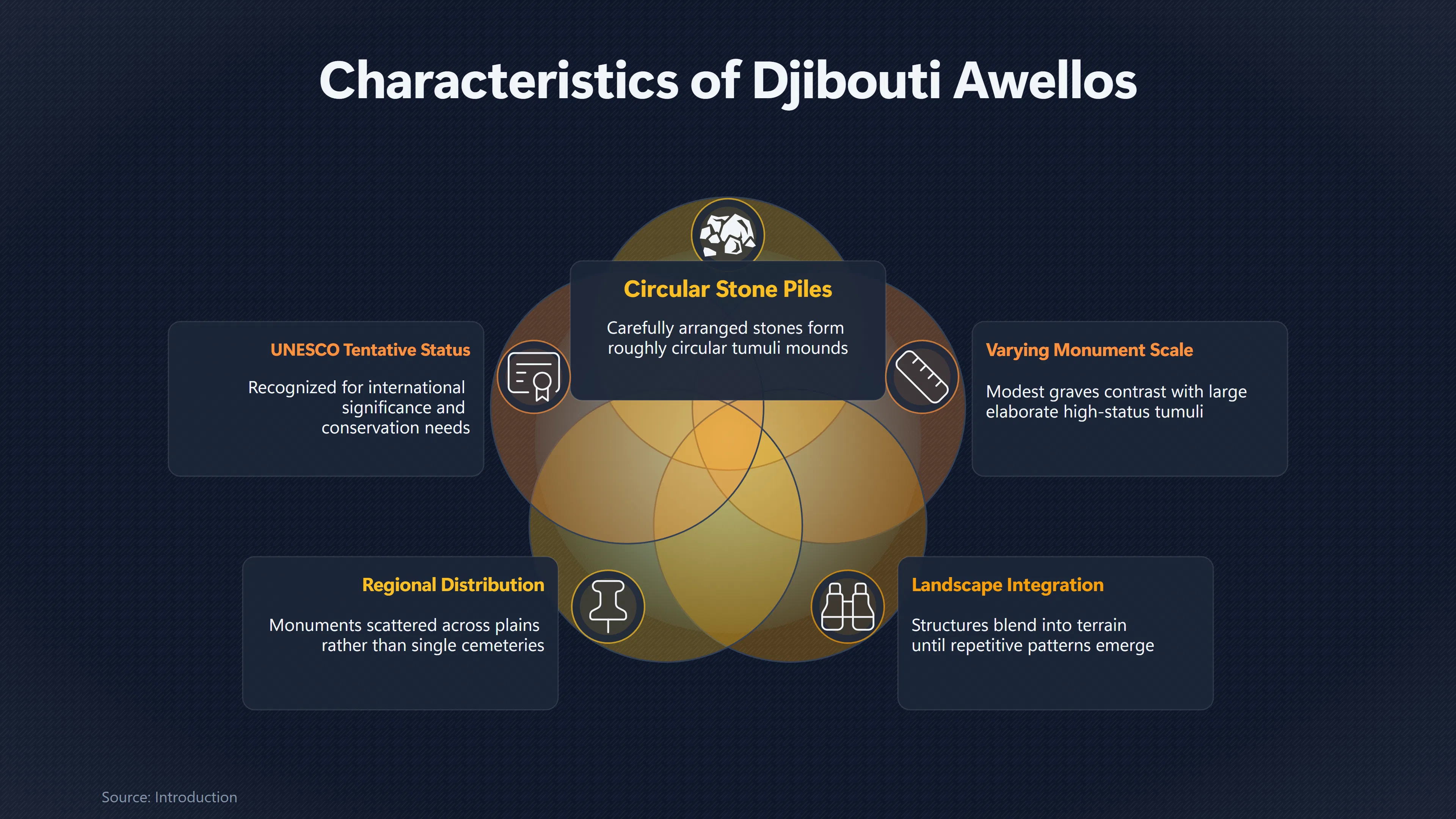
Most awellos appear as circular or roughly circular piles of carefully arranged stones. Some are relatively modest, while others are much larger and more elaborate. Together they form extensive funerary landscapes rather than isolated graves, suggesting that certain places remained important burial grounds across long periods.
Unlike spectacular pyramids or monumental temples, the awellos blend into the surrounding terrain. From ground level they can resemble natural stone heaps until their regular shapes become apparent. Seen across entire hillsides, however, their repetitive patterns reveal deliberate construction on a remarkable scale.
How Awellos Were Built and Used
Although many monuments have yet to be scientifically excavated, archaeologists broadly agree that the awellos functioned as burial monuments rather than dwellings or defensive structures.
The UNESCO nomination describes a society in which burial architecture reflected social status. Larger tumuli were reportedly reserved for high-ranking individuals such as political or spiritual leaders, while ordinary members of society received simpler graves. Grave goods may have included valuable possessions buried alongside the deceased, although relatively few tombs have undergone modern archaeological investigation capable of documenting these practices systematically.[UNESCO World Heritage Centre]whc.unesco.orgWorld Heritage Centre Les Tumulus (AwellosUNESCO World Heritage CentreLes Tumulus (Awellos) - UNESCO World Heritage CentreJanuary 5, 2015…
The construction itself would have required organised labour rather than advanced technology. Building stone cairns by gathering local rock, arranging retaining walls and covering burials is well within the capabilities of prehistoric pastoral communities. Comparable burial monuments appear elsewhere across the Horn of Africa and neighbouring regions, reflecting widespread traditions of commemorating the dead with stone architecture rather than evidence for a technologically lost civilisation.
What Archaeology Can and Cannot Prove
The awellos present archaeologists with a familiar challenge: there are many monuments but relatively few excavated examples.
Current evidence supports several conclusions with reasonable confidence:
- They are authentic prehistoric archaeological sites rather than modern fabrications.
- They represent funerary monuments associated with ancient communities living in what is now Djibouti.
- Similar forms of stone burial architecture are known elsewhere in north-east Africa and the Red Sea region.
- Their distribution across Djibouti indicates a substantial and long-lasting burial tradition rather than a single construction event.[UNESCO World Heritage Centre]whc.unesco.orgWorld Heritage Centre Les Tumulus (AwellosUNESCO World Heritage CentreLes Tumulus (Awellos) - UNESCO World Heritage CentreJanuary 5, 2015…
Important uncertainties remain.
Researchers still debate the precise chronology of different groups of monuments, whether all awellos belong to the same cultural tradition, how societies using them were organised, and how burial customs changed over time. Limited excavation means many of these questions cannot yet be answered confidently.
This distinction matters. Archaeology accepts uncertainty when evidence is incomplete. Gaps in knowledge are not themselves evidence for extraordinary explanations.

Why Lost-Civilisation Claims Persist
The awellos possess several characteristics that repeatedly attract speculative theories.
First is scale. Thousands of stone monuments spread across remote landscapes naturally encourage questions about who built them and why.
Second is visibility. Satellite imagery and aerial photography reveal striking patterns that are difficult to appreciate from ground level, making the landscapes appear even more mysterious.
Third is limited research. Because relatively few monuments have been excavated or published in detail, internet articles and travel websites sometimes fill the gaps with unsupported speculation.
Common claims suggest that the awellos were built by an unknown advanced civilisation, by people possessing forgotten engineering techniques, or by a culture unrelated to the ancestors of present-day populations. None of these ideas is supported by archaeological evidence.
Instead, the available evidence fits a far more familiar pattern seen throughout world archaeology: prehistoric communities invested considerable effort in honouring the dead, creating monuments that remained visible for generations and accumulated cultural significance over time. Monumentality does not require an advanced lost civilisation. It requires social organisation, shared beliefs and sustained communal labour.
Why the Myth Can Be So Persuasive
Lost-civilisation narratives often follow a recognisable pattern, and the awellos fit several elements perfectly.
The monuments are old but not fully understood. They survive in a harsh landscape that feels isolated today. Written records from the builders do not exist. Excavation remains incomplete. These conditions make imaginative explanations attractive, especially in popular media that rewards dramatic stories over cautious interpretation.
Another factor is that prehistoric societies are frequently underestimated. Modern audiences sometimes assume that ancient pastoral communities lacked the ability to organise large construction projects. Archaeology repeatedly shows the opposite. Across Africa and elsewhere, prehistoric societies built impressive ceremonial and funerary monuments using local materials, practical engineering and collective labour without requiring metal machinery or forgotten technologies.
The real achievement of the awellos is therefore no less remarkable because it has a human explanation.
Visiting the Awellos Today
The awellos are archaeological landscapes rather than fully developed visitor attractions. Travellers should not expect interpretation centres, extensive signage or museum-style displays comparable with major archaeological parks elsewhere.
Their importance lies in the landscape itself: scattered stone monuments preserved across open country that illustrate a chapter of Djibouti’s prehistoric past still being investigated by researchers. Visitors should treat the sites with the same respect afforded to ancient cemeteries, avoiding climbing on structures or disturbing stones that remain part of protected cultural heritage.
The awellos also form part of Djibouti’s wider heritage ambitions. They were added to the country’s UNESCO Tentative List in 2015, recognising their potential international significance while also highlighting the need for further conservation, research and management before any future World Heritage nomination could be considered.[UNESCO World Heritage Centre]whc.unesco.orgWorld Heritage Centre Les Tumulus (AwellosUNESCO World Heritage CentreLes Tumulus (Awellos) - UNESCO World Heritage CentreJanuary 5, 2015…

The Real Mystery Is Still Worth Exploring
The awellos demonstrate that genuine archaeological uncertainty can be more interesting than invented legends. Much remains unknown about the people who constructed these burial landscapes, their social organisation, their beliefs about death and the chronology of the monuments themselves.
Those unanswered questions leave room for future excavation rather than fantasy. As archaeological work expands and heritage protection improves, the awellos may eventually reveal far more about prehistoric life in the Horn of Africa. Until then, they remain one of Djibouti’s most compelling open-air archaeological collections: authentic, ancient and mysterious, but not evidence for a forgotten advanced civilisation.[UNESCO World Heritage Centre]whc.unesco.orgWorld Heritage Centre Les Tumulus (AwellosUNESCO World Heritage CentreLes Tumulus (Awellos) - UNESCO World Heritage CentreJanuary 5, 2015…
Amazon book picks
Further Reading
Books and field guides related to What Are Djibouti's Mysterious Stone Tombs?. Use these as the next step if you want deeper reading beyond the article.
The Archaeology of Death and Burial
The archaeology of death and burial is central to our attempts to understand vanished societies. Through the remains of funerary rituals...
The Oxford Handbook of the Archaeology of Death and Burial
The Oxford Handbook of the Archaeology of Death and Burial reviews the current state of mortuary archaeology and its practice, highlighti...
Death and Burial in Ancient Egypt
A Book Riot 100 Must-Read Book on Ancient History Death, burial, and the afterlife were as important to the ancient Egyptians as how they...
Prehistoric Europe: Theory and Practice
First published 2008. Subjects: Prehistoric peoples, Archaeology, Antiquities, Antiquities, prehistoric, Europe, antiquities.
eBay marketplace picks
Marketplace Samples
Live-tested eBay searches with available results related to this page.
Selected fromarchaeology wall art oneBay.co.uk.



Endnotes
1.
Source: whc.unesco.org
Title: World Heritage Centre Les Tumulus (Awellos)
Link:https://whc.unesco.org/en/tentativelists/5956/
Source snippet
UNESCO World Heritage CentreLes Tumulus (Awellos) - UNESCO World Heritage CentreJanuary 5, 2015...
Published: January 5, 2015
2.
Source: unesco.org
Title: Djibouti reviews its potential World Heritage sites | UNESCO
Link:https://www.unesco.org/en/articles/djibouti-reviews-its-potential-world-heritage-sites
Source snippet
December 16, 2020 — DJIBOUTI REVIEWS ITS POTENTIAL WORLD HERITAGE SITES Participants in the World Heritage workshop included the Director...
Published: December 16, 2020
3.
Source: whc.unesco.org
Title: World Heritage Centre Djibouti
Link:https://whc.unesco.org/en/statesparties/dj
Source snippet
UNESCO World Heritage CentreDjibouti - UNESCO World Heritage Convention...
4.
Source: unesco.org
Title: Djibouti passe en revue ses sites potentiels du patrimoine mondial
Link:https://www.unesco.org/fr/articles/djibouti-passe-en-revue-ses-sites-potentiels-du-patrimoine-mondial
Source snippet
December 16, 2020 — DJIBOUTI PASSE EN REVUE SES SITES POTENTIELS DU PATRIMOINE MONDIAL Parmi les participants à l'atelier sur le patrimoi...
Published: December 16, 2020
5.
Source: unesco.org
Title: Djibouti receives support for preparation of a first World Heritage
Link:https://www.unesco.org/en/articles/djibouti-receives-support-preparation-first-world-heritage-nomination-file
Source snippet
August 11, 2020 — DJIBOUTI RECEIVES SUPPORT FOR PREPARATION OF A FIRST WORLD HERITAGE NOMINATION FILE Guardian of [Abourma Rock Art]({{ 'abourma/' | relative_url }}) Site i...
Published: August 11, 2020
6.
Source: unesco.org
Title: djibouti considers nominating abourma rock art site unesco world heritage list
Link:https://www.unesco.org/en/articles/djibouti-considers-nominating-abourma-rock-art-site-unesco-world-heritage-list
7.
Source: whc.unesco.org
Link:https://whc.unesco.org/en/list/1542/
8.
Source: whc.unesco.org
Link:https://whc.unesco.org/fr/listesindicatives/5956/
9.
Source: whc.unesco.org
Link:https://whc.unesco.org/fr/etatsparties/dj/
11.
Source: whc.unesco.org
Link:https://whc.unesco.org/en/list/1073/
12.
Source: academic.oup.com
Link:https://academic.oup.com/edited-volume/61643/chapter/539822148?searchresult=1
Source snippet
Introduction 2. Earthen Tumuli as an Archaeological Site Category 3. History of Research: Archaeological Excavations of West African Tumu...
Additional References
13.
Source: djibouti.un.org
Link:https://djibouti.un.org/fr/309312-djibouti-franchit-une-%C3%A9tape-historique-validation-nationale-et-d%C3%A9p%C3%B4t-du-tout-premier-dossier
Source snippet
franchit une étape historique: validation nationale et dépôt du tout premier dossier de nomination au Patrimoine mondial de l’UNESCO ave...
14.
Source: youtube.com
Link:https://www.youtube.com/watch?v=2YWi0YmXqNQ
Source snippet
DEBATE: Can We Disprove the Lost Civilization Hypothesis? with Dr David Miano...
15.
Source: youtube.com
Title: Archaeologist Debunks Ancient Civilisation Myths
Link:https://www.youtube.com/watch?v=o74w5rDpMXo
Source snippet
What Does Graham Hancock Want You to Ignore? 13,000 Ice Age Sites From Around the World...
16.
Source: youtube.com
Title: NEW Satellite Discovery: 260 Unknown Monuments Found in Africa
Link:https://www.youtube.com/watch?v=9uz1X19mClE
Source snippet
The Mystery of Ethiopia's Ancient Stones | GEDEON DOC...
17.
Source: youtube.com
Title: The Mystery of Ethiopia’s Ancient Stones | GEDEON DOC
Link:https://www.youtube.com/watch?v=sn4tkv6S6mw
Source snippet
Archaeologist Debunks Ancient Civilisation Myths...
18.
Source: africabib.org
Link:https://www.africabib.org/rec.php?RID=256534063
19.
Source: worldheritagesite.org
Link:https://www.worldheritagesite.org/tentative/id/5956
20.
Source: archeologie.culture.gouv.fr
Link:https://archeologie.culture.gouv.fr/en/world-dead-first-livestock-breeders
21.
Source: archeologie.culture.gouv.fr
Link:https://archeologie.culture.gouv.fr/monde/en/world-dead-first-livestock-breeders
22.
Source: archeologie.culture.gouv.fr
Title: culture.gouv.fr Ali Dabba | French Archaeology Abroad Djibouti
Link:https://archeologie.culture.gouv.fr/monde/en/ali-dabba