Within Strange Australia
Should Human Remains Ever Be Museum Objects?
Australia's medical collections reveal disease in unsettling detail while raising difficult questions about consent, ancestry and repatriation.
On this page
- Inside Australia's pathology collections
- What genuine specimens teach visitors
- Consent, colonial collecting and repatriation
Page outline Jump by section
Introduction
Australia’s medical collections are unusual because many contain genuine human tissues rather than replicas. Preserved organs, pathological specimens and historical anatomical collections allow visitors to see disease in ways that books and digital images cannot. Yet these displays also raise difficult ethical questions. Who consented to their preservation? Should all human remains be displayed, even for education? And how should museums deal with collections assembled during the colonial period, when Indigenous ancestral remains were often taken without permission?
Unlike many curiosity attractions, Australia’s medical collections are increasingly judged not only by what they display but by how they acquired, interpret and care for those specimens. Modern museums and universities now place much greater emphasis on informed consent, cultural authority, transparency and repatriation, making ethics an inseparable part of the visitor experience rather than an issue hidden behind the scenes.[National Museum of Australia]nma.gov.auOpen source on nma.gov.au.
Inside Australia’s pathology collections
Australia’s best-known public pathology collection is the Museum of Human Disease at the University of New South Wales in Sydney. Instead of presenting medical history as a series of instruments or famous discoveries, it displays real preserved human organs affected by cancer, cardiovascular disease, infections, congenital disorders and many other conditions. The aim is educational rather than sensational: visitors compare healthy and diseased tissues to understand how illness changes the body.
This type of collection belongs to a long international tradition of pathology museums established to train doctors before modern imaging and digital teaching tools existed. In Australia, university collections remain valuable because genuine specimens reveal the physical consequences of disease in ways that photographs cannot fully reproduce. Many collections now accompany displays with explanations about prevention, public health and advances in treatment, shifting attention away from shock value towards scientific understanding.
Visitors expecting a cabinet of Victorian curiosities are therefore often surprised by the restrained atmosphere. Lighting, interpretation and labels typically emphasise anatomy, diagnosis and medical education rather than spectacle. That distinction is important because these collections continue to serve students and health professionals as well as the general public.
What genuine specimens teach visitors
Seeing an actual diseased heart, damaged lung or cancerous liver produces a different response from viewing an illustration. Physical specimens communicate scale, texture and anatomical change that can make otherwise abstract medical conditions immediately understandable.
Educational collections are particularly valuable for showing:
- the progression of chronic diseases over time;
- differences between healthy and diseased organs;
- congenital abnormalities and rare conditions;
- the effects of smoking, alcohol misuse and cardiovascular disease;
- historical approaches to diagnosis before modern scanning technologies.
Many museums argue that carefully interpreted human specimens encourage empathy as well as scientific literacy. Instead of reducing people to objects, modern interpretation increasingly reminds visitors that every specimen once belonged to an individual whose illness contributed to medical education for future generations.
That educational argument, however, depends heavily on trust. Visitors are more likely to accept the display of genuine human tissue when institutions clearly explain how specimens were donated, why they remain useful for teaching and how they are treated with dignity.
When does education become exploitation?
The hardest ethical question is not whether pathology museums have educational value but whether every specimen should remain on public display.
Today, Australian institutions generally distinguish between modern donated medical specimens and historical human remains collected under very different ethical standards. Modern pathology collections typically rely on legal donation systems and institutional oversight. Historical collections, by contrast, may contain remains acquired when informed consent was poorly defined or entirely absent.
Museums therefore face several recurring questions:
- Was informed consent obtained?
- Can the person’s identity or descendants be established?
- Does public display add genuine educational value?
- Could the same lesson be taught without exhibiting human remains?[metmuseum.org]metmuseum.orgWe ackStewardship of Human Remains - The Metropolitan Museum of ArtApril 22, 2025 — The purpose of this document is to outline how we, as stewa…
- Do cultural or religious beliefs require different treatment?
Rather than assuming display is automatically justified by science, many institutions now treat exhibition as a decision requiring continuing ethical review rather than permanent approval.

Consent, colonial collecting and repatriation
Australia’s most significant ethical debates concern Aboriginal and Torres Strait Islander ancestral remains collected during the colonial era.
Throughout the nineteenth and early twentieth centuries, Indigenous remains were removed from burial places, exchanged between collectors and scientific institutions, and studied as anthropological specimens. Many entered museum collections without consent from families or communities. What earlier generations regarded as scientific collecting is now widely recognised as part of the broader history of colonial dispossession.
Modern museum policy has changed dramatically. The National Museum of Australia states that Aboriginal and Torres Strait Islander ancestral remains should not be displayed unless authorised by the relevant community or custodians. Scientific research similarly requires free, prior and informed consent wherever communities can be identified. The Museum also no longer seeks to acquire ancestral remains except in limited circumstances aimed at protecting or returning them.[National Museum of Australia]nma.gov.auOpen source on nma.gov.au.
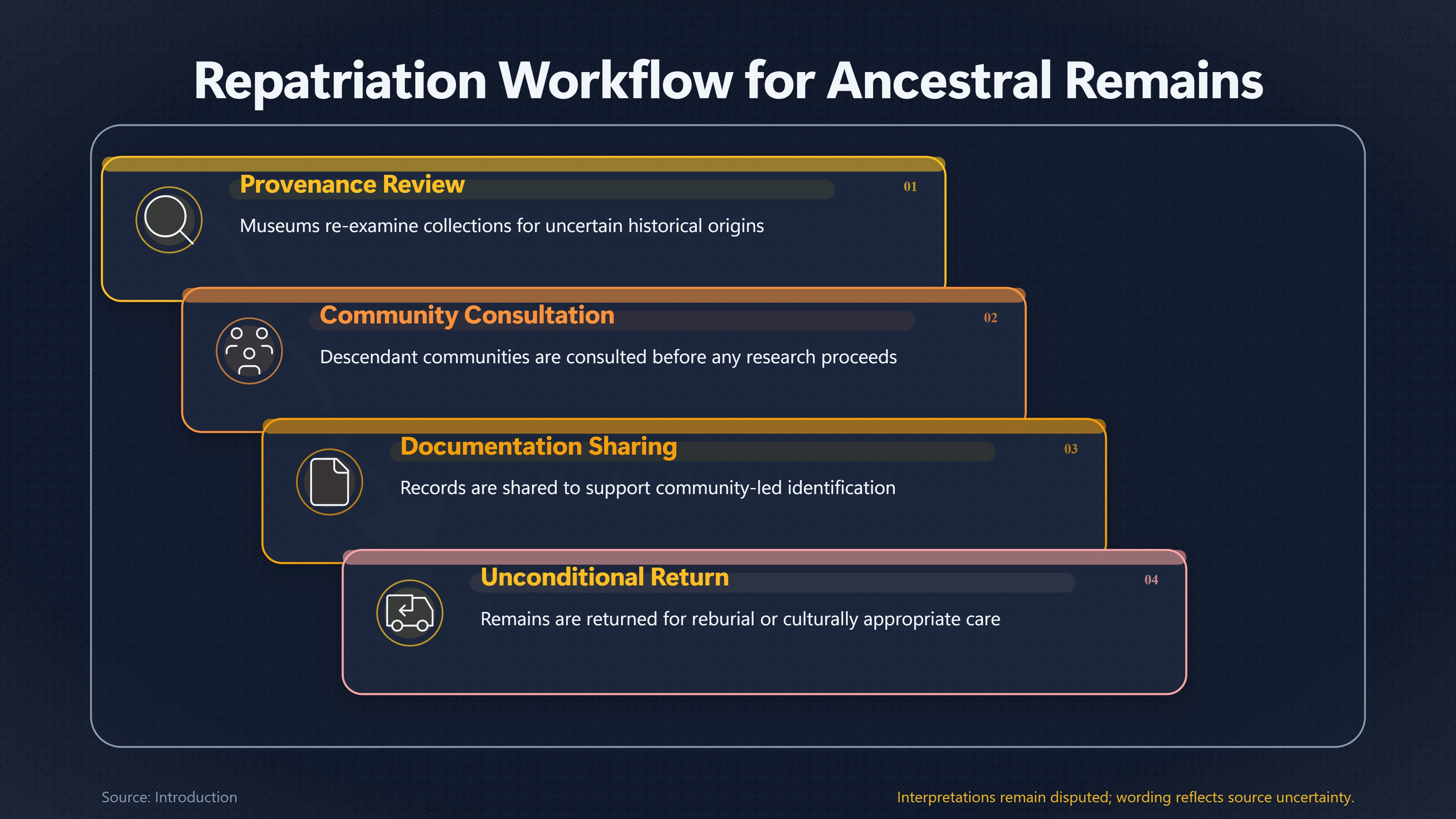
Repatriation has consequently become one of the defining developments in Australian museum practice. Rather than viewing remains as permanent scientific collections, museums increasingly work with First Nations communities to identify ancestors, document provenance and arrange unconditional returns for reburial or culturally appropriate care.[National Museum of Australia]nma.gov.auNational Museum of Australia Repatriation | National Museum of AustraliaNational Museum of Australia Repatriation | National Museum of Australia
Why repatriation changes how museums operate
Repatriation is not simply the physical return of remains. It changes how museums think about ownership, authority and expertise.
Earlier museum practice often assumed that scientific institutions had the strongest claim to preserve and study human remains. Contemporary practice increasingly recognises that descendant communities possess cultural authority over their ancestors and should determine whether research, storage or display is appropriate.
This shift affects museum work in practical ways:
- collections are re-examined for uncertain provenance;
- descendant communities are consulted before research proceeds;
- display policies distinguish medical specimens from ancestral remains;
- documentation is shared to support community-led identification;
- exhibitions increasingly explain the history of collecting alongside the objects themselves.
The result is that ethics has become part of interpretation rather than an administrative process invisible to visitors.
Why this debate matters in Australia’s curiosity culture
Medical collections remain among Australia’s most thought-provoking unusual attractions precisely because they resist easy categorisation. They are neither horror exhibitions nor conventional history museums. Instead, they occupy a space where science, education, mortality and cultural responsibility intersect.
For visitors interested in unusual collections, the most memorable lesson often extends beyond the preserved specimens themselves. Australia’s pathology museums demonstrate how museums have evolved from institutions that primarily accumulated objects into organisations expected to justify why those objects are held, who has authority over them and whether public display continues to serve the public good.
In that sense, the ethical questions are no longer separate from the collections. They have become one of the most important exhibits in their own right.
Amazon book picks
Further Reading
Books and field guides related to Should Human Remains Ever Be Museum Objects?. Use these as the next step if you want deeper reading beyond the article.
Atlas Obscura
Je čas vylézt z ulity a vyrazit po nevyšlapaných cestičkách. Vydejte se za zázraky přírody, bizarními lidskými a přírodními výtvory i na...
The Ethics of Collecting Cultural Property
First published 1991. Subjects: Cultural property, protection, Antiquities, collection and preservation.
eBay marketplace picks
Marketplace Samples
Live-tested eBay searches with available results related to this page.
Selected fromhuman anatomy wall art oneBay.co.uk.
Endnotes
1.
Source: australian.museum
Title: case study la perouse 2002
Link:https://australian.museum/learn/cultures/restricted-collections-repatriation/case-study-la-perouse-2002/
Source snippet
Case Study: La Perouse 2002 - The Australian MuseumDecember 4, 2019 — CASE STUDY: LA PEROUSE 2002 * Author(s) Vu Tuan Nguyen * Updated 04...
Published: December 4, 2019
2.
Source: australian.museum
Link:https://australian.museum/learn/cultures/restricted-collections-repatriation/
3.
Source: australian.museum
Title: First Nations Collections
Link:https://australian.museum/learn/cultures/first-nations-collections/
4.
Source: australian.museum
Link:https://australian.museum/learn/collections/aboriginal-and-torres-strait-islander-collection/first-nations-restricted/
5.
Source: australian.museum
Title: Our Organisation
Link:https://australian.museum/Our-policies
6.
Source: nma.gov.au
Link:https://www.nma.gov.au/about/corporate/policies/aboriginal-torres-strait-islander-human-remains
7.
Source: nma.gov.au
Title: National Museum of Australia Repatriation | National Museum of Australia
Link:https://www.nma.gov.au/about/repatriation
8.
Source: safetyandquality.gov.au
Title: Pathology Standards | Australian Commission on Safety and Quality in Health Care
Link:https://www.safetyandquality.gov.au/national-standards/pathology-standards
Source snippet
They cover patient safety, communication, supervision, and technical and specific requir...
9.
Source: health.gov.au
Link:https://www.health.gov.au/topics/communicable-diseases/biosecurity/importing-human-remains?language=aus-A66
Source snippet
Find out what requirements you need to meet to help us keep Australia safe. * Listen * Print...
10.
Source: nma.gov.au
Title: TITLE Non-Australian indigenous ancestral human remains managem
Link:https://www.nma.gov.au/about/corporate/policies/non-australian-indigenous-human-remains
Source snippet
Non-Australian indigenous human remains policy | National Museum of AustraliaFebruary 26, 2020 — POL-G-024, VERSION 2.0, 26 FEBRUARY 2020...
Published: February 26, 2020
11.
Source: nma.gov.au
Title: Collections – return of cultural objects policy | National Museum of Australia
Link:https://www.nma.gov.au/about/corporate/policies/collections-return-of-cultural-objects
12.
Source: nma.gov.au
Link:https://www.nma.gov.au/about/corporate/policies
13.
Source: nma.gov.au
Link:https://www.nma.gov.au/about/publications/repatriation-handbook/chapter-2
14.
Source: nma.gov.au
Link:https://www.nma.gov.au/about/publications/repatriation-handbook/chapter-5
15.
Source: nma.gov.au
Title: Understanding Museums
Link:https://nma.gov.au/research/understanding-museums/MPickering_PGordon_2011.html
16.
Source: recollections.nma.gov.au
Title: nma.gov.aure Collections
Link:https://recollections.nma.gov.au/issues/vol_3_no_1/notes_and_comments/the_management_of_restricted_aboriginal_objects
17.
Source: nhmrc.gov.au
Link:https://www.nhmrc.gov.au/research-policy/ethics/ethical-guidelines-cell-tissue-and-organ-donation-and-transplantation
Additional References
18.
Source: apnews.com
Link:https://apnews.com/article/654e87306101b3c3a5e91b3dcd678d7c
Source snippet
The remains, originating from the Ugar Island community in the Torres Strait Islands, were handed over during a ceremony attended by comm...
19.
Source: youtube.com
Title: Plastination Exhibitions Explained: Body Worlds, Ethics, and Human Rights
Link:https://www.youtube.com/watch?v=1xXO8-HVyHE
Source snippet
Should human remains be displayed in museums? | Stuff The British Stole features investigative journalist Marc Fennell exploring the spec...
20.
Source: youtube.com
Title: Should human remains be displayed in museums? | Stuff The British Stole
Link:https://www.youtube.com/watch?v=HpF6P8SDzYk
Source snippet
Repatriation at the Australian Museum - Phil Gordon...
21.
Source: youtube.com
Title: Tasmania apologises for unauthorised use of body parts
Link:https://www.youtube.com/watch?v=RbRANQ4kLNI
Source snippet
Should human remains be displayed in museums? | Stuff The British Stole...
22.
Source: youtube.com
Title: Repatriation at the Australian Museum
Link:https://www.youtube.com/watch?v=Lk7OCza2Y2Y
Source snippet
Plastination Exhibitions Explained: Body Worlds, Ethics, and Human Rights...
23.
Source: metmuseum.org
Title: We ack
Link:https://www.metmuseum.org/policies/human-remains-guidelines
Source snippet
Stewardship of Human Remains - The Metropolitan Museum of ArtApril 22, 2025 — The purpose of this document is to outline how we, as stewa...
Published: April 22, 2025
24.
Source: youtube.com
Title: Our Biggest Killers: Derek Williamson at TEDx Sydney
Link:https://www.youtube.com/watch?v=HcoIhgjTJHg
Source snippet
Tasmania apologises for unauthorised use of body parts...
25.
Source: unsw.edu.au
Title: Donate | Museum of Human Disease
Link:https://www.unsw.edu.au/medicine-health/disease-museum/donate