Within Venezuela Curiosities
The Human Remains Behind Venezuela's Science Museum
Caracas' Museum of Sciences preserves unusual anthropology collections, including human remains and reduced heads linked to wider South American collecting
On this page
- Anthropology collections and unusual specimens
- Collecting histories and ethical questions
- What visitors can actually see today
Page outline Jump by section
Introduction
Caracas’ Museum of Sciences is one of Venezuela’s most important places for understanding how science has historically collected, classified and displayed human bodies, cultural objects and the natural world. Among its most unusual holdings are anthropology collections containing human skeletal material, preserved bodies, funerary objects and reduced heads associated with Shuar and Achuar communities of Ecuador and Peru.[RNV]rnv.gob.veRNVMuseo de Ciencias expone sus coleccionesLa Emisora Oficial del Estado venezolanoSeptember 26, 2016…
These collections make the museum unusual not because they are simply “macabre”, but because they reveal a complicated history of scientific curiosity. The same objects that can help researchers study health, migration, burial traditions and past societies also raise difficult questions about colonial-era collecting, consent, cultural ownership and the respectful treatment of human remains.[Yale Peabody Museum]peabody.yale.eduPeabody Museum Stewardship of Human Remains | Yale Peabody MuseumYale Peabody MuseumStewardship of Human Remains | Yale Peabody Museum…
The Museum of Sciences therefore belongs to Venezuela’s strange-history landscape as a place where curiosity meets ethics: a scientific institution preserving evidence of human lives, while also preserving the debates created by earlier generations of collectors.[Inparques]inparques.gob.veInparques | Calendario verdeSeptember 1, 2022…
Anthropology collections and unusual specimens
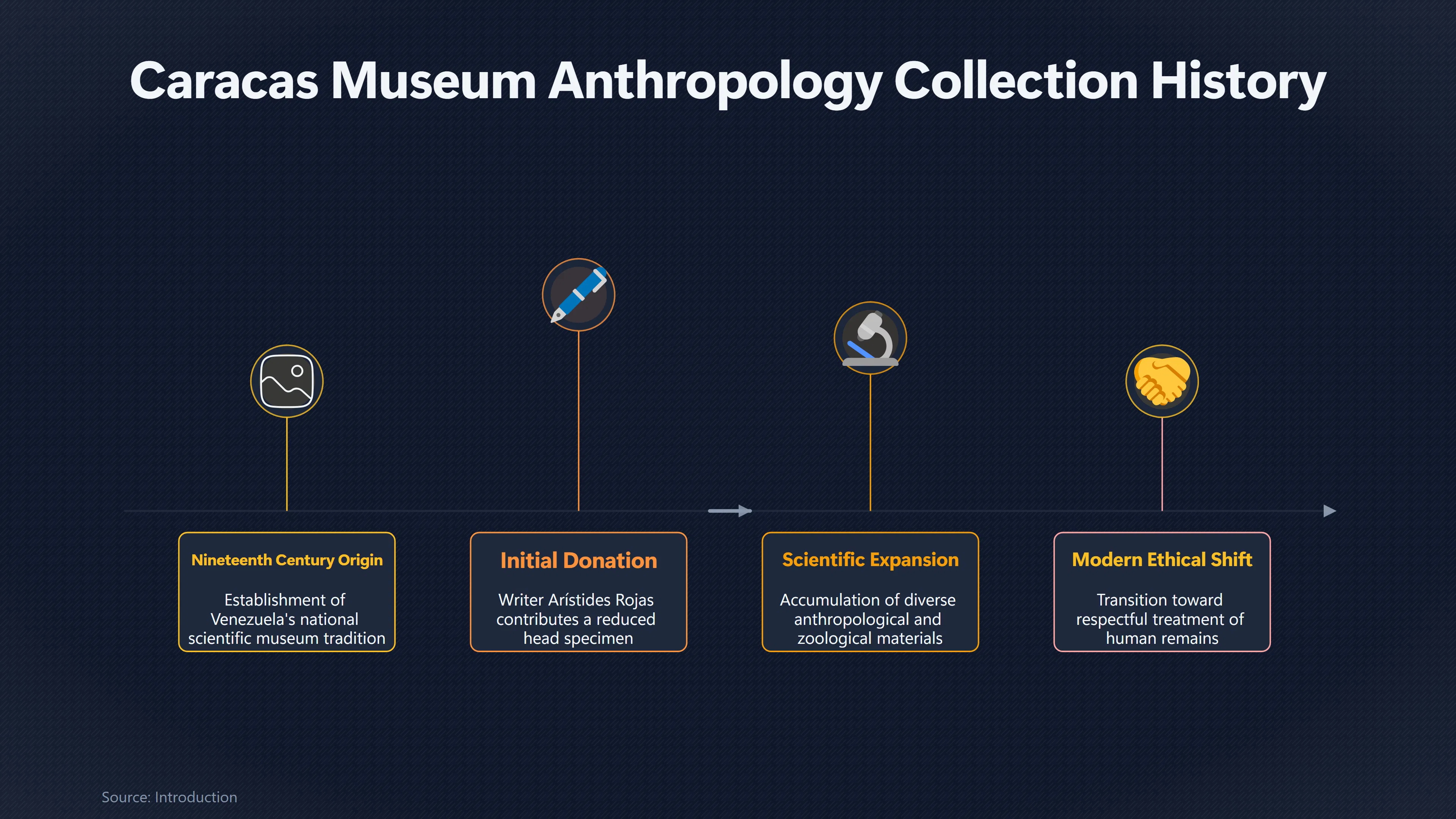
The Museum of Sciences in Caracas began as Venezuela’s national scientific museum tradition in the nineteenth century. Today it holds a broad collection covering fields such as zoology, palaeontology, archaeology, ethnography and anthropology. Institutional descriptions place its overall holdings at more than 150,000 objects and specimens, although only a portion can be displayed at any given time.[Inparques]inparques.gob.veInparques | Calendario verdeSeptember 1, 2022…
The anthropology holdings are among the most striking because they include direct evidence of human existence rather than only objects made by humans. The physical anthropology collection includes skulls and other skeletal remains, preserved human bodies, funerary materials and comparative anatomical material such as casts of hominin and primate skulls.[Wikipedia]WikipediaMuseo de Ciencias (VenezuelaMuseo de Ciencias (Venezuela
A particularly unusual part of the collection is the presence of reduced heads, known as tsantsa, linked to Shuar and Achuar peoples of the Ecuadorian and Peruvian Amazon. These objects are often presented in popular culture as mysterious curiosities, but their real significance lies in their connection to Indigenous ritual practices and the later international trade in ethnographic objects. The Museum of Sciences’ collection is therefore part of a much wider South American and global history of collecting Indigenous cultural materials.[Wikipedia]WikipediaMuseo de Ciencias (VenezuelaMuseo de Ciencias (Venezuela
The history of these objects is important because museums once often treated such items as examples of “exotic” customs rather than as objects connected to living communities. Modern museum practice increasingly tries to explain the people, beliefs and historical circumstances behind collections rather than presenting them only as unusual spectacles.[PRM Oxford]prm.ox.ac.ukPRM Oxford Shrunken heads | Pitt Rivers MuseumPRM Oxford Shrunken heads | Pitt Rivers Museum
Other human remains in the collection have a more direct connection to Venezuela’s own archaeological and anthropological record. The museum’s physical anthropology holdings include pre-Hispanic Venezuelan skulls, including examples showing intentional cranial modification, as well as remains showing evidence of disease or physical conditions experienced during life. These materials allow researchers to study past populations, health and cultural practices.[Wikipedia]WikipediaMuseo de Ciencias (VenezuelaMuseo de Ciencias (Venezuela
Collecting histories and ethical questions
The most controversial aspect of the Museum of Sciences’ human remains collections is not whether the objects are scientifically interesting, but how they entered museum collections and how they should be treated today.
The museum’s anthropology collection developed during a period when scientific institutions around the world were actively gathering human remains and cultural objects. In Venezuela, early collecting included a reduced head donated by writer Arístides Rojas in 1879, after which the museum accumulated further anthropological material through research and collecting activities.[Inparques]inparques.gob.veInparques | Calendario verdeSeptember 1, 2022…
This history reflects a broader nineteenth- and early twentieth-century museum tradition in which human remains were often treated as scientific specimens. Contemporary approaches have changed considerably. Many museums now recognise that human remains are not ordinary objects but the remains of individuals, often connected to communities with their own views about ancestors, burial and memory.[Yale Peabody Museum]peabody.yale.eduPeabody Museum Stewardship of Human Remains | Yale Peabody MuseumYale Peabody MuseumStewardship of Human Remains | Yale Peabody Museum…
Reduced heads provide a clear example of this shift. International museum debates have shown that displaying tsantsa without context can reinforce outdated stereotypes about Indigenous societies. The Pitt Rivers Museum in Oxford, for example, removed its Shuar/Achuar reduced heads from public display after an ethical review, arguing that earlier presentation methods had encouraged visitors to view them through sensational or colonial ideas rather than cultural understanding.[Museums Association]museumsassociation.orgMuseums AssociationPitt Rivers Museum removes shrunken heads from display after ethical review - Museums Association…
The issue for institutions such as the Museum of Sciences is therefore not simply whether human remains are “real” or scientifically valuable. The deeper questions are:
- Who collected them and under what circumstances? Older collections often contain incomplete records about acquisition.
- How should descendants and source communities be involved? Many museums now seek dialogue with communities connected to human remains and sacred objects.[Yale Peabody Museum]peabody.yale.eduPeabody Museum Stewardship of Human Remains | Yale Peabody MuseumYale Peabody MuseumStewardship of Human Remains | Yale Peabody Museum…
- Should remains be displayed, stored, researched or returned? Different museums and communities answer this differently depending on cultural, legal and historical circumstances.[Science Museum]sciencemuseum.org.ukScience Museum Human Remains | Science MuseumScience Museum Human Remains | Science Museum
These questions make the Caracas collection historically significant. It is not only a collection of unusual specimens; it is also a record of changing ideas about science, anthropology and the relationship between museums and the people whose histories they preserve.
What visitors can actually see today
For visitors, the Museum of Sciences is not simply a “human remains museum”. Its public identity remains that of a broad science institution with collections ranging from animals and fossils to archaeology and ethnography.[RNV]rnv.gob.veRNVMuseo de Ciencias expone sus coleccionesLa Emisora Oficial del Estado venezolanoSeptember 26, 2016…
The human anthropology holdings are primarily part of a larger scientific collection, and not every stored specimen is necessarily on permanent public display. Museums normally hold far more material in research collections than they can exhibit in galleries, with access and interpretation changing over time.[Science Museum]sciencemuseum.org.ukScience Museum Human Remains | Science MuseumScience Museum Human Remains | Science Museum
Visitors interested in the unusual side of Venezuela’s museum heritage should therefore approach the collection as a place of historical investigation rather than a cabinet of horrors. The most memorable objects are not important simply because they appear strange; they matter because they reveal how Venezuelan science institutions recorded humanity, how Indigenous cultures were interpreted by outsiders, and how museums are now reconsidering their responsibilities.
The Museum of Sciences’ human remains collections sit at an unusual crossroads: part scientific archive, part record of Venezuelan anthropology, and part reminder that every specimen was once connected to a person, a community and a history.[Yale Peabody Museum]peabody.yale.eduPeabody Museum Stewardship of Human Remains | Yale Peabody MuseumYale Peabody MuseumStewardship of Human Remains | Yale Peabody Museum…
Amazon book picks
Further Reading
Books and field guides related to The Human Remains Behind Venezuela's Science Museum. Use these as the next step if you want deeper reading beyond the article.
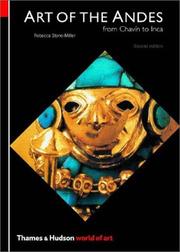
Art of the Andes
First published 1995. Subjects: Andean Art, Andes Region, Antiquities, Art, Andean, Indian art.
The Museum of Other People
A TLS BEST BOOK OF 2023 'A formidable work' Nigel Barley, author of The Innocent Anthropologist 'Should be required reading' Richard Lamb...
Exhibiting Cultures: The Poetics and Politics of Museum Display
Debating the practices of museums, galleries, and festivals, Exhibiting Cultures probes the often politically charged relationships among...

Human Remains: A Guide for Museums and Academic Institutions
First published 2006. Subjects: Collection and preservation, Moral and ethical aspects, Conservation and restoration, Human remains (Arch...
eBay marketplace picks
Marketplace Samples
Live-tested eBay searches with available results related to this page.
Selected fromscience museum collectible oneBay.co.uk.
Endnotes
1.
Source: rnv.gob.ve
Title: RNVMuseo de Ciencias expone sus colecciones
Link:https://rnv.gob.ve/museo-de-ciencias-expone-sus-colecciones/
Source snippet
La Emisora Oficial del Estado venezolanoSeptember 26, 2016...
Published: September 26, 2016
2.
Source: Wikipedia
Title: Museo de Ciencias (Venezuela)
Link:https://es.wikipedia.org/wiki/Museo_de_Ciencias_%28Venezuela%29
3.
Source: peabody.yale.edu
Title: Peabody Museum Stewardship of Human Remains | Yale Peabody Museum
Link:https://peabody.yale.edu/explore/collections/anthropology/stewardship-human-remains
Source snippet
Yale Peabody MuseumStewardship of Human Remains | Yale Peabody Museum...
4.
Source: rnv.gob.ve
Title: museo de ciencias una opcion para toda la familia en este 2019
Link:https://rnv.gob.ve/museo-de-ciencias-una-opcion-para-toda-la-familia-en-este-2019/
Source snippet
Museo de Ciencias, una opción para toda la familia en este 2019 - RNV | La Emisora Oficial del Estado venezolano...
5.
Source: museum.de
Title: museo de ciencias caracas venezuela
Link:https://www.museum.de/museen/museo-de-ciencias-caracas-venezuela
6.
Source: inparques.gob.ve
Link:https://www.inparques.gob.ve/cms/main/verCalendarioV/1634
Source snippet
Inparques | Calendario verdeSeptember 1, 2022...
Published: September 1, 2022
7.
Source: prm.ox.ac.uk
Title: PRM Oxford Shrunken heads | Pitt Rivers Museum
Link:https://www.prm.ox.ac.uk/shrunken-heads
8.
Source: museumsassociation.org
Link:https://www.museumsassociation.org/museums-journal/news/2020/09/pitt-rivers-museum-removes-shrunken-heads-from-display-after-ethical-review/
Source snippet
Museums AssociationPitt Rivers Museum removes shrunken heads from display after ethical review - Museums Association...
9.
Source: sciencemuseum.org.uk
Title: Science Museum Human Remains | Science Museum
Link:https://www.sciencemuseum.org.uk/human-remains
10.
Source: mincultura.gob.ve
Link:https://www.mincultura.gob.ve/noticias/tigre-dientes-de-sable-y-tecnologia-litica-protagonizan-nueva-exposicion-del-museo-de-ciencias/
Source snippet
turaMay 30, 2026 — TIGRE DIENTES DE SABLE Y TECNOLOGÍA LÍTICA PROTAGONIZAN NUEVA EXPOSICIÓN DEL MUSEO DE CIENCIAS Prensa MPPC (30/05/26)...
Published: May 30, 2026
11.
Source: museumsassociation.org
Title: Shuar people seek repatriation of ‘shrunken heads’ in UK collections
Link:https://www.museumsassociation.org/museums-journal/news/2025/10/shuar-people-seek-repatriation-of-shrunken-heads-in-uk-collections/
Source snippet
Museums AssociationOctober 28, 2025 — SHUAR PEOPLE SEEK REPATRIATION OF ‘SHRUNKEN HEADS’ IN UK COLLECTIONS Delegation expresses wish for...
Published: October 28, 2025
12.
Source: mincultura.gob.ve
Link:https://www.mincultura.gob.ve/noticias/el-museo-de-ciencias-remozado-en-pincel-digital/
13.
Source: cultura.gob.es
Title: Commitment on the treatment of human remains
Link:https://www.cultura.gob.es/mnantropologia/en/museo/museo/tratamiento-restos-humanos.html
14.
Source: rnv.gob.ve
Title: Museo de Ciencias abre sus puertas a investigadores y estudiantes
Link:https://rnv.gob.ve/museo-de-ciencias-abre-sus-puertas-a-investigadores-y-estudiantes/
15.
Source: mnhn.gob.cl
Link:https://www.mnhn.gob.cl/noticias/cabezas-jibaras-fascinacion-cientifica-y-fetichismo-museografico
16.
Source: mincultura.gob.ve
Link:https://www.mincultura.gob.ve/noticias/museo-de-ciencias-abre-sus-puertas-con-espacios-recuperados-y-modernizados/
17.
Source: cultura.gob.es
Title: Colecciones de antropología física
Link:https://www.cultura.gob.es/mnantropologia/colecciones/fondos-museogr-ficos-y-documentales/nuestra-coleccion/antropologia-fisica.html
18.
Source: cultura.gob.es
Title: Tsantsa (shrunken head)
Link:https://www.cultura.gob.es/museodeamerica/en/coleccion/etnologia/tsantsa.html
19.
Source: cultura.gob.es
Title: Tratamiento de fondos
Link:https://www.cultura.gob.es/mnescultura/en/colecciones/tratamiento-fondos.html
20.
Source: cultura.gob.es
Link:https://www.cultura.gob.es/msorolla/va/colecciones/carta-compromiso-restos-humanos.html
21.
Source: mincultura.gob.ve
Link:https://www.mincultura.gob.ve/eventos/inauguracion-del-museo-de-ciencias-en-caracas/
22.
Source: mincultura.gob.ve
Title: 4 de marzo de 1894 fallecio aristides rojas
Link:https://www.mincultura.gob.ve/eventos/4-de-marzo-de-1894-fallecio-aristides-rojas/
23.
Source: collection.sciencemuseumgroup.org.uk
Title: tsantsa of a female sloth
Link:https://collection.sciencemuseumgroup.org.uk/objects/co103936/tsantsa-of-a-female-sloth
24.
Source: collection.sciencemuseumgroup.org.uk
Link:https://collection.sciencemuseumgroup.org.uk/objects/co103804/tsantsa-with-long-brown-hair
25.
Source: collection.sciencemuseumgroup.org.uk
Title: tsantsa with long hair
Link:https://collection.sciencemuseumgroup.org.uk/objects/co104877/tsantsa-with-long-hair
Additional References
26.
Source: youtube.com
Link:https://www.youtube.com/watch?v=gO-qNds8u_4
Source snippet
Ethical considerations for caring and managing human remains in museums...
27.
Source: youtube.com
Title: Ceremonial Shrunken Head Returning To The Amazon From U.S
Link:https://www.youtube.com/watch?v=PabxJKTA_8s
Source snippet
Bone Rooms: How Elite Schools and Museums Amassed Black and Native Human Remains Without Consent...
28.
Source: youtube.com
Title: Ethical considerations for caring and managing human remains in museums
Link:https://www.youtube.com/watch?v=lml7S5-teqc
Source snippet
Making a full circle: cultural repatriation from museum collections...
29.
Source: youtube.com
Title: DNA Analysis Reveals Troubling News About Shrunken Heads
Link:https://www.youtube.com/watch?v=aw-PSlIlK5Y
Source snippet
Ceremonial Shrunken Head Returning To The Amazon From U.S...
30.
Source: researchgate.net
Link:https://www.researchgate.net/publication/382248508_Evaluacion_bioarqueologica_de_la_subcoleccion_maldonado_del_museo_de_ciencias_naturales_de_Caracas
31.
Source: man.es
Link:https://www.man.es/man/fr/coleccion/tratamiento-etico-restos-humanos.html
32.
Source: mos.org
Link:https://www.mos.org/ethics?campaign=781609
33.
Source: openagenda.com
Link:https://openagenda.com/eu/sistema-nacional-de-museos-fundacion-museos-nacionales/events/el-museo-de-ciencias-naturales-de-caracas-mvci-un-ejemplo-de-reimaginar-y-recuperacion
34.
Source: es-academic.com
Link:https://es-academic.com/dic.nsf/eswiki/836372/
35.
Source: multiversojournal.org
Link:https://multiversojournal.org/index.php/multiverso/article/view/86