Within Strange Paraguay
Why Paraguay's Carved Saints Look Different
Asunción's carved saints show how Catholic imagery, local workmanship and colonial power became embedded in devotional objects.
On this page
- What the Museum of Sacred Art displays
- Local makers and changing European religious models
- Devotion, evangelisation and colonial authority
Page outline Jump by section
Introduction
Paraguay’s most unusual religious collection is not strange because it displays relics or miracles. It is unusual because it reveals how colonial faith was quietly transformed by the people expected simply to reproduce it. The Museum of Sacred Art in Asunción preserves carved wooden saints, Virgins and Christs created largely during the seventeenth and eighteenth centuries by Guaraní and locally trained artisans working within Franciscan and Jesuit missionary traditions. At first glance these sculptures resemble familiar Catholic devotional art. A closer look shows something different: European religious models reinterpreted through local craftsmanship, aesthetic choices and cultural experience. Rather than copies, they became distinctly Paraguayan works that embody the country’s hybrid colonial history.[visitparaguay.travel]visitparaguay.travelVisit Paraguay MUSEO DE ARTE SACROVisit Paraguay MUSEO DE ARTE SACRO
For visitors interested in Paraguay’s stranger cultural heritage, the museum offers an unusual form of curiosity. Instead of monsters or occult objects, it demonstrates how political power, evangelisation and indigenous creativity became embedded in devotional sculptures that still challenge expectations about what colonial religious art should look like.[Museo de Arte Sacro]museodeartesacro.comMuseo de Arte SacroMUSEO DE ARTE SACROApril 24, 2026…
What the Museum of Sacred Art displays
Located in Asunción’s historic centre, the Museum of Sacred Art is devoted almost entirely to Paraguayan religious sculpture and iconography from the colonial period. Unlike broader historical museums, its galleries are arranged by religious themes—including Christ, the Virgin Mary, angels and saints—allowing visitors to compare changing artistic styles and devotional purposes across nearly one hundred surviving works.[Museo de Arte Sacro]museodeartesacro.comOpen source on museodeartesacro.com.
Most of the sculptures are carved from wood and retain their original painted surfaces. The museum deliberately emphasises conservation rather than extensive restoration, allowing visitors to see ageing pigments, carving techniques and the physical traces of centuries of devotional use. This makes the collection valuable not simply as religious art but as evidence of how sacred images functioned in churches, homes and mission settlements throughout colonial Paraguay.[Museo de Arte Sacro]museodeartesacro.comOpen source on museodeartesacro.com.
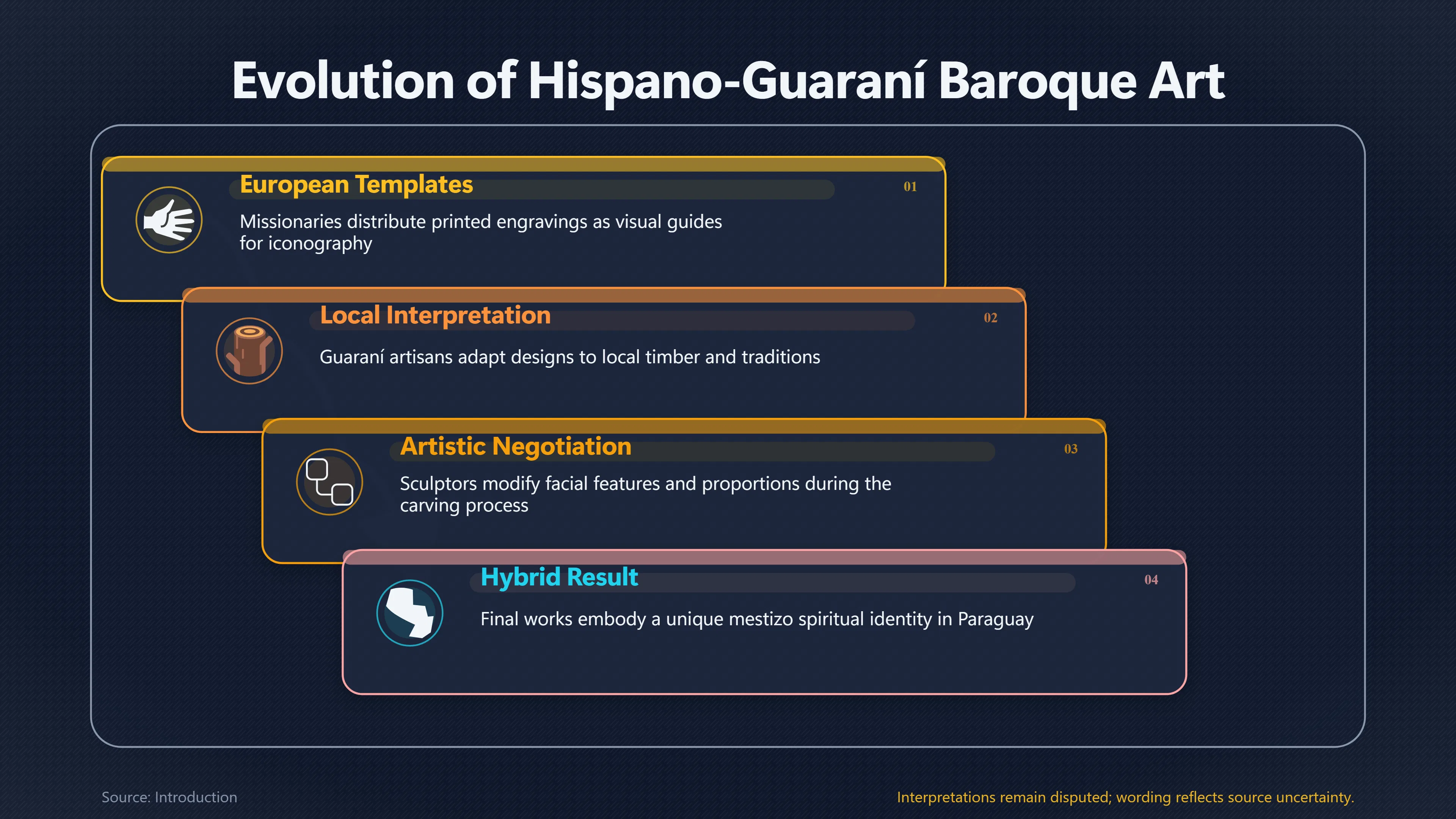
Many pieces originated within the Jesuit and Franciscan missionary world, while others were produced in colonial workshops outside the famous mission settlements. Together they document the evolution of what is often described as Hispano-Guaraní Baroque, a regional artistic tradition rather than a direct imitation of European Baroque sculpture.[Visit Paraguay]visitparaguay.travelVisit Paraguay MUSEO DE ARTE SACROVisit Paraguay MUSEO DE ARTE SACRO
Why Paraguay’s carved saints look different
The sculptures appear recognisably Catholic because missionaries relied on standard European iconography to teach biblical stories and the lives of saints. Yet the craftsmen responsible for producing these images were frequently Guaraní or locally trained artisans who interpreted imported models through their own artistic traditions and practical experience.[EFE Noticias]efe.comNoticias Un museo de arte sacro revela el mestizaje espiritual de ParaguayEFE NoticiasUn museo de arte sacro revela el mestizaje espiritual de Paraguay…
This process produced what scholars and museum curators describe as a hybrid or mestizo style. Rather than reproducing European originals exactly, artists simplified proportions, altered facial expressions, introduced distinctive decorative details and adapted compositions to local materials and workshop practices. The resulting figures remain unmistakably Christian while also reflecting indigenous craftsmanship and regional visual preferences.[Museo de Arte Sacro]museodeartesacro.comMuseo de Arte SacroMUSEO DE ARTE SACROApril 24, 2026…
The museum repeatedly encourages visitors to see these sculptures as creative reinterpretations instead of imperfect copies. Their differences reveal artistic agency rather than technical limitation. European engravings supplied general templates, but local makers decided how those ideas became physical objects.[Museo de Arte Sacro]museodeartesacro.comOpen source on museodeartesacro.com.
Local makers changed imported religious models
One of the museum’s most revealing themes is how European religious imagery changed once it entered colonial Paraguay.
Missionaries distributed printed devotional images from Europe to establish consistent representations of biblical figures and saints. These engravings acted as visual guides, especially where literacy was limited. However, carving a life-sized wooden sculpture required numerous artistic decisions that no printed image could dictate. Local sculptors determined facial features, posture, proportions and surface decoration while adapting designs to available timber and workshop traditions.[Museo de Arte Sacro]museodeartesacro.comOpen source on museodeartesacro.com.
The result is not a hidden indigenous religion disguised beneath Christianity. Instead, it is a visible negotiation between missionary instruction and local artistic practice. The religious message remained Catholic, but the artistic language gradually became Paraguayan.[Visit Paraguay]visitparaguay.travelVisit Paraguay MUSEO DE ARTE SACROVisit Paraguay MUSEO DE ARTE SACRO
This helps explain why visitors sometimes notice saints whose expressions feel gentler, bodies appear differently proportioned or compositions diverge subtly from familiar European examples. Such differences are not random curiosities but evidence of cultural adaptation occurring over generations.[Museo de Arte Sacro]museodeartesacro.comOpen source on museodeartesacro.com.

Hybrid saints as evidence of colonial power
These sculptures cannot be understood only as artworks. They were instruments of evangelisation within a colonial society where Catholicism was closely connected to Spanish political authority and missionary organisation.
Images of saints served practical purposes inside churches and missions. They taught biblical narratives, reinforced Christian doctrine and created emotional focus for worshippers who might never read religious texts. Sculpture therefore became one of the principal technologies of conversion.[EFE Noticias]efe.comNoticias Un museo de arte sacro revela el mestizaje espiritual de ParaguayEFE NoticiasUn museo de arte sacro revela el mestizaje espiritual de Paraguay…
Yet the very success of this strategy depended on indigenous participation. Guaraní communities did not simply receive European religious imagery; they carved, painted, maintained and eventually reshaped it. The museum’s collection demonstrates that colonial authority could prescribe subjects and doctrines, but it could not eliminate local artistic interpretation.[Museo de Arte Sacro]museodeartesacro.comMuseo de Arte SacroMUSEO DE ARTE SACROApril 24, 2026…
Seen this way, the hybrid saints embody both colonial control and indigenous creativity. They are products of unequal historical relationships while simultaneously preserving evidence that local makers exercised meaningful artistic choices within those constraints.[EFE Noticias]efe.comNoticias Un museo de arte sacro revela el mestizaje espiritual de ParaguayEFE NoticiasUn museo de arte sacro revela el mestizaje espiritual de Paraguay…
Curious works that break familiar rules
Several sculptures in the collection stand out because they depart noticeably from conventional European iconography.
The museum highlights a unique Virgin of the Encounter, depicted with open arms awaiting the resurrected Christ—an image not established in standard biblical iconography but developed within the local devotional tradition. Another striking example adapts Michelangelo’s famous Pietà: the Virgin sits enthroned while the adult Christ appears deliberately reduced in scale, emphasising Mary’s continuing maternal relationship with her son rather than anatomical realism. Curators interpret these works as creative Guaraní reinterpretations rather than mistakes or corruptions of European models.[EFE Noticias]efe.comNoticias Un museo de arte sacro revela el mestizaje espiritual de ParaguayEFE NoticiasUn museo de arte sacro revela el mestizaje espiritual de Paraguay…
The museum also preserves works whose identities remain uncertain because they lack the standard symbolic attributes normally used to identify saints. Rather than assigning speculative names, curators present these figures as puzzles in colonial iconography, illustrating how artistic traditions could evolve in unexpected directions over centuries.[Museo de Arte Sacro]museodeartesacro.comOpen source on museodeartesacro.com.
These objects give the museum much of its appeal for visitors interested in unusual collections. Their fascination lies not in supernatural claims but in the surprising ways familiar religious images became transformed within a specific historical and cultural setting.
Why the museum matters within Paraguay’s curiosity landscape
Paraguay’s curiosity culture often revolves around places where belief becomes material: mythological creatures rendered as sculpture, indigenous ceremonial objects preserved in museums, or colonial religious carvings that reveal unexpected cultural exchanges.
Within that landscape, the Museum of Sacred Art complements rather than duplicates folklore collections. Instead of displaying legendary beings, it demonstrates how everyday devotional objects became historical evidence for cultural mixing. The collection shows that some of Paraguay’s most distinctive “strange” artefacts are not mysterious because of hidden powers but because they preserve the visible traces of negotiation between European Christianity, Guaraní artistic traditions and colonial authority.[visitparaguay.travel]visitparaguay.travelVisit Paraguay MUSEO DE ARTE SACROVisit Paraguay MUSEO DE ARTE SACRO
For modern visitors, the carved saints are therefore more than beautiful religious sculptures. They are records of how imported beliefs were absorbed, reshaped and made local—revealing that even the most familiar sacred figures can become culturally unique when viewed through Paraguay’s colonial history.
Amazon book picks
Further Reading
Books and field guides related to Why Paraguay's Carved Saints Look Different. Use these as the next step if you want deeper reading beyond the article.
Art of the Andes
This is a study of the art and architecture created by the various cultures of the ancient Andes. The book examines the goldwork, intrica...
The Art of the Pacific Islands
Du site de l'éd.: In spite of the wealth it has to offer, the art of the Pacific Islands remains perhaps the least known of the world's a...
The Colonial Andes: Tapestries and Silverwork,
The arrival of the Spanish in South America in 1532 permanently transformed the Andean cultural landscape. Within a generation, societies...
eBay marketplace picks
Marketplace Samples
Live-tested eBay searches with available results related to this page.
Selected fromLatin American art print oneBay.co.uk.
Endnotes
1.
Source: visitparaguay.travel
Title: Visit Paraguay MUSEO DE ARTE SACRO
Link:https://visitparaguay.travel/index.php/places/museo-de-arte-sacro
2.
Source: museodeartesacro.com
Link:https://www.museodeartesacro.com/nosotros
3.
Source: efe.com
Title: Noticias Un museo de arte sacro revela el mestizaje espiritual de Paraguay
Link:https://efe.com/cultura/2025-09-23/museo-arte-sacro-mestizaje-espiritual-paraguay/
Source snippet
EFE NoticiasUn museo de arte sacro revela el mestizaje espiritual de Paraguay...
4.
Source: museodeartesacro.com
Link:https://museodeartesacro.com/noticias/el-museo-de-arte-sacro-de-asuncion-revela-la-espiritualidad-mestiza-del-paraguay-colonial
Source snippet
Museo de Arte SacroMUSEO DE ARTE SACROApril 24, 2026...
Published: April 24, 2026
5.
Source: museodeartesacro.com
Link:https://www.museodeartesacro.com/public/noticias/15-anos-del-exito-del-museo-de-arte-sacro
Source snippet
MUSEO DE ARTE SACROMarch 24, 2025 — 15 AÑOS DEL ÉXITO DEL MUSEO DE ARTE SACRO INICIO → NOTICIAS → 15 AÑOS DEL ÉXITO DEL MUSEO DE ARTE SAC...
Published: March 24, 2025
6.
Source: museodeartesacro.com
Link:https://www.museodeartesacro.com/
7.
Source: museodeartesacro.com
Link:https://www.museodeartesacro.com/public/noticias/la-iconografia-de-los-santos—analisis
8.
Source: museodeartesacro.com
Link:https://www.museodeartesacro.com/noticias/figura-liturgica
9.
Source: museodeartesacro.com
Title: los rostros de cristo
Link:https://www.museodeartesacro.com/noticias/los-rostros-de-cristo
10.
Source: museodeartesacro.com
Link:https://www.museodeartesacro.com/noticias/espinario
11.
Source: encarnacion.gov.py
Title: Museo de Arte Sacro
Link:https://encarnacion.gov.py/museo-de-arte-sacro/
12.
Source: museodeartesacro.com
Link:https://www.museodeartesacro.com/coleccion-permanente
13.
Source: petitfute.co.uk
Title: MUSE O DE ARTE SACRO
Link:https://www.petitfute.co.uk/v59251-asuncion/c1173-visites-points-d-interet/c958-musee/550133-museo-de-arte-sacro.html
Additional References
14.
Source: scielo.iics.una.py
Title: py Fiestas patronales en las reducciones jesuíticas del Paraguay
Link:https://scielo.iics.una.py/scielo.php?lng=en&nrm=iso&pid=S2520-99142025000100143&script=sci_arttext
Source snippet
"Entre la solemnidad, el convite y los juegosJune 1, 2025 — ESTUD. PARAG. VOL.43 NO.1 ASUNCIÓN JUNE 2025 [https://DOI.ORG/10.47133/RESPY43..."](https://DOI.ORG/10.47133/RESPY43...")...
Published: June 1, 2025
15.
Source: youtube.com
Link:https://www.youtube.com/watch?v=FZiDNitq9Ec
Source snippet
Exploring the Jesuit Missions of Paraguay: La Santísima Trinidad de Paraná & Jesús de Tavarangue...
16.
Source: youtube.com
Title: Paraguay, country with only one UNESCO World Heritage Site
Link:https://www.youtube.com/watch?v=RzPcfo0dUoA
Source snippet
"Museum of Sacred Art" Asuncion Paraguay Tourist Attractions in Asuncion - Paraguay | 2022 Top Rated Online...
17.
Source: youtube.com
Link:https://www.youtube.com/watch?v=2rPHdgFBfP0
Source snippet
Inside Paraguay: A Vibrant Melting Pot Of Cultures...
18.
Source: youtube.com
Title: UNESCO Ruins of Paraguay: Visiting Trinidad and Jesús de Tavarangue
Link:https://www.youtube.com/watch?v=nAknMDodAYg
Source snippet
Paraguay, country with only one UNESCO World Heritage Site...
19.
Source: youtube.com
Title: Inside Paraguay: A Vibrant Melting Pot Of Cultures
Link:https://www.youtube.com/watch?v=_6hwbaN2ryA
Source snippet
UNESCO Ruins of Paraguay: Visiting Trinidad and Jesús de Tavarangue...
20.
Source: icom.museum
Link:https://icom.museum/en/object/archangel-michael-wood-museo-de-la-mision-jesuitica-de-los-guaranies-de-santa-maria-de-fe-paraguay/
21.
Source: cultura.gov.py
Link:https://cultura.gov.py/2017/04/casa-de-la-independencia-exhibe-su-coleccion-de-arte-sacro/
22.
Source: cultura.gov.py
Link:https://cultura.gov.py/2017/03/expertos-alemanes-expusieron-resultados-de-investigacion-sobre-las-esculturas-jesuiticas/
23.
Source: ijih.org
Link:https://ijih.org/volumes/article/947