Within Dominican Curiosities
What Do Dominican Masks and Ritual Objects Mean?
National and regional collections preserve ceremonial seats, ancestral figures and horned masks whose meanings extend beyond visual spectacle.
On this page
- Indigenous ceremonial objects and spiritual authority
- Carnival masks, horned figures and cultural mixture
- How museums frame living and contested traditions
Page outline Jump by section
Introduction
Dominican museums use ritual objects and carnival masks to explain far more than colourful festivals. Together, these collections reveal how the country’s identity has been shaped by Indigenous Taíno traditions, African-Caribbean religious and artistic influences, European colonial customs and modern community celebrations. Rather than presenting masks simply as decorative folk art, the strongest museums interpret them as objects that once carried spiritual authority, expressed political power or continue to play active roles in living traditions. The result is an unusually rich combination of archaeology, ethnography and performance, where ceremonial stools stand alongside horned carnival masks to show how ideas about ancestry, protection, authority and identity have changed across centuries.
Indigenous ceremonial objects and spiritual authority
The most important institution for understanding Dominican ritual heritage is the Museo del Hombre Dominicano in Santo Domingo. Its archaeological collections contain many of the country’s finest surviving Taíno ceremonial objects, allowing visitors to see artefacts that were originally created for religious and political purposes rather than everyday use. The museum explicitly presents these collections as evidence of the island’s earliest inhabitants and the enduring importance of Taíno culture within Dominican national identity.[Museos RD]museosrd.gob.doMuseos RDMuseo del Hombre Dominicano | MUSEOSRD2 days agoMuseos RDMuseo del Hombre Dominicano | MUSEOSRD2 days ago
Among the most significant ritual objects are:
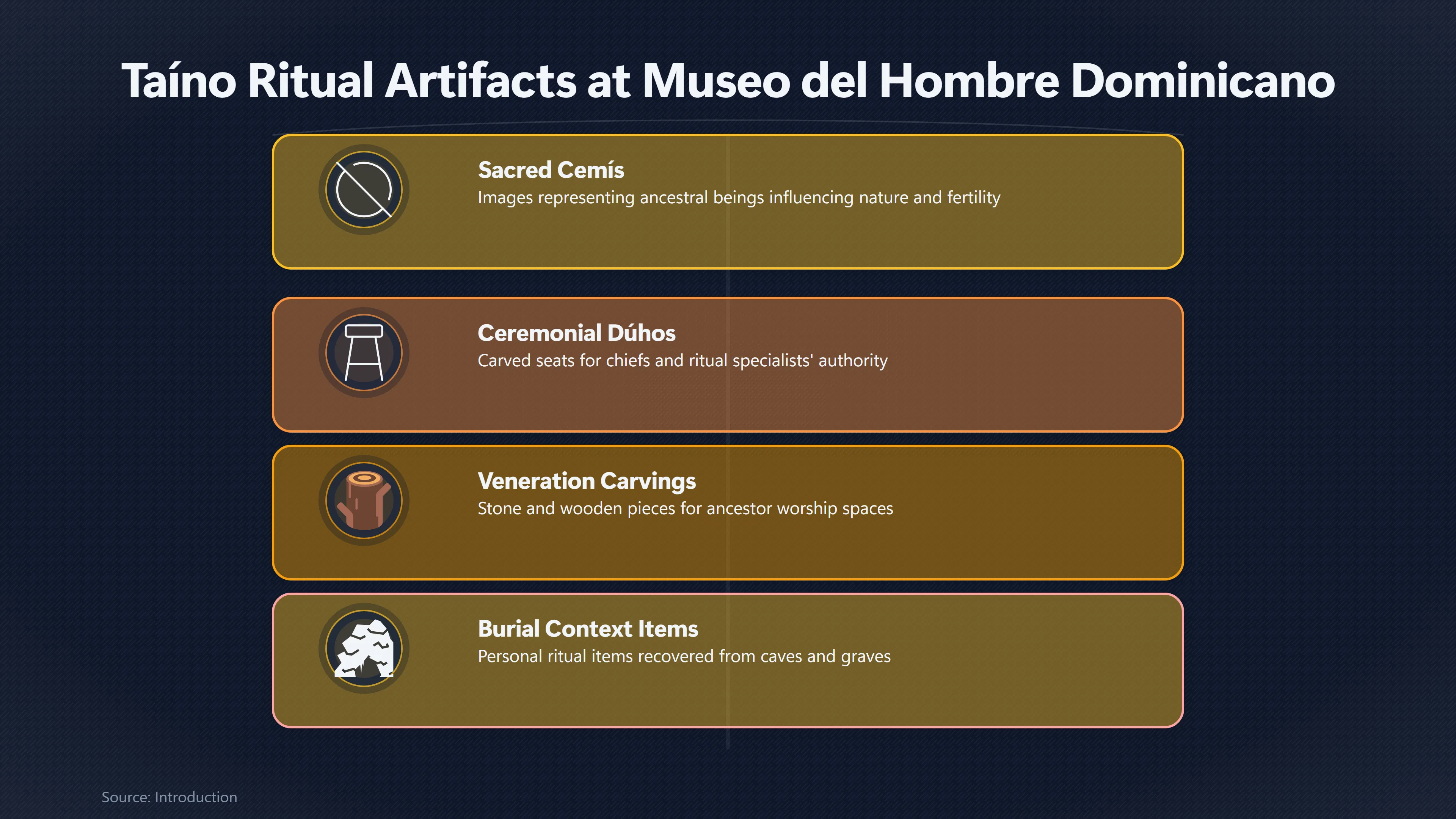
- Cemís, sacred images representing ancestral or supernatural beings believed to influence nature, fertility and community wellbeing.
- Dúhos, carved ceremonial seats reserved for chiefs and ritual specialists, symbolising authority and communication with the spirit world.
- Stone and wooden carvings associated with ceremonial spaces, ancestor veneration and religious leadership.
- Personal ritual items recovered from caves and burial contexts, reflecting beliefs about death and the continuing presence of ancestors.[Museos RD]museosrd.gob.docemies duhos y rituales aborigenesMuseos RDCemíes, Dúhos y Rituales Aborígenes | MUSEOSRDJuly 14, 2026…
Modern exhibitions increasingly place these objects within their original ceremonial context rather than treating them simply as archaeological sculptures. Recent displays at the Museo del Hombre Dominicano have focused specifically on cemís, dúhos and Indigenous ritual life, explaining how ancestor worship, sacred landscapes and ceremonial leadership formed an interconnected religious system. The exhibitions also emphasise that Taíno culture emerged through interaction among several Antillean Indigenous groups rather than representing a single static civilisation.[Museos RD]museosrd.gob.doMuseos RDExposición Cemíes, Dúhos y Rituales Aborígenes | MUSEOSRDMuseos RDExposición Cemíes, Dúhos y Rituales Aborígenes | MUSEOSRD
One particularly important development has been the temporary exhibition of the world’s only surviving cotton Taíno cemí, brought to the Dominican Republic through an international cultural agreement with Italy. Because organic ritual objects rarely survive in the Caribbean climate, this loan has exceptional historical importance and demonstrates how museum collections continue to reshape public understanding of Taíno religion.[MINC]cultura.gob.doMINCMinisterio de CulturaEl único cemí de algodón taíno en el mundo será exhibido en RDOctober 21, 2024…
Carnival masks, horned figures and cultural mixture
If archaeological galleries preserve ancient ritual authority, carnival collections demonstrate how ritual performance continues to evolve in public life. Dominican museums commonly display masks associated with regional carnival traditions, particularly the famous Diablo Cojuelo figures whose spectacular horned masks have become international symbols of Dominican Carnival.
Although visitors often describe these as “devil masks”, museums generally present a more complex picture. The masks combine European medieval ideas about devils with African-Caribbean performance traditions and distinctly Dominican local identities that developed over centuries. Different regions created their own styles rather than following one national design.[Mask Museum]maskmuseum.orgMask Museum Diablo Cojuelo Mask and Costume – Second FaceMask Museum Diablo Cojuelo Mask and Costume – Second Face
Several regional traditions appear in museum collections:
- La Vega is famous for elaborate horned Diablo Cojuelo masks, now frequently produced in painted fibreglass although earlier examples were made from papier-mâché.
- Santiago preserves distinctive Lechón masks, recognisable by their different horn arrangements and local decorative styles.
- Bonao developed numerous Macarao mask traditions, each associated with particular carnival groups and makers.
- Other regions contribute unique combinations of colours, animal forms and symbolic decorations that reflect local history rather than a single national pattern.[Mask Museum]maskmuseum.orgMask Museum Diablo Cojuelo Mask and Costume – Second FaceMask Museum Diablo Cojuelo Mask and Costume – Second Face
Museum displays also explain that the masks belong to complete performances rather than existing as isolated artworks. Costumes, bells, inflated bladders used during carnival processions and regional performance customs all help visitors understand how these objects function in practice. The physical mask is only one element within a broader tradition involving music, dance, public participation and seasonal celebration.[Mask Museum]maskmuseum.orgMask Museum Diablo Cojuelo Mask and Costume – Second FaceMask Museum Diablo Cojuelo Mask and Costume – Second Face
Many museums and cultural centres also preserve masks as examples of remarkable craftsmanship. Modern makers continue to hand-paint, carve and decorate increasingly elaborate creations, demonstrating how carnival remains a living artistic tradition instead of a historical survival frozen behind glass.

How museums frame living and contested traditions
One of the most interesting aspects of Dominican museum interpretation is the effort to distinguish between ancient ritual religion and modern cultural performance without treating either as less authentic.
Taíno ritual objects are usually presented through archaeology and historical anthropology. Their original religious functions can only be reconstructed through excavations, colonial-era descriptions and comparison with surviving Indigenous Caribbean traditions. Museums therefore acknowledge that many aspects of Taíno ceremonial life remain uncertain because European colonisation destroyed much of the original religious system.[Museos RD]museosrd.gob.docemies duhos y rituales aborigenesMuseos RDCemíes, Dúhos y Rituales Aborígenes | MUSEOSRDJuly 14, 2026…
Carnival masks present a different challenge because they belong to living communities. Museums increasingly avoid describing them as relics from the past. Instead, they interpret them as evolving traditions that continue to change with new materials, artistic styles and regional identities. A fibreglass Diablo Cojuelo mask displayed today is not necessarily less traditional than an older papier-mâché version; it reflects the ongoing creativity of contemporary mask makers responding to changing audiences and technologies.[Mask Museum]maskmuseum.orgMask Museum Diablo Cojuelo Mask and Costume – Second FaceMask Museum Diablo Cojuelo Mask and Costume – Second Face
This approach also helps avoid a common misunderstanding among visitors. While devil imagery dominates Dominican carnival, museums generally explain that these figures should not be interpreted as evidence of devil worship or surviving pagan religion. Instead, they belong to a complex performance tradition where humour, satire, local rivalry, spectacle and historical symbolism all coexist.
Why these collections matter
Ritual objects and carnival masks occupy a distinctive place within Dominican museum culture because they connect ancient archaeology with living heritage more directly than many other collections.
A carved dúho or cemí demonstrates how authority, ancestry and spiritual power were understood before European colonisation. A horned carnival mask shows how later generations blended Indigenous memory, African cultural influence and European festival customs into traditions that remain central to Dominican public life.
Seen together, these collections challenge the idea that museums only preserve objects from vanished cultures. In the Dominican Republic, many ritual traditions continue outside museum walls every carnival season, while archaeological collections provide the deeper historical framework that allows visitors to recognise how ideas about identity, belief and ceremonial authority have persisted through transformation rather than simple survival.
Amazon book picks
Further Reading
Books and field guides related to What Do Dominican Masks and Ritual Objects Mean?. Use these as the next step if you want deeper reading beyond the article.
The Tainos: Rise and Decline of the People Who Greeted Columbus
When Columbus arrived in the Americas, the first people he encountered were the Tainos, inhabitants of the islands of the northern Caribb...
The Indigenous People of the Caribbean
"A survey of the current state of study of indigenous Caribbean people by archaeologists, historians, and anthropologists. . . . Emphasiz...
The Caribbean Before Columbus
The Caribbean before Columbus is a new synthesis of the region's insular history. It combines the results of the authors' 55 years of arc...
eBay marketplace picks
Marketplace Samples
Live-tested eBay searches with available results related to this page.
Selected fromritual objects poster oneBay.co.uk.
Endnotes
1.
Source: museosrd.gob.do
Title: Museos RDMuseo del Hombre Dominicano | MUSEOSRD2 days ago
Link:https://museosrd.gob.do/museos/museo-del-hombre-dominicano/
2.
Source: cultura.gob.do
Title: MINCMinisterio de Cultura
Link:https://cultura.gob.do/index.php/noticias/item/2690-el-unico-cemi-de-algodon-taino-en-el-mundo-sera-exhibido-en-rd
Source snippet
El único cemí de algodón taíno en el mundo será exhibido en RDOctober 21, 2024...
Published: October 21, 2024
3.
Source: museosrd.gob.do
Title: Museos RDExposición Cemíes, Dúhos y Rituales Aborígenes | MUSEOSRD
Link:https://museosrd.gob.do/evento/exposicion-cemies-duhos-y-rituales-aborigenes/
4.
Source: museosrd.gob.do
Title: cemies duhos y rituales aborigenes
Link:https://museosrd.gob.do/cemies-duhos-y-rituales-aborigenes/
Source snippet
Museos RDCemíes, Dúhos y Rituales Aborígenes | MUSEOSRDJuly 14, 2026...
Published: July 14, 2026
5.
Source: maskmuseum.org
Title: Mask Museum Diablo Cojuelo Mask and Costume – Second Face
Link:https://www.maskmuseum.org/mask/diablo-cojuelo-3/
6.
Source: maskmuseum.org
Title: Mask Museum Penguin Macarao – Second Face
Link:https://www.maskmuseum.org/mask/macarao-bonao-1/
7.
Source: historico.centroleon.org.do
Title: Museo del Hombre Dominicano | Centro Cultural Eduardo León Jimenes
Link:https://historico.centroleon.org.do/colecciones-antropologicas/tag/Museo%20del%20Hombre%20Dominicano
8.
Source: presidencia.gob.do
Link:https://www.presidencia.gob.do/noticias/el-unico-cemi-taino-de-algodon-en-el-mundo-sera-exhibido-en-rd
Source snippet
October 21, 2024 — EL ÚNICO CEMÍ TAÍNO DE ALGODÓN EN EL MUNDO SERÁ EXHIBIDO EN RD 21 de Octubre 2024 | 11:31 Image: Cultura Roma, Italia...
Published: October 21, 2024
9.
Source: mna.inah.gob.mx
Title: inah.gob.mx Museo Nacional de Antropología
Link:https://mna.inah.gob.mx/detalle_pieza_mes.php?id=277
10.
Source: maskmuseum.org
Link:https://www.maskmuseum.org/mask/lechon-1/
11.
Source: maskmuseum.org
Link:https://www.maskmuseum.org/mask/lechon-costume/
12.
Source: maskmuseum.org
Link:https://www.maskmuseum.org/mask/witch-fantasy-dr/
Additional References
13.
Source: culturadominicana.org
Title: Conoce la historia del unico cemí taíno de algodon
Link:https://culturadominicana.org/cemi-taino/
Source snippet
October 24, 2024 — CONOCE LA HISTORIA DEL UNICO CEMÍ TAÍNO DE ALGODON octubre 24, 2024 Image: Conoce la historia del unico cemí taíno de...
Published: October 24, 2024
14.
Source: dominicanaonline.org
Link:https://www.dominicanaonline.org/en/cultura/carnavales/
15.
Source: dominicanmasks.com
Link:https://www.dominicanmasks.com/
16.
Source: acento.com.do
Link:https://acento.com.do/cultura/inauguran-exposicion-africa-esculturas-y-mascaras-rituales-19053.html
17.
Source: visitdominicanrepublic.org
Link:https://www.visitdominicanrepublic.org/museum-dominican-man-santo-domingo
18.
Source: emuseum.centroleon.org.do
Link:https://emuseum.centroleon.org.do/es/objects/336/cemi-de-la-cohoba
19.
Source: meridional.uchile.cl
Link:https://meridional.uchile.cl/index.php/MRD/article/view/48849
20.
Source: biblioteca-repositorio.clacso.edu.ar
Link:https://biblioteca-repositorio.clacso.edu.ar/handle/CLACSO/234645
21.
Source: revistas.intec.edu.do
Link:https://revistas.intec.edu.do/index.php/ciso/article/view/1931/2885
22.
Source: youtube.com
Title: Desde El Museo: Grupo Las Fieras
Link:https://www.youtube.com/watch?v=C8BrzbZU_lE
Source snippet
Museo del Hombre Dominicano / Los Taínos - Proyecto Universitario...