Within Curious Moldova
When Collections Become Spectacle, Business and Politics
Wine tunnels, giant bottle collections and Soviet-memory museums show how spectacle, commerce and politics shape Moldova's unusual attractions.
On this page
- Cricova and Mileștii Mici as living archives
- Private collecting and the giant bottle museum
- Transnistrian narratives and visitor risk
Page outline Jump by section
Introduction
Moldova’s most distinctive curiosity attractions are not hidden crypt collections or secret archives but vast underground wine galleries where industrial infrastructure, national identity and tourism have merged into a single spectacle. The limestone tunnels beneath Cricova and Mileștii Mici preserve millions of bottles in conditions that function as living archives rather than conventional museums. At the same time, some of the country’s most unusual visitor experiences lie within Transnistria, the breakaway region whose museums and heritage sites present contested historical narratives under institutions outside the control of the Moldovan government. Together these places demonstrate how curiosity tourism in Moldova is shaped as much by politics and commerce as by unusual collections themselves.[UNESCO World Heritage Centre]whc.unesco.orgUNESCO World Heritage CentreThe Underground Wineries of Moldova (Cricova and Mileștii Mici) - UNESCO World Heritage CentreJanuary 3, 2025…
When an Underground Storehouse Becomes an Archive
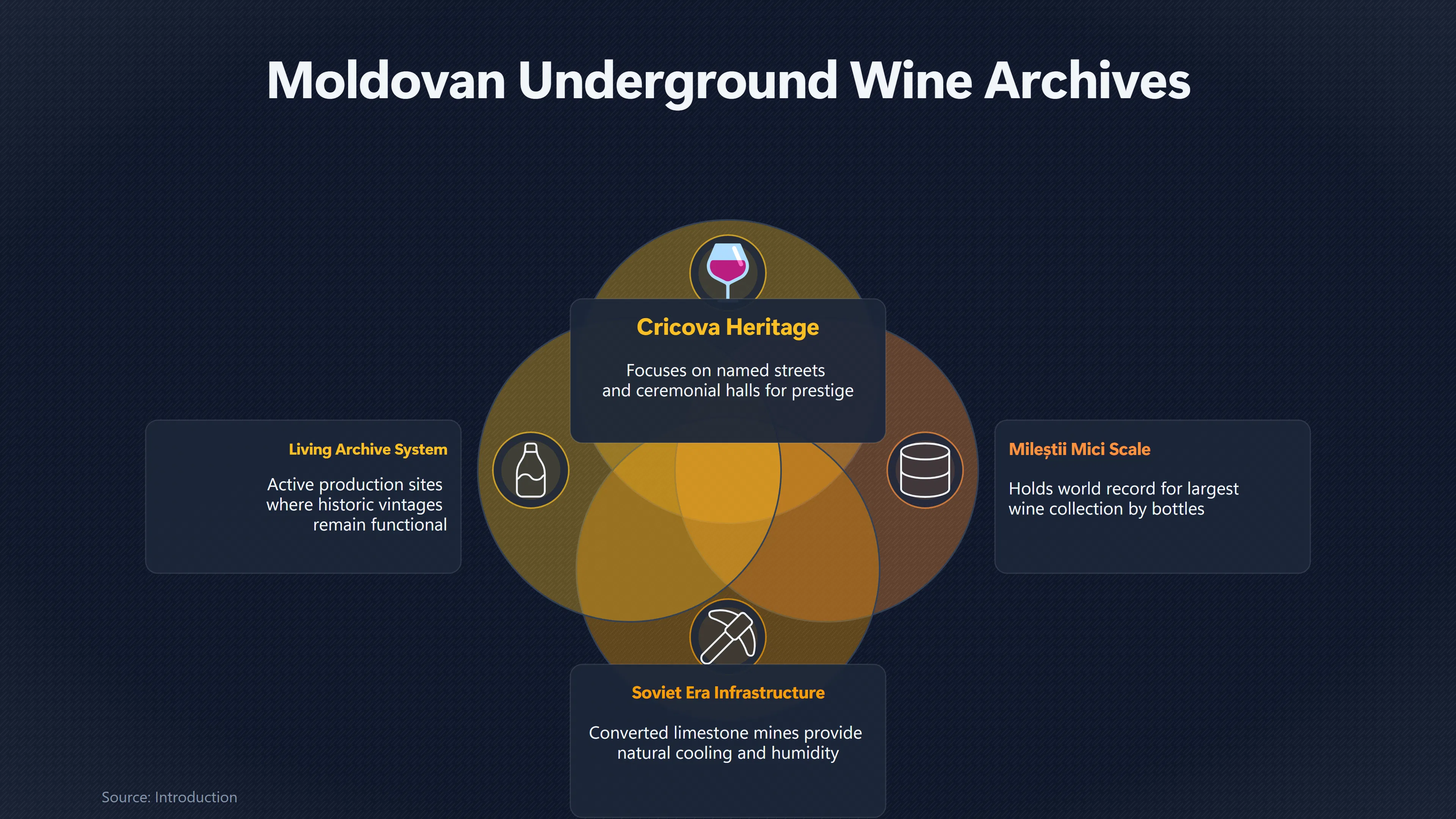
The underground wineries at Cricova and Mileștii Mici are often promoted through dramatic statistics—hundreds of kilometres of tunnels and millions of bottles—but their cultural importance extends beyond record-breaking marketing. Both sites occupy former limestone mines that were converted during the Soviet period into ideal storage environments, where naturally cool temperatures and high humidity preserve wine over decades. Rather than static museum displays, these are working repositories where historic vintages remain part of an active production system.[UNESCO World Heritage Centre]whc.unesco.orgUNESCO World Heritage CentreThe Underground Wineries of Moldova (Cricova and Mileștii Mici) - UNESCO World Heritage CentreJanuary 3, 2025…
Calling these collections “archives” is more than a metaphor. Individual bottles document changing grape varieties, production methods, political eras and international trade. Wines produced under Soviet planning sit alongside modern vintages intended for global export, allowing visitors to see how Moldova’s wine industry evolved from a centrally planned economy into an internationally marketed cultural asset. UNESCO’s Tentative List nomination explicitly presents the underground galleries as industrial heritage transformed into cultural heritage rather than simply commercial wineries.[UNESCO World Heritage Centre]whc.unesco.orgUNESCO World Heritage CentreThe Underground Wineries of Moldova (Cricova and Mileștii Mici) - UNESCO World Heritage CentreJanuary 3, 2025…
Unlike conventional museums, these collections are not separated from their original function. New bottles are continually added, older vintages remain under controlled preservation, and guided tours move through spaces that are simultaneously archive, warehouse, production facility and tourist attraction.
Cricova and Mileștii Mici as Living Archives
Although frequently mentioned together, the two underground complexes present different interpretations of Moldova’s wine heritage.
Cricova emphasises heritage presentation. Visitors travel through named underground “streets”, ceremonial halls and carefully staged spaces where the wine collection is woven into stories about national prestige, diplomatic gifts and historic vintages. The collection itself dates from the 1950s and includes bottles from numerous countries alongside Moldovan production, reinforcing the image of an international wine archive. The complex has also become a venue for festivals, official receptions and cultural events, blurring the line between industrial site and heritage attraction.[UNESCO World Heritage Centre]whc.unesco.orgUNESCO World Heritage CentreThe Underground Wineries of Moldova (Cricova and Mileștii Mici) - UNESCO World Heritage CentreJanuary 3, 2025…
Mileștii Mici projects scale above all else. Its Golden Collection achieved Guinness World Records recognition for the world’s largest wine collection by number of bottles, originally recorded at around 1.5 million bottles stored across 55 kilometres of accessible galleries. Tourism literature increasingly highlights the continuing growth of the collection beyond that figure while stressing that only part of the much larger tunnel network is used for wine storage.[Guinness World Records]guinnessworldrecords.comOpen source on guinnessworldrecords.com.
For visitors interested in curiosity culture rather than wine alone, the attraction lies in the transformation of industrial voids into immense underground landscapes where bottles replace books as historical records. The atmosphere owes as much to abandoned mining infrastructure and Cold War engineering as it does to viticulture.
Private Collecting and the Giant Bottle Museum
Commercial curiosity tourism in Moldova is not confined to underground tunnels. One of the country’s most eccentric attractions is the Bottle Museum created by collector Andrei Cojocaru near Hîncești, immediately recognisable because the museum itself is constructed in the shape of an enormous bottle.
Its collection extends far beyond Moldovan wine, bringing together thousands of bottles from many countries and historical periods. Unlike Cricova or Mileștii Mici, where bottles primarily remain valuable because of their contents, the Bottle Museum treats containers themselves as historical artefacts, exploring changing designs, manufacturing techniques and cultural symbolism.
This private initiative illustrates an important feature of Moldova’s curiosity landscape. Many memorable attractions emerge from personal enthusiasm and tourism entrepreneurship rather than state museum systems. Interpretation is therefore often informal and highly individual, reflecting the collector’s interests instead of academic curatorial practice. That makes such sites engaging but also means visitors should distinguish between documented historical interpretation and anecdotal storytelling.
Spectacle, Branding and the Business of Curiosity
The success of Moldova’s underground wineries depends partly on presenting working infrastructure as an extraordinary experience. Visitors do not simply observe storage rooms; they enter an “underground city”, travel through tunnels named after grape varieties and encounter tasting halls designed to feel ceremonial rather than industrial.[UNESCO World Heritage Centre]whc.unesco.orgUNESCO World Heritage CentreThe Underground Wineries of Moldova (Cricova and Mileștii Mici) - UNESCO World Heritage CentreJanuary 3, 2025…
This approach reflects a broader trend in industrial heritage tourism. Infrastructure becomes attractive once its practical function is combined with narrative, architecture and carefully managed visitor experience. The wine itself remains central, yet many tourists remember the tunnels, underground streets and sheer scale more vividly than individual tastings.
The strategy has proved remarkably successful. Cricova and Mileștii Mici are consistently promoted as flagship national attractions, drawing tens of thousands of international visitors each year and helping reshape Moldova’s international image around wine culture rather than post-Soviet stereotypes.[Moldova Travel]moldova.travelTravel Arhivă Routes of lifeArhivă Routes of life - Page 40 of 46 - Moldova Travel…
At the same time, commercial presentation inevitably simplifies history. Tours focus on memorable stories, famous visitors and record-breaking collections, while the more complex economic history of Soviet industrial planning or post-independence restructuring usually receives less attention.
Transnistria’s Museums and the Politics of Heritage
Curiosity tourism becomes considerably more complicated in Transnistria. Museums in cities such as Tiraspol and Bender preserve genuine historical objects—including military equipment, Soviet memorabilia and regional archives—but they operate within institutions established by the self-proclaimed Transnistrian authorities rather than the internationally recognised Moldovan state.
For visitors, this creates two overlapping realities.
The first concerns interpretation. Exhibitions commonly present Soviet history, regional identity and the 1992 conflict from perspectives that differ significantly from those found in Moldovan national institutions. Displays therefore function not only as collections but also as expressions of contemporary political identity.
The second concerns practical travel. The UK Foreign, Commonwealth & Development Office advises against all travel to Transnistria because the region lies outside Moldovan government control, borders Ukraine and offers extremely limited consular assistance. Anyone considering visits to museums or Soviet heritage sites there should treat official travel advice as an essential part of trip planning rather than an afterthought.[UNESCO World Heritage Centre]whc.unesco.orgUNESCO World Heritage CentreThe Underground Wineries of Moldova (Cricova and Mileștii Mici) - UNESCO World Heritage CentreJanuary 3, 2025…
This does not mean the collections lack historical value. Instead, they require visitors to approach interpretation critically, recognising that museums can preserve authentic artefacts while presenting contested historical narratives.
Reading Moldova’s Curiosity Tourism Critically
Moldova’s underground collections reward visitors who look beyond spectacle. The tunnels at Cricova and Mileștii Mici genuinely preserve remarkable industrial heritage and historically significant wine collections, yet they are also carefully branded tourism experiences designed to promote the country’s international image.
Similarly, private museums demonstrate how personal collecting can enrich public culture without necessarily following academic museum standards. Meanwhile, heritage sites in Transnistria remind visitors that museums are never entirely neutral spaces, especially where questions of sovereignty, identity and historical memory remain unresolved.
Taken together, these attractions reveal an unusual national pattern. Moldova’s most memorable curiosity destinations are not defined by bizarre artefacts or sensational legends, but by places where archives remain alive, commercial tourism shapes historical storytelling, and politics influences how collections are understood.
Amazon book picks
Further Reading
Books and field guides related to When Collections Become Spectacle, Business and Politics. Use these as the next step if you want deeper reading beyond the article.

The Oxford companion to wine
First published 1994. Subjects: Wine and wine making, Long Now Manual for Civilization, Wine and wine making, dictionaries.
The Museum Experience
As the first book to take a "visitor's eye view" of the museum visit, The Museum Experience revolutionized the way museum professionals u...
eBay marketplace picks
Marketplace Samples
Live-tested eBay searches with available results related to this page.
Selected fromvintage winery decor oneBay.co.uk.


Endnotes
1.
Source: whc.unesco.org
Link:https://whc.unesco.org/en/tentativelists/6789/
Source snippet
UNESCO World Heritage CentreThe Underground Wineries of Moldova (Cricova and Mileștii Mici) - UNESCO World Heritage CentreJanuary 3, 2025...
Published: January 3, 2025
2.
Source: moldova.travel
Title: Travel Top Moldovan Winery Experiences: Plan Your Wine Tasting Holiday
Link:https://moldova.travel/en/wine-holidays/
Source snippet
Top Moldovan Winery Experiences: Plan Your Wine Tasting Holiday - Moldova Travel...
3.
Source: moldova.travel
Title: Travel Arhivă Routes of life
Link:https://moldova.travel/en/rutele-vietii/page/40/
Source snippet
Arhivă Routes of life - Page 40 of 46 - Moldova Travel...
4.
Source: whc.unesco.org
Link:https://whc.unesco.org/fr/listesindicatives/6789/
Source snippet
Underground Wineries of Moldova (Cricova and Mileștii Mici) - UNESCO Centre du patrimoine mondialJanuary 3, 2025 — THE UNDERGROUND WINERI...
Published: January 3, 2025
5.
Source: cricova.md
Link:https://cricova.md/en/beciurile
6.
Source: travel.md
Link:https://www.travel.md/what-to-see/wineries-wine-cellars/cricova-winery/
7.
Source: guinnessworldrecords.com
Link:https://www.guinnessworldrecords.com/world-records/largest-wine-cellar-by-number-of-bottles
8.
Source: guinnessworldrecords.de
Link:https://www.guinnessworldrecords.de/world-records/largest-wine-cellar-by-number-of-bottles
9.
Source: guinnessworldrecords.es
Link:https://www.guinnessworldrecords.es/world-records/largest-wine-cellar-by-number-of-bottles
Additional References
10.
Source: czasopisma.ujd.edu.pl
Link:https://czasopisma.ujd.edu.pl/index.php/sport/article/view/1102
Source snippet
Jana Długosza University JournalsCricova – The National and International Tourist Brand of The Republic of Moldova | Sport and Tourism Ce...
11.
Source: youtube.com
Title: Moldova: The Hidden Piece | The History Of Cricova | Winery Tour
Link:https://www.youtube.com/watch?v=YUDy9Z_XkyQ
Source snippet
World's largest wine cellar Milestii Mici, Moldova...
12.
Source: youtube.com
Title: The Biggest Wine Cellar in the World: Milestii Mici Winery
Link:https://www.youtube.com/watch?v=PwCv7if2apQ
Source snippet
Inside Transnistria: The Country That Doesn't Exist...
13.
Source: youtube.com
Title: Inside Transnistria: The Country That Doesn’t Exist
Link:https://www.youtube.com/watch?v=ZspODpBH8WQ
Source snippet
Don't go to this Abandoned Soviet School in a Conflict Zone...
14.
Source: youtube.com
Title: World’s largest wine cellar Milestii Mici, Moldova
Link:https://www.youtube.com/watch?v=sSB27iewY7A
Source snippet
The Biggest Wine Cellar in the World: Milestii Mici Winery...
15.
Source: visit.chisinau.md
Link:https://visit.chisinau.md/en/imprejurimi/
16.
Source: nationalgeographic.com
Link:https://www.nationalgeographic.com/travel/article/worlds-largest-wine-cellar
17.
Source: youtube.com
Title: Don’t go to this Abandoned Soviet School in a Conflict Zone
Link:https://www.youtube.com/watch?v=DrgvyaNPCJM