Within Strange Ghana
How Ussher Fort Became a Prison Again and Again
Ussher Fort shows how one coastal stronghold repeatedly served systems of trade, detention, punishment and displacement.
On this page
- From European trading fort to slave trade site
- Military detention, courts and twentieth century imprisonment
- Reading cells and courtyards through guided interpretation
Page outline Jump by section
Introduction
Ussher Fort in Accra is unusual because it never belonged to just one chapter of history. Unlike sites remembered solely as slave forts or military outposts, Ussher Fort was repeatedly adapted to new systems of confinement. Built as a European trading post, it became part of the Atlantic slave trade, later functioned as a colonial prison, military detention centre, police facility and court-martial unit, and even served humanitarian purposes as a refugee shelter before becoming a museum. That succession of roles makes it one of Ghana’s clearest examples of how the same physical spaces were repeatedly reused to control, imprison and displace people across more than three centuries.[unesco.org]whc.unesco.orgUNESCO World Heritage CentreGhana inaugurates the rehabilitated Ussher Fort Slave Museum and Documentary Centre - UNESCO World Heritage C…
Today the fort forms part of the UNESCO-listed network of Ghana’s coastal forts and castles. Rather than presenting slavery as an isolated historical episode, guided interpretation encourages visitors to recognise how systems of detention evolved over time while continuing to occupy the same courtyards, cells and walls. This layered history distinguishes Ussher Fort from many other heritage sites along Ghana’s coast.[UNESCO World Heritage Centre]whc.unesco.orgUNESCO World Heritage CentreForts and Castles, Volta, Greater Accra, Central and Western Regions - UNESCO World Heritage Centre…
From European trading fort to slave-trade site
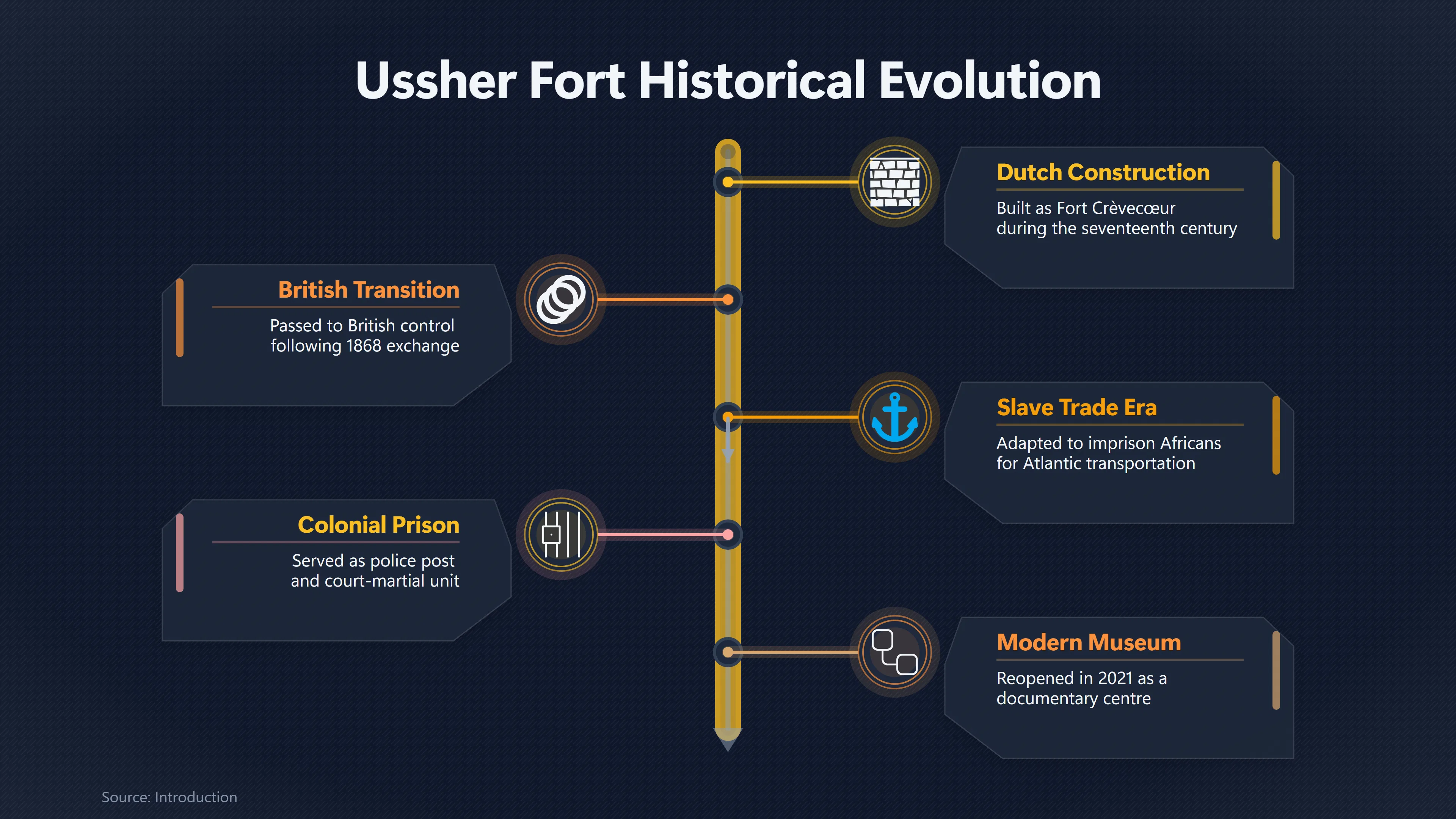
Originally constructed by the Dutch as Fort Crèvecœur during the seventeenth century, the fort occupied a strategic position on the coast of what is now Accra. Following the Anglo-Dutch exchange of forts in 1868, it passed to British control, was partly rebuilt after earthquake damage and renamed Ussher Fort after the British administrator Herbert Ussher.[Ghana Mining and Minerals Board]gmmb.gov.ghOpen source on gmmb.gov.gh.
Although the fort initially supported commerce in commodities such as gold, its purpose shifted as the transatlantic slave trade expanded. Like many coastal forts in the region, it became one link in a wider trading network that imprisoned Africans before forced transportation across the Atlantic. The architecture itself reflects this change: storage areas, enclosed courtyards and secure rooms were adapted to hold people awaiting shipment rather than ordinary merchandise. UNESCO identifies Ussher Fort as one of the coastal fortifications that illustrate the transformation of European trading posts into infrastructure supporting the Atlantic slave trade.[UNESCO World Heritage Centre]whc.unesco.orgUNESCO World Heritage CentreForts and Castles, Volta, Greater Accra, Central and Western Regions - UNESCO World Heritage Centre…
Unlike larger castles such as Cape Coast or Elmina, Ussher Fort is not primarily known for the scale of its slave dungeons. Its importance lies in demonstrating that slavery relied upon a chain of interconnected forts of different sizes rather than only a handful of famous castles. The museum therefore places the fort within the broader commercial system that linked inland capture, coastal imprisonment and overseas transportation.[Ghana Mining and Minerals Board]gmmb.gov.ghussher fort museum 2007Ghana Mining and Minerals BoardUssher Fort Museum (2007) – Ghana Museums and Monuments Board…
Military detention, courts and twentieth-century imprisonment
One of Ussher Fort’s most distinctive characteristics is that imprisonment did not end with the abolition of the Atlantic slave trade. Instead, confinement became one of the fort’s defining functions.
Under British colonial administration the fort operated as a prison and detention facility. It also served as a police post, military detention centre and court-martial unit. These successive uses demonstrate how colonial authorities reused existing fortified buildings rather than abandoning them once the slave trade declined. The spaces originally associated with commercial and slave-trading activities instead became part of the machinery of colonial law, punishment and political control.[UNESCO World Heritage Centre]whc.unesco.orgUNESCO World Heritage CentreGhana inaugurates the rehabilitated Ussher Fort Slave Museum and Documentary Centre - UNESCO World Heritage C…
Among the best-known prisoners was Kwame Nkrumah, later Ghana’s first president, who was imprisoned there during the colonial period because of his political activities in the independence movement. His imprisonment adds another historical layer: the same fort that had once confined enslaved Africans later confined one of the leading figures in Ghana’s struggle against colonial rule.[Ghana Mining and Minerals Board]gmmb.gov.ghOpen source on gmmb.gov.gh.
The prison function continued remarkably late. Ussher Fort remained an operational prison until 1993, long after many comparable colonial facilities had ceased serving that purpose. This extended use reinforces the idea that the site’s history is not divided neatly into separate eras of trade, slavery and heritage, but instead represents a continuous story of changing forms of incarceration.[Ghana Mining and Minerals Board]gmmb.gov.ghOpen source on gmmb.gov.gh.
The fort’s later history is equally revealing. In 2005 parts of the complex were temporarily used as accommodation for refugees from conflicts in Liberia and South Sudan. Although very different from earlier forms of confinement, this episode again transformed the fort into a place associated with displacement and vulnerable populations.[UNESCO]unesco.orgDirector-General of UNESCO tours World Heritage Site in GhanaDirector-General of UNESCO tours World Heritage Site in Ghana…
Reading cells and courtyards through guided interpretation
Visitors today encounter Ussher Fort as both a historic structure and a museum. The museum first opened in 2007 through collaboration between Ghana’s Ministry of Tourism, UNESCO and European partners, and after conservation work it reopened in 2021 as the rehabilitated Ussher Fort Slave Museum and Documentary Centre. Restoration focused not simply on preserving masonry but on improving interpretation of the site’s complex history.[gmmb.gov.gh]gmmb.gov.ghussher fort museum 2007Ghana Mining and Minerals BoardUssher Fort Museum (2007) – Ghana Museums and Monuments Board…
Rather than relying solely on surviving architecture, the exhibitions combine physical spaces with interpretive displays. Collections include shackles, weapons, domestic objects, models illustrating slave ships and European forts, wall paintings explaining the development of the slave trade, and displays introducing major abolitionists including Harriet Tubman, Sojourner Truth and William Wilberforce. These objects are intended to explain processes rather than to create a cabinet of curiosities.[Ghana Mining and Minerals Board]gmmb.gov.ghussher fort museum 2007Ghana Mining and Minerals BoardUssher Fort Museum (2007) – Ghana Museums and Monuments Board…
Guided tours encourage visitors to move through the fort chronologically. Cells, passageways and courtyards are interpreted according to their changing functions across different historical periods. A room associated with slave confinement may also be discussed as a later prison cell or detention space, making visitors aware that architecture can outlive the political systems that first created it. This emphasis on continuity distinguishes Ussher Fort from museums that focus almost exclusively on the Atlantic slave trade.[Ghana Mining and Minerals Board]gmmb.gov.ghGhana Mining and Minerals Board Museums – Ghana Museums and Monuments BoardGhana Mining and Minerals Board Museums – Ghana Museums and Monuments Board
Why Ussher Fort matters in Ghana’s unusual heritage
Within Ghana’s landscape of unusual historic sites, Ussher Fort stands apart because its significance lies less in rare artefacts than in the repeated reuse of one place for different forms of human confinement. The fort embodies several overlapping histories: European commercial expansion, the Atlantic slave trade, colonial punishment, nationalist resistance, military justice, refugee accommodation and modern public remembrance.[unesco.org]unesco.orgDirector-General of UNESCO tours World Heritage Site in GhanaDirector-General of UNESCO tours World Heritage Site in Ghana…
That layered history also shapes its emotional impact. Visitors are not simply looking at preserved prison cells or slave dungeons in isolation. They are walking through a building where successive generations adapted the same enclosed spaces to enforce changing political and economic systems. In Ghana’s wider network of forts and castles, Ussher Fort therefore offers an especially powerful reminder that the legacy of slavery cannot be understood separately from the longer history of imprisonment, state power and memory that followed it.[UNESCO World Heritage Centre]whc.unesco.orgUNESCO World Heritage CentreGhana inaugurates the rehabilitated Ussher Fort Slave Museum and Documentary Centre - UNESCO World Heritage C…
Amazon book picks
Further Reading
Books and field guides related to How Ussher Fort Became a Prison Again and Again. Use these as the next step if you want deeper reading beyond the article.
The Slave Ship: A Human History
The slave ship was the instrument of history's greatest forced migration and a key to the origins and growth of global capitalism, yet mu...
A Crime So Monstrous: Face-to-Face with Modern-Day Slavery
Based on four years of research in over a dozen countries across the globe, journalist Skinner provides a shocking expos of the inner wor...
The Wretched of the Earth
A distinguished psychiatrist from Martinique who took part in the Algerian Nationalist Movement, Frantz Fanon was one of the most importa...
The Door of No Return: The History of Cape Coast Castle and t...
First published 2009. Subjects: Slave trade, great britain, Slavery, history, Slavery, africa.
eBay marketplace picks
Marketplace Samples
Live-tested eBay searches with available results related to this page.
Selected fromhistory wall art oneBay.co.uk.


Endnotes
1.
Source: whc.unesco.org
Link:https://whc.unesco.org/en/news/2300
Source snippet
UNESCO World Heritage CentreGhana inaugurates the rehabilitated Ussher Fort Slave Museum and Documentary Centre - UNESCO World Heritage C...
2.
Source: unesco.org
Title: Director-General of UNESCO tours World Heritage Site in Ghana
Link:https://www.unesco.org/en/articles/director-general-unesco-tours-world-heritage-site-ghana
Source snippet
Director-General of UNESCO tours World Heritage Site in Ghana...
3.
Source: whc.unesco.org
Link:https://whc.unesco.org/en/list/34
Source snippet
UNESCO World Heritage CentreForts and Castles, Volta, Greater Accra, Central and Western Regions - UNESCO World Heritage Centre...
4.
Source: unesco.org
Link:https://www.unesco.org/en/articles/un-ghana-visits-rehabilitated-ussher-fort-slave-museum-and-documentary-centre-accra
Source snippet
UN in Ghana visits the rehabilitated Ussher Fort Slave Museum andJuly 15, 2021 — UN IN GHANA VISITS THE REHABILITATED USSHER FORT SLAVE M...
Published: July 15, 2021
5.
Source: unesco.org
Title: Diplomatic Corps in Ghana visits the rehabilitated Ussher Fort Slave
Link:https://www.unesco.org/en/articles/diplomatic-corps-ghana-visits-rehabilitated-ussher-fort-slave-museum-and-documentary-centre-accra
Source snippet
July 8, 2021 — DIPLOMATIC CORPS IN GHANA VISITS THE REHABILITATED USSHER FORT SLAVE MUSEUM AND DOCUMENTARY CENTRE IN ACCRA 8 July 2021 La...
Published: July 8, 2021
7.
Source: whc.unesco.org
Link:https://whc.unesco.org/en/decisions/8548
8.
Source: gmmb.gov.gh
Title: ussher fort museum 2007
Link:https://gmmb.gov.gh/ussher-fort-museum-2007/
Source snippet
Ghana Mining and Minerals BoardUssher Fort Museum (2007) – Ghana Museums and Monuments Board...
9.
Source: gmmb.gov.gh
Link:https://gmmb.gov.gh/ussher-fort-crevecoeur-accra/
10.
Source: gmmb.gov.gh
Title: Ghana Mining and Minerals Board Museums – Ghana Museums and Monuments Board
Link:https://gmmb.gov.gh/museums/
11.
Source: gmmb.gov.gh
Title: fort william anomabu 1753
Link:https://gmmb.gov.gh/fort-william-anomabu-1753/
12.
Source: gmmb.gov.gh
Title: fort batentstein butre 1656
Link:https://gmmb.gov.gh/fort-batentstein-butre-1656/
Additional References
13.
Source: ghana.un.org
Link:https://ghana.un.org/en/131052-unesco-and-partners-rehabilitate-ussher-fort-slave-museum-and-documentary-centre-accra
14.
Source: youtube.com
Title: The Horrors of Cape Coast Castle: Ghana’s “Door of No Return”
Link:https://www.youtube.com/watch?v=8acyVG3hzDM
Source snippet
Ussher Fort Accra history documentary Explore Ussher Fort in Ghana, Africa's MOST FEARSOME Prison? #ghana #westafrica #history Jeeda’s Lens...
15.
Source: youtube.com
Title: Brief history of James Town and Ussher Town with Nii Teiko Tunma, Obonufoitse
Link:https://www.youtube.com/watch?v=tmNk1zy1vuc
Source snippet
Jamestown Accra - The 1st habour in Ghana(documentary)...
16.
Source: youtube.com
Title: Jamestown Accra
Link:https://www.youtube.com/watch?v=Df-Ja8Q8dCk
Source snippet
The Horrors of Cape Coast Castle: Ghana's "Door of No Return"...
17.
Source: youtube.com
Link:https://www.youtube.com/watch?v=URNLGPFj5KQ
Source snippet
Brief history of James Town and Ussher Town with Nii Teiko Tunma, Obonufoitse...
18.
Source: citylifeaccra.com
Link:https://www.citylifeaccra.com/things-to-do-accra-listings/ussher-fort
19.
Source: citylifeaccra.com
Link:https://www.citylifeaccra.com/features-accra/ussher-fort-a-journey-through-ghanas-past
20.
Source: slaveryandremembrance.org
Title: Slavery and Remembrance Ghana Museums and Monuments | Slavery and Remembrance
Link:https://www.slaveryandremembrance.org/partners/partner/?id=P0039
21.
Source: youtube.com
Title: Explore Ussher Fort in Ghana, Africa’s MOST FEARSOME Prison?
Link:https://www.youtube.com/watch?v=BtW1o9f8ris
Source snippet
05-2007 -- Ussher Fort Documentary...
22.
Source: ghanamuseums.wordpress.com
Link:https://ghanamuseums.wordpress.com/museums-introduction/