Within Strange Egypt
How Mummification Joined Craft, Faith and Magic
Embalming equipment, amulets and funerary objects show that preserving the dead was both a practical craft and a religious process.
On this page
- The tools and substances used by embalmers
- Amulets, spells and protection of the body
- What visitors see in Luxor's Mummification Museum
Page outline Jump by section
Introduction
Ancient Egyptian mummification was never simply a method of preserving a body. It combined skilled practical work with religious ritual and protective magic, reflecting the belief that physical preservation was essential for a successful existence after death. Every stage of embalming—from drying the body with mineral salts to wrapping it in linen and placing amulets beneath the bandages—was intended to protect the deceased both physically and spiritually. This combination of craft, faith and ritual is brought together particularly clearly in Luxor’s Mummification Museum, where embalming equipment, funerary objects and protective charms are displayed as parts of a single religious process rather than separate archaeological curiosities.[Egyptian Monuments]egymonuments.gov.egEgyptian Monuments Mummification MuseumEgyptian MonumentsMummification Museum - Discover Egypt's Monuments - Ministry of Tourism and Antiquities…

The tools and substances used by embalmers
The ancient Egyptian embalmer worked with a carefully developed set of specialised tools and materials. While methods varied over nearly three thousand years, the overall aim remained remarkably consistent: preserve the body so that the individual’s identity could survive into the afterlife.
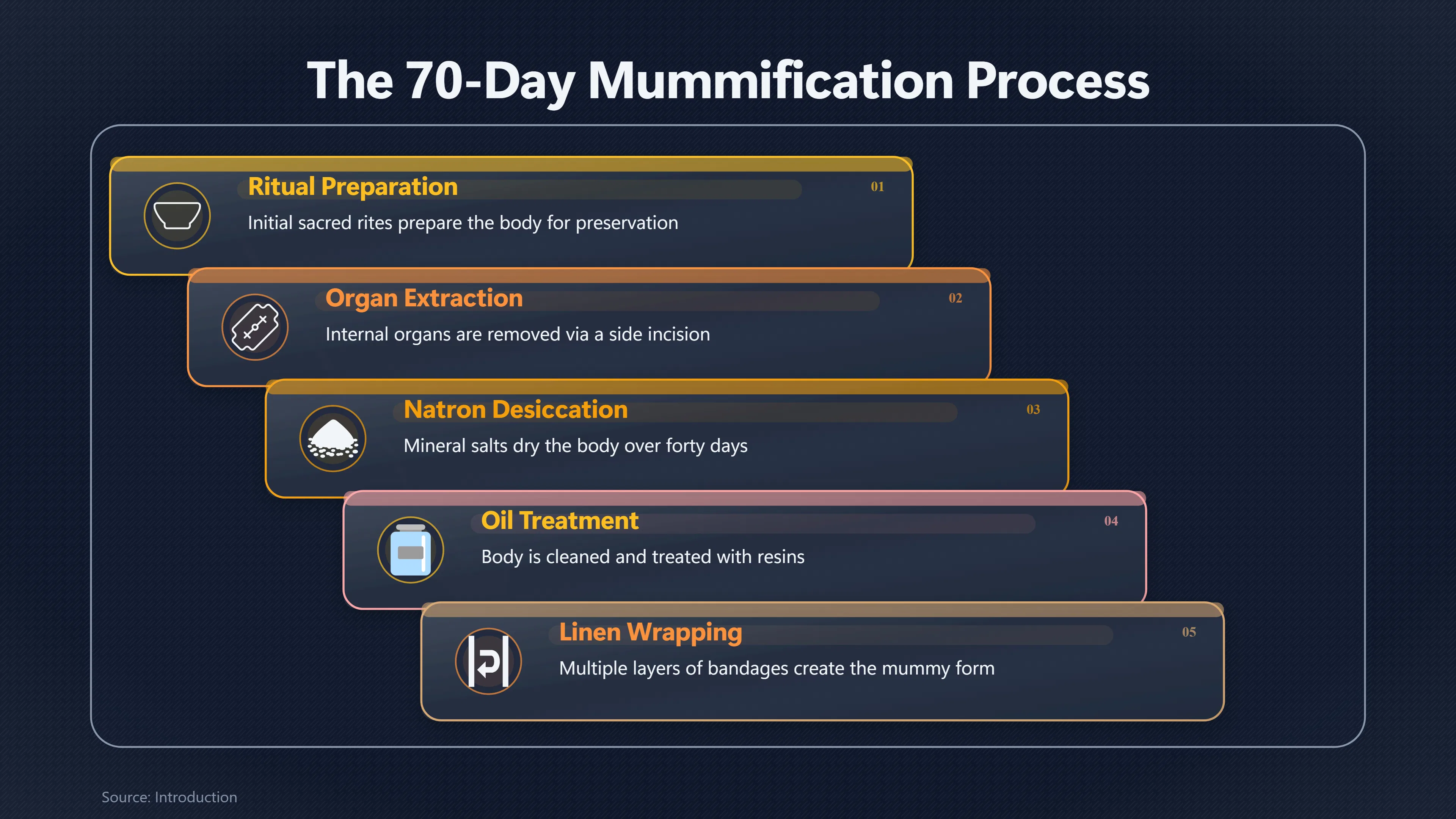
The process generally took around seventy days. After ritual preparation, internal organs—apart from the heart in most periods—were removed through a small incision in the body’s left side. These organs were preserved separately in canopic jars, while the brain was extracted through the nose using specialised hooks. The body was then packed and covered with natron, a naturally occurring mixture of mineral salts from the Wadi El Natrun region, which removed moisture over approximately forty days before the body was cleaned, treated with oils and resins, and wrapped in many layers of linen.[Egyptian Monuments]egymonuments.gov.egEgyptian Monuments Mummification MuseumEgyptian MonumentsMummification Museum - Discover Egypt's Monuments - Ministry of Tourism and Antiquities…
Visitors to Luxor’s Mummification Museum encounter many of the objects that made this work possible, including:
- Bronze and metal hooks associated with removing the brain.
- Stone or metal knives used for the carefully controlled incision.
- Natron, the drying agent that prevented decomposition.
- Oils, perfumes and tree resins applied both for preservation and ritual purification.
- Linen bandages used to build the familiar wrapped form of the mummy.
- Canopic jars designed to protect the preserved internal organs.
- Measuring vessels and embalming equipment associated with preparing the body.[egymonuments.gov.eg]egymonuments.gov.egEgyptian Monuments Mummification MuseumEgyptian MonumentsMummification Museum - Discover Egypt's Monuments - Ministry of Tourism and Antiquities…
These were not simply practical instruments. Ancient Egyptian religion regarded successful embalming as an act of restoration that echoed the mythical reconstruction of the god Osiris. Embalmers therefore worked within a sacred framework rather than as technicians alone, with the jackal-headed god Anubis serving as the divine patron of the process.[Egyptian Monuments]egymonuments.gov.egEgyptian Monuments Mummification MuseumEgyptian MonumentsMummification Museum - Discover Egypt's Monuments - Ministry of Tourism and Antiquities…
Amulets, spells and protection of the body
For ancient Egyptians, preserving flesh was only one part of surviving death. The body also required magical protection against dangers believed to exist on the journey into the next world.
This protection came through a carefully arranged combination of amulets, written spells and ritual performance. Small objects made from faience, precious stones, gold or semi-precious minerals were inserted between the layers of linen wrapping at specific points on the body. Their placement was deliberate rather than decorative, with different amulets intended to safeguard different parts of the deceased or provide particular forms of divine assistance.[Egyptian Monuments]egymonuments.gov.egEgyptian Monuments Mummification MuseumEgyptian MonumentsMummification Museum - Discover Egypt's Monuments - Ministry of Tourism and Antiquities…
The written component of this protection is often known today as the Book of the Dead. Rather than being a single fixed book, it was a collection of spells selected according to a family’s wealth, preferences and beliefs. Wealthier burials might include long illustrated papyrus scrolls, while shorter versions or selected texts appeared on mummy wrappings, coffins or tomb walls. These spells acted as practical instructions for navigating the afterlife, identifying dangerous beings, passing guarded gateways and ensuring the deceased retained essential parts of their identity such as the heart, name and physical form.[British Museum]britishmuseum.orgBritish Museum What is a Book of the Dead? | British MuseumBritish MuseumWhat is a Book of the Dead? | British MuseumSeptember 22, 2010…
Modern popular culture often presents Egyptian funerary magic as mysterious curses. Archaeological evidence paints a different picture. Most protective texts were defensive rather than aggressive. They sought to preserve the deceased, maintain bodily integrity, provide food and air in the next world, and help the individual pass divine judgement successfully rather than inflict harm upon the living.[British Museum]britishmuseum.orgBritish Museum What is a Book of the Dead? | British MuseumBritish MuseumWhat is a Book of the Dead? | British MuseumSeptember 22, 2010…
The close relationship between wrapping and magic also explains why so many surviving mummies contain hidden amulets discovered only through modern X-rays and CT scanning. These technologies have shown that objects concealed beneath the linen were carefully positioned during embalming as integral parts of the funerary ritual rather than later additions.[British Museum]britishmuseum.orgBritish Museum Egyptian death and afterlife: mummies | British MuseumBritish Museum Egyptian death and afterlife: mummies | British Museum

What visitors see in Luxor’s Mummification Museum
Unlike larger Egyptian museums that present mummies as one attraction among many, Luxor’s Mummification Museum is organised around a single question: how and why did ancient Egyptians preserve the dead?
The museum therefore combines practical equipment with religious objects instead of separating them into different displays. Visitors move through exhibits showing embalming tools, canopic jars, linen wrappings, protective amulets, funerary statues, ritual equipment and preserved human and animal mummies. Together these explain that mummification was understood as a complete religious system rather than merely an anatomical procedure.[Egyptian Monuments]egymonuments.gov.egEgyptian Monuments Mummification MuseumEgyptian MonumentsMummification Museum - Discover Egypt's Monuments - Ministry of Tourism and Antiquities…
Among its most striking exhibits are:
- Embalming implements associated with preparing the body.
- Collections of protective amulets illustrating the magical dimension of wrapping.
- Canopic jars that demonstrate how organs were preserved separately.
- Human mummies that reveal different standards of preservation.
- Animal mummies showing that embalming extended beyond humans to creatures associated with particular deities.
- Displays explaining the religious role of Anubis and the symbolism surrounding funerary preparation.[egymonuments.gov.eg]egymonuments.gov.egEgyptian Monuments Mummification MuseumEgyptian MonumentsMummification Museum - Discover Egypt's Monuments - Ministry of Tourism and Antiquities…
The museum’s relatively compact size encourages visitors to focus on relationships between objects rather than simply admiring individual artefacts. A bronze tool, a fragment of linen and a small amulet each become meaningful only when understood as parts of a ritual intended to transform death into continued existence.
Why mummification remains one of Egypt’s most unusual heritage traditions
Within Egypt’s landscape of unusual museums and archaeological collections, mummification stands apart because it unites science, religion and material culture in ways that are difficult to separate. The same exhibit can be interpreted simultaneously as evidence of medical knowledge, skilled craftsmanship, sacred ritual and deeply held beliefs about life after death.
Luxor’s Mummification Museum captures this intersection particularly well. Rather than presenting embalming as an exotic or gruesome practice, it demonstrates that every knife, jar, linen bandage and protective amulet formed part of a coherent worldview in which preserving the body was inseparable from preserving the person. That perspective helps explain why mummification remains one of the most distinctive—and most frequently misunderstood—elements of Egypt’s extraordinary archaeological heritage.[egymonuments.gov.eg]egymonuments.gov.egEgyptian Monuments Mummification MuseumEgyptian MonumentsMummification Museum - Discover Egypt's Monuments - Ministry of Tourism and Antiquities…
Amazon book picks
Further Reading
Books and field guides related to How Mummification Joined Craft, Faith and Magic. Use these as the next step if you want deeper reading beyond the article.
Mummies, magic and medicine in ancient Egypt
This volume, published in honour of Egyptologist Professor Rosalie David OBE, presents the latest research on three of the most important...
The Rise and Fall of Ancient Egypt
NEW YORK TIMES BESTSELLER • “Magisterial . . . [A] rich portrait of ancient Egypt’s complex evolution over the course of three millennium...
The British Museum Book of Ancient Egypt
"This thoughtful and highly readable book covers every aspect of Egyptian culture, from early prehistory, through the three millenia of p...
eBay marketplace picks
Marketplace Samples
Live-tested eBay searches with available results related to this page.
Selected fromEgyptian decor oneBay.co.uk.
Endnotes
1.
Source: egymonuments.gov.eg
Title: Egyptian Monuments Mummification Museum
Link:https://egymonuments.gov.eg/museums/mummification-museum/
Source snippet
Egyptian MonumentsMummification Museum - Discover Egypt's Monuments - Ministry of Tourism and Antiquities...
2.
Source: sis.gov.eg
Title: SISThe Mummification Museum
Link:https://sis.gov.eg/en/egypt/tourism/cultural-tourism/museums/the-mummification-museum/
3.
Source: britishmuseum.org
Title: British Museum Egyptian death and afterlife: mummies | British Museum
Link:https://www.britishmuseum.org/collection/galleries/egyptian-death-and-afterlife-mummies
4.
Source: britishmuseum.org
Title: British Museum What is a Book of the Dead? | British Museum
Link:https://www.britishmuseum.org/blog/what-book-dead
Source snippet
British MuseumWhat is a Book of the Dead? | British MuseumSeptember 22, 2010...
Published: September 22, 2010
5.
Source: britishmuseum.org
Title: British Museummummy-wrapping | British Museum
Link:https://www.britishmuseum.org/collection/object/Y_EA10265
6.
Source: sis.gov.eg
Title: It is located on th
Link:https://sis.gov.eg/en/egypt/tourism/cultural-tourism/museums/luxor-museum-1/
Source snippet
Luxor museumNovember 6, 2023 — Image: Luxor museum LUXOR MUSEUM 06 November, 2023 21 March, 2024 Location On Map Luxor Museum is one of t...
Published: November 6, 2023
7.
Source: GOV.UK
Title: www.gov.uk Journey through the afterlife
Link:https://www.gov.uk/government/news/journey-through-the-afterlife
8.
Source: britishmuseumshoponline.org
Title: Egyptian Book of the Dead
Link:https://www.britishmuseumshoponline.org/the-egyptian-book-of-the-dead-pocket-edition.html
9.
Source: monumentsstg.linkdev.com
Title: mummification museum
Link:https://monumentsstg.linkdev.com/en/museums/mummification-museum
10.
Source: visitegypt.com
Link:https://visitegypt.com/location/mummification-museum/
11.
Source: egymonuments.gov.eg
Title: 28th anniversary of the opening of the Mummification Museum
Link:https://egymonuments.gov.eg/en/news/28th-anniversary-of-the-opening-of-the-mummification-museum/
Additional References
12.
Source: book-of-the-dead.fitzmuseum.cam.ac.uk
Link:https://book-of-the-dead.fitzmuseum.cam.ac.uk/explore/book-of-the-dead/funerary-literature
Source snippet
funerary literature | Passport to the Egyptian Afterlife: The Book of the Dead of RamoseAugust 15, 2025 — EGYPTIAN FUNERARY LITERATURE TH...
Published: August 15, 2025
13.
Source: egypttoursportal.com
Title: Witness Ancient artifacts in the Luxor Mummification Museum
Link:https://www.egypttoursportal.com/en-gb/blog/egypt-attractions/luxor-attractions/mummification-museum/
Source snippet
March 24, 2025 — LUXOR’S MUMMIFICATION MUSEUM: A DEEP DIVE INTO THE SCIENCE OF IMMORTALITY The Mummification Museum in Luxor, opened in 1...
Published: March 24, 2025
14.
Source: exploreluxor.org
Title: Explore Luxor Mummification Museum: A Guide to the Art of Immortality
Link:https://exploreluxor.org/mummification-museum/
Source snippet
Explore LuxorMummification Museum: A Guide to the Art of Immortality - Explore Luxor...
15.
Source: amberturas.lt
Title: mumifikacijos muziejus luksore
Link:https://amberturas.lt/en/mumifikacijos-muziejus-luksore
Source snippet
November 1, 2023 — MUMMIFICATION MUSEUM IN LUXOR 2023-11-01 Image: Mummification Museum in Luxor The Mummification Museum in Luxor (ancie...
Published: November 1, 2023
16.
Source: globalegyptianmuseum.org
Link:https://www.globalegyptianmuseum.org/glossary.aspx?id=93
17.
Source: globalegyptianmuseum.org
Link:https://www.globalegyptianmuseum.org/glossary.aspx?id=251
18.
Source: book-of-the-dead.fitzmuseum.cam.ac.uk
Link:https://book-of-the-dead.fitzmuseum.cam.ac.uk/explore/book-of-the-dead/
19.
Source: youtube.com
Title: Choosing the right amulet in ancient Egypt
Link:https://www.youtube.com/watch?v=PQtIYb_oVjk
Source snippet
What Amulets Were Placed On Mummies? - Archaeology Quest...
20.
Source: youtube.com
Title: What Did Ancient Egyptians Do After Someone Died
Link:https://www.youtube.com/watch?v=nok07EHWTYc
Source snippet
Choosing the right amulet in ancient Egypt...
21.
Source: youtube.com
Title: Mummification process and rituals
Link:https://www.youtube.com/watch?v=LCaYOwM6rHs
Source snippet
What Did Ancient Egyptians Do After Someone Died...