Where Nepal Keeps Its Strangest Objects
Nepal does not have a large, clearly defined network of “weird museums” devoted to witchcraft, ghosts, cryptids or medical horrors. Its curiosity culture is more dispersed and, arguably, more interesting for that reason.
Page outline Jump by section
Introduction
The strongest examples range from malformed animal specimens in Kathmandu and an alleged yeti scalp in a Himalayan monastery to a passenger aircraft converted into a walk-in museum. Elsewhere, leather artillery, ritual implements, royal regalia and the physical setting of a modern palace tragedy acquire an uncanny force through history rather than theatrical presentation. Nepal’s strange collections therefore sit at the meeting point of science, devotion, folklore, national memory and tourism. Visitors should expect uneven interpretation and sometimes uncertain access, but also objects whose meanings cannot be reduced to a simple label of “real” or “fake”.
Where Nepal’s strangest specimens are kept
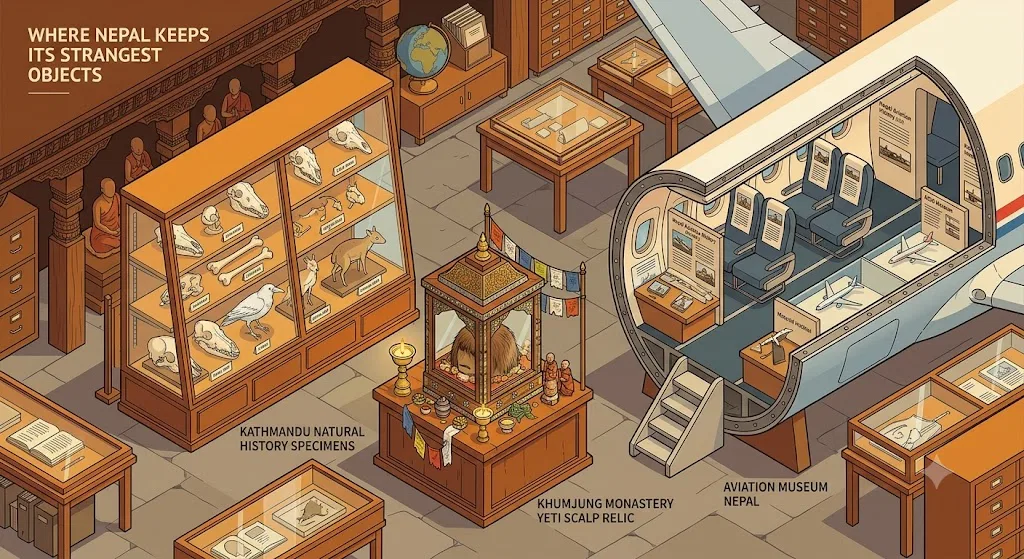
Kathmandu’s Natural History Museum is the country’s clearest equivalent to a traditional museum of biological oddities. Operated under Tribhuvan University, it maintains permanent displays drawn from zoological, botanical, geological and palaeontological collections. Among the most memorable specimens listed by the museum itself are a two-headed snake, an eight-legged female goat kid and a piglet with one head and two bodies. These sit alongside fossils, preserved birds, mammals, insects and examples of species believed to have disappeared from Nepal.[Natural History Museum]nhmnepal.edu.npWe also take part of the exhibits to different places at the request of the governmental or non-governmental organization under the aware…
Such specimens belong to an older style of natural-history display in which preservation, classification and visual impact are closely intertwined. Congenital abnormalities that would now often be discussed through genetics or developmental biology can look like monsters when presented in jars or cases without extensive explanation. Their value is scientific, but their public appeal comes partly from the same impulse that once filled European cabinets of curiosity: the desire to see where familiar forms break down.
The museum is therefore unusual without being a deliberate freak show. Its official framing stresses research, conservation and public awareness, and the abnormal specimens form only a small part of a much wider record of Nepal’s biodiversity. That distinction matters. They are documented biological material, not fabricated creatures, even when their appearance invites folklore-minded interpretation.[Natural History Museum]nhmnepal.edu.npWe also take part of the exhibits to different places at the request of the governmental or non-governmental organization under the aware…
The collection also preserves creatures that have become strange through absence. The museum identifies its white crow and mouse deer specimens as examples probably extinct within Nepal. A preserved animal may consequently function as evidence of a lost local environment as well as an arresting object in a case.[Natural History Museum]nhmnepal.edu.npWe also take part of the exhibits to different places at the request of the governmental or non-governmental organization under the aware…
The alleged yeti scalp at Khumjung
Nepal’s most famous cryptid-related display is not held in a conventional museum. It is kept at Khumjung Monastery in the Everest region, where visitors may see a dome-shaped, hair-covered object traditionally described as a yeti scalp. The setting is important: this is a religious institution holding a community relic, not a cryptozoology attraction built to prove that an unknown ape inhabits the Himalayas. Accounts describe the object as being shown in the monastery’s prayer hall, commonly in return for a donation.[ECS NEPAL]ecs.com.npECS NEPALCracking the Yeti Myth | Features | ECSNEPALNowadays, the name of yeti, sometimes accompanied by a contrived image, is used to promote everything from mountain bikes to restaurants…
The scalp entered international popular culture during the twentieth-century hunt for the “abominable snowman”. In 1960, Edmund Hillary and journalist Desmond Doig were permitted to take it abroad for examination, subject to conditions that included a monastery representative accompanying it and donations being made locally. Contemporary reporting recorded its arrival in London as an object believed by Khumjung villagers to come from a yeti.[The Guardian]theguardian.comEventually we took it under three conditions: that we gave a donation to the village monastery; that one of the headmen came with us; an…
Scientific examination did not validate it as the remains of an unknown primate. Published discussion of tests and microscopic study has generally linked its hair and hide to a known Himalayan hoofed animal, most commonly the serow. Later summaries of the evidence treat the object as animal material shaped into a scalp-like form rather than zoological proof of the yeti.[unexplained-mysteries.com]unexplained-mysteries.comAn alleged Yeti scalp kept at Khumjung monastery in Nepal had intrigued researchers for a time until an analysis of a hair sample reveale…
Calling it simply a “fake”, however, can flatten the object’s more complicated history. It may have originated as a ritual headdress, ceremonial object or intentionally fashioned relic. Its significance to the monastery and local storytelling does not depend on satisfying modern standards for identifying a new species. The display is best understood as a meeting point between Himalayan belief, expedition-era publicity, scientific testing and tourist curiosity.
That mixture has also commercialised the creature. The yeti has become a flexible emblem for hotels, restaurants, shops and other businesses across Nepal, particularly along trekking routes. Khumjung’s object is unusual because it remains embedded in a devotional setting even as it forms part of a much broader tourism mythology.[ECS NEPAL]ecs.com.npECS NEPALCracking the Yeti Myth | Features | ECSNEPALNowadays, the name of yeti, sometimes accompanied by a contrived image, is used to promote everything from mountain bikes to restaurants…
Visitors should approach it as a monastery relic rather than a museum prop. Behaviour suitable for a sacred space is expected, and access arrangements can change locally. The most credible interpretation is not that the case contains a scientifically verified cryptid, but that it preserves one of the most influential physical objects in the modern history of the yeti story.

A crashed airliner turned into a museum
Near Kathmandu’s international airport, the Aviation Museum Nepal offers one of the country’s most literal exercises in turning an extraordinary object into an exhibition space. The museum occupies an Airbus A330 that crash-landed at Tribhuvan International Airport in 2015 after only a short period in service. The aircraft was subsequently converted so that visitors could enter the fuselage rather than merely look at a retired plane from behind a barrier.[Nepal Tourism Board]ntb.gov.npNepal Tourism BoardAviation Museum Kathmandu | Aircraft Museum in KathmanduThe Aircraft Museum, the second of its kind in Nepal, is in Si…
Inside, the museum presents photographs, documents, aircraft models and material relating to Nepal’s aviation history, from the country’s earliest flights to the modern airline era. Its operators also advertise cockpit access, flight simulators and educational displays.[aviationmuseumnepal.com]aviationmuseumnepal.comOpen source on aviationmuseumnepal.com.
What makes it unusual is the relationship between container and collection. A large passenger jet is both the building and the principal artefact. The visitor moves through a machine associated with international travel but permanently grounded by an accident. Although there were no fatalities in the 2015 landing, knowledge of the aircraft’s final flight gives the interior a faintly archaeological quality: a recent technological object preserved after an abrupt end to its working life.
The museum is commercial and visitor-led, but it is not merely a novelty installation. Nepal’s difficult terrain has made aviation unusually important to transport, tourism, emergency access and national connectivity. Displaying that history inside an actual wide-body aircraft gives the subject an immediacy that cabinets of model planes could not achieve.
A smaller aircraft museum was also established in Dhangadhi before the Kathmandu attraction. Together, the projects show how individual enthusiasts and aviation professionals have created museums from retired machines in a country where conventional museum funding and purpose-built exhibition space can be limited.[Nepal Tourism Board]ntb.gov.npNepal Tourism BoardAviation Museum Kathmandu | Aircraft Museum in KathmanduThe Aircraft Museum, the second of its kind in Nepal, is in Si…
Leather cannon, ritual weapons and royal curiosities
The National Museum of Nepal in Chhauni is a broad historical institution, but several of its objects fit naturally into a survey of unusual collections. The most frequently singled out is a Tibetan leather cannon associated with the Nepal–Tibet conflict of 1792. The museum also displays a locally produced machine gun, historic weapons, armour, military costumes and a sword presented by Napoleon III.[Nepal Tourism Board]ntb.gov.npOpen source on ntb.gov.np.
A leather-bodied cannon is arresting because it contradicts the modern assumption that artillery must be cast entirely from heavy metal. It belongs to a history of lightweight or improvised gun construction in which materials such as hide, rope and wood could reinforce a barrel or make weapons easier to transport. In the museum it works both as a military artefact and as a technological curiosity.
The collections also contain religious objects that may look occult to visitors unfamiliar with Himalayan Buddhist traditions. These include ritual daggers, amulets, diagrams of the body and sacred implements associated with protection, meditation and symbolic destruction of spiritual obstacles. Treating them as “black magic” props would be misleading. Their strangeness is largely a product of cultural distance: within their religious setting they possess recognised ceremonial functions rather than serving as evidence of secret supernatural crimes.[Wikipedia]WikipediaNational Museum of NepalNational Museum of Nepal
This is a recurring issue in Nepal’s museums. Masks, fierce deities, ritual blades and objects connected with spirits can be visually unsettling, yet they belong to living Hindu and Buddhist systems of worship. Responsible interpretation distinguishes sacred iconography from modern horror aesthetics.
A royal palace caught between splendour and tragedy
The Narayanhiti Palace Museum in Kathmandu preserves the material world of Nepal’s former monarchy: reception rooms, diplomatic gifts, state furnishings, a gold coach, royal regalia and the jewel-covered crown associated with the Shah dynasty. The palace became a public museum as Nepal moved from monarchy to a federal democratic republic, turning the private architecture of royal authority into state-managed heritage.[Narayanhiti Palace Museum]narayanhitipalacemuseum.comOpen source on narayanhitipalacemuseum.com.
Its collection is unusual partly because the political system it represented ended so recently. The crown and sceptre are not remote archaeological treasures but objects connected to a monarchy abolished in 2008. When the crown was placed on public display in 2018, its jewels and bird-of-paradise plumes made it so difficult to value that earlier insurance discussions had reportedly failed to produce a satisfactory figure.[Nepali Times]nepalitimes.comNepali Times Showcasing the royal crownNepali Times Showcasing the royal crown
The palace also carries the shadow of the royal massacre of 1 June 2001. Tribhuvan Sadan, a residence behind the main complex, was the location of the killings that destroyed much of the immediate royal family. The Nepal Tourism Board explicitly identifies the building as the massacre site, although visitors should not assume that every part of the former crime scene is always open or presented in detail.[Nepal Tourism Board]ntb.gov.npOpen source on ntb.gov.np.
This creates an uneasy combination of palace museum, political memorial and dark-tourism site. Some visitors come for royal luxury; others are drawn by an unresolved sense of national trauma and the conspiracy theories that grew around the killings. The museum’s strongest value is not in encouraging those theories but in allowing the architecture and objects of monarchy to be seen after the institution itself has vanished.
Unlike a purpose-built crime museum, Narayanhiti does not primarily organise the visitor experience around forensic evidence. It presents royal life and state ceremony, with the massacre site forming one charged layer of the larger complex. That restraint can leave questions unanswered, but it also prevents the palace from becoming only a sensational attraction.
An archive of instruments that might otherwise disappear
The Music Museum of Nepal, also known as the Nepali Folk Musical Instrument Museum, is unusual for a quieter reason: it attempts to gather an extraordinary range of instruments from the country’s many communities before their makers and players disappear.
Founder Ram Prasad Kadel registered the institution as a charity in 1997 after beginning the preservation project in the mid-1990s. The museum states that it holds hundreds of distinct types of folk instrument and has expanded into recording, research and the preservation of traditional music and dance.[musicmuseumnepal.org]musicmuseumnepal.orgOpen source on musicmuseumnepal.org.
The collection includes familiar drums, flutes and stringed instruments, but also rare ceremonial devices and very large horns whose forms can seem closer to sculpture than to everyday musical tools. A 2025 account described nearly 1,200 instruments at the museum, including a horn roughly ten feet long. It also emphasised the founder’s concern that knowledge held by elderly musicians was dying without being written down.[Condé Nast Traveler]cntraveler.comOpen source on cntraveler.com.
This is a curiosity collection in the older, constructive sense: a private passion expanded into a public archive. Its objects document how sound is shaped by geography, caste, ritual, craft and local identity. Some instruments are associated with specific ceremonies or communities and cannot be fully understood simply by viewing them in silence.
The museum is therefore less polished than a major national institution but potentially more valuable as a record of endangered knowledge. Its credibility rests not on spectacle but on long-term collecting, fieldwork and collaboration with musicians. The unusualness lies in its density: hundreds of variations on the basic human urge to make rhythm and tone from wood, skin, metal, horn and bamboo.

Archaeological mysteries that are not tourist museums
Upper Mustang’s “sky caves” are frequently promoted as one of Nepal’s great archaeological mysteries. Thousands of human-made cavities puncture the cliffs, and investigations have uncovered burials, partially preserved bodies, manuscripts, paintings, sculptures and domestic material from different periods. The caves were used for more than one purpose over many centuries, and no single explanation accounts for the entire complex.[Wikipedia]WikipediaMustang CavesMustang Caves
They belong in Nepal’s curiosity landscape, but not as an ordinary visitor collection. Many caves are remote, unstable, difficult to enter and archaeologically sensitive. Human remains and fragile materials recovered during research should not be assumed to be on routine public display. The spectacle is primarily the landscape itself: cliff faces transformed into a vast, inaccessible archive.
The remains have encouraged dramatic claims about lost civilisations and secret kingdoms, yet archaeological evidence points towards changing patterns of burial, habitation, religious use and storage. The mystery is real in the limited sense that many questions remain unanswered. It does not require supernatural builders or an invented ancient race.
Ramagrama offers a different kind of unresolved sacred archaeology. The mound is traditionally identified as the only undisturbed original stupa containing relics of the Buddha. Geophysical survey has indicated substantial buried structures, but the central relic deposit has not been excavated. It is therefore a collection defined by deliberate non-display: the object of greatest significance is believed to remain sealed underground.[Wikipedia]WikipediaRamagrama stupaRamagrama stupa
For curiosity-minded travellers, this is an important counterexample to the assumption that valuable remains must be opened, catalogued and exhibited. Religious reverence, archaeological ethics and conservation can all favour leaving a suspected relic deposit intact.
Folklore, witchcraft and the limits of museum treatment
Nepal has abundant traditions concerning dangerous spirits, protective beings, forest shamans, witches, ghosts and the yeti, but there is no well-documented national museum devoted specifically to supernatural folklore. Such beliefs are more often encountered through ritual objects, festivals, masks, oral histories and religious sites than through explanatory galleries.
That absence should not be filled by treating current accusations of witchcraft as quaint heritage. Violence against people branded as witches remains a documented social problem, particularly affecting women in vulnerable or marginalised positions. Medical and human-rights literature describes accusations leading to assault, humiliation, torture and exclusion.[PubMed]pubmed.ncbi.nlm.nih.govOpen source on nih.gov.
A future museum or exhibition on the subject would therefore need to distinguish folklore from persecution. It could examine healing traditions, spirit beliefs, protective rites and supernatural storytelling while making clear that accusations against living individuals can serve as tools of coercion, misogyny, property conflict or revenge.
The same care applies to shamanic and religious material. Objects associated with healing, possession or exorcism are not automatically evidence of fraud, nor should museums present spiritual claims as scientifically demonstrated facts. Good curation explains who used an object, what community understood it to do, and whether that interpretation is devotional, folkloric, historical or biomedical.
What visitors should realistically expect
Nepal’s unusual collections are rewarding precisely because they are not packaged into a single “weird museum” circuit. They vary greatly in purpose and presentation:
- Scientific collections such as the Natural History Museum preserve genuine specimens, including congenital abnormalities, within broader research displays.
- Devotional collections such as the Khumjung scalp retain sacred or community meanings even when scientific testing challenges literal claims.
- Private and charitable archives such as the Music Museum of Nepal grow from individual collecting and may have fewer resources than state museums.
- Commercial attractions such as the aircraft museum use novelty and immersive presentation to make technical history accessible.
- National-memory sites such as Narayanhiti combine material splendour with political rupture and tragedy.
- Archaeological landscapes such as the Mustang caves contain extraordinary evidence but are not freely accessible cabinets of treasures.
Opening times, gallery access and photography rules can change, particularly at smaller institutions and religious sites. Official museum or tourism pages are more reliable than old travel blogs, although local confirmation remains sensible before making a special journey.
The most useful approach is to ask what kind of truth each place is offering. A two-headed snake is a biological specimen. A yeti scalp is a culturally powerful relic whose cryptozoological claim has not survived scientific scrutiny. A royal crown is authentic regalia, but its meaning changes when monarchy becomes museum history. A ritual dagger may appear sinister while functioning within a complex sacred system. Nepal’s strange collections matter because they preserve these differences rather than collapsing everything unusual into either superstition or spectacle.
Why Nepal’s curiosity culture matters
Nepal’s most distinctive collections reveal a country where the boundary between museum and living culture remains porous. Sacred objects may still be worshipped. Musical instruments may still be played by the communities from which they were collected. A former royal residence remains entangled with arguments about recent history. Archaeological sites can be places of pilgrimage before they are research subjects.
This makes Nepal less suited to a checklist of gimmicky museums and better suited to a more attentive form of strange travel. The unusual object is rarely isolated from its setting. The monastery, palace, aircraft, cliff cave or ageing university gallery is part of the story.
The result is a curiosity culture built around contested meanings. Science explains the malformed animal without making it visually ordinary. Testing weakens the yeti claim without erasing the scalp’s cultural history. Republican Nepal displays royal splendour without restoring royal power. Traditional instruments become museum pieces precisely because the knowledge required to make and play them is at risk.
Nepal’s strangest collections are therefore not merely rooms full of odd things. They are places where relic, specimen, evidence, memory and legend repeatedly overlap—and where understanding what an object is may be less revealing than asking why somebody chose to preserve it.
Amazon book picks
Further Reading
Books and field guides related to Where Nepal Keeps Its Strangest Objects. Use these as the next step if you want deeper reading beyond the article.
Abominable Science!: Origins of the Yeti, Nessie, and Other F...
"A sharp analysis of the quest for unreal critters―cryptids, as they are called―and the people who pursue them . . . entertaining and tho...
Kathmandu
One of the greatest cities of the Himalaya, Kathmandu, Nepal, is a unique blend of thousand-year-old cultural practices and accelerated u...
Lonely Planet Nepal
Lonely Planet: The world’s number one travel guide publisher* Lonely Planet’s Nepal is your passport to the most relevant, up-to-date adv...
eBay marketplace picks
Marketplace Samples
Live-tested eBay searches with available results related to this page.
Selected fromNepal map print oneBay.co.uk.
Endnotes
1.
Source: ecs.com.np
Title: ECS NEPALCracking the Yeti Myth | Features | ECSNEPAL
Link:https://ecs.com.np/features/cracking-the-yeti-myth
Source snippet
Nowadays, the name of yeti, sometimes accompanied by a contrived image, is used to promote everything from mountain bikes to restaurants...
2.
Source: unexplained-mysteries.com
Link:https://www.unexplained-mysteries.com/encyclopedia/101269/yeti
Source snippet
An alleged Yeti scalp kept at Khumjung monastery in Nepal had intrigued researchers for a time until an analysis of a hair sample reveale...
3.
Source: aviationmuseumnepal.com
Link:https://aviationmuseumnepal.com/about.html
4.
Source: aviationmuseumnepal.com
Link:https://aviationmuseumnepal.com/
5.
Source: Wikipedia
Title: National Museum of Nepal
Link:https://en.wikipedia.org/wiki/National_Museum_of_Nepal
6.
Source: musicmuseumnepal.org
Link:https://musicmuseumnepal.org/about-us/
7.
Source: musicmuseumnepal.org
Link:https://musicmuseumnepal.org/
8.
Source: Wikipedia
Title: Mustang Caves
Link:https://en.wikipedia.org/wiki/Mustang_Caves
9.
Source: Wikipedia
Title: Ramagrama stupa
Link:https://en.wikipedia.org/wiki/Ramagrama_stupa
10.
Source: musicmuseumnepal.org
Link:https://musicmuseumnepal.org/gallery-9/
11.
Source: musicmuseumnepal.org
Link:https://musicmuseumnepal.org/gift-shop-2/
12.
Source: nepal.com
Link:https://www.nepal.com/blog/visit-the-fascinating-mustang-eco-museum/
13.
Source: nepal.com
Link:https://www.nepal.com/attractions/museums/national-museum/
14.
Source: Wikipedia
Title: Museum of Witchcraft and Magic
Link:https://en.wikipedia.org/wiki/Museum_of_Witchcraft_and_Magic
15.
Source: Wikipedia
Title: Witch hunts in Nepal
Link:https://en.wikipedia.org/wiki/Witch_hunts_in_Nepal
16.
Source: kathmandu.im
Link:https://kathmandu.im/attractions/narayanhiti-palace-museum
17.
Source: nhmnepal.edu.np
Link:https://nhmnepal.edu.np/attractions/
Source snippet
We also take part of the exhibits to different places at the request of the governmental or non-governmental organization under the aware...
18.
Source: theguardian.com
Link:https://www.theguardian.com/world/2009/dec/23/yeti-scalp-nepal-edmund-hillary
Source snippet
"Eventually we took it under three conditions: that we gave a donation to the village monastery; that one of the headmen came with us; an...
19.
Source: ntb.gov.np
Link:https://ntb.gov.np/en/aircraft-museum-kathmandu
Source snippet
Nepal Tourism BoardAviation Museum Kathmandu | Aircraft Museum in KathmanduThe Aircraft Museum, the second of its kind in Nepal, is in Si...
20.
Source: ntb.gov.np
Link:https://ntb.gov.np/en/national-museum-of-nepal
21.
Source: narayanhitipalacemuseum.com
Link:https://narayanhitipalacemuseum.com/
22.
Source: narayanhitipalacemuseum.com
Link:https://narayanhitipalacemuseum.com/major-attractions/
23.
Source: narayanhitipalacemuseum.com
Link:https://www.narayanhitipalacemuseum.com/about/
24.
Source: nepalitimes.com
Title: Nepali Times Showcasing the royal crown
Link:https://nepalitimes.com/the-brief-showcasing-the-royal-crown
25.
Source: ntb.gov.np
Link:https://ntb.gov.np/en/narayanhiti-palace-museum
26.
Source: cntraveler.com
Link:https://www.cntraveler.com/story/in-kathmandu-finding-notes-of-commonality-in-nepali-folk-music
27.
Source: pubmed.ncbi.nlm.nih.gov
Link:https://pubmed.ncbi.nlm.nih.gov/33632014/
28.
Source: nepalvisitors.com
Title: Narayanhiti Palace Museum | Get info Entry Fee, Ticket Price, Open Day
Link:https://www.nepalvisitors.com/narayanhiti-palace-museum/
29.
Source: wondersofnepal.com
Title: Narayanhiti Palace Museum
Link:https://www.wondersofnepal.com/narayanhiti-palace-museum/
30.
Source: aviationmuseum.eu
Title: Nepal – Aviation Museum
Link:https://aviationmuseum.eu/Blogvorm/2017/11/21/nepal/
31.
Source: ecs.com.np
Title: The mysterious Yeti | Features | ECSNEPAL
Link:https://ecs.com.np/features/the-mysterious-yeti
32.
Source: ntb.gov.np
Link:https://ntb.gov.np/international-mountain-museum
33.
Source: ntb.gov.np
Link:https://ntb.gov.np/en/museums-in-nepal
34.
Source: ntb.gov.np
Link:https://ntb.gov.np/en/patan-museum
35.
Source: narayanhitipalacemuseum.com
Link:https://narayanhitipalacemuseum.com/about/history/
36.
Source: narayanhitipalacemuseum.com
Link:https://www.narayanhitipalacemuseum.com/about/museum-information/
37.
Source: narayanhitipalacemuseum.com
Title: contact us
Link:https://www.narayanhitipalacemuseum.com/contact-us/
38.
Source: narayanhitipalacemuseum.com
Link:https://narayanhitipalacemuseum.com/ganatantra-smarak/
39.
Source: narayanhitipalacemuseum.com
Link:https://narayanhitipalacemuseum.com/?sa=X&ved=2ahUKEwiwgfadhuWCAxV_MPkAHdsjDwUQyK4DegQIAxAl
40.
Source: newworldencyclopedia.org
Link:https://www.newworldencyclopedia.org/entry/Yeti
41.
Source: aviationmuseum.eu
Link:https://aviationmuseum.eu/Blogvorm/aviation-museum/
42.
Source: cryptidarchives.fandom.com
Link:https://cryptidarchives.fandom.com/wiki/Yeti
43.
Source: ddinews.gov.in
Link:https://ddinews.gov.in/international/royal-crown-scepter-and-sword-used-former-kings-placed-public-exhibition-nepal
44.
Source: tourism.pokharamun.gov.np
Link:https://tourism.pokharamun.gov.np/museum-tours.html
45.
Source: nhmnepal.edu.np
Link:https://nhmnepal.edu.np/collections/
46.
Source: nhmnepal.edu.np
Link:https://nhmnepal.edu.np/museum-info/
47.
Source: nhmnepal.edu.np
Link:https://nhmnepal.edu.np/plan-your-visit/
48.
Source: nhm.ac.uk
Link:https://www.nhm.ac.uk/our-science/services/collections.html
49.
Source: nhm.ac.uk
Link:https://www.nhm.ac.uk/our-science/collections.html/
50.
Source: caanepal.gov.np
Title: AI M DEPARTMENT
Link:https://caanepal.gov.np/functions/air-navigation/aim-department
51.
Source: atthemuseum.org
Title: Narayanhiti Palace
Link:https://atthemuseum.org/museums/narayanhiti-palace
52.
Source: nhm.tu.edu.np
Link:https://nhm.tu.edu.np/
53.
Source: cdztu.edu.np
Title: museum collection
Link:https://www.cdztu.edu.np/museum-collection/
54.
Source: mustangnepal.com
Link:https://mustangnepal.com/history/
Additional References
55.
Source: atlasobscura.com
Link:https://www.atlasobscura.com/places/the-yeti-scalp-of-khumjung-khumjung-nepal
Source snippet
A small village monastery in northeast Nepal claims to have a 300-year-old Yeti scalp, one carried by Sir Edmund Hillary across the globe...
56.
Source: youtube.com
Link:https://www.youtube.com/watch?v=WbgmsStBkzY
Source snippet
The $600 Dinosaur Tail That Proved Warm-Blooded Dinosaurs...
57.
Source: youtube.com
Title: Illicit Fossils: The Ethical Dilemma in Protecting the World’s Natural History
Link:https://www.youtube.com/watch?v=PnssaLktiXw
Source snippet
A tale of two papers: ethics of Burmese amber...
58.
Source: facebook.com
Link:https://www.facebook.com/groups/themountainscalling/posts/10155386662640775/
59.
Source: aviationnepal.com
Link:https://aviationnepal.com/first-airplane-museum-capt-bed-upreti-contribution/
60.
Source: madanbahadurkc.com.np
Link:https://www.madanbahadurkc.com.np/projects/aviation-museum
61.
Source: nepalisite.com
Link:https://www.nepalisite.com/crown-worn-by-former-shah-dynasty-kings-on-display-at-narayanhiti-museum-in-kathmandu/
62.
Source: instagram.com
Link:https://www.instagram.com/p/C0YYXhVSPaj/?hl=en
63.
Source: tripadvisor.com
Link:https://www.tripadvisor.com/Attraction_Review-g186235-d24829409-Reviews-Gwithti_an_Pystri_a_Cabinet_of_Folklore_and_Magic-Falmouth_Cornwall_England.html
64.
Source: nhm.ac.uk
Link:https://www.nhm.ac.uk/our-science/services/collections/zoology/herpetology.html