Within Dominican Curiosities
What Makes Dominican Amber Museums Scientifically Fascinating?
Amber museums turn tiny preserved insects into a meeting point between genuine natural history, gemstone tourism and commercial claims.
On this page
- How Dominican amber preserves ancient life
- Museum displays, inclusions and fossil value
- Where science ends and sales language begins
Page outline Jump by section
Introduction
Dominican amber museums are unusual because they sit at the crossroads of natural history, gemstone collecting and tourism. Visitors are often drawn in by spectacular pieces containing insects, spiders, lizards or flowers, but the real scientific value lies in the way these fossils preserve an ancient Caribbean rainforest in extraordinary three-dimensional detail. Unlike a conventional fossil compressed into rock, an organism trapped in resin can retain delicate structures such as hairs, wings, pollen grains and even microscopic tissues.
Within the Dominican Republic’s landscape of unusual collections, amber museums stand out because their most astonishing exhibits are also their most scientifically significant. They offer genuine windows into prehistoric ecosystems while also illustrating how commercial gemstone sales and popular myths can blur the line between evidence and marketing.
How Dominican amber preserves ancient life
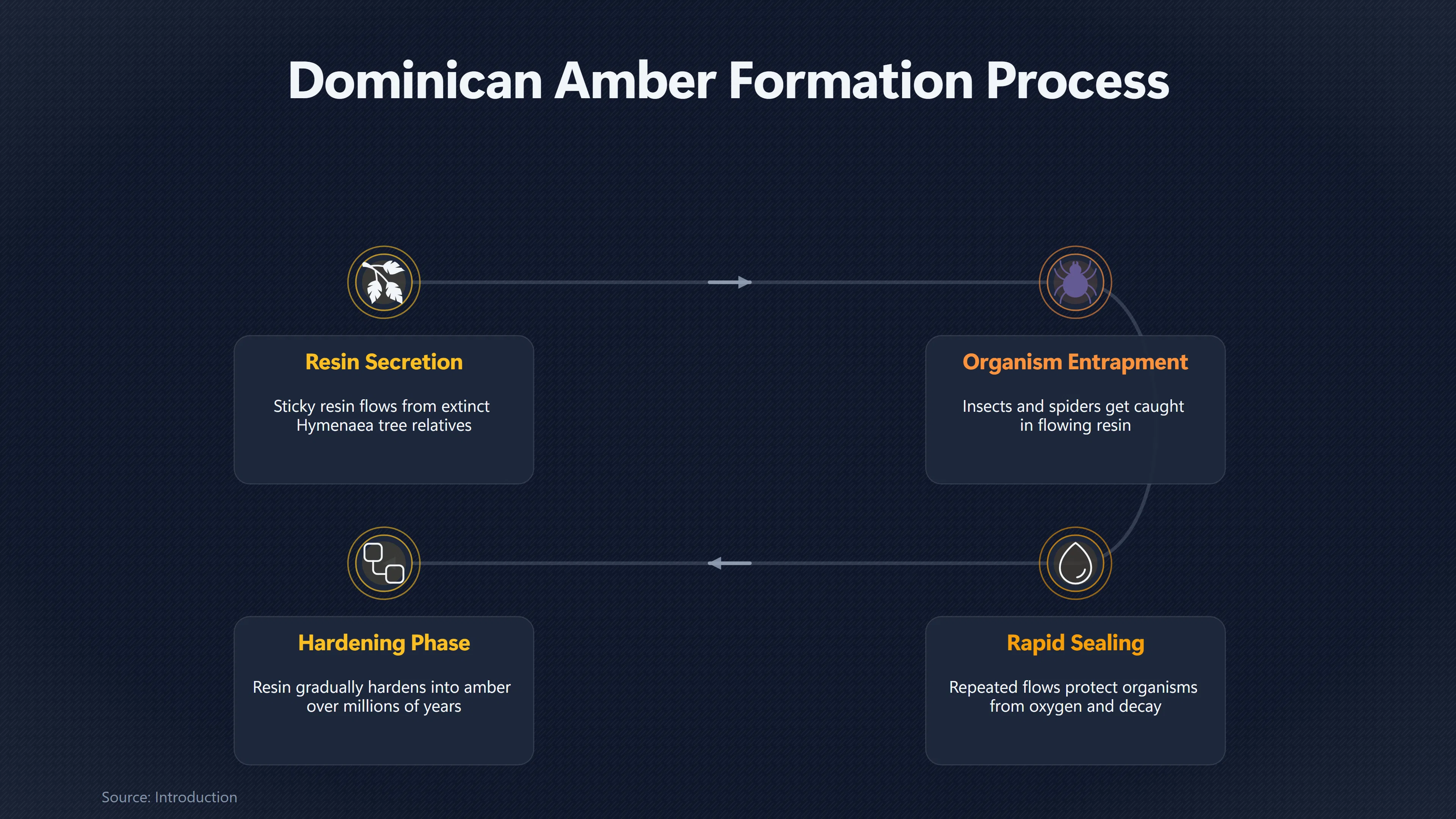
Dominican amber originated as sticky resin produced by an extinct relative of the modern tropical tree Hymenaea. As resin flowed down trunks and branches, it trapped insects, spiders, fungi, plant fragments and occasionally small vertebrates. Repeated flows sealed earlier layers, protecting organisms from decay before the resin gradually hardened into amber over millions of years. Scientific studies generally place the principal Dominican amber deposits in the Miocene, around 15–20 million years old, although their precise age has been debated because different dating methods have produced varying estimates.[ScienceDirect]sciencedirect.comScienceDirect Dominican AmberDominican Amber - an overview | ScienceDirect Topics…
This style of preservation differs dramatically from ordinary fossilisation. Most fossils preserve bones or shells after minerals replace the original material. Amber instead captures organisms almost as they appeared in life. Fine details including compound insect eyes, spider silk, feathers, pollen and fungal growth can survive because they were sealed rapidly inside oxygen-poor resin before decomposition began. As a result, Dominican amber has become one of the world’s richest sources of fossil arthropods and tropical forest organisms.[ScienceDirect]sciencedirect.comScienceDirect Dominican AmberDominican Amber - an overview | ScienceDirect Topics…
The exceptional transparency of much Dominican amber also distinguishes it from many other famous amber deposits. Researchers can often examine inclusions under microscopes without destructive preparation, allowing museums to display scientifically valuable specimens while preserving them intact.[Wikipedia]WikipediaDominican amberDominican amber
Museum displays, inclusions and fossil value
The country’s principal amber museums combine geological interpretation with displays designed to appeal to both scientists and tourists.
The Dominican Amber Museum in Puerto Plata occupies the restored Villa Bentz, a historic early twentieth-century mansion. Guided displays explain how amber formed, how it is mined and polished, and why inclusions matter scientifically. Specimens range from tiny insects and leaves to more dramatic vertebrate remains, helping visitors understand that even the smallest trapped organism contributes evidence about vanished ecosystems.[Museos RD]museosrd.gob.doamber museum experienceMuseos RDAmber Museum Experience | MUSEOSRDJuly 7, 2026…
The Amber World Museum, with locations in Santo Domingo’s Colonial City and Altos de Chavón, presents amber as both a gemstone and a scientific archive. Exhibits include fossil insects viewed through microscopes, interpretive panels explaining resin formation, and collections assembled through decades of collaboration with researchers studying fossil arthropods and ancient tropical biodiversity.[amberworldmuseum.com]amberworldmuseum.comOpen source on amberworldmuseum.com.
Rather than valuing specimens only for their size, museums often highlight inclusions that answer scientific questions. Examples include:
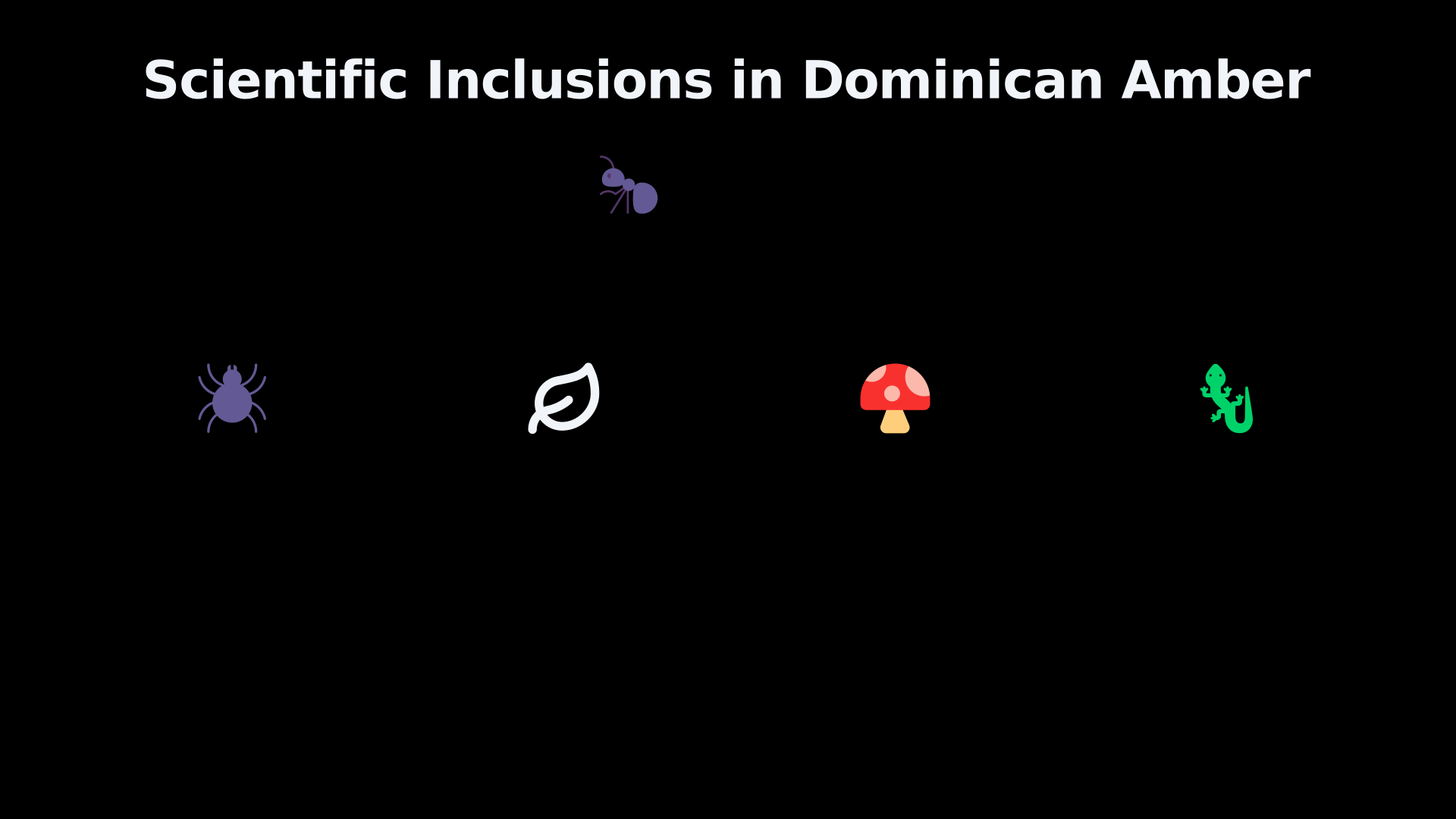
- Ants, bees and wasps that reveal the evolution of social insects.
- Spiders preserving ancient hunting adaptations.
- Plant fragments that reconstruct rainforest vegetation.
- Fungal spores and pollen that help identify extinct environments.
- Rare vertebrate remains such as lizards, which provide unusually complete snapshots of small tropical animals.[amnh.org]amnh.orgOpen source on amnh.org.
The American Museum of Natural History alone houses hundreds of scientifically important Dominican amber type specimens, reflecting the international importance of the country’s fossil deposits for taxonomy and evolutionary research.[American Museum of Natural History]amnh.orgOpen source on amnh.org.
Why these fossils matter beyond display cases
Dominican amber preserves an ancient Caribbean rainforest unlike any living ecosystem today. Because organisms were trapped at random during ordinary forest life, researchers can study ecological relationships rather than isolated species.
Amber has revealed evidence of:
- Ancient pollination systems involving insects and flowering plants.
- Predator-prey interactions preserved in mid-action.
- Parasites attached to hosts.
- Forest floor communities that rarely fossilise elsewhere.
- Extinct species closely related to modern Caribbean and Central American animals.[ScienceDirect]sciencedirect.comScienceDirect Dominican AmberDominican Amber - an overview | ScienceDirect Topics…
This breadth explains why Dominican amber continues to generate new scientific descriptions decades after major collections were assembled. Individual pieces often contain multiple organisms whose relationships can be examined together rather than as isolated fossils.
Where science ends and sales language begins
Amber museums also operate within a commercial gemstone industry, and visitors should distinguish carefully between well-supported science and promotional storytelling.
One common misconception concerns the age of Dominican amber. Museum marketing sometimes rounds figures upwards to around 40 or even 60 million years, while current geological research generally favours a Miocene age of approximately 15–20 million years for the principal deposits. The difference matters because it determines which animals and ecosystems could realistically have been preserved.[ScienceDirect]sciencedirect.comScienceDirect Dominican AmberDominican Amber - an overview | ScienceDirect Topics…
Another persistent myth involves dinosaurs. Dominican amber is far younger than the age of non-avian dinosaurs, making dinosaur remains impossible within these deposits. The famous mosquito in Jurassic Park drew inspiration from Dominican amber, and Puerto Plata’s museum even displays the mosquito that appeared in the film, but the fictional premise of recovering usable dinosaur DNA from amber has never been supported by science. DNA degrades far too rapidly over geological time, and no authenticated dinosaur DNA has been recovered from amber inclusions.[Dominican Republic Tourism]godominicanrepublic.comDominican Republic Tourism Museo del ÁmbarDominican Republic TourismMuseo del Ámbar - Dominican Republic Tourism - Official Website…
Commercial value also differs from scientific value. Large, visually striking insects command high prices in jewellery markets, yet researchers may prize a tiny fly, pollen grain or fungal inclusion because it fills an evolutionary gap or documents an extinct lineage. Museums therefore often preserve specimens that appear unimpressive to casual visitors but are invaluable to science.
What visitors should look for
A rewarding visit goes beyond admiring attractive gemstones.
Instead, pay attention to how museums explain:
- The sequence from living tree resin to fossil amber.
- The difference between genuine amber and younger copal, which is only partially fossilised.
- Why microscopic inclusions can be scientifically more significant than spectacular display pieces.
- How palaeontologists identify species using preserved anatomical details.
- Which specimens have documented research histories rather than purely commercial descriptions.
Microscopes, magnified photographs and explanatory diagrams often reveal features invisible to the naked eye. These tools transform what initially looks like an attractive yellow stone into a detailed record of a rainforest that disappeared millions of years ago.
Why amber museums occupy a special place in Dominican curiosity culture
Many unusual attractions rely on folklore, legend or personal interpretation. Dominican amber museums are different because their sense of wonder comes from genuine scientific evidence. They preserve creatures that appear almost alive yet belong to ecosystems that vanished long before humans arrived in the Caribbean.
That combination makes them distinctive within the Dominican Republic’s broader landscape of unusual collections. They function simultaneously as geological museums, natural history galleries, educational attractions and gateways into one of the world’s most important fossil archives. Even for visitors primarily interested in jewellery or unusual museums, the greatest fascination often comes from recognising that each tiny inclusion represents a real moment from an ancient tropical forest, frozen with remarkable fidelity inside fossilised resin.
Amazon book picks
Further Reading
Books and field guides related to What Makes Dominican Amber Museums Scientifically Fascinating?. Use these as the next step if you want deeper reading beyond the article.
The Quest for Life in Amber
"Amber is a semi-precious gem that is formed over eons by natural forces out of the resin of trees. Human fascination with amber dates ba...
Fossils: The Key to the Past
This introduction offers an explanation of how fossils are a product of our evolving habitat. The emphasis is on what paleontology is rea...
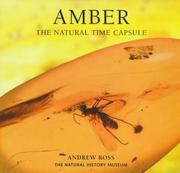
Amber: The Natural Time Capsule
First published 1998. Subjects: Amber, Amber fossils, Fossils.
eBay marketplace picks
Marketplace Samples
Live-tested eBay searches with available results related to this page.
Selected frommuseums wall art oneBay.co.uk.

Endnotes
1.
Source: sciencedirect.com
Title: ScienceDirect Dominican Amber
Link:https://www.sciencedirect.com/topics/agricultural-and-biological-sciences/dominican-amber
Source snippet
Dominican Amber - an overview | ScienceDirect Topics...
2.
Source: Wikipedia
Title: Dominican amber
Link:https://en.wikipedia.org/wiki/Dominican_amber
3.
Source: museosrd.gob.do
Title: amber museum experience
Link:https://museosrd.gob.do/museos/amber-museum-experience/
Source snippet
Museos RDAmber Museum Experience | MUSEOSRDJuly 7, 2026...
Published: July 7, 2026
4.
Source: amberworldmuseum.com
Link:https://amberworldmuseum.com/
5.
Source: museosrd.gob.do
Title: Museos RDAmber World Museum | MUSEOSRD
Link:https://museosrd.gob.do/museos/amber-world-museum/
Source snippet
Amber World Museum | MUSEOSRDJuly 14, 2026 — PORTAL DE LA Red Nacional de Museos de la República Dominicana AMBER WORLD MUSEUM UNA VENTAN...
Published: July 14, 2026
6.
Source: sciencedirect.com
Link:https://www.sciencedirect.com/science/article/abs/pii/S0146638017301857
7.
Source: amberworldmuseum.com
Link:https://amberworldmuseum.com/conocenos/
8.
Source: amnh.org
Link:https://www.amnh.org/research/invertebrate-zoology/collections/amber/amber-fossil-type-list
9.
Source: godominicanrepublic.com
Title: Dominican Republic Tourism Museo del Ámbar
Link:https://www.godominicanrepublic.com/things-to-do/museo-del-ambar
Source snippet
Dominican Republic TourismMuseo del Ámbar - Dominican Republic Tourism - Official Website...
10.
Source: godominicanrepublic.com
Title: Museo del Ámbar
Link:https://www.godominicanrepublic.com/things-to-do/museo-del-mbar
11.
Source: amnh.org
Link:https://www.amnh.org/research/invertebrate-zoology/collections/amber
Additional References
12.
Source: youtube.com
Title: Amber from the Dominican Republic documentary of Patrick Voillot
Link:https://www.youtube.com/watch?v=yLDGVjH8sZs
Source snippet
"Insanely preserved insects in Amber[https://www.youtube.com/watch?v=2OfJZVJUizg..."](https://www.youtube.com/watch?v=2OfJZVJUizg...")...
13.
Source: youtube.com
Title: Ancient Bee Trapped in Amber
Link:https://www.youtube.com/watch?v=Fyub9CUALc4
Source snippet
Amber from the Dominican Republic documentary of Patrick Voillot...
14.
Source: pmc.ncbi.nlm.nih.gov
Link:https://pmc.ncbi.nlm.nih.gov/articles/PMC13000247/
Source snippet
nih.govThermal, geological and biological processes shape the internal fabric and fluorescence of amber from La Cumbre, Dominican Republi...
15.
Source: mapress.com
Title: Remarks on the age of Dominican amber | Palaeoentomology
Link:https://www.mapress.com/pe/article/view/palaeoentomology.2.3.7
Source snippet
2 No. 3: June 2019 Type: Short Communication...
Published: June 2019
16.
Source: cambridge.org
Link:https://www.cambridge.org/core/journals/earth-and-environmental-science-transactions-of-royal-society-of-edinburgh/article/abs/assemblages-of-mammalian-hair-and-bloodfeeding-midges-insecta-diptera-psychodidae-phlebotominae-in-miocene-amber/58C275018A4022D78DE8D9999778E463
17.
Source: cambridge.org
Link:https://www.cambridge.org/core/journals/canadian-entomologist/article/abs/crickets-grylloptera-grylloidea-in-dominican-amber/3D4F8F89BCA37936BAEF1DCC456B4879
18.
Source: visitdominicanrepublic.org
Link:https://www.visitdominicanrepublic.org/dominican-amber-museum-puerto-plata
19.
Source: dominicanamberfossils.com
Link:https://dominicanamberfossils.com/en/informations/what-is-amber
20.
Source: puertoplatadr.com
Link:https://puertoplatadr.com/museums/amber-museum-puertoplata/
21.
Source: researchgate.net
Title: (PDF) Age and Paleogeographical Origin of Dominican Amber
Link:https://www.researchgate.net/publication/235232648_Age_and_Paleogeographical_Origin_of_Dominican_Amber