Within Strange Denmark
How Should Danish Museums Display Human Bodies?
Grauballe Man and Medical Museion reveal how Danish institutions balance scientific value, public access and respect for human remains.
On this page
- Grauballe Man as archaeology rather than spectacle
- Medical specimens and The Body Collected
- Consent, provenance and respectful museum display
Page outline Jump by section
Introduction
Denmark’s museums are home to some of Europe’s most remarkable preserved human remains, yet they rarely present them as macabre curiosities. Instead, institutions such as Moesgaard Museum and Medical Museion have increasingly reframed their displays around a central question: how can museums preserve and study human bodies while treating the people they once belonged to with dignity? The result is an approach that combines archaeology, medical history and public education with careful attention to ethics, provenance and visitor experience.
Rather than encouraging spectacle, Danish museums generally place human remains within broader stories about scientific discovery, changing ideas of health, and the responsibilities that come with collecting and exhibiting the dead. Their displays reveal not only what researchers have learned from preserved bodies but also how museums have reconsidered older collecting practices that would be regarded very differently today.
Why are human remains displayed at all?
Human remains are among the most sensitive objects found in museum collections. Archaeologists, historians and medical researchers argue that they can answer questions that written records cannot, including how people lived, what diseases they suffered, what they ate and how they died.
Danish museums therefore tend to justify displaying human remains only when there is a clear educational or scientific purpose. The emphasis is on helping visitors understand past lives, medical knowledge or archaeological discoveries rather than provoking shock. This reflects wider international museum ethics, which stress respect, transparency and careful consideration of why remains are exhibited rather than assuming public display is automatically justified.[GOV.UK]GOV.UKGuidance for the Care of Human Remains in Museums11, 2005…
Visitors are also prepared in advance. Museums commonly explain that exhibitions contain genuine human remains, allowing individuals to decide whether they wish to enter.
Grauballe Man: archaeology rather than spectacle
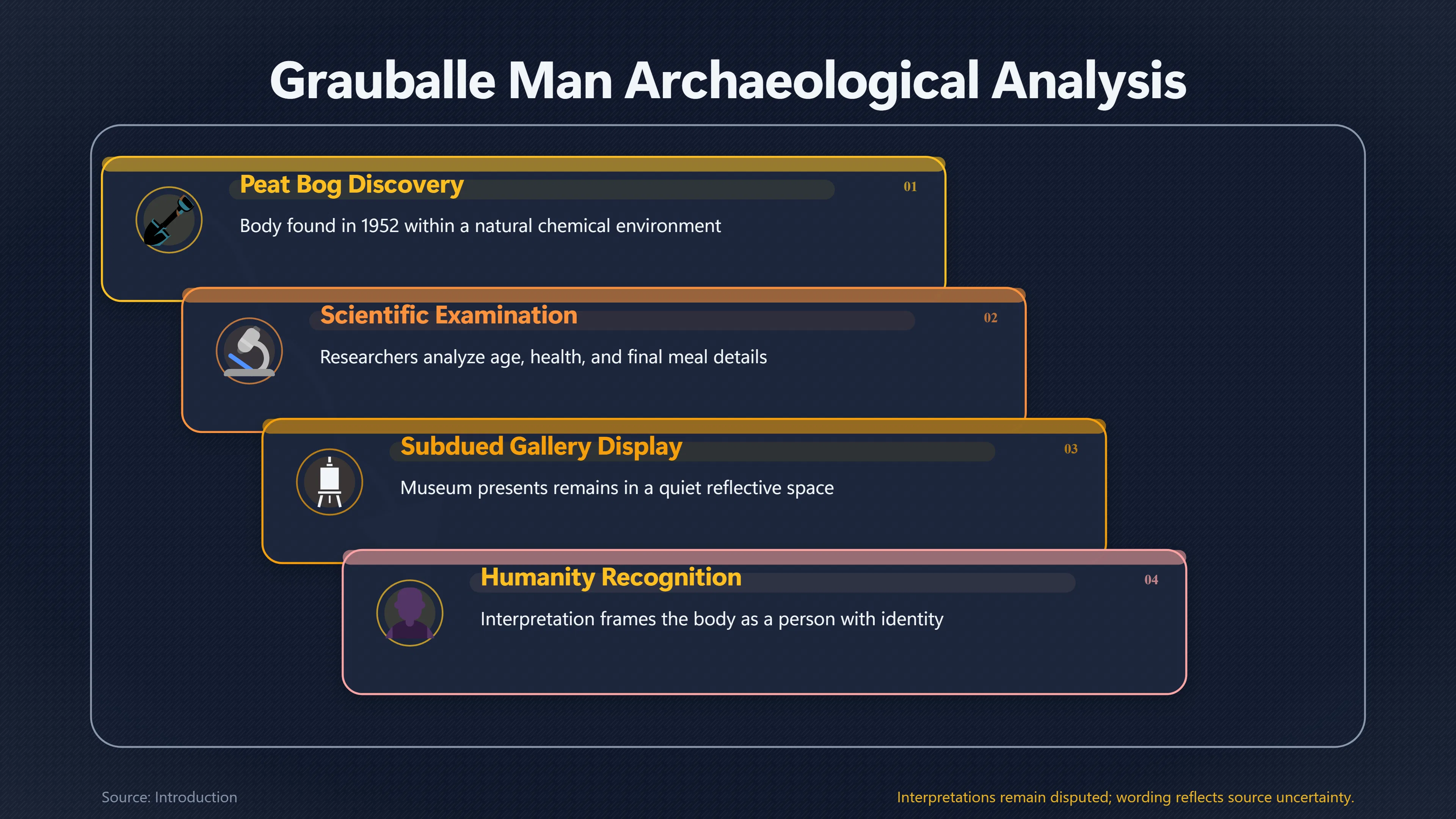
The clearest example is the Grauballe Man at Moesgaard Museum near Aarhus, one of the world’s best-preserved Iron Age bog bodies.
Discovered in a peat bog in 1952, Grauballe Man lived around 390 BC and died violently before his body was deposited in the bog, where natural chemical conditions preserved skin, hair and facial features for more than two millennia. Scientific analysis has revealed details of his age, health, final meal and probable cause of death, making him one of Europe’s most intensively studied archaeological individuals.[moesgaardmuseum.dk]moesgaardmuseum.dkThe Grauballe ManMoesgaard…
What makes the display distinctive is its presentation. Rather than placing the body among dramatic effects or sensational claims, Moesgaard presents Grauballe Man in a quiet, subdued gallery intended to encourage reflection. Museum interpretation consistently refers to him as a person rather than an object, inviting visitors to consider both his humanity and the archaeological evidence surrounding his life and death. The museum explicitly frames the encounter as meeting an individual from another age rather than viewing an anonymous specimen.[moesgaardmuseum.dk]moesgaardmuseum.dkThe Grauballe ManMoesgaard…
This represents a significant change from earlier twentieth-century approaches, when bog bodies were often promoted primarily as spectacular archaeological discoveries. Modern interpretation instead balances scientific explanation with emotional distance and respect.
Medical specimens and The Body Collected
If Grauballe Man represents archaeological ethics, Copenhagen’s Medical Museion explores the ethical questions surrounding medical collections.
Its permanent exhibition, The Body Collected, traces how human bodies have been gathered for anatomy, pathology and biomedical research from the eighteenth century to the present day. Visitors encounter preserved organs, skeletons, foetuses, tissue samples and modern biological materials alongside explanations of why these collections were assembled and how medical science has progressively shifted its attention from whole bodies to organs, cells and DNA.[Medicinsk Museion]museion.ku.dkMedicinsk Museion The Body CollectedMedicinsk MuseionThe Body Collected - Medicinsk Museion…
The exhibition deliberately avoids presenting specimens simply as medical curiosities. Instead, it asks visitors to consider difficult questions:
- Why were these bodies collected?
- Who gave permission, if anyone?
- How have ideas about consent changed?
- What responsibilities do museums have towards people whose remains entered collections under very different historical circumstances?
Medical Museion also openly explains practical curatorial decisions. Some specimens are displayed in low light because organic material is vulnerable to damage, while visitors are warned beforehand that genuine human remains are present and that some material may be disturbing, particularly for children.[Medicinsk Museion]museion.ku.dkMedicinsk Museion The Body CollectedMedicinsk MuseionThe Body Collected - Medicinsk Museion…
Rather than hiding ethical uncertainty, the exhibition makes it part of the visitor experience.

Consent, provenance and changing museum standards
Many historical medical collections were assembled before modern concepts of informed consent existed. Bodies could enter anatomy collections through hospitals, workhouses, prisons or unclaimed deaths under legal systems that differed greatly from today’s expectations.
Consequently, contemporary museum practice places increasing emphasis on provenance—the documented history of where remains came from and how they entered a collection. When provenance is incomplete or ethically problematic, museums face difficult decisions about research access, public display and, in some cases, repatriation.
Medical Museion has been active in discussing these issues publicly. Museum researchers have described human remains as an ethical “grey zone”, arguing that museum professionals must continually balance scientific value against the recognition that every specimen originated from a deceased individual rather than merely scientific material.[Medicinsk Museion]museion.ku.dkMedicinsk MuseionHuman remains collection management as a 'grey zone' in ICOM's Code of Ethics - Medicinsk Museion…
This shift reflects a broader change in museum thinking. Instead of asking simply whether museums are allowed to display human remains, many institutions now ask whether displaying a particular individual serves a sufficiently strong educational purpose and whether it is done respectfully.
How Danish museums balance research and respect
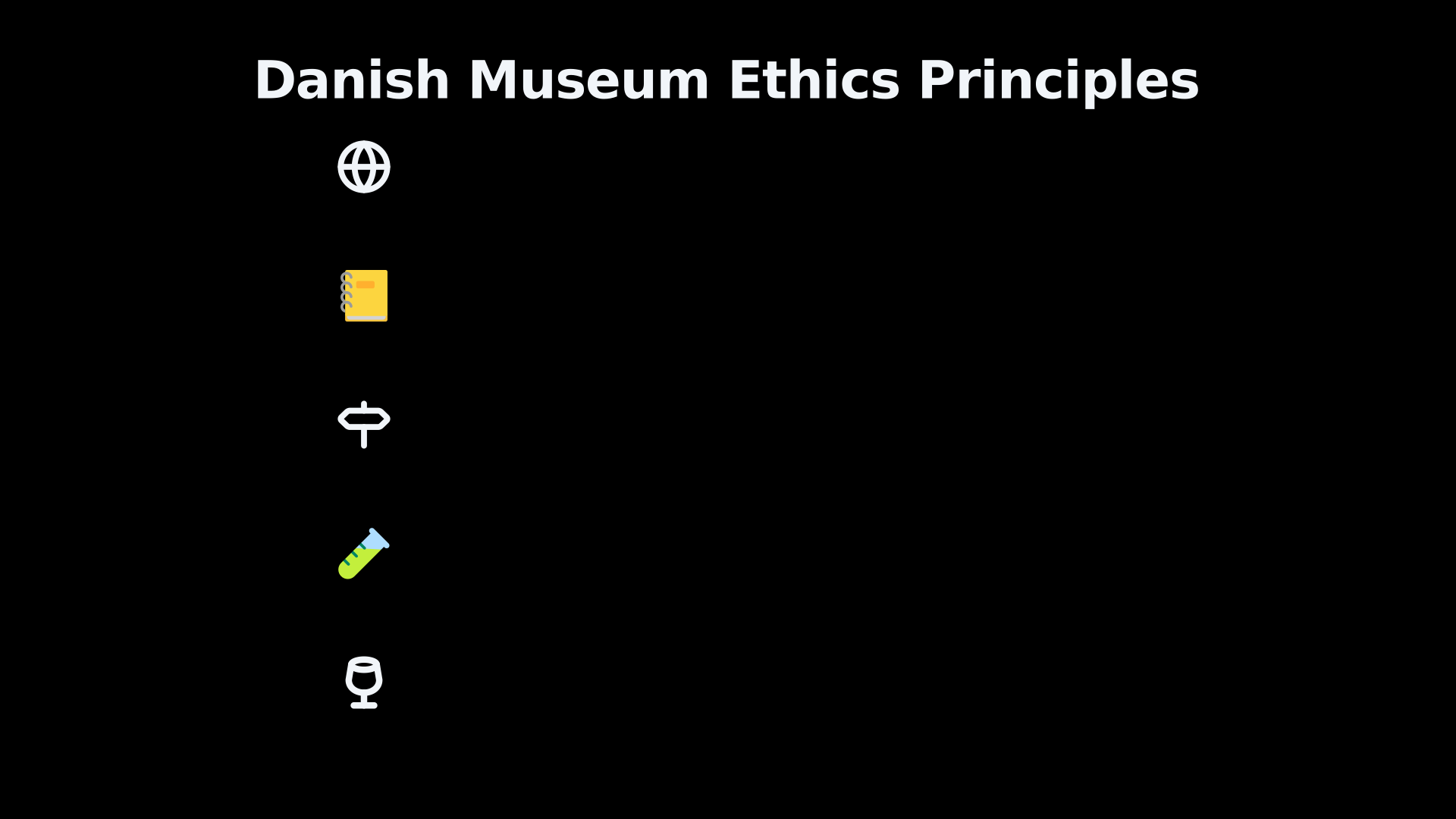
Several principles are visible across Denmark’s major archaeological and medical collections.
Context before spectacle. Human remains are interpreted through history, archaeology or medicine rather than presented as attractions in themselves.
Recognition of personhood. Labels increasingly describe individuals as people with lives and identities rather than anonymous specimens.
Transparency. Museums explain why remains are displayed and how they entered collections whenever possible.
Scientific value. Displays demonstrate what modern research has learned from preserved bodies, including diet, disease, forensic evidence and ancient environments.
Visitor choice. Clear notices allow visitors to avoid exhibitions containing human remains if they prefer.
These practices do not eliminate ethical debate, but they show how museums attempt to reconcile public education with respect for the dead.
Why this debate matters
Human remains occupy a unique position within Denmark’s unusual museums. Unlike cabinets of curiosities or collections of mysterious artefacts, these displays involve real people whose bodies have survived across centuries through exceptional archaeological preservation or medical collecting.
The Grauballe Man illustrates how archaeology can transform an ancient death into a powerful encounter with the past without reducing the individual to a spectacle. Medical Museion, meanwhile, reminds visitors that scientific progress has often depended on collecting human bodies—and that modern museums must also examine the ethics of those collecting practices.
Together these institutions show that Denmark’s most thought-provoking displays are not unusual because they contain preserved bodies alone. They are unusual because they encourage visitors to think critically about science, history, consent and the responsibilities museums carry whenever the people in their care are no longer able to speak for themselves.
Amazon book picks
Further Reading
Books and field guides related to How Should Danish Museums Display Human Bodies?. Use these as the next step if you want deeper reading beyond the article.
The Body: A Guide for Occupants
NATIONAL BESTSELLER NEW YORK TIMES BESTSELLER INTERNATIONAL BESTSELLER A NEW YORK TIMES EDITORS' CHOICE NAMED ONE OF THE BEST BOOKS OF 20...
Body Worlds: The Anatomical Exhibition of Real Human Bodies
Catalog of Gunther von Hagen's exhibition of human bodies preserved by "plastination"and presented as "natural art" (p. 13).
Medical Museums: Past, Present, Future
First published 2013. Subjects: Medical museums, Museums, Health and Wellbeing.
eBay marketplace picks
Marketplace Samples
Live-tested eBay searches with available results related to this page.
Selected fromarchaeology replica display oneBay.co.uk.
Endnotes
1.
Source: GOV.UK
Title: Guidance for the Care of Human Remains in Museums
Link:https://www.gov.uk/government/publications/guidance-for-the-care-of-human-remains-in-museums
Source snippet
11, 2005...
2.
Source: moesgaardmuseum.dk
Title: The Grauballe Man
Link:https://moesgaardmuseum.dk/en/exhibitions/current-exhibitions/iron-age-exhibition/the-grauballe-man/
Source snippet
Moesgaard...
3.
Source: moesgaardmuseum.dk
Link:https://moesgaardmuseum.dk/en/
Source snippet
Open today 10:00 - 20:00 Buy ticketLogin with annual pass STEP INTO HISTORY Explore the museum ◀ CURRENT EXHIBITIONS ◀ Special exhibition...
4.
Source: museumsandgalleries.leeds.gov.uk
Link:https://museumsandgalleries.leeds.gov.uk/human-remains-policy-y45l
Source snippet
STATEMENT OF PURPOSE Leeds Museums and Galleries (LMG) acknowledges that human remains were once parts of living peopl...
5.
Source: museion.ku.dk
Title: Medicinsk Museion The Body Collected
Link:https://www.museion.ku.dk/en/the-body-collected/
Source snippet
Medicinsk MuseionThe Body Collected - Medicinsk Museion...
6.
Source: museion.ku.dk
Link:https://www.museion.ku.dk/blog/human-remains-collection-management-as-a-grey-zone-in-icoms-code-of-ethics/
Source snippet
Medicinsk MuseionHuman remains collection management as a 'grey zone' in ICOM's Code of Ethics - Medicinsk Museion...
7.
Source: museion.ku.dk
Link:https://www.museion.ku.dk/blog/collecting-and-displaying-bodies-and-body-parts-whats-the-problem/
Source snippet
ku.dk"Collecting and displaying bodies and body parts: What’s the problem?" - Medicinsk Museion“COLLECTING AND DISPLAYING BODIES AND BODY...
8.
Source: britishmuseum.org
Link:https://www.britishmuseum.org/our-work/departments/human-remains
Source snippet
The scene shows episodes in Hunefer's judgement. Egypt, 19th Dynasty. Book of the Dead of Hunefer on Collection online. ON THI...
9.
Source: museion.ku.dk
Title: dkhuman remains Arkiv
Link:https://www.museion.ku.dk/en/category/human-remains-da/
Source snippet
remains Arkiv - Medicinsk MuseionHUMAN REMAINS From Pathological Collections to Biobanks: Medicine as a Collection Science When creating...
Additional References
10.
Source: penn.museum
Link:https://www.penn.museum/about/statements-and-policies/statement-on-human-remains
Source snippet
Human Remains PolicyHUMAN REMAINS POLICY "Prioritizing human dignity and the wishes of descendant communities are the governing principle...
11.
Source: ucl.ac.uk
Link:https://www.ucl.ac.uk/social-historical-sciences/archaeology/research/human-remains-policy
Source snippet
Human Remains Policy | UCL Faculty of Social & Historical SciencesHUMAN REMAINS POLICY The UCL Institute of Archaeology Human Remains Pol...
12.
Source: youtube.com
Title: Ethical considerations for caring and managing human remains in museums
Link:https://www.youtube.com/watch?v=lml7S5-teqc
Source snippet
Ethical issues, study and display of human remains...
13.
Source: youtube.com
Title: Ethical issues, study and display of human remains
Link:https://www.youtube.com/watch?v=5Q-AnHMQ1k8
Source snippet
Something Isn't Rotten in the State of Denmark: The Bog Bodies...
14.
Source: museumsgalleriesscotland.org.uk
Title: Museums Galleries Scotland
Link:https://www.museumsgalleriesscotland.org.uk/advice-article/introduction-to-human-remains-in-museums/
Source snippet
Introduction to human remains in museums - Museums Galleries Scotland...
15.
Source: youtube.com
Title: The Moesgaard Museum Exhibit Tour
Link:https://www.youtube.com/watch?v=vsGI17nEy_c
Source snippet
How Was The Grauballe Man Preserved So Well...
16.
Source: youtube.com
Title: Something Isn’t Rotten in the State of Denmark: The Bog Bodies
Link:https://www.youtube.com/watch?v=HjhnYKPBB2g
Source snippet
The Moesgaard Museum Exhibit Tour...
17.
Source: youtube.com
Title: How Was The Grauballe Man Preserved So Well
Link:https://www.youtube.com/watch?v=ZsPVzWZelPM