Where Finland Keeps Its Strangest Stories
Finland does not have a single national “museum of the strange”. Its curiosity culture is scattered across ethnographic stores, former prisons, Cold War attractions, military fortifications, Indigenous collections, interactive technology museums and eccentric outdoor art environments.
Page outline Jump by section
Introduction
For visitors, this creates a varied landscape rather than a neat trail. Some collections are academically researched but rarely displayed; others are commercial and playful; still others are artworks that function like open-air cabinets of curiosity. The strongest places are candid about whether they are interpreting belief, documenting lived experience or presenting spectacle. That distinction matters in Finland, where folklore, nationalism, war, border politics and modern tourism often meet inside the same object or exhibition.
Where Finland’s strangest objects are kept
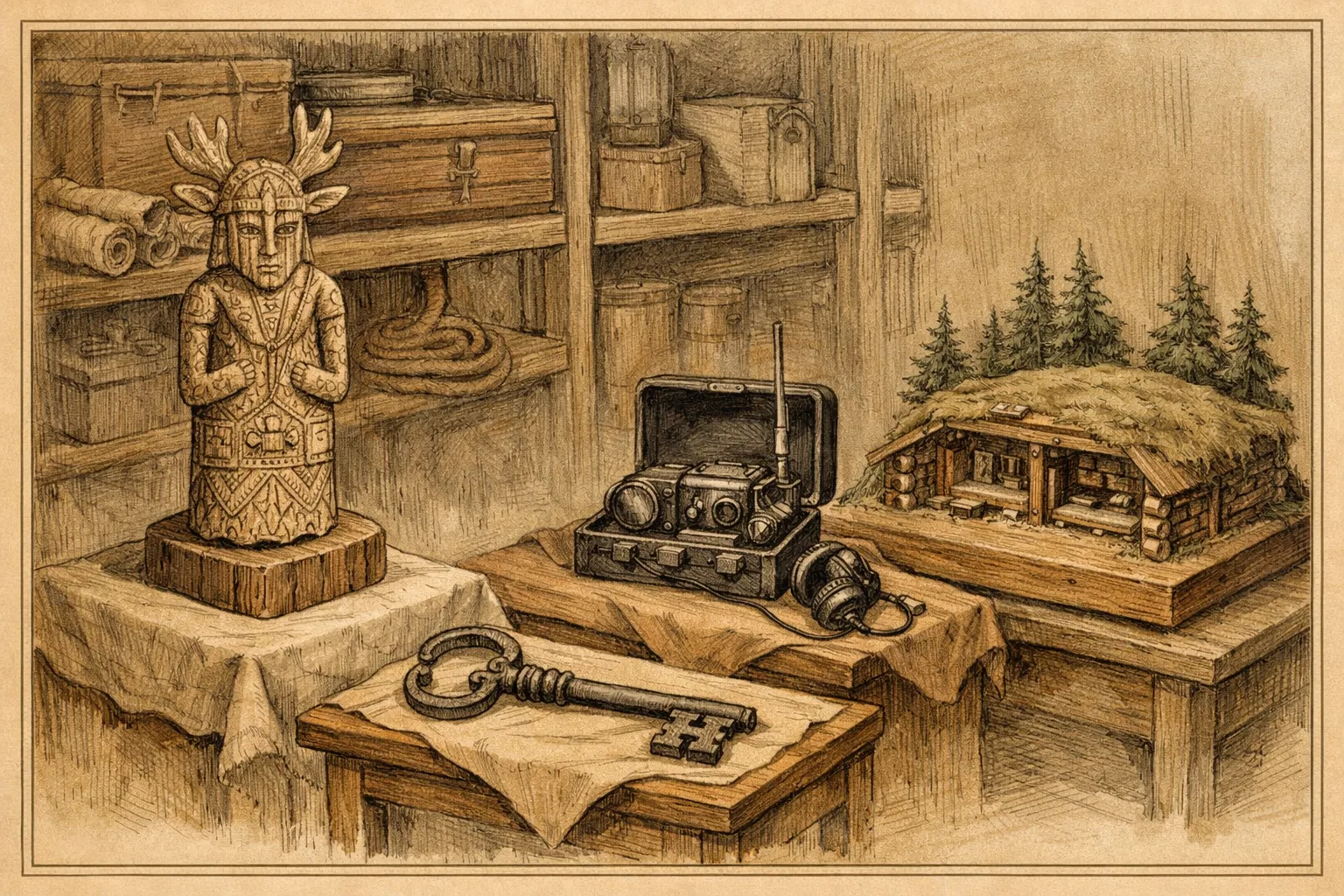
The closest thing Finland has to a classic occult cabinet is not a dedicated witchcraft museum but a dispersed body of folk-magic material held by major public institutions. Researchers have identified hundreds of objects in the National Museum of Finland, Tampere museum collections and the Museum Centre of Turku. Recorded examples include bear teeth and claws, unusual stones, animal bones, circular tree growths, protective pouches and frogs placed in miniature coffins. Many were collected during the late nineteenth and early twentieth centuries, when scholars and museum workers were attempting to preserve rural customs they believed were disappearing.[tandfonline.com]tandfonline.comStill, during the late nineteenth and early twentieth centuries several magical objects were gathered into museums, in addition to the ar…
These objects are strange partly because their museum labels can never fully reproduce the systems of knowledge in which they once operated. A naturally shaped stone might have been understood as a healing implement, a protective object or evidence of invisible forces. One so-called witch’s stone was catalogued as relieving pain after being pressed against the body three times; its reputed power was associated with the blood of nine ravens. The important point is not whether the claim is medically credible, but that the object preserves a record of how healing, symbolism and material properties were once connected.[Archaeology of Folk Religion]archaeomagic.blogit “has been smeared with the bloodArchaeology of Folk ReligionThe Unique Witch's Stone - Archaeology of Folk ReligionDecember 21, 2020 — 21 Dec 2020 — This so-called witch…
Academic work on these collections also warns against treating “magic object” as a self-evident category. Some items acquired their special meaning through ritual use, oral testimony or collectors’ interpretation rather than through an obviously unusual appearance. A claw in a display case may look like an ordinary zoological specimen unless its history is supplied. Museum classification therefore shapes what modern visitors perceive as magical, just as earlier users shaped an object’s meaning through handling, storytelling and ceremony.[Taylor & Francis Online]tandfonline.comStill, during the late nineteenth and early twentieth centuries several magical objects were gathered into museums, in addition to the ar…
Access is the practical limitation. The National Museum’s ethnological collections are substantial, and selected material can be encountered through loans, online records and object features, but much remains in storage rather than in a permanent occult display. The museum’s Helsinki building is currently closed for its major renovation and is expected to reopen in spring 2027. Visitors should not plan a trip expecting rows of witchcraft artefacts on public view.[Suomen kansallismuseo]kansallismuseo.fiSuomen kansallismuseo Ethnological collectionsSuomen kansallismuseo Ethnological collections

Sacred objects are not merely curiosities
Sámi heritage adds a necessary ethical boundary to any discussion of Finland’s unusual collections. At the Sámi Museum Siida in Inari, objects, photographs, archives, art and open-air buildings are maintained as the cultural heritage of a living Indigenous people. They are not presented simply as exotic relics from a vanished northern belief system. Siida’s national collecting role includes documentation and research as well as exhibition.[siida.fi]siida.fiOpen source on siida.fi.
Drums associated with Sámi spiritual specialists are especially vulnerable to sensational treatment. Their painted surfaces have been interpreted as maps of relationships between people, animals, places and spiritual realms, while the drums could be used in divination and ritual practice. Yet many surviving examples entered European collections through missionary suppression, confiscation and unequal collecting. Calling them “shaman drums” may help a visitor understand their broad function, but reducing them to occult props obscures the histories of Christianisation and colonial control that helped remove them from their communities.[openedition.org]journals.openedition.orgOpen source on openedition.org.
This issue is not confined to distant history. The National Museum of Finland has undertaken work concerning the ownership and return of Sámi collections, reflecting a wider change in museum practice from possessing Indigenous culture to negotiating stewardship with the people whose heritage is represented. The result is one of the most important distinctions in Finland’s curiosity landscape: an object may be mysterious to tourists while remaining culturally specific, sacred or politically sensitive to others.[Suomen kansallismuseo]kansallismuseo.fiSuomen kansallismuseo Ethnological collectionsSuomen kansallismuseo Ethnological collections
Siida is therefore a better place for understanding northern cosmology than for seeking a theatrical museum of sorcery. Its authority comes from community connection, research and cultural context. Visitors expecting gothic spectacle may find a more restrained institution, but they gain a clearer view of why certain objects cannot responsibly be separated from land, language and historical power.
Prisons, spies and borders made visitable
Finland’s darker museums are most convincing when visitors can enter the original spaces. The Prison in Hämeenlinna occupies the former county prison beside Häme Castle. The building remained in use as a prison until 1993 and is now described as Finland’s largest prison museum. Its cells, corridors and institutional architecture provide the unsettling element without needing fictional hauntings or staged horror.[Hämeenlinna]hameenlinna.fiHämeenlinna The PrisonHämeenlinna The Prison
What makes it more than a collection of restraints and uniforms is the opportunity to consider imprisonment as an everyday system. A cell door, sparse room or surveillance arrangement becomes evidence of how punishment organised time, privacy and human movement. The site is publicly operated as part of the National Museum of Finland, giving it a historical and educational purpose rather than the atmosphere of a commercial “crime experience”. It sits within a broader museum area that also includes Häme Castle and Museo Militaria.[Hämeenlinna]hameenlinna.fiHämeenlinna Museums and galleriesHämeenlinna Museums and galleries
Tampere’s Spy Museum takes a more entertainment-led approach. Promoted as the world’s first museum devoted to espionage, it brings together intelligence history, surveillance techniques, concealed devices and the popular mythology of spies. It is a visitor attraction rather than a state intelligence archive, so its strength lies in making clandestine methods tangible and accessible. Its broad framing covers political, military, industrial and ideological espionage rather than concentrating solely on Finnish cases.[Visit Tampere]visittampere.fiVisit Tampere Spy MuseumVisit Tampere Spy Museum
The difference between the two institutions is useful. The Prison derives its authority from place and institutional history; the Spy Museum uses themed objects and interactive curiosity. Both are legitimate, but they answer different questions. One shows what confinement felt like inside an authentic penal structure. The other demonstrates how secrecy and technical ingenuity can be packaged into an enjoyable museum visit.
Finland’s bunker museums extend this encounter with original environments into the landscape. The Salpa Line was a vast defensive system constructed along the eastern frontier after the Winter War. At the Salpa Line Museum in Miehikkälä, visitors can explore fortifications, shelters, trenches and anti-tank structures alongside indoor interpretation. The line was built as protection against a possible Soviet assault but was never tested in battle, giving it the peculiar status of an enormous military object whose historical meaning lies partly in what did not happen.[Salpalinja-museo]salpalinjamuseo.fiSalpalinja-museo EtusivuSalpalinja-museo Etusivu
These sites are unusual because they turn fear, engineering and national survival strategy into physical tourism. They are neither ruins in the romantic sense nor collections assembled in neutral galleries. The terrain itself is the principal artefact.
When political relics outlive their museum
Tampere once contained one of Finland’s most internationally distinctive ideological collections: the Lenin Museum, opened in 1946 in the Workers’ Hall where Vladimir Lenin and Joseph Stalin had met in 1905. Over time, the museum shifted from post-war friendship symbolism and Lenin biography towards a more critical treatment of Soviet history. Even so, its name increasingly suggested nostalgia or political allegiance that did not match its curatorial direction.[Yle.fi]yle.fiGoodbye Lenin — Tampere museum commemoratingGoodbye Lenin — Tampere museum commemorating
The Lenin Museum closed in November 2024. In February 2025 it was replaced in the same premises by Nootti, the Museum of Finnish–Russian Relations. The new institution covers subjects including Finnish independence, civil wars, Stalinist terror, the Winter War, Cold War diplomacy, trade, tourism, intelligence and Finland’s later turn towards NATO membership.[icom.museum]uk.icom.museumOpen source on icom.museum.
This transformation is a revealing example of museum meaning changing faster than museum objects. Soviet memorabilia that could once be treated with humour or retro fascination became harder to display lightly after Russia’s full-scale invasion of Ukraine. The problem was not that the historical material ceased to matter, but that visitors interpreted the old brand through a changed political present. Nootti therefore preserves the site’s relationship with Russia while replacing the personality cult implied by a museum named after Lenin.[The Guardian]theguardian.comOpen source on theguardian.com.
For curiosity travellers, Nootti remains unusual, although in a less theatrical way. It is a museum built partly from the afterlife of another museum: a case study in how propaganda objects, diplomatic souvenirs and ideological nostalgia can be recatalogued when national relationships deteriorate. Its credibility rests on acknowledging that exhibitions are not politically weightless and that the act of retaining, removing or reframing an artefact is itself a historical decision.
Outsider environments that behave like museums
Some of Finland’s most memorable collections were never intended to operate as conventional museums. The Veijo Rönkkönen Sculpture Park near Parikkala contains hundreds of concrete figures made over nearly five decades around the artist’s home. The best-known group consists of more than 200 figures performing yoga, many resembling variations on the artist himself. Other statues combine animals, human bodies, plants, artificial teeth and intensely individual facial expressions. Estimates commonly place the total at roughly 500 to 560 works.[noba.ac]noba.acVEIJ O RÖNKKÖNENVEIJ O RÖNKKÖNEN
The park is often marketed as eerie, but “outsider art environment” is more informative than “horror attraction”. Rönkkönen created a private world through repetition, self-portraiture, bodily poses and garden architecture. Because the works remain close to the place where they were made, visitors experience an accumulation rather than a curated retrospective. The unsettling effect comes from encountering an entire personal symbolic system without a museum’s usual explanatory distance.
The site is publicly accessible and promoted by the local tourism organisation as a year-round destination. Its preservation has turned a private artistic environment into a form of open-air collection, but it remains less controlled than an indoor museum. Weather, vegetation and gradual material change are part of the experience.[visitParikkala.fi]visitparikkala.comOpen source on visitparikkala.com.
At Suomussalmi, the Silent People offers a different kind of collective oddity. Roughly a thousand human-shaped figures stand in a field beside Highway 5, with peat heads, straw hair and changing clothes. Created by artist Reijo Kela, the installation resembles a gathering, a memorial, an army or an abandoned population, depending on the viewer. Its official tourism presentation leaves the figures’ meaning open rather than imposing a single legend.[Visit Finland]visitfinland.comOpen source on visitfinland.com.
Neither location is a museum in the strict institutional sense. There are no comprehensive object labels, accession systems or neutral gallery rooms. Yet both perform a museum-like function by preserving and presenting large bodies of unusual material to the public. They also show how readily ambiguity can be commercialised: “creepy statues” are easy to sell as roadside spectacle, while the works themselves support more complicated readings about isolation, memory, bodily identity and rural space.

Playable collections and everyday technology
Not every strange Finnish collection is dark or folkloric. The Finnish Museum of Games at Vapriikki in Tampere treats digital games, board games, arcade machines and domestic play environments as cultural heritage. Its displays range from internationally recognised Finnish creations such as Angry Birds and Max Payne to older or more locally specific titles. Many exhibits are playable, allowing visitors to encounter obsolete hardware and software through use rather than through glass.[Museokeskus Vapriikki]vapriikki.fithe finnish museum of gamesthe finnish museum of games
The museum is unusual because digital objects challenge traditional preservation. A game is not fully represented by a cartridge, disc or computer casing: it also depends on software, controls, screens, social habits and the memory of how people played. Reconstructed rooms and operational machines therefore preserve behaviour as well as equipment. The result resembles a living technology cabinet in which visitors activate the collection.
Temporary displays have also used games to examine themes beyond entertainment. One exhibition traced Finnish games about health and wellbeing, including material designed to educate players about intoxicants, sexual health and social issues. Such objects may look quaint, awkward or unintentionally comic decades later, but they reveal how public institutions tried to make moral and medical instruction interactive.[Museokeskus Vapriikki]vapriikki.fiMuseokeskus Vapriikki Temporary exhibitionsMuseokeskus Vapriikki Temporary exhibitions
This is a different branch of curiosity culture from folk magic, yet the underlying question is similar: how does an ordinary object acquire museum value? A bear claw becomes significant through ritual history; an old mobile-phone game becomes significant through collective memory and technical obsolescence. Finland’s strongest unusual collections make that transformation visible.
What visitors should expect
Finland rewards travellers who look beyond the promise of a single spectacular “weird museum”. Its unusual heritage is spread across different levels of access and authority:
- For documented folk belief: consult the National Museum’s collections and research projects, while remembering that much material is stored or digitised rather than permanently exhibited. The Helsinki museum building is closed until its expected reopening in spring 2027.[Suomen kansallismuseo]kansallismuseo.fiOpen source on kansallismuseo.fi.
- For Indigenous cultural interpretation: visit Siida, where spiritual and ceremonial material is presented within living Sámi heritage rather than as anonymous occult exotica.[siida.fi]siida.fiOpen source on siida.fi.
- For authentic dark-history environments: the Prison at Hämeenlinna and the Salpa Line sites offer original architecture, cells, shelters and fortifications.[Hämeenlinna]hameenlinna.fiHämeenlinna The PrisonHämeenlinna The Prison
- For playful commercial curiosity: Tampere’s Spy Museum foregrounds gadgets, secrecy and espionage stories in an accessible visitor format.[Visit Tampere]visittampere.fiVisit Tampere Spy MuseumVisit Tampere Spy Museum
- For outsider art and roadside uncanniness: Parikkala Sculpture Park and the Silent People provide large-scale environments whose ambiguity is part of their appeal.[Visit Finland]visitfinland.comOpen source on visitfinland.com.
- For contested political memory: Nootti demonstrates how a museum can survive by changing the story told around its inherited site and objects.[Nootti]museonootti.fithe new museum of finnish russian relations symbols the turn in foreign policythe new museum of finnish russian relations symbols the turn in foreign policy
The common thread is not a national obsession with monsters or the paranormal. It is Finland’s habit of preserving material at the boundary between private belief and public history: protective charms, confiscated sacred objects, Cold War souvenirs, obsolete games, unused bunkers and forests of handmade figures. The best collections do not ask visitors simply to believe or disbelieve. They show how an object becomes strange when its original world disappears, when its ownership is disputed, or when later generations decide that something once ignored is worth keeping.
Amazon book picks
Further Reading
Books and field guides related to Where Finland Keeps Its Strangest Stories. Use these as the next step if you want deeper reading beyond the article.
The Nordic Theory of Everything
An optimistic account of how the Nordic countries can teach us to live easier, healthier, happier lives. From childcare to healthcare to...
The Cambridge history of Scandinavia
First published 2003. Subjects: History, Scandinavia, history.
eBay marketplace picks
Marketplace Samples
Live-tested eBay searches with available results related to this page.
Selected fromNordic folk art oneBay.co.uk.
Endnotes
1.
Source: kansallismuseo.fi
Title: Suomen kansallismuseo Ethnological collections
Link:https://www.kansallismuseo.fi/en/collections/kansatieteen-kokoelma
2.
Source: kansallismuseo.fi
Title: Suomen kansallismuseo Collections
Link:https://www.kansallismuseo.fi/en/kokoelmat-1
3.
Source: kansallismuseo.fi
Link:https://www.kansallismuseo.fi/en/kansallismuseo
4.
Source: siida.fi
Link:https://siida.fi/en/the-sami-museum/museum-collections/
5.
Source: journals.openedition.org
Link:https://journals.openedition.org/clo/445?gathStatIcon=true&lang=en
6.
Source: doria.fi
Link:https://www.doria.fi/bitstream/handle/10024/134162/The%2520Saami%2520Shaman%2520Drum%25201991%2520OCR.pdf?sequence=2
7.
Source: kansallismuseo.fi
Title: Suomen kansallismuseo Info
Link:https://www.kansallismuseo.fi/en/vankila/info
8.
Source: yle.fi
Title: Goodbye Lenin — Tampere museum commemorating
Link:https://yle.fi/a/74-20085401
9.
Source: uk.icom.museum
Link:https://uk.icom.museum/finlands-lenin-museum-to-close-and-be-replaced-by-a-new-museum-of-russian-relations/
10.
Source: noba.ac
Title: VEIJ O RÖNKKÖNEN
Link:https://noba.ac/en/exhibition/veijo-ronkkonen-mystical-sculpture-park
11.
Source: visitparikkala.com
Link:https://www.visitparikkala.com/
12.
Source: vapriikki.fi
Title: the finnish museum of games
Link:https://www.vapriikki.fi/en/the-museum/the-finnish-museum-of-games/
13.
Source: vapriikki.fi
Title: Museokeskus Vapriikki Temporary exhibitions
Link:https://www.vapriikki.fi/en/the-museum/the-finnish-museum-of-games/temporary-exhibitions/
14.
Source: kansallismuseo.fi
Title: Historical collections
Link:https://www.kansallismuseo.fi/en/collections/historian-kokoelma
15.
Source: kansallismuseo.fi
Title: Prison collection
Link:https://www.kansallismuseo.fi/en/collections/vankilan-kokoelma
16.
Source: kansallismuseo.fi
Link:https://www.kansallismuseo.fi/en/vankila/accessibility
17.
Source: kansallismuseo.fi
Link:https://www.kansallismuseo.fi/en/kansallismuseo/renovation
18.
Source: ae.trip.com
Title: parikkala sculpture park 61773609
Link:https://ae.trip.com/travel-guide/attraction/parikkala/parikkala-sculpture-park-61773609?poiType=3&scene=gsDestination
19.
Source: trip.com
Title: suomussalmi 22430 10279247
Link:https://www.trip.com/moments/detail/suomussalmi-22430-10279247/
20.
Source: yle.fi
Link:https://yle.fi/a/74-20025340
21.
Source: tampere.fi
Link:https://www.tampere.fi/en/culture-and-museums/museums
22.
Source: medicalmuseum.health.mil
Link:https://medicalmuseum.health.mil/index.cfm/collections/anatomical/index
23.
Source: vapriikki.fi
Link:https://www.vapriikki.fi/en/exhibition/the-renewed-finnish-museum-of-games/
24.
Source: noba.ac
Link:https://noba.ac/en/gallery/parikkala-sculpture-park
25.
Source: youtube.com
Title: Sámi Museum Siida
Link:https://www.youtube.com/watch?v=q56BMRlnUcg
Source snippet
In Finland, the 'existential threat' of Russia looms...
26.
Source: tandfonline.com
Link:https://www.tandfonline.com/doi/abs/10.1080/17432200.2018.1443893
Source snippet
Still, during the late nineteenth and early twentieth centuries several magical objects were gathered into museums, in addition to the ar...
27.
Source: abo.fi
Link:https://www.abo.fi/en/project/the-materiality-of-magic-in-finland-in-a-long-term-perspective-developing-the-archaeology-of-folk-religion/
Source snippet
Åbo AkademiThe Materiality of Magic in Finland in a Long-Term Perspective: Developing the Archaeology of Folk Religion | Åbo AkademiThe p...
28.
Source: archaeomagic.blog
Title: it “has been smeared with the blood
Link:https://archaeomagic.blog/2020/12/21/the-unique-witchs-stone/
Source snippet
Archaeology of Folk ReligionThe Unique Witch's Stone - Archaeology of Folk ReligionDecember 21, 2020 — 21 Dec 2020 — This so-called witch...
Published: December 21, 2020
29.
Source: tandfonline.com
Link:https://www.tandfonline.com/doi/full/10.1080/17432200.2018.1443893
Source snippet
Still, during the late nineteenth and early twentieth centuries several magical objects were gathered into museums, in addition to the ar...
30.
Source: theguardian.com
Title: three centuries on a shamans precious rune drum returns home
Link:https://www.theguardian.com/science/2022/mar/13/three-centuries-on-a-shamans-precious-rune-drum-returns-home
31.
Source: hameenlinna.fi
Title: Hämeenlinna The Prison
Link:https://www.hameenlinna.fi/en/services/the-prison/
32.
Source: hameenlinna.fi
Link:https://www.hameenlinna.fi/en/tourism-and-events/hameenlinnas-museums/
33.
Source: hameenlinna.fi
Title: Hämeenlinna Museums and galleries
Link:https://www.hameenlinna.fi/en/tourism-and-events/see-and-experience/museums-and-galleries/
34.
Source: visittampere.fi
Title: Visit Tampere Spy Museum
Link:https://visittampere.fi/en/destination/spy-museum/
35.
Source: salpalinjamuseo.fi
Title: Salpalinja-museo Etusivu
Link:https://salpalinjamuseo.fi/en/home/
36.
Source: salpalinjamuseo.fi
Title: Salpalinja-museo Salpa Line Museum
Link:https://salpalinjamuseo.fi/en/salpa-line-museum/
37.
Source: theguardian.com
Link:https://www.theguardian.com/world/2025/mar/10/goodbye-lenin-finnish-museum-reinvents-itself-in-response-to-shifting-relations-with-russia
38.
Source: museonootti.fi
Title: the new museum of finnish russian relations symbols the turn in foreign policy
Link:https://www.museonootti.fi/en/the-new-museum-of-finnish-russian-relations-symbols-the-turn-in-foreign-policy/
39.
Source: atlasobscura.com
Title: veijo roenkkoenen sculpture garden
Link:https://www.atlasobscura.com/places/veijo-roenkkoenen-sculpture-garden
40.
Source: visitfinland.com
Link:https://www.visitfinland.com/en/product/54b61c48-70c2-45b6-89be-8bc5eeea5c6b/the-silent-people/
41.
Source: visitfinland.com
Link:https://www.visitfinland.com/en/product/b35dacec-9fd0-44cd-8919-026b3a7679e3/the-finnish-museum-of-games/
42.
Source: visittampere.fi
Title: Museums in Tampere
Link:https://visittampere.fi/en/articles/museums-in-tampere/
43.
Source: tandfonline.com
Link:https://www.tandfonline.com/doi/abs/10.1080/17432200.2018.1443893?needAccess=true
44.
Source: Wikipedia
Title: Finnish Museum of Games
Link:https://en.wikipedia.org/wiki/Finnish_Museum_of_Games
45.
Source: Wikipedia
Title: National Museum of Finland
Link:https://en.wikipedia.org/wiki/National_Museum_of_Finland
46.
Source: hameenlinna.fi
Title: Museo Militaria
Link:https://www.hameenlinna.fi/en/services/museo-militaria-the-artillery-engineer-and-signals-museum-of-finland/
47.
Source: tripadvisor.co.uk
Title: MUSEOKESKU S VAPRIIKKI
Link:https://www.tripadvisor.co.uk/Attraction_Review-g189948-d592831-Reviews-Museokeskus_Vapriikki-Tampere_Pirkanmaa.html
48.
Source: finlandtravel.fi
Title: Salpa Line Museum
Link:https://finlandtravel.fi/en/listing/salpa-line-museum/
49.
Source: visitfinland.com
Title: The Prison | Visit Finland THE PRISON From 4
Link:https://www.visitfinland.com/en/product/c2779045-b32d-4c4e-939d-a09bc46a3edd/the-prison/
50.
Source: visitfinland.com
Title: Spy Museum | Visit Finland SPY MUSEUM From 6
Link:https://www.visitfinland.com/en/product/38a4c911-f7f4-45ad-8af2-607e72dedecb/spy-museum/
51.
Source: visitfinland.com
Title: Salpa Line Museum | Visit Finland SALPA LINE MUSEUM From 7
Link:https://www.visitfinland.com/en/product/a2faa8ac-6570-447a-9e2d-3fbbd877aabd/salpa-line-museum/
52.
Source: visitfinland.com
Link:https://www.visitfinland.com/en/product/fa89ec39-c71c-4400-9eb7-5dbd853763e0/virolahti-bunker-museum-green-belt-center/
53.
Source: visitfinland.com
Link:https://www.visitfinland.com/en/product/8a580d53-0b81-44e3-9d50-71faf78f8cb2/salpa-trail/
54.
Source: salpalinjamuseo.fi
Title: Salpa Trail
Link:https://salpalinjamuseo.fi/en/salpa-trail/
55.
Source: salpalinjamuseo.fi
Link:https://salpalinjamuseo.fi/en/tapahtumat/
56.
Source: salpalinjamuseo.fi
Link:https://salpalinjamuseo.fi/
57.
Source: atlasobscura.com
Link:https://www.atlasobscura.com/things-to-do/finland/outsider-art
58.
Source: atlasobscura.com
Title: Anatomical museums
Link:https://www.atlasobscura.com/users/inhiuyx/lists/anatomical-museums
59.
Source: rexby.com
Title: The Silent People
Link:https://www.rexby.com/damonbeckford/ttd/world-famous-art-installation-with-faceless-figures
60.
Source: jensenhughes.com
Title: the national museum of finland
Link:https://www.jensenhughes.com/europe/insights/the-national-museum-of-finland
61.
Source: visithame.fi
Title: The Prison
Link:https://visithame.fi/en/Tuotteet/vankila-suomen-suurin-vankilamuseo/
62.
Source: navicup.com
Title: Parikkala Sculpture Park
Link:https://navicup.com/object/finland-grand-tour/parikkala-sculpture-park-243347/us
63.
Source: vakoilumuseo.fi
Title: Spy Museum
Link:https://www.vakoilumuseo.fi/fi/
Additional References
64.
Source: blogit.utu.fi
Link:https://blogit.utu.fi/kansanuskonarkeologia/magic-objects-in-finnish-museum-collections-archaeology-of-folk-religion/
Source snippet
iaaThis project focuses on the ‘Magic Objects’ card index of Finland’s National Museum.The collection includes more than 300 objects: for...
65.
Source: utupub.fi
Title: International Magic?
Link:https://www.utupub.fi/items/befbee4a-6fea-490e-b829-fe9c122d7d86
Source snippet
Finnish Folk Magic Objects in a European ContextFolk magic objects in two Finnish museum collections (the National Museum of Finland and...
66.
Source: youtube.com
Title: Parikkalan patsaspuisto/ Parikkala Sculpture Park, Finland, 09.06.24
Link:https://www.youtube.com/watch?v=Gcq56Vtsg_0
Source snippet
Lieksa, Unveiling the mysteries of Pielinen Museum...
67.
Source: rcseng.ac.uk
Link:https://www.rcseng.ac.uk/museums-and-archives/anatomy-and-pathology-museum/
68.
Source: facebook.com
Link:https://www.facebook.com/DiscoveringFinland/posts/did-you-know-that-the-silent-people-an-installation-by-finnish-artist-reijo-kela/4030844026960485/?locale=af_ZA
69.
Source: academia.edu
Link:https://www.academia.edu/70107800/Fabulous_creatures_mythical_monsters_and_animal_power_symbols_a_handbook
70.
Source: facebook.com
Link:https://www.facebook.com/groups/241181559369054/posts/3367347136752465/
71.
Source: peribo.com.au
Link:https://peribo.com.au/wp-content/uploads/1125-Title-Information-Sheets-e.pdf
72.
Source: museot.fi
Link:https://museot.fi/exhibitions/?x_hakulause=Outsider+art
73.
Source: hunterianmuseum.org
Link:https://hunterianmuseum.org/