Within Curious Cambodia
Why Cambodia's Sacred Objects Were Hidden and Recovered
Hidden Buddha caches, grave goods and returned sculptures reveal how Cambodian objects survive danger, displacement and contested ownership.
On this page
- Buried Buddha images and emergency caches
- Grave goods, cremation vessels and belief
- Looted sculpture and the politics of return
Page outline Jump by section
Introduction
Cambodia’s most unusual archaeological collections are not defined simply by age or artistic beauty, but by survival. Many sacred sculptures now displayed in museums were never meant to be hidden. Buddha images were buried beneath temple floors, sealed inside damaged shrines or concealed in hurried caches during periods of war and religious upheaval. Other sculptures vanished into the international art market before being painstakingly identified and returned decades later. Together they tell an extraordinary story of objects that repeatedly disappeared from public view and then re-emerged with entirely new meanings.
For visitors, the National Museum of Cambodia and major archaeological museums offer more than galleries of Khmer art. They preserve evidence of emergency concealment, ritual burial, excavation and international restitution. The result is a collection that sits at the intersection of archaeology, religion, crime investigation and living belief, making Cambodia one of the most compelling places in Southeast Asia to understand how sacred objects survive conflict and displacement.[SOAS]soas.ac.uksoas antiquities expert helps return looted artefacts cambodiaSOAS antiquities expert helps return looted artefacts to Cambodia | SOASJuly 17, 2024…
Why sacred images ended up underground
Hidden Buddha images are not a uniquely Cambodian phenomenon, but Cambodia’s history gave the practice unusual importance. Temples faced repeated threats from warfare, political instability, looting and changing religious landscapes over many centuries. Monks, local communities and temple custodians sometimes concealed valuable images beneath floors, within masonry or inside ruined structures to protect them from theft or destruction.
Archaeologists distinguish these deliberate deposits from ordinary archaeological layers. A cache may contain several sculptures carefully arranged together, often with signs that they were intentionally wrapped or placed rather than discarded. In many cases there is no written record explaining who hid them or whether those responsible expected to recover them later. Their discovery therefore becomes part historical investigation and part archaeological interpretation.
These concealed groups are unusual because they preserve a snapshot of a particular crisis. Instead of representing centuries of gradual accumulation, they capture a single decision to remove sacred objects from public worship and entrust them to the ground.
Buried Buddha images and emergency caches
Excavations around Angkor and other Khmer temple sites have uncovered concealed Buddhist images that demonstrate this pattern of emergency protection. Some were hidden inside temple architecture, while others were buried close to shrines or beneath later construction phases.
These finds matter because they preserve archaeological context. A Buddha statue recovered from an undisturbed cache can often be linked to the precise temple where it was worshipped, allowing researchers to understand its ritual setting rather than treating it as an isolated work of art.
For museum visitors, these discoveries explain why some sculptures appear remarkably well preserved despite centuries of political turmoil. Their survival was not accidental. It often resulted from deliberate concealment carried out by people who viewed the statues as sacred beings rather than decorative objects.
Grave goods, cremation vessels and changing beliefs
Cambodian archaeological collections also contain cremation urns, ceramics, jewellery and other grave goods recovered from burials dating from prehistoric communities through later historical periods. These objects differ from hidden Buddha caches because they were intentionally buried as part of funerary practice rather than emergency protection.
Such finds reveal changing ideas about death and the afterlife. Pottery vessels, ornaments and personal possessions placed with the dead suggest beliefs about status, memory and spiritual continuity. Although spectacular royal tombs are rare compared with some neighbouring countries, Cambodian museums preserve many smaller archaeological assemblages that illustrate everyday ritual practice across different regions and periods.
Visitors should not expect dramatic “treasure chambers”. Instead, these collections are valuable because the relationship between the objects is preserved. Archaeologists can reconstruct burial customs, dating evidence and social patterns from complete groups of artefacts rather than from isolated museum pieces.
This distinction is important. A Buddha hidden beneath a temple floor represents an attempt to save a sacred image from danger. A vessel buried beside human remains reflects a deliberate funerary ceremony. Both involve objects entering the ground, but for entirely different cultural reasons.

Returned sculptures tell a second story
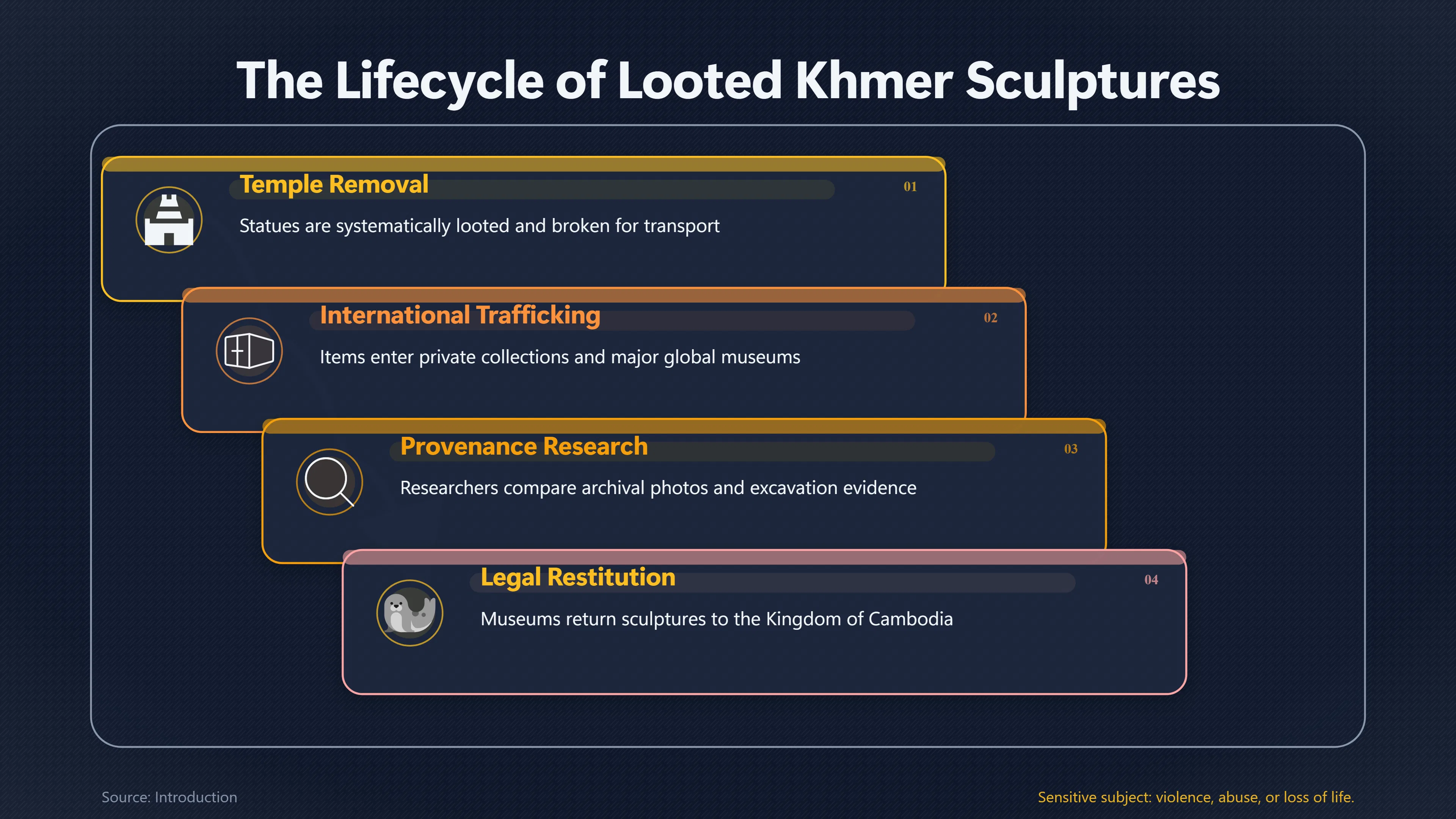
Many of Cambodia’s most significant sacred sculptures disappeared not into archaeological deposits but into international collections during decades of civil war, particularly from the 1970s onwards. Temples were systematically looted, with statues broken apart for easier transport and smuggled across borders before appearing in private collections and major museums.
Investigations over the past two decades have transformed understanding of these objects. Researchers compared archival photographs, excavation evidence, surviving fragments and old temple records to establish where many sculptures originally stood. The work exposed extensive trafficking networks associated with dealer Douglas Latchford and prompted voluntary returns, legal settlements and museum-led provenance reviews across several countries.[theartnewspaper.com]theartnewspaper.comArt NewspaperMuseums face pressure to explain presence of Cambodian relics linked to disgraced dealer Douglas Latchford - The Art Newspap…
A striking example involves bronze and stone sculptures whose separated fragments have finally been reunited after decades apart. In one case, a bronze head returned from the Metropolitan Museum of Art could be reattached to its matching torso, which had remained in Cambodia after being discovered separately many years earlier. Such reunifications demonstrate that restitution is not only about ownership but also about restoring archaeological integrity.[SOAS]soas.ac.uksoas antiquities expert helps return looted artefacts cambodiaSOAS antiquities expert helps return looted artefacts to Cambodia | SOASJuly 17, 2024…
Recent returns have continued this process. The Metropolitan Museum of Art returned fourteen Khmer sculptures in 2024, while the Smithsonian’s National Museum of Asian Art later announced the return of additional Cambodian sculptures after provenance research concluded they had been removed during periods of widespread wartime looting.[lemonde.fr]lemonde.frThe National Museum in Phnom Penh, now overflowing with restituted artifacts, is receiving support from France to expand its exhibition s…
Why these collections feel different from ordinary art museums
Cambodian sacred sculptures are rarely interpreted purely as aesthetic masterpieces. Many Cambodians regard ancient Buddha and deity images as retaining spiritual significance even after centuries underground or decades overseas.
This perspective affects how returned objects are received. Repatriation ceremonies frequently include Buddhist monks, blessings and traditional rituals alongside museum conservation. Returned sculptures may be welcomed as the recovery of ancestors’ heritage rather than simply the acquisition of additional exhibits.[The World from PRX]theworld.orgThe World from PRXLooted relics returned to Cambodia receive monks’ blessingsThe World from PRXMarch 28, 2023…
For visitors, this creates a distinctive museum experience. Labels often explain not only artistic style and historical period but also where a sculpture was hidden, how it was identified, who removed it, and how it eventually returned to Cambodia. The object’s biography becomes as important as its craftsmanship.
What visitors can expect today
The National Museum of Cambodia in Phnom Penh provides the clearest introduction to this story. Alongside masterpieces of Khmer sculpture, visitors increasingly encounter exhibitions devoted to recently repatriated works, archaeological discoveries and conservation projects that reconnect sculptures with their original temple contexts.[Le Monde.fr]lemonde.frThe National Museum in Phnom Penh, now overflowing with restituted artifacts, is receiving support from France to expand its exhibition s…
Rather than presenting buried Buddhas, cremation vessels and returned sculptures as separate curiosities, Cambodian museums reveal a common theme: sacred objects repeatedly crossed the boundary between visibility and concealment. Some were hidden by devotees hoping to preserve them. Others disappeared through looting before modern investigations traced them home.
That shared history makes Cambodia’s archaeological collections distinctive within the country’s landscape of unusual heritage. These are not simply galleries of ancient religious art but records of survival, loss, concealment and recovery, where every sculpture carries evidence not only of the civilisation that created it but also of the dangers it endured.
Amazon book picks
Further Reading
Books and field guides related to Why Cambodia's Sacred Objects Were Hidden and Recovered. Use these as the next step if you want deeper reading beyond the article.
Cambodia's Curse: The Modern History of a Troubled Land
First published 2011. Subjects: Cambodia, history, Cambodia, politics and government, Democracy, Social change, New York Times reviewed.
Angkor and the Khmer Civilization
The ancient city of Angkor in Cambodia has fascinated scholars and visitors alike since its rediscovery in the mid-19th century. A great...
Loot: The Battle over the Stolen Treasures of the Ancient World
A journey across four continents to the heart of the conflict over who should own the great works of ancient art Why are the Elgin Marble...
eBay marketplace picks
Marketplace Samples
Live-tested eBay searches with available results related to this page.
Selected fromAsian temple decor oneBay.co.uk.
Endnotes
1.
Source: soas.ac.uk
Title: soas antiquities expert helps return looted artefacts cambodia
Link:https://www.soas.ac.uk/about/news/soas-antiquities-expert-helps-return-looted-artefacts-cambodia
Source snippet
SOAS antiquities expert helps return looted artefacts to Cambodia | SOASJuly 17, 2024...
Published: July 17, 2024
2.
Source: lemonde.fr
Link:https://www.lemonde.fr/en/international/article/2025/04/02/cambodia-celebrates-the-return-of-its-khmer-deities_6739755_4.html
Source snippet
The National Museum in Phnom Penh, now overflowing with restituted artifacts, is receiving support from France to expand its exhibition s...
3.
Source: theartnewspaper.com
Link:https://www.theartnewspaper.com/2021/10/27/pressure-mounts-on-museums-to-explain-presence-of-cambodian-relics-linked-to-disgraced-dealer-douglas-latchford
Source snippet
Art NewspaperMuseums face pressure to explain presence of Cambodian relics linked to disgraced dealer Douglas Latchford - The Art Newspap...
4.
Source: smithsonianmag.com
Link:https://www.smithsonianmag.com/smart-news/daughter-antiquities-trafficker-returns-stunning-collection-khmer-dynasty-artifacts-cambodia-180976900/
5.
Source: asia.si.edu
Link:https://asia.si.edu/about/press/releases/cambodia-return-2025/
Source snippet
National Museum of Asian ArtNational Museum of Asian Art Returns Three Sculptures to the Kingdom of Cambodia - National Museum of Asian Art...
6.
Source: theworld.org
Title: The World from PRXLooted relics returned to Cambodia receive monks’ blessings
Link:https://theworld.org/stories/2023/03/28/looted-relics-returned-cambodia-receive-monks-blessings
Source snippet
The World from PRXMarch 28, 2023...
Published: March 28, 2023
7.
Source: theartnewspaper.com
Title: Smithsonian’s National Museum of Asian Art returns three sculptures to Cambodia
Link:https://www.theartnewspaper.com/2025/12/23/smithsonians-national-museum-of-asian-art-returns-three-sculptures-to-cambodia
8.
Source: nysean.org
Link:https://www.nysean.org/blog/national-museum-of-asian-art-returns-three-sculptures-to-the-kingdom-of-cambodia
Additional References
9.
Source: culture.org
Title: Douglas Latchford: Looting Cambodia’s Gods Into Museums
Link:https://culture.org/art-and-culture/art/how-douglas-latchford-looted-cambodias-stolen-gods/
Source snippet
May 29, 2026 — Art HOW DOUGLAS LATCHFORD TRAFFICKED CAMBODIA’S GODS INTO WESTERN MUSEUMS * Luke David * | * May 29, 2026 * | * Image 5 mi...
Published: May 29, 2026
10.
Source: akp.gov.kh
Title: Agence Kampuchea Presse
Link:https://akp.gov.kh/post/detail/363498
Source snippet
February 27, 2026 — CAMBODIA WELCOMES RETURN OF 74 KHMER CULTURAL TREASURES FROM DOUGLAS LATCHFORD COLLECTION Share to ៖ AKP Phnom Pe...
Published: February 27, 2026
11.
Source: youtube.com
Title: Reclaiming Cambodia’s Cultural Heritage: Provenance Research in Action
Link:https://www.youtube.com/watch?v=1t_uIALqZws
Source snippet
APSARA Authority finds over 100 pieces of sandstone Buddha statues at Ta Prohm Temple...
12.
Source: youtube.com
Title: Famous temples in Cambodia work to recover stolen artifacts
Link:https://www.youtube.com/watch?v=fBX8gVpT4Ko
Source snippet
Cambodia welcomes return of centuries-old artifacts looted by notorious smuggling ring...
13.
Source: courthousenews.com
Link:https://www.courthousenews.com/cambodia-welcomes-return-from-abroad-of-centuries-old-artifacts-looted-by-notorious-smuggling-ring/
14.
Source: the-independent.com
Link:https://www.the-independent.com/news/cambodia-phnom-penh-united-kingdom-new-york-angkor-wat-b2928876.html
15.
Source: icij.org
Link:https://www.icij.org/investigations/pandora-papers/cambodia-relics-looted-temples-museums-offshore/
16.
Source: artmarketstudies.org
Link:https://www.artmarketstudies.org/news-national-museum-of-asian-art-returns-three-sculptures-to-the-kingdom-of-cambodia/
17.
Source: si.edu
Link:https://www.si.edu/newsdesk/releases/national-museum-asian-art-returns-three-sculptures-kingdom-cambodia-0
18.
Source: cambridge.org
Link:https://www.cambridge.org/core/journals/international-journal-of-cultural-property/article/prakhon-chai-hoard-debunked-unravelling-six-decades-of-myth-misdirection-and-misidentification/F6018E93F8087341014345C099F92790