Where Namibia Keeps Its Strangest Stories
Namibia does not have a famous museum of witchcraft, cryptids or paranormal phenomena.
Page outline Jump by section
Introduction
These collections matter because they sit at the meeting point of science, folklore, tourism and disputed history. Some are carefully curated public museums; others are community performances, preserved industrial ruins or sacred places whose treatment as tourist attractions remains controversial. Visitors therefore need to ask not only, “What unusual thing is here?” but also, “Who is interpreting it, whose history is being told, and what has been left unexplained?”
Where Namibia’s strangest objects are kept
The strongest conventional museums for unusual material are geological, mining and local-history institutions. Namibia’s ancient rocks, exceptionally dry landscapes and long extractive history have produced displays that can feel closer to natural cabinets of wonder than to ordinary civic museums.
The National Earth Science Museum in Windhoek, housed within the government’s geological administration, holds the country’s largest institutional collection of Namibian minerals, rocks and fossils. Its attractions include eight large pieces from the Gibeon meteorite shower, vividly coloured mineral specimens, Ediacaran fossils more than half a billion years old, marine reptiles, mammal-like reptiles and a life-sized reconstruction of the early dinosaur Massospondylus. One particularly important specimen is Otavipithecus namibiensis, described by the museum as the oldest fossil ape found south of the equator. This is a scientific collection rather than a commercial “oddities museum”, but its combination of meteorites, extinct creatures and unfamiliar mineral forms gives it much the same appeal.[mme.gov.na]mme.gov.naMinistry of Industries, Mines and EnergyEight big meteorites of the Gibeon Meteorite Shower are on display in the museum…. Its fossilized remains were found in the Etjo Sands…
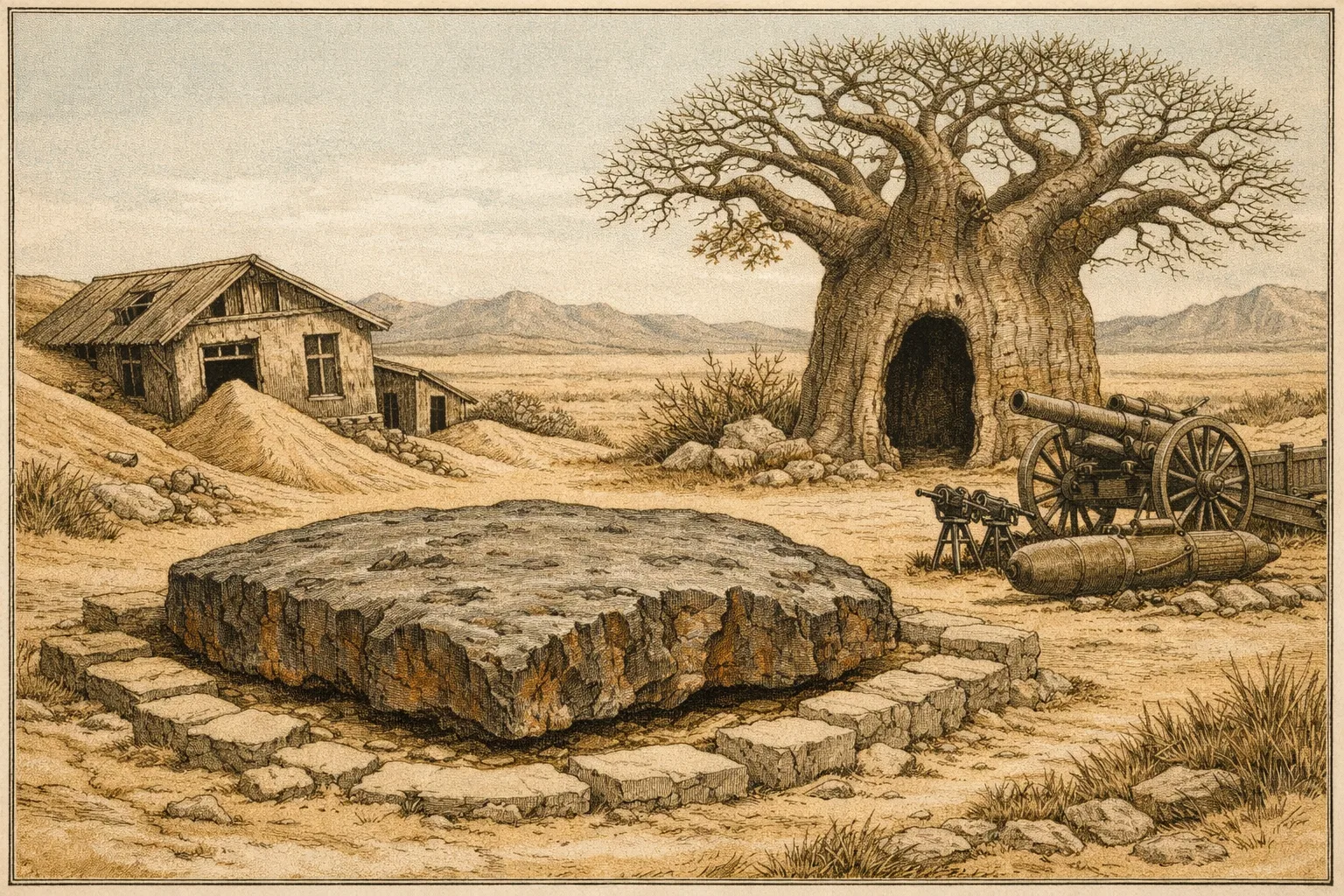
The Grootfontein Museum combines regional history with ethnographic objects and material connected to northern Namibia’s settlement, transport and agricultural past. Its wider significance for curiosity travellers comes from its relationship with the nearby Hoba meteorite site. Hoba is not an indoor museum object: it remains where it was found on farmland, surrounded by a visitor area. At roughly 60 tonnes, it is generally recognised as the largest known intact meteorite on Earth. The contrast is part of the attraction. Instead of seeing a fragment behind glass, visitors encounter an immense iron mass lying almost flush with the ground, more like an archaeological monument than something that fell from space.[museums.com.na]museums.com.naMuseum MattersDecember 8, 2016 — Migrant Labour and the Making. Hoba Meteorite. Exhibitions that can be viewed. The founding of the Republic of Upingto…
At the Tsumeb Museum, geological wealth is joined by a more dramatic historical collection. The museum interprets the town’s mining industry and displays artillery and military equipment associated with Lake Otjikoto. During the First World War, retreating German colonial forces dumped weapons into the deep, steep-sided lake to prevent their capture. Later recovery efforts turned some of those submerged objects into museum exhibits. The collection is unusual because the lake itself functions as part of the story: a natural sinkhole became an improvised weapons cache, and the recovered guns became both military evidence and local legend.[museums.com.na]museums.com.naOpen source on com.na.
The Swakopmund Museum, Namibia’s largest privately run museum, takes a broad cabinet-like approach. Its displays range across natural history, archaeology, ethnography, colonial settlement and the coastal environment. Rather than building an experience around one spectacular object, it accumulates specimens, domestic material, tools and historical reconstructions. This older encyclopaedic style can be fascinating, although visitors should remain alert to how inherited labels and classifications present Indigenous communities and the colonial past.[com.na]museums.com.naSwakopmund MuseumSwakopmund Museum

A tree, a lake and a ghost town as museums
Some of Namibia’s most memorable “collections” are places in which the building, landscape or natural object is the principal exhibit.
The Ombalantu Baobab Tree Heritage Centre in Outapi preserves one of the country’s most extraordinary adaptive spaces. The enormous hollow baobab has reportedly been used as a refuge during conflict and later as a post office, chapel and kindergarten. The surrounding heritage centre interprets the tree’s local history and the wider cultural and practical importance of baobabs. What makes it compelling is that its many functions are not an invented visitor gimmick. The hollow trunk really became civic architecture, repeatedly repurposed as local circumstances changed.[com.na]visitnamibia.com.naOpen source on com.na.
Nearby, the Outapi War Museum was developed around a former military bunker that served as the headquarters of a South African base during Namibia’s liberation struggle. Its underground setting distinguishes it from a conventional military museum: the surviving defensive structure is itself the central artefact. Early accounts of the project describe local efforts to restore the bunker and gather objects capable of telling the regional history of the conflict. Visitor information has not always been as consistently documented as that for Namibia’s larger museums, so opening arrangements should be checked locally rather than assumed.[facebook.com]facebook.comOpen source on facebook.com.
In southern Namibia, Kolmanskop is a preserved diamond-mining ghost town near Lüderitz. Founded during the early twentieth-century diamond rush, it once contained elaborate houses and recreational facilities built for a wealthy settler community. As mining shifted elsewhere, the settlement was abandoned and desert sand moved steadily through its rooms. Restored buildings, a small museum and guided tours now present the town as both industrial heritage and spectacular ruin.[livelikeitstheweekend.com]livelikeitstheweekend.comOpen source on livelikeitstheweekend.com.
Kolmanskop is often photographed as an uncanny landscape of doors opening onto dunes and rooms half buried in sand. That visual appeal can obscure the systems behind its wealth: colonial control, racialised labour and restricted access to diamond territory. The museum experience is most useful when the decaying architecture is read not simply as a romantic ghost town, but as evidence of an extractive settlement whose comforts depended upon unequal political and labour arrangements.
Oranjemund’s Jasper House Museum offers a more recent attempt to interpret a diamond town through several overlapping collections. Its displays address migrant labour, mining, geology, archaeology, wildlife, conservation and everyday life in the formerly company-controlled settlement. Art installations and forward-looking material distinguish it from museums that freeze mining history at the moment of industrial expansion.[museums.com.na]museums.com.naJasper House MuseumJasper House Museum
Medicine, plants and changing ideas of healing
The Onandjokwe Medical Museum is one of Namibia’s clearest examples of an unusual specialist collection. It preserves medical equipment and photographs dating back to 1908 and interprets the history of Onandjokwe Hospital, including its role during the liberation struggle. Historical instruments and clinical photographs allow visitors to trace the development of institutional medicine in northern Namibia without presenting that history as a simple march from superstition to science.[museums.com.na]museums.com.naonandjokwe medical museumonandjokwe medical museum
Its Traditional Medicine Garden is particularly important. Medicinal plants are presented as a living knowledge system rather than as exotic props. This places local botanical practice alongside hospital history, inviting comparison between different forms of diagnosis, care and authority. The result is unusual not because the museum promises occult cures, but because it acknowledges that medical history in Namibia includes missionaries, trained clinicians, local healers, plant knowledge and wartime experience.
This is a more responsible way to approach subjects sometimes marketed elsewhere as “witchcraft”. Namibia has beliefs, accusations and healing traditions that could be sensationalised for visitors, but there is little reliable evidence of a permanent public museum devoted specifically to witchcraft, sorcery or the occult. Treating every traditional object or medicinal practice as magical would distort its social meaning. The country’s established museums generally place such material within cultural, historical or botanical interpretation rather than constructing a theatrical horror attraction.
Living museums: preservation or performance?
Namibia has developed an extensive network of living museums in which community members demonstrate skills, clothing, foodways, crafts, tracking, hunting knowledge, music and storytelling. Projects associated with the Ju/’Hoansi, Damara, Mafwe, Mbunza, Ovahimba and other communities are typically open-air and visitor-facing. The Living Culture Foundation Namibia describes its role as helping communities establish and operate these cultural projects, while tourism material emphasises direct income and local management.[facebook.com]facebook.comOpen source on facebook.com.
For visitors interested in unusual collections, these sites differ fundamentally from glass-case ethnography. The “collection” is made up of practised knowledge: how to make fire, identify plants, prepare food, work leather, track animals or tell inherited stories. Objects are frequently demonstrated in use rather than detached from their makers.
Their credibility must nevertheless be judged with care. A living museum presents a selected version of culture for an audience, often within a limited visit and in exchange for payment. Academic research on Namibian living museums has therefore examined the tension between economic empowerment and the staging of a timeless or simplified Indigenous identity. Community control can make these museums more participatory than colonial-era ethnographic displays, but it does not mean that every performance represents ordinary contemporary life.[Taylor & Francis Online]tandfonline.comOpen source on tandfonline.com.
The best approach is neither to dismiss the experience as fake nor accept it as an untouched survival from the past. Visitors are seeing a curated performance of skills and memories that participants have chosen to preserve and commercialise. Asking who owns the project, how fees are distributed and whether guides discuss modern life as well as tradition produces a more honest encounter.

Colonial remains and the ethics of display
Namibia’s most disturbing museum story concerns objects and human remains removed during German colonial rule. Skulls, skeletons and cultural belongings were taken to European and North American institutions, where some entered racial-science collections. Descendants of Ovaherero and Nama victims have campaigned for their identification, return and dignified treatment. The issue turns the history of collecting itself into a subject of scrutiny: institutions once presented as neutral centres of knowledge were also beneficiaries of colonial violence.[The New Yorker]newyorker.comThe New Yorker The Troubling Origins of the Skeletons in a New York MuseumThe New Yorker The Troubling Origins of the Skeletons in a New York Museum
In 2022, Berlin’s Ethnological Museum agreed that 23 Namibian cultural belongings transferred to Namibia for research could remain there. Their status was later changed to permanent return, and the objects have been placed under the curatorship of the National Museum of Namibia, with exhibitions involving the Museum of Namibian Fashion and the National Art Gallery. These returns are important not merely because objects have crossed a border, but because Namibian researchers and communities can reassess names, uses and meanings that European catalogues may have misunderstood or erased.[smb.museum]smb.museumOpen source on smb.museum.
A related dispute surrounds Shark Island at Lüderitz, the site of a German colonial concentration camp used between 1905 and 1907. Large numbers of Nama and Ovaherero prisoners died through exposure, forced labour, violence and disease. The site is a national heritage place, but tourism, port activity and inadequate commemoration have generated repeated criticism from descendant communities and researchers. Forensic Architecture’s investigation has mapped evidence of the camp and warned about possible graves and other material traces threatened by development.[forensic-architecture.org]forensic-architecture.orgshark islandshark island
Shark Island is therefore not an “odd attraction” in the playful sense. It is a sacred and politically contested landscape. Visitors should not treat it as interchangeable with Kolmanskop’s photogenic ruins or a bunker museum. Its importance lies precisely in the failure of conventional museum boundaries: graves, harbour infrastructure, monuments and altered ground all form part of the archive, while descendants continue to argue over how the place should be protected and interpreted.
How to visit Namibia’s curiosity culture responsibly
Namibia’s unusual collections are widely dispersed, and their access ranges from regular museum hours to guided tours, community appointments and poorly documented local arrangements. Opening times, fees and photography rules can change, particularly at smaller museums and heritage centres. The Museums Association of Namibia and relevant government or municipal bodies are generally more dependable starting points than old travel blogs.
A useful route through the country’s stranger heritage would combine different kinds of evidence rather than chasing novelty alone:
- For meteorites, fossils and minerals: the National Earth Science Museum, Hoba meteorite and Tsumeb Museum.
- For transformed spaces: the Ombalantu baobab, Outapi bunker and sand-filled buildings of Kolmanskop.
- For medicine and traditional plant knowledge: Onandjokwe Medical Museum.[museums.com.na]museums.com.naonandjokwe medical museumonandjokwe medical museum
- For community-curated cultural practice: one of the established living museums, approached as a contemporary tourism and heritage project rather than a window into a frozen past.
- For colonial violence and contested memory: the Independence Memorial Museum and carefully researched visits to Lüderitz and Shark Island, with particular attention to descendant perspectives. The Independence Memorial Museum officially serves as a repository for material relating to anti-colonial resistance and the liberation struggle, although its strongly heroic presentation may require visitors to seek additional historical context.[museums.com.na]museums.com.naOpen source on com.na.
Taken together, these places show that Namibia’s curiosity culture is not dominated by manufactured monsters or theatrical mysteries. Its strangeness is material and often real: metal from space, weapons hauled from a lake, fossil animals from vanished worlds, rooms consumed by dunes and a living tree repeatedly converted into a public building. Yet its deepest questions concern curation. Namibia’s collections reveal how objects become evidence, how landscapes become museums and how the right to interpret the past remains inseparable from the right to own, protect and remember it.
Amazon book picks
Further Reading
Books and field guides related to Where Namibia Keeps Its Strangest Stories. Use these as the next step if you want deeper reading beyond the article.
Namibia: The Bradt Travel Guide
First published 1998. Subjects: Guidebooks, Namibia, description and travel.

The sheltering desert
First published 1957. Subjects: Description and travel, Fiction, action & adventure.
The Kaiser’s Holocaust: Germany's Forgotten Genocide and the...
On 12 May 1883, the German flag was raised on the coast of South-West Africa, modern Namibia - the beginnings of Germany's African Empire...
The Fate of Africa: A History of the Continent Since Independ...
First published in 2005, The Fate of Africa was hailed by reviewers as "A masterpiece....The nonfiction book of the year" (The New York P...
eBay marketplace picks
Marketplace Samples
Live-tested eBay searches with available results related to this page.
Selected fromNamibia travel poster oneBay.co.uk.
Endnotes
1.
Source: mme.gov.na
Title: Ministry of Industries, Mines and Energy
Link:https://www.mme.gov.na/gsn/museum/
Source snippet
Eight big meteorites of the Gibeon Meteorite Shower are on display in the museum.... Its fossilized remains were found in the Etjo Sands...
2.
Source: mme.gov.na
Title: Ministry of Industries, Mines and Energy
Link:https://www.mme.gov.na/gsn/geoinformation/
Source snippet
Geo-informationThe National Earth Science Museum houses the largest collection of Namibia's mineral, rock and fossil record.... Fossils...
3.
Source: museums.com.na
Title: The National Earth Sciences Museum of Namibia
Link:https://www.museums.com.na/museums/windhoek/earth-sciences
Source snippet
Some of the highlights in the museum include beautiful Namibian minerals and gems, iron meteorites of the Gibeon Meteorite Shower, applic...
4.
Source: museums.com.na
Title: Museum Matters
Link:https://www.museums.com.na/images/pdf/Museum_Matters_30e.pdf
Source snippet
December 8, 2016 — Migrant Labour and the Making. Hoba Meteorite. Exhibitions that can be viewed. The founding of the Republic of Upingto...
Published: December 8, 2016
5.
Source: museums.com.na
Title: NHW 2023 Portrait Individual Posters compressed
Link:https://www.museums.com.na/images/NHW_2023_Portrait_Individual_Posters-compressed.pdf
6.
Source: museums.com.na
Link:https://www.museums.com.na/museums/central/tsumeb-museum
7.
Source: museums.com.na
Link:https://www.museums.com.na/museums/central
Source snippet
Museums in Central NamibiaThe Tsumeb Museum focuses on Tsumeb's mining industry and its history as well as on the artillery which was dum...
8.
Source: museums.com.na
Title: Swakopmund Museum
Link:https://www.museums.com.na/museums/coast/swakopmund-museum
9.
Source: museums.com.na
Link:https://www.museums.com.na/component/content/category/8-museums?Itemid=0&start=10
10.
Source: omusatirc.gov.na
Title: Omusatirc Ombalantu Baobab Tree Heritage Centre
Link:https://omusatirc.gov.na/ombalantu-baobab-tree-heritage-centre
11.
Source: museums.com.na
Title: Baobab Tree
Link:https://www.museums.com.na/museums/north/baobab-tree
12.
Source: museums.com.na
Title: MA N Mobile Exhibitions Catalogue
Link:https://www.museums.com.na/mobile-exhibitions
13.
Source: facebook.com
Link:https://www.facebook.com/NamibiaTourismBoard/posts/step-into-history-at-outapi-war-museum-where-underground-bunkers-reveal-the-unto/1181072957385766/
14.
Source: museums.com.na
Title: museum matters20 full colour
Link:https://www.museums.com.na/images/pdf/museum_matters20_full_colour.pdf
15.
Source: museums.com.na
Link:https://www.museums.com.na/images/pdf/Museum_Matters_.pdf
16.
Source: kolmanskuppe.com
Link:https://kolmanskuppe.com/
17.
Source: info-namibia.com
Link:https://www.info-namibia.com/activities-and-places-of-interest/luederitz/kolmanskop
18.
Source: museums.com.na
Title: Jasper House Museum
Link:https://www.museums.com.na/museums/south/jasper-house-museum
19.
Source: museums.com.na
Title: onandjokwe medical museum
Link:https://www.museums.com.na/museums/north/onandjokwe-medical-museum
20.
Source: facebook.com
Link:https://www.facebook.com/NamibiaTourismBoard/posts/the-living-museum-of-the-juhoansi-san-is-the-first-living-museum-of-namibia-it-i/877559201070478/
21.
Source: lcfn.info
Title: The Living Culture Foundation Namibia
Link:https://www.lcfn.info/
22.
Source: info-namibia.com
Link:https://www.info-namibia.com/highlights-activities/living-museums
23.
Source: forensic-architecture.org
Title: shark island
Link:https://forensic-architecture.org/investigation/shark-island
24.
Source: theholocaustexplained.org
Title: shark island concentration camp
Link:https://www.theholocaustexplained.org/shark-island-concentration-camp/
25.
Source: museums.com.na
Link:https://www.museums.com.na/museums/windhoek/independence-museum
26.
Source: namibian.org
Link:https://namibian.org/blog/museum-in-oranjemund-tells-story-of-the-bom-jesus-stranded-infifteen-thirty-three?hs_amp=true
27.
Source: museums.com.na
Title: Swakopmund Museum Annual Report
Link:https://www.museums.com.na/component/content/article/58-swakopmund-museum-annual-report-2015?Itemid=525&catid=10
28.
Source: museums.com.na
Title: Museum Matters 18 full colour
Link:https://www.museums.com.na/images/pdf/Museum_Matters_18_full_colour.pdf
29.
Source: museums.com.na
Title: Museums in Northern Namibia
Link:https://www.museums.com.na/museums/north
30.
Source: museums.com.na
Title: Museums in the coastal region of Namibia
Link:https://www.museums.com.na/museums/coast
31.
Source: museums.com.na
Title: Museums in Southern Namibia
Link:https://www.museums.com.na/museums/south
32.
Source: museums.com.na
Title: Museums in Namibia
Link:https://www.museums.com.na/museums/overview
33.
Source: museums.com.na
Link:https://www.museums.com.na/component/content/category/8-museums?Itemid=0&start=30
34.
Source: museums.com.na
Title: Museums in Namibia
Link:https://www.museums.com.na/index.php?Itemid=153&lang=en-GB
35.
Source: museums.com.na
Title: about us
Link:https://www.museums.com.na/about-us
36.
Source: omusatirc.gov.na
Title: TOURIS M
Link:https://omusatirc.gov.na/tourism
38.
Source: mme.gov.na
Title: Ministry of Industries, Mines and Energy
Link:https://www.mme.gov.na/directorates/gsn/geoinfo/
40.
Source: mme.gov.na
Title: Ministry of Industries, Mines and Energy
Link:https://mme.gov.na/directorates/dire_gsn_geoinfo.php
41.
Source: namibian.org
Title: museums in central namibia
Link:https://namibian.org/blog/museums-in-central-namibia
42.
Source: ombalantu.org
Link:https://ombalantu.org/
43.
Source: facebook.com
Title: shark island no more tourismjemima beukesshark island the site of one of namibia
Link:https://www.facebook.com/61561749038394/posts/shark-island-no-more-tourismjemima-beukesshark-island-the-site-of-one-of-namibia/122167667534391634/
44.
Source: meiysac.gov.na
Link:https://meiysac.gov.na/index.php/dep/dep-lifelong-learning/directorate-of-heritage-and-culture-programmes/national-museum
45.
Source: swakopmundnamibia.com
Link:https://www.swakopmundnamibia.com/swakopmund-museum/
46.
Source: visitnamibia.com.na
Link:https://visitnamibia.com.na/directory/ombalantu_baobab_tree_heritage_centre/
47.
Source: livelikeitstheweekend.com
Link:https://www.livelikeitstheweekend.com/kolmanskop-namibia/
48.
Source: tandfonline.com
Link:https://www.tandfonline.com/doi/abs/10.1080/23323256.2023.2189443
49.
Source: newyorker.com
Title: The New Yorker The Troubling Origins of the Skeletons in a New York Museum
Link:https://www.newyorker.com/culture/culture-desk/the-troubling-origins-of-the-skeletons-in-a-new-york-museum
50.
Source: smb.museum
Link:https://www.smb.museum/en/whats-new/detail/ethnologisches-museum-restitutions-to-namibia-and-tanzania/
51.
Source: openrestitution.africa
Title: return of 23 cultural belongings to namibia
Link:https://openrestitution.africa/case-study/return-of-23-cultural-belongings-to-namibia/?fbclid=IwY2xjawP8Ec1leHRuA2FlbQIxMABicmlkETF6NWhKcEpXNUtJbzU2TXE0c3J0YwZhcHBfaWQQMjIyMDM5MTc4ODIwMDg5MgABHjPdg8qZP3x6on5eZN5YEUjSjMlPrf3g2WXD4MnR6Q4PwwXk-u27CmTLh9Cq_aem_lKZBzW7A3Q4RchbtZKp10Q
52.
Source: nhm.ac.uk
Link:https://www.nhm.ac.uk/our-science/services/collections/mineralogy/meteorites.html
53.
Source: tripadvisor.com
Title: National Museum of Namibia
Link:https://www.tripadvisor.com/Attraction_Review-g293821-d2372547-Reviews-National_Museum_of_Namibia-Windhoek_Khomas_Region.html
54.
Source: visitnamibia.com.na
Link:https://visitnamibia.com.na/museum-monuments/
55.
Source: visitnamibia.com.na
Link:https://visitnamibia.com.na/roof-of-namibia/
56.
Source: africabizinfo.com
Link:https://www.africabizinfo.com/NA/jasper-museum
Additional References
57.
Source: youtube.com
Link:https://www.youtube.com/watch?v=WbgmsStBkzY
Source snippet
The $600 Dinosaur Tail That Proved Warm-Blooded Dinosaurs...
58.
Source: youtube.com
Title: Illicit Fossils: The Ethical Dilemma in Protecting the World’s Natural History
Link:https://www.youtube.com/watch?v=PnssaLktiXw
Source snippet
A tale of two papers: ethics of Burmese amber...
59.
Source: atlasobscura.com
Link:https://www.atlasobscura.com/things-to-do/south-africa/museums
60.
Source: medium.com
Link:https://medium.com/the-hairpin/13-spooooky-witchcraft-and-magic-museums-to-visit-8906af3158ab
61.
Source: researchgate.net
Link:https://www.researchgate.net/publication/405674183_Namibia%27s_Ancestral_Remains_held_at_the_Iziko_Museums_of_South_Africa_Social_History_Collection_A_Case_for_Repatriation
62.
Source: dark-tourism.com
Link:https://www.dark-tourism.com/index.php/1455-houseofleaves
63.
Source: jasperhousemuseum.wheretostay.na
Link:https://jasperhousemuseum.wheretostay.na/
64.
Source: tripadvisor.com
Link:https://www.tripadvisor.com/Attraction_Review-g479197-d3983505-Reviews-Khama_III_Memorial_Museum-Serowe_Central_District.html
65.
Source: yourbotswana.com
Link:https://yourbotswana.com/kobokwes-cave-a-supernatural-site-that-was-feared-now-a-sacred-place-of-worship/
66.
Source: safariworldtours.com
Link:https://safariworldtours.com/kolmanskop-ghost-town-old