Where Ghana's Strangest Objects Still Hold Power
Ghana does not have a large, clearly defined circuit of witchcraft museums, medical-oddity galleries or commercial cabinets of curiosity.
Page outline Jump by section
Introduction
The most rewarding places are therefore not “weird museums” in the novelty-attraction sense. They concern death, spiritual authority, exile, enslavement and disputed ownership. Some are formal museums with professional interpretation; others remain active religious places, working craft studios or communities facing serious human-rights problems. That distinction matters. Ghana’s curiosity culture is strongest where an object is not merely displayed, but continues to carry ritual, political or emotional power.
The most distinctive public collections
Nkyinkyim Museum: thousands of ancestors in clay
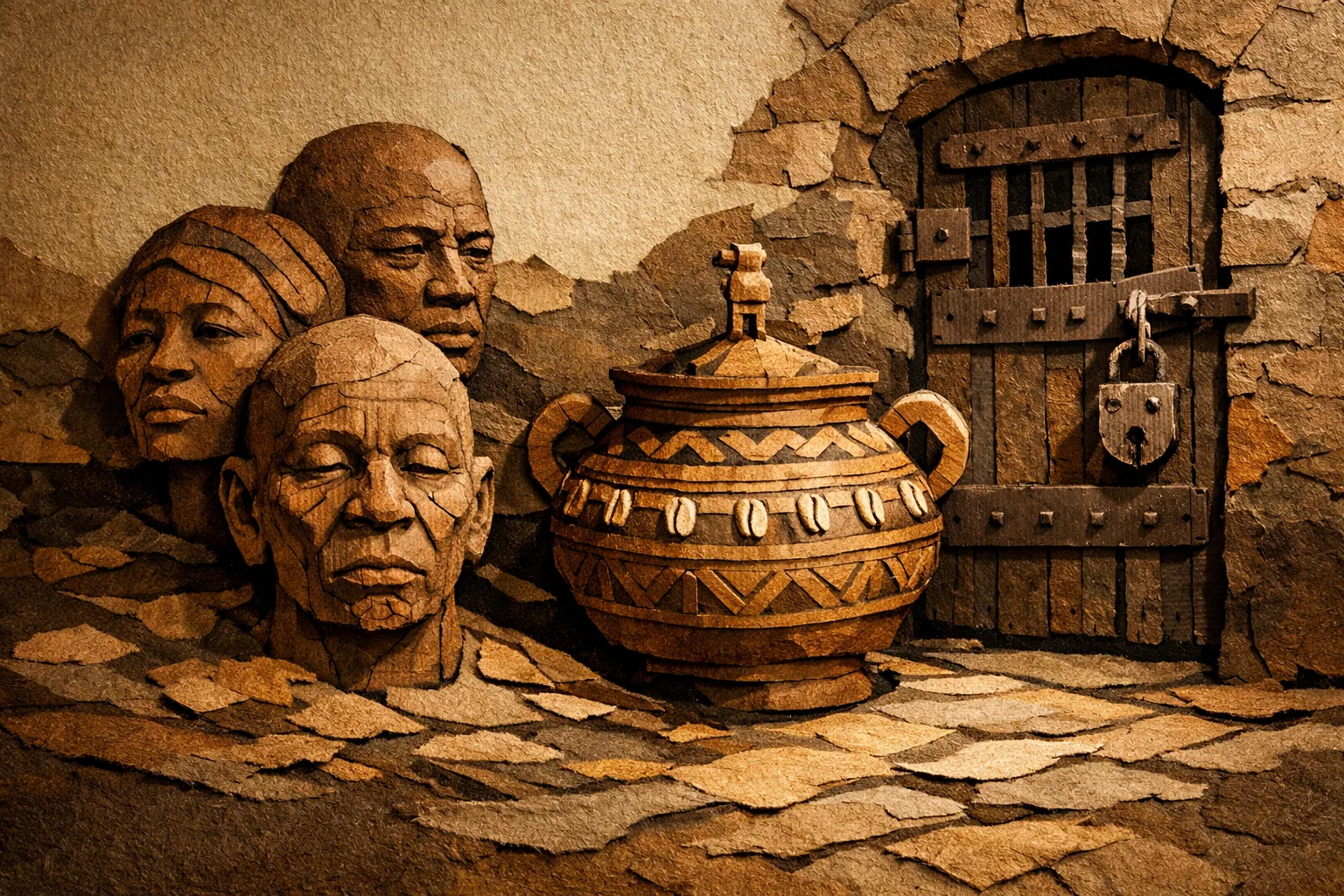
Near Ada, the Nkyinkyim Museum offers Ghana’s most visually extraordinary contemporary museum experience. Its centrepiece is an expanding installation by artist Kwame Akoto-Bamfo: thousands of individually modelled clay heads representing Africans who were enslaved, displaced or killed through the transatlantic slave trade. Some emerge from the ground or water; others wear blindfolds, masks or shackles. They form less a conventional sculpture exhibition than a symbolic population of the dead.[ancestorproject.org.gh]ancestorproject.org.ghThe Ancestor ProjectAbout The ProjectThe most notable of these is the Nkyinkyim Museum in Ada-Ghana, whose centre-piece is the globally a…
The museum describes itself as a non-profit art and education organisation concerned with healing from enslavement and colonialism. Its wider grounds include studios, installations, traditional architectural forms, cultural archives and spaces used for workshops and ceremonies. Reporting in 2025 placed the number of clay heads above 3,500, with a long-term ambition to create 11,111. Visitors commonly describe the experience as emotional rather than merely informative.[nkyinkyimmuseum.org]nkyinkyimmuseum.orgNkyinkyim MuseumAbout Us – Nkyinkyim MuseumThe Ancestor Project/Nkyinkyim Museum is a non-profit organisation that uses art and education…
What makes Nkyinkyim unusual is its deliberate blurring of memorial, museum, sacred landscape and living art project. The heads do not claim to be archaeological portraits of documented individuals. They are artistic embodiments of ancestral loss. That symbolic status should be understood clearly: the installation communicates historical violence through scale and repetition rather than through a conventional display of authenticated slave-trade artefacts.
Manhyia Palace Museum: regalia that is more than treasure
The Manhyia Palace Museum in Kumasi is outwardly a royal-history museum, but its most compelling objects resist the ordinary museum category. Asante gold ornaments, swords, badges and ceremonial vessels were created for court ritual and political authority. Their importance is not limited to craftsmanship or monetary value; Asante interpretations connect royal regalia with kingship, memory and the continuing spiritual identity of the kingdom.[britishmuseum.org]britishmuseum.orgBritish MuseumAsante Gold RegaliaThis is the largest collection of Asante regalia in the UK and one of the most significant assemblages o…
The museum became internationally prominent in 2024 when objects taken during British military attacks on Kumasi in the nineteenth century went on display there. Fifteen pieces came from the British Museum and seventeen from the Victoria and Albert Museum under a renewable loan arrangement, while seven objects from the Fowler Museum in California were permanently returned. The distinction caused debate: the British-held pieces had physically returned to Kumasi, but their legal ownership had not been transferred.[britishmuseum.org]britishmuseum.orgOpen source on britishmuseum.org.
For visitors interested in mysterious or sacred objects, the value of Manhyia lies in seeing regalia within the political culture that produced it. Gold masks, sword ornaments and court vessels can appear exotic when isolated in European display cases. In Kumasi, they are interpreted as parts of an active royal institution. The museum is therefore also a case study in contested collecting: who owns an object, who may display it and whether a loan can meaningfully repair an act of wartime looting.

Ussher Fort: a slave dungeon that became a prison
Ussher Fort in Accra has accumulated unusually dark layers of use. Built as a European trading fort, it was connected with the slave trade before serving as a police post, court-martial site, military detention centre and prison. It later accommodated refugees, and its slavery museum was temporarily closed before the fort underwent rehabilitation and reopened as a museum and documentation centre.[unesco.org]whc.unesco.orgOpen source on unesco.org.
The experience is architectural rather than object-led. Visitors pass through confined rooms, courtyards and cells whose meanings changed repeatedly as one coercive system replaced another. The fort’s prison history continued into the twentieth century, making it different from coastal castles presented solely through the history of Atlantic enslavement.[citylifeaccra.com]citylifeaccra.comCity Life Accra Ussher FortCity Life Accra Ussher Fort
Ussher Fort belongs within Ghana’s strange-history landscape because the building itself is the principal exhibit. Its unsettling quality comes from continuity: spaces originally shaped by European trade and confinement remained useful to later colonial and post-colonial systems of punishment. As with Cape Coast and Elmina castles, guided interpretation is essential; without it, an old cell or storeroom can easily be misidentified or detached from the historical period in which it was used.
Death, archaeology and objects outside conventional museums
Ghana’s most memorable collections are not always housed in galleries. Working studios, university stores and sacred sites preserve material that may be more unusual than anything in a tourist museum, but access and interpretation vary considerably.
Fantasy-coffin workshops. In and around Accra, particularly in communities associated with the Ga people, carpenters make elaborate figurative coffins shaped to represent a person’s occupation, status, ambitions or character. Examples include fish, birds, aircraft, vehicles, food products and tools. The Kane Kwei workshop in Teshie is among the best-known working studios, while other coffin makers continue and adapt the form.[kanekwei.com]kanekwei.comOpen source on kanekwei.com.
These workshops should not be mistaken for permanent coffin museums. Objects may be commissions awaiting funerals, examples retained for display, or sculptures made for international collectors. Their strangeness also changes once their purpose is explained. A fish-shaped coffin is not simply comic or macabre; it can operate as a final biographical statement, identifying the deceased with fishing, prosperity, religious symbolism or a family story.[AP News]apnews.comOpen source on apnews.com.
The University of Ghana Museum of Archaeology. Located at Legon, this is a teaching museum whose collection grew from archaeological material gathered around Achimota and from later excavations across Ghana. It preserves objects ranging from prehistory to the recent past and periodically mounts public or university-facing exhibitions.[U Garch Museum]ugarchmuseum.comU Garch Museum About UsU Garch Museum About Us
Its less visible holdings include human skeletal remains. Academic work on the museum has examined the ethical and practical difficulties of cataloguing, storing and preserving them. This makes the institution relevant to the history of medical and anatomical collections, although it should not be promoted as a spectacle of bones. Much of the material exists for teaching and research, and public access to sensitive remains may be limited or carefully controlled.[ScienceDirect]sciencedirect.comOpen source on sciencedirect.com.
The Museum of Science and Technology. Accra’s science museum was founded in the early 1960s to explain scientific and technological development in Ghana. It is not primarily a museum of medical horrors or obsolete machines, but its historic apparatus and changing exhibitions can interest visitors drawn to older technologies and the ways science was presented in the post-independence period. Its programme and gallery availability should be checked before making a special journey.[Ghana Mining and Minerals Board]gmmb.gov.ghOpen source on gmmb.gov.gh.
Shrines, sacred records and living belief
Tengzug is a religious site, not an occult attraction
The Tongo Hills and Tengzug Shrine in northern Ghana combine striking rock formations with an active sacred landscape. People travel there seeking guidance or resolution of personal problems, and local religious authority remains central to the site. Tourism descriptions commonly present the hills, caves, rock formations and shrine together, but access is governed by community rules rather than by ordinary museum practice.[visitghana.com]visitghana.comOpen source on visitghana.com.
Visitors should therefore expect guidance, restrictions and potentially sensitive ritual activity. The shrine is not a reconstructed folklore exhibit and its objects are not curios placed behind glass. Dress requirements, photography rules and permitted areas can depend upon local direction. Treating the site as a “witchcraft attraction” would obscure its continuing devotional role and flatten a complex religious tradition into tourist spectacle.
Its importance to Ghana’s curiosity culture lies precisely in this difference. European museums often preserve ritual objects after their religious use has ended or after they have been removed from their communities. At Tengzug, landscape, authority, ritual practice and material culture remain connected.
Accra’s witchcraft-trial archive
One of Ghana’s most unusual collections is largely documentary rather than visitor-facing. Records preserved at major Accra shrines contain accounts of hearings involving alleged witchcraft, curses and other disputes understood to involve supernatural as well as social harm. A British Library Endangered Archives Programme project digitised records associated with the Nai, Korle and Sakumo We shrines, including ledgers, correspondence and case papers dating mainly from 1984 to 2013. The original material remained with the relevant shrine custodians.[bl.uk]searcharchives.bl.ukOpen source on bl.uk.
These documents are important because they reveal a functioning system of adjudication rather than a collection of folktales. Complainants, accused people, priests and community members used shrine hearings to address conflicts that might also involve family tension, debt, illness, misfortune or suspected spiritual attack. Researchers have studied how civil, criminal and supernatural explanations could overlap within these proceedings.[Semantic Scholar]semanticscholar.orgOpen source on semanticscholar.org.
The archive is more credible than sensational second-hand accounts because it preserves records created through the institutions themselves. Yet it is not a neutral transcript of supernatural events. The papers document accusations, testimony and decisions; they do not prove that magic caused the harms being investigated. They are best approached as evidence of belief, authority and community conflict.
Why witch camps must not be treated as museums
Northern Ghana’s settlements for people accused of witchcraft frequently appear in unusual-travel writing. Some have received outsiders, journalists and organised visitors, leading to descriptions that resemble dark-tourism attractions. That framing is ethically misleading. These are communities of displaced people, primarily older women, who may have fled violence or been expelled after accusations arising from illness, death, family disputes or unexplained misfortune.[harvard.edu]rpl.hds.harvard.eduOpen source on harvard.edu.
Amnesty International reported that more than 500 people were living across four informal camps when researchers visited in November 2023 and April 2024. It documented inadequate access to food, water, healthcare, secure housing and livelihoods. Ghana’s Commission on Human Rights and Administrative Justice and civil-society organisations have pursued reintegration and the eventual closure of the camps, although progress has been uneven and residents cannot safely return home simply because officials declare a settlement closed.[chraj.gov.gh]chraj.gov.ghOpen source on chraj.gov.gh.
The camps are relevant to any account of Ghanaian witchcraft culture, but not because they preserve charming folklore. They show the real consequences of accusations and the authority still granted to witch-finders, shrine specialists, religious leaders and community rumours. A responsible visitor should not arrive uninvited, photograph residents as curiosities or pay intermediaries for voyeuristic access.
This is also an important credibility test for travel writing. A source that advertises a “witch village” without discussing displacement, consent and personal safety is presenting a human-rights crisis as entertainment. The most reliable accounts distinguish belief in witchcraft from evidence that a particular accused person caused supernatural harm.
What Ghana’s national collections do and do not offer
The National Museum of Ghana in Accra reopened after extensive renovation in 2022. Its galleries cover archaeology, history, ethnography and modern national life, alongside changing exhibitions. The reopening displays also included a collection of official vehicles used by former heads of state.[Ghana Mining and Minerals Board]gmmb.gov.ghOpen source on gmmb.gov.gh.
Visitors may encounter ceremonial, religious or funerary material within the broader national collection, but the museum is not a dedicated institution of magic, monsters or occult practice. Older travel descriptions and online videos sometimes single out “witchcraft objects” without explaining provenance, ritual context or whether the labels remain current. Such claims should be treated cautiously unless confirmed by the museum itself.
This limitation is revealing. Ghana’s most spiritually charged material is dispersed among royal institutions, local shrines, university collections, community custodians and museums overseas. Colonial collecting removed many objects from their original settings, while museum classification frequently separated “art”, “ethnography” and “religion” even when an object occupied all three categories. The debate over Asante regalia demonstrates how dramatically interpretation changes when material returns to an active cultural centre.[britishmuseum.org]britishmuseum.orgBritish MuseumAsante Gold RegaliaThis is the largest collection of Asante regalia in the UK and one of the most significant assemblages o…
How to judge an unusual Ghanaian collection
The most useful question is not whether a place is strange, but what kind of authority it claims.
- A formal museum should have identifiable management, stated opening arrangements and some explanation of provenance. Nkyinkyim, Manhyia Palace Museum, Ussher Fort and the national museums fit this broad category, although their governance models differ.
- A working studio produces objects for real use or sale. Fantasy-coffin workshops are active businesses and artistic spaces, not frozen reconstructions of funeral culture.
- A teaching collection may restrict access because objects or human remains are held for research rather than tourism.
- A sacred site remains under religious and community authority. Visitor access does not convert it into a museum.
- A digital archive may provide better documentary access than the physical location, particularly where original records are fragile or privately held.
- A displaced community is not an attraction. Witch camps should be understood through consent, safeguarding and human rights, not curiosity tourism.
Practical information can change quickly. Government museum pages, institutional websites and direct contact with a venue are more dependable than undated travel blogs for opening hours, exhibition status and photography rules. At shrines and workshops, arranging a recognised local guide or appointment is often more appropriate than arriving unexpectedly.
Ghana’s place in strange-museum culture
Ghana’s unusual heritage is less about hoaxes, cryptids or theatrical horror than about objects whose power remains unsettled. A clay head represents an unnamed ancestor. A gold ornament may be simultaneously art, royal property, spiritual vessel and evidence of colonial plunder. A coffin can be a sculpture, a proverb and a functioning burial container. A shrine ledger records accusations that shaped real lives. A prison cell can belong to several overlapping histories of captivity.
That makes Ghana particularly valuable for readers accustomed to Western curiosity museums, where the strange object is often isolated, labelled and made safe behind glass. Here, the central questions remain active: whether the dead are being remembered adequately, whether sacred authority should be displayed, whether looted regalia has truly returned, and whether curiosity can become exploitation.
The country’s strongest offbeat collections reward careful interpretation rather than sensationalism. Their mystery does not depend upon inventing monsters or supernatural proof. It comes from the continuing tension between museum object and living presence, between memorial and spectacle, and between possession and rightful custody.
Amazon book picks
Further Reading
Books and field guides related to Where Ghana's Strangest Objects Still Hold Power. Use these as the next step if you want deeper reading beyond the article.
A History of Zimbabwe
The first single-volume history of Zimbabwe with detailed coverage from pre-colonial times to the present, this book examines Zimbabwe's...
A History of African Archaeology
First published 1990. Subjects: History, Antiquities, Archaeology, Archéologie, Antiquités.
eBay marketplace picks
Marketplace Samples
Live-tested eBay searches with available results related to this page.
Selected fromAfrican archaeology decor oneBay.co.uk.
Endnotes
1.
Source: whc.unesco.org
Link:https://whc.unesco.org/en/news/2300
2.
Source: sciencedirect.com
Link:https://www.sciencedirect.com/science/article/abs/pii/S2352552522000020
3.
Source: rpl.hds.harvard.edu
Link:https://rpl.hds.harvard.edu/religion-context/case-studies/violence-peace/witch-camps-ghana
4.
Source: amnesty.org
Title: ghana witchcraft accusations
Link:https://www.amnesty.org/en/latest/news/2025/04/ghana-witchcraft-accusations/
5.
Source: amnesty.org
Link:https://www.amnesty.org/en/documents/afr28/9220/2025/en/
6.
Source: ghana.actionaid.org
Link:https://ghana.actionaid.org/news/2025/lawmakers-join-actionaid-ghana-and-partners-advocacy-visits-witch-camps-step-toward
7.
Source: journals.ug.edu.gh
Link:https://journals.ug.edu.gh/index.php/cjas/article/download/231/91/
8.
Source: amnesty.org
Title: Branded for life but resilient: women accused of witchcraft in Ghana
Link:https://www.amnesty.org/en/latest/news/2025/07/ghana-witchcraft-accusations-2/
9.
Source: amnesty.org
Link:https://www.amnesty.org/es/documents/afr28/9220/2025/en/
10.
Source: amnesty.org
Link:https://www.amnesty.org/es/latest/news/2025/04/ghana-witchcraft-accusations/
11.
Source: amnesty.org
Title: Ghana: Branded for Life
Link:https://www.amnesty.org/en/latest/research/2025/04/ghana-branded-for-life/
12.
Source: amnesty.org
Link:https://www.amnesty.org/zh-hant/documents/afr28/9220/2025/en/
13.
Source: ghana.travel
Link:https://ghana.travel/2022/06/13/
14.
Source: museum.knust.edu.gh
Title: knust.edu.gh Simply Iconic Travels to KNUST Museum | Opoku Ware II Museum
Link:https://museum.knust.edu.gh/gallery/simply-iconic-travels-knust-museum
15.
Source: medicalhistorymuseum.mdhs.unimelb.edu.au
Link:https://medicalhistorymuseum.mdhs.unimelb.edu.au/collections
16.
Source: ancestorproject.org.gh
Link:https://ancestorproject.org.gh/about-us/
Source snippet
The Ancestor ProjectAbout The ProjectThe most notable of these is the Nkyinkyim Museum in Ada-Ghana, whose centre-piece is the globally a...
17.
Source: nkyinkyimmuseum.org
Link:https://nkyinkyimmuseum.org/about-us/
Source snippet
Nkyinkyim MuseumAbout Us – Nkyinkyim MuseumThe Ancestor Project/Nkyinkyim Museum is a non-profit organisation that uses art and education...
18.
Source: theguardian.com
Link:https://www.theguardian.com/global-development/2025/mar/03/people-cry-get-angry-remembering-the-enslaved-in-ghanas-remarkable-sculpture-park
Source snippet
Established by artist Kwame Akoto-Bamfo in 2019, the museum aims to eventually showcase 11,111 heads, each representing an individual anc...
19.
Source: britishmuseum.org
Link:https://www.britishmuseum.org/about-us/british-museum-story/contested-objects-collection/asante-gold-regalia
Source snippet
British MuseumAsante Gold RegaliaThis is the largest collection of Asante regalia in the UK and one of the most significant assemblages o...
20.
Source: museumsassociation.org
Title: va commission marks next phase of ghana partnership
Link:https://www.museumsassociation.org/museums-journal/news/2025/10/va-commission-marks-next-phase-of-ghana-partnership/
Source snippet
Museums AssociationV&A commission marks next phase of Ghana partnership23 Oct 2025 — The V&A holds a small but significant collection of...
21.
Source: theguardian.com
Title: vas return of looted ghana gold is a new way to tackle britains painful past
Link:https://www.theguardian.com/culture/2024/jan/27/vas-return-of-looted-ghana-gold-is-a-new-way-to-tackle-britains-painful-past
Source snippet
Other material, including "two complete masks of gold", were acquired by the British Museum, the Wallace Collection, and the royal househ...
22.
Source: britishmuseum.org
Link:https://www.britishmuseum.org/sites/default/files/2024-01/Asante_regalia_to_be_displayed_in_Ghana_for_first_time_in_150_years.pdf
23.
Source: vam.ac.uk
Title: homecoming exhibition of asante gold regalia at manhiya palace museum kumasi
Link:https://www.vam.ac.uk/blog/news/homecoming-exhibition-of-asante-gold-regalia-at-manhiya-palace-museum-kumasi?srsltid=AfmBOopUAIbZ_913rujTgzNryH55mZ20hQyUtdCoumb5r0RWFVwc65AM
24.
Source: apnews.com
Link:https://apnews.com/article/e5aa77f9c07ab8952e507dd01e983c76
25.
Source: apnews.com
Link:https://apnews.com/article/d4165d0364c59aaadb1a4f4dfdab9dbb
26.
Source: ghana.un.org
Link:https://ghana.un.org/en/131052-unesco-and-partners-rehabilitate-ussher-fort-slave-museum-and-documentary-centre-accra
27.
Source: gmmb.gov.gh
Link:https://gmmb.gov.gh/museums/
28.
Source: citylifeaccra.com
Title: City Life Accra Ussher Fort
Link:https://www.citylifeaccra.com/features-accra/ussher-fort
29.
Source: uni-passau.de
Title: University of Passau Fort Ussher
Link:https://www.uni-passau.de/en/mitrawa/public/fort-ussher
30.
Source: graphic.com.gh
Title: ghana news a peep into ussher fort
Link:https://www.graphic.com.gh/lifestyle/life/ghana-news-a-peep-into-ussher-fort.html
31.
Source: kanekwei.com
Link:https://www.kanekwei.com/contact
32.
Source: apnews.com
Link:https://apnews.com/article/01220db5b2e240a12ae8e4ba8820f993
33.
Source: ugarchmuseum.com
Title: U Garch Museum About Us
Link:https://ugarchmuseum.com/about/
34.
Source: ugarchmuseum.com
Link:https://ugarchmuseum.com/
35.
Source: gmmb.gov.gh
Title: museum of science and technology mst accra 1963
Link:https://gmmb.gov.gh/museum-of-science-and-technology-mst-accra-1963/
36.
Source: visitghana.com
Link:https://visitghana.com/tengzug-tongo-hills-and-shrines/
37.
Source: graphic.com.gh
Link:https://www.graphic.com.gh/news/general-news/ghana-news-iconic-tongo-hills-tengzug-shrine-whistling-rocks-revamping-needed-to-boost-tourism.html
38.
Source: searcharchives.bl.uk
Link:https://searcharchives.bl.uk/?f%5Bcollection_area_ssi%5D%5B%5D=Endangered+Archives+Programme&f%5Bmaterial_type_si%5D%5B%5D=Archives+and+Manuscripts&f%5Bproject_collections_ssim%5D%5B%5D=Shrines+of+Accra%3A+Witchcraft+trial+records+at+Nai%2C+Korle+and+Sakumo+We%2C+Accra%2C+Ghana&f%5Brelated_places_ssim%5D%5B%5D=Ghana%2C+Africa&page=1&per_page=20&search_field=all_fields&sort=title_for_sort_si+asc%2C+scope_and_content_for_sort_si+asc%2C+reference_for_sort_si+asc
39.
Source: africacommons.net
Link:https://africacommons.net/artifacts/3124960/shrines-of-accra/3918163/
40.
Source: searcharchives.bl.uk
Link:https://searcharchives.bl.uk/?f%5Blanguage_ssim%5D%5B%5D=English&f%5Bmaterial_type_si%5D%5B%5D=Archives+and+Manuscripts&f%5Bproject_collections_ssim%5D%5B%5D=Shrines+of+Accra%3A+Witchcraft+trial+records+at+Nai%2C+Korle+and+Sakumo+We%2C+Accra%2C+Ghana&f%5Brelated_places_ssim%5D%5B%5D=Ghana%2C+Africa&f%5Burl_non_blank_si%5D%5B%5D=Yes+%28available%29&per_page=20&sort=hierarchy
41.
Source: semanticscholar.org
Link:https://www.semanticscholar.org/paper/Shrines%2C-Witches%2C-and-Explanations-on-Trial%3A-The-of-Martin/235001ed0e9f923ff7f067d0aa9212221441e1e8
42.
Source: chraj.gov.gh
Link:https://chraj.gov.gh/2025/03/11/chraj-set-to-shut-down-witch-camps-by-dec-20/
43.
Source: chraj.gov.gh
Link:https://chraj.gov.gh/2025/04/08/chrajs-northern-regional-office-engages-chiefs-on-human-rights-abuses-against-persons-accused-of-witchcraft/
44.
Source: gmmb.gov.gh
Link:https://gmmb.gov.gh/the-national-museum-of-ghana-reopens/
45.
Source: gmmb.gov.gh
Link:https://gmmb.gov.gh/exhibitions/
46.
Source: unescoghana.gov.gh
Link:https://unescoghana.gov.gh/j/288554449
47.
Source: gmmb.gov.gh
Title: Exhibitions – Ghana Museums and Monuments Board
Link:https://gmmb.gov.gh/category/exhibitions/
48.
Source: motac.gov.gh
Link:https://www.motac.gov.gh/president-akufo-addo-re-opens-refurbished-kwame-nkrumah-memorial-park/
49.
Source: ama.gov.gh
Link:https://ama.gov.gh/news-details.php?n=czEwb3A2NXIyMXBwcm4wMnJyN29wbnNxNXE4NjhzMm40MTZvMDIzNg%3D%3D
50.
Source: reddit.com
Link:https://www.reddit.com/r/submechanophobia/comments/1jj6z73/the_ancestor_project_at_nkyinkyim_museum_ghana/
51.
Source: facebook.com
Link:https://www.facebook.com/groups/3244777048911738/posts/5768281689894582/
52.
Source: instagram.com
Link:https://www.instagram.com/nkyinkyim_museum/?hl=en
53.
Source: gmmb.gov.gh
Link:https://gmmb.gov.gh/
54.
Source: gmmb.gov.gh
Link:https://gmmb.gov.gh/national-museum-of-ghana/
55.
Source: gmmb.gov.gh
Title: exhibitions grid
Link:https://gmmb.gov.gh/exhibitions-grid/
56.
Source: gmmb.gov.gh
Title: the national museum accra 1957
Link:https://gmmb.gov.gh/the-national-museum-accra-1957/
57.
Source: gmmb.gov.gh
Link:https://gmmb.gov.gh/news/page/2/
58.
Source: searcharchives.bl.uk
Link:https://searcharchives.bl.uk/?f%5Bcollection_area_ssi%5D%5B%5D=Endangered+Archives+Programme&f%5Bmaterial_type_si%5D%5B%5D=Archives+and+Manuscripts&f%5Brelated_places_ssim%5D%5B%5D=Ghana%2C+Africa&page=4&per_page=10&search_field=all_fields&sort=title_for_sort_si+asc%2C+scope_and_content_for_sort_si+asc%2C+reference_for_sort_si+asc
59.
Source: Wikipedia
Title: Ussher Fort
Link:https://en.wikipedia.org/wiki/Ussher_Fort
60.
Source: Wikipedia
Title: National Museum of Ghana
Link:https://en.wikipedia.org/wiki/National_Museum_of_Ghana
61.
Source: africacommons.net
Link:https://africacommons.net/orgs/endangered-archives-programme/
62.
Source: kanekwei.com
Link:https://www.kanekwei.com/past-events
63.
Source: kanekwei.com
Link:https://www.kanekwei.com/about
64.
Source: africanscolumn.com
Link:https://africanscolumn.com/nkyinkyim-museum-the-must-visit-treasure-preserving-african-history-and-culture-in-ghana/
65.
Source: nkyinkyimmuseum.org
Link:https://nkyinkyimmuseum.org/donate/
Additional References
66.
Source: youtube.com
Link:http://www.youtube.com/watch?v=Qpd9j-J8YFI
Source snippet
Kwame Akoto-Bamfo Nkyinkyim Museum Ghana NKYINKYIM: The Creation of an African Museum | Kwame Akoto Bamfo | TEDxAccra TEDx Talks...
67.
Source: youtube.com
Title: Nkyinkyim Installation
Link:http://www.youtube.com/watch?v=de6o8CQcduk
Source snippet
Sculptor Kwame Akoto-Bamfo chats Africa, Ghana, the origins of his work, and why he chose sculpting...
68.
Source: youtube.com
Title: $20,000 FANTASY COFFINS! | Touring the Fantasy Coffin Workshop in Ghana!
Link:http://www.youtube.com/watch?v=r6SjwU60EDo
Source snippet
Nkyinkyim Installation - Sculptures dedicated to enslaved African ancestors lost...
69.
Source: journals.openedition.org
Link:https://journals.openedition.org/angles/9964
Source snippet
OpenEdition JournalsA Means of Raising Awareness about the History of Trans-...by B Sidibé · 2025 — This article explores the artistic pr...
70.
Source: youtube.com
Title: Meet the First Family of Custom Coffins
Link:http://www.youtube.com/watch?v=LqBnoETB5EA
Source snippet
$20,000 FANTASY COFFINS! | Touring the Fantasy Coffin Workshop in Ghana...
71.
Source: facebook.com
Link:https://www.facebook.com/amnestyafrica/posts/a-look-back-at-the-opening-of-our-photo-exhibition-i-am-not-a-witch-at-the-place/1360062772816295/
72.
Source: facebook.com
Link:https://www.facebook.com/missuppereastghana/videos/a-visit-to-the-tengzug-shrine-and-tongo-hills-in-the-upper-east-region-of-ghana-/500912780701846/
73.
Source: instagram.com
Link:https://www.instagram.com/reel/DEGkMdsCmRG/?hl=en
74.
Source: graphic.com.gh
Link:https://www.graphic.com.gh/news/general-news/bringing-museums-alive-9-iconic-facilities-to-be-rehabilitated-national-gallery-reopens-in-march.html
75.
Source: gna.org.gh
Link:https://gna.org.gh/2024/04/chraj-appeals-to-president-akufo-addo-to-urgently-sign-anti-witchcraft-bill/