Within Strange Ecuador
Should Ecuador's Tsantsa Be Displayed at All?
Ecuador's ceremonial heads reveal how ritual objects became trophies, museum specimens and subjects of repatriation.
On this page
- What tsantsa meant in Shuar and Achuar ritual life
- How collecting created fakes and lost identities
- Authentication, repatriation and respectful display
Page outline Jump by section
Introduction
Should Ecuador’s tsantsa be displayed at all? There is no simple yes-or-no answer. Today, most museum professionals, Indigenous representatives and heritage authorities agree that tsantsa are not merely unusual artefacts or tourist curiosities. They are human remains with deep cultural significance, shaped by a history of ritual practice, colonial collecting and an international market that encouraged exploitation. The debate has therefore shifted away from whether shrunken heads are fascinating towards how they should be interpreted, who has the authority to decide their future, and whether display, storage, repatriation or ceremonial care is the most respectful option. Recent returns of tsantsa to Ecuador and collaborations with Shuar communities show that museums are increasingly treating them as living cultural heritage rather than macabre exhibits.[unesco.org]unesco.orgtzantza restituted ecuadorA Tzantza Restituted to Ecuador | UNESCOJune 13, 2025…
What tsantsa meant in Shuar and Achuar ritual life
Public discussion often reduces tsantsa to “shrunken heads”, but that description obscures their original cultural context. Ceremonial tsantsa were created by some Indigenous peoples of the upper Amazon, particularly the Shuar and, to a lesser extent in historical accounts, the Achuar, as part of complex social and spiritual traditions rather than as decorative objects or collectibles. Their significance was bound to ideas about warfare, kinship, ritual power and relationships between communities.
Modern museums increasingly stress that these objects cannot be understood simply through their physical appearance. Detached from their original ceremonial setting, they easily become spectacles that reinforce stereotypes portraying Amazonian peoples as violent or “primitive”. This concern has become one of the strongest arguments for rethinking traditional museum displays.[prm.ox.ac.uk]prm.ox.ac.ukProyecto Tsantsa | Pitt Rivers MuseumProyecto Tsantsa | Pitt Rivers Museum
For Ecuador, this matters because tsantsa are simultaneously:
- human remains deserving respectful treatment;
- cultural heritage associated with living Indigenous communities;
- evidence of colonial collecting practices; and
- objects whose meaning has often been distorted for commercial audiences.
How collecting created fakes and lost identities
The greatest ethical difficulty is not only that many tsantsa entered museums through unequal colonial relationships, but that the nineteenth- and early twentieth-century international curiosity trade fundamentally changed what was being collected.
European and North American demand for exotic souvenirs created a profitable market. Historical research indicates that commercial demand encouraged the manufacture of additional heads specifically for sale, while skilled forgers also produced convincing imitations using animal remains or other materials. As a result, museum collections around the world contain mixtures of authentic ceremonial tsantsa, commercial-era examples and outright fakes.[Nature]nature.comThe authentication and repatriation of a ceremonial tsantsa to its country of origin (Ecuador) | npj Heritage Science…
This has several consequences.
First, provenance is frequently poor. Many museums cannot identify the individual, community or exact circumstances under which a particular tsantsa was acquired.
Second, authenticity is uncertain. Modern scientific examination—including anatomical study, imaging and forensic analysis—is often required before museums can determine whether a specimen is genuinely human and whether it was produced using traditional techniques.[Nature]nature.comThe authentication and repatriation of a ceremonial tsantsa to its country of origin (Ecuador) | npj Heritage Science…
Third, commercial collecting erased personal identities. Many surviving specimens are catalogued only as anonymous ethnographic objects, making it impossible to reconnect them with named individuals or specific communities.
Why display has become so controversial
The ethical debate today is less about preserving tsantsa than about displaying them.
Traditional ethnographic museums frequently exhibited shrunken heads alongside weapons and “primitive” curiosities, encouraging visitors to view them as shocking trophies. Critics argue that this presentation stripped them of cultural meaning while reinforcing racist narratives about Indigenous peoples.
A growing number of museums have therefore removed tsantsa from permanent public galleries. One of the best-known examples is the Pitt Rivers Museum in Oxford, which withdrew its tsantsa from display after concluding that visitors often interpreted them through stereotypes rather than understanding their cultural context. The museum now works directly with Shuar representatives to decide whether and how such remains should ever be exhibited again.[prm.ox.ac.uk]prm.ox.ac.ukProyecto Tsantsa | Pitt Rivers MuseumProyecto Tsantsa | Pitt Rivers Museum
The shift reflects a broader principle increasingly applied to human remains worldwide: educational value alone is no longer considered sufficient justification for permanent display if descendant communities object or if the display causes continuing harm.
Authentication, repatriation and respectful display
Recent events involving Ecuador illustrate how museum practice is changing.
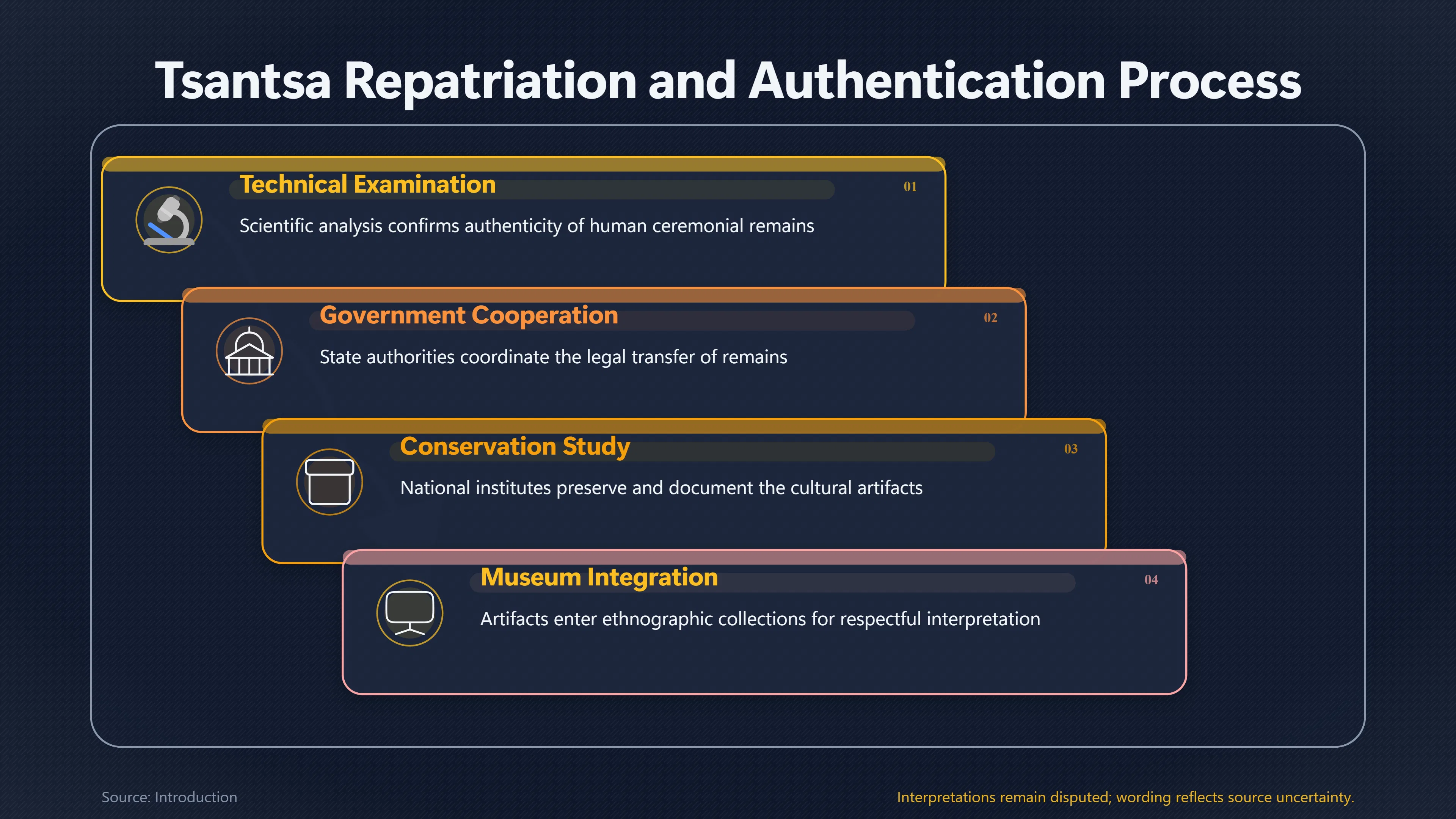
A tsantsa held for decades in the Vatican Museums was returned to Ecuador after technical examination confirmed it to be an authentic human ceremonial object associated with the Shuar. Following conservation and study by Ecuador’s National Institute of Cultural Heritage, it was transferred to the Pumapungo Museum in Cuenca, where authorities intended it to be interpreted within Ecuador’s most important ethnographic collection rather than as an isolated curiosity.[patrimoniocultural.gob.ec]patrimoniocultural.gob.ecOpen source on gob.ec.
The process demonstrated several modern principles:
- Scientific authentication before making decisions about ownership or display.
- Recognition as cultural heritage, not merely an anthropological specimen.
- Government-to-government cooperation in returning culturally significant human remains.
- Controlled interpretation that explains historical and Indigenous context instead of presenting sensational imagery.[gob.ec]patrimoniocultural.gob.ecOpen source on gob.ec.
The process has continued internationally. In 2025, a Swiss family voluntarily returned another authenticated tsantsa to Ecuador with support from UNESCO and specialists at the University of Geneva after learning more about its cultural significance. The case reflects a growing willingness among private holders to treat such objects as heritage requiring respectful return rather than collectible curiosities.[UNESCO]unesco.orgtzantza restituted ecuadorA Tzantza Restituted to Ecuador | UNESCOJune 13, 2025…
Does repatriation always mean public display ends?
Not necessarily.
Repatriation and display are separate questions. Returning a tsantsa to Ecuador does not automatically mean it will disappear into storage, nor does keeping one in a museum automatically imply disrespect.
Instead, museums increasingly ask several practical questions before deciding what should happen:
- Is the tsantsa authentic?
- Is its provenance adequately documented?
- Have descendant communities been consulted?
- Does public display educate visitors without sensationalising human remains?
- Are there cultural or spiritual reasons that favour restricted access instead?
These questions recognise that no single solution fits every case. Different Indigenous communities may have different expectations regarding ancestral remains, and decisions increasingly depend on consultation rather than assumptions.[prm.ox.ac.uk]prm.ox.ac.ukProyecto Tsantsa | Pitt Rivers MuseumProyecto Tsantsa | Pitt Rivers Museum
What visitors should expect in Ecuador today
Visitors expecting horror-museum presentations are likely to be surprised.
Where tsantsa are displayed in Ecuador’s major public institutions, interpretation increasingly emphasises Indigenous history, colonial collecting and cultural meaning instead of shock value. Displays tend to be incorporated into wider ethnographic exhibitions that explain Amazonian societies rather than isolating the heads as bizarre curiosities.
This approach also reflects a broader change in Ecuador’s heritage policy. Human remains are increasingly treated as subjects requiring dignity, research and cultural dialogue rather than simply as museum attractions. The aim is not to erase difficult history but to ensure that visitors understand how these objects became museum specimens in the first place—and why many museums now believe that respectful interpretation matters as much as the objects themselves.[gob.ec]patrimoniocultural.gob.ecOpen source on gob.ec.
Amazon book picks
Further Reading
Books and field guides related to Should Ecuador's Tsantsa Be Displayed at All?. Use these as the next step if you want deeper reading beyond the article.
The Spears of Twilight: Life and Death in the Amazon Jungle
The Achuar people have survived in isolation in the Amazonian jungle by aggressively resisting intruders. In this book, Descola depicts a...
Museums and Restitution: New Practices, New Approaches
This book examines contemporary approaches to restitution from the perspective of museums. It focuses on the ways in which these institut...
eBay marketplace picks
Marketplace Samples
Live-tested eBay searches with available results related to this page.
Selected fromMakes Ecuador's Strangest Collections patch oneBay.co.uk.

Endnotes
1.
Source: unesco.org
Title: tzantza restituted ecuador
Link:https://www.unesco.org/en/articles/tzantza-restituted-ecuador
Source snippet
A Tzantza Restituted to Ecuador | UNESCOJune 13, 2025...
Published: June 13, 2025
2.
Source: patrimoniocultural.gob.ec
Link:https://www.patrimoniocultural.gob.ec/tzantza-ecuatoriana-que-reposaba-en-el-vaticano-llega-a-pumapungo/
3.
Source: prm.ox.ac.uk
Title: Proyecto Tsantsa | Pitt Rivers Museum
Link:https://www.prm.ox.ac.uk/proyecto-tsantsa
4.
Source: prm.ox.ac.uk
Title: Critical Changes | Pitt Rivers Museum
Link:https://www.prm.ox.ac.uk/node/1268656
5.
Source: nature.com
Link:https://www.nature.com/articles/s40494-021-00518-z
Source snippet
The authentication and repatriation of a ceremonial tsantsa to its country of origin (Ecuador) | npj Heritage Science...
6.
Source: cancilleria.gob.ec
Link:https://www.cancilleria.gob.ec/2018/01/20/la-cancilleria-entrega-al-instituto-nacional-de-patrimonio-cultural-la-tzantza-restituida-por-el-vaticano/
Source snippet
CancilleríaLa Cancillería entrega al Instituto Nacional de Patrimonio Cultural la tzantza restituida por el Vaticano – Ministerio de Rela...
7.
Source: unesco.org
Title: una tzantza restituida al ecuador
Link:https://www.unesco.org/es/articles/una-tzantza-restituida-al-ecuador
Source snippet
June 13, 2025 — UNA TZANTZA RESTITUIDA AL ECUADOR El 21 de mayo de 2025, la UNESCO acogió la ceremonia de restitución de un bien cu...
Published: June 13, 2025
Additional References
8.
Source: museumsassociation.org
Title: Shuar people seek repatriation of ‘shrunken heads’ in UK collections
Link:https://www.museumsassociation.org/museums-journal/news/2025/10/shuar-people-seek-repatriation-of-shrunken-heads-in-uk-collections/
Source snippet
Museums AssociationOctober 28, 2025 — * News * Repatriation * Co-curation * Human remains SHUAR PEOPLE SEEK REPATRIATION OF ‘SHRUNKEN HEA...
Published: October 28, 2025
9.
Source: pmc.ncbi.nlm.nih.gov
Link:https://pmc.ncbi.nlm.nih.gov/articles/PMC7618824/
Source snippet
ethical disagreement on ancestral human remains in museums - PMCFebruary 11, 2026 — INTRODUCTION This paper explores two participative, i...
Published: February 11, 2026
10.
Source: journals.plos.org
Link:https://journals.plos.org/plosone/article?id=10.1371%2Fjournal.pone.0270305
Source snippet
tomography and authentication features of a shrunken head (tsantsa) | PLOS OneAugust 3, 2022 — CORRELATIVE TOMOGRAPHY AND AUTHENTICATION...
Published: August 3, 2022
11.
Source: sciencedirect.com
Link:https://www.sciencedirect.com/science/article/abs/pii/S1296207416300024
12.
Source: sciencedirect.com
Link:https://www.sciencedirect.com/science/article/pii/S1296207416300024
13.
Source: doaj.org
Link:https://doaj.org/article/777e6bc71b784f9eaa88dc9adfd8a9a3
14.
Source: redi.cedia.edu.ec
Link:https://redi.cedia.edu.ec/document/255071
15.
Source: paediatrics.ox.ac.uk
Link:https://www.paediatrics.ox.ac.uk/publications/1560535
16.
Source: research.usfq.edu.ec
Link:https://research.usfq.edu.ec/en/publications/correlative-tomography-and-authentication-features-of-a-shrunken-/
17.
Source: dialnet.unirioja.es
Link:https://dialnet.unirioja.es/servlet/articulo?codigo=6086131