Where Georgia Keeps Its Strangest Stories
Georgia’s strangest collections are not concentrated in a single museum of witchcraft, monsters or paranormal phenomena. Instead, the country’s curiosity culture is scattered across archaeological displays, Soviet memorial museums, private ethnographic environments, scientific specimen collections, palace treasuries and active religious sites.
Page outline Jump by section
Introduction
This makes Georgia rewarding for travellers who prefer unusual history to manufactured horror. Its oddities are generally embedded in serious institutions rather than promoted as freak-show attractions. Visitors therefore need to distinguish between scientifically documented finds, politically selective displays, family collections, reconstructed folklore and objects preserved because believers regard them as sacred.[museum.ge]museum.geCOLLECTIONS საქართველოს ეროვნული მუზეუმი… Painting… Collection of Russian Art…
Where Georgia’s unusual collections are found
Georgia has no well-documented national museum devoted specifically to cryptids, UFOs, ceremonial magic or witchcraft. The strongest public collections instead fall into four overlapping groups:
- Scientific curiosities, particularly the early-human fossils from Dmanisi and the entomological and industrial holdings of the State Silk Museum.
- Political relics, centred on Stalin, Soviet occupation and revolutionary underground activity.
- Dynastic and devotional objects, including death masks, reliquaries, icons and objects connected to saints or biblical tradition.
- Immersive folk environments, where historic work, clothing and domestic life are reconstructed through buildings, mannequins, tools and hand-carved scenes.
This dispersed pattern matters. Georgia’s strange-history landscape is less about claiming that unexplained creatures or supernatural forces are real than about preserving objects at the boundary between evidence, memory, ideology and belief. The same item can be a scholarly specimen, a national symbol, a political problem or a pilgrimage focus depending on where and how it is displayed.
Dmanisi and the deep past
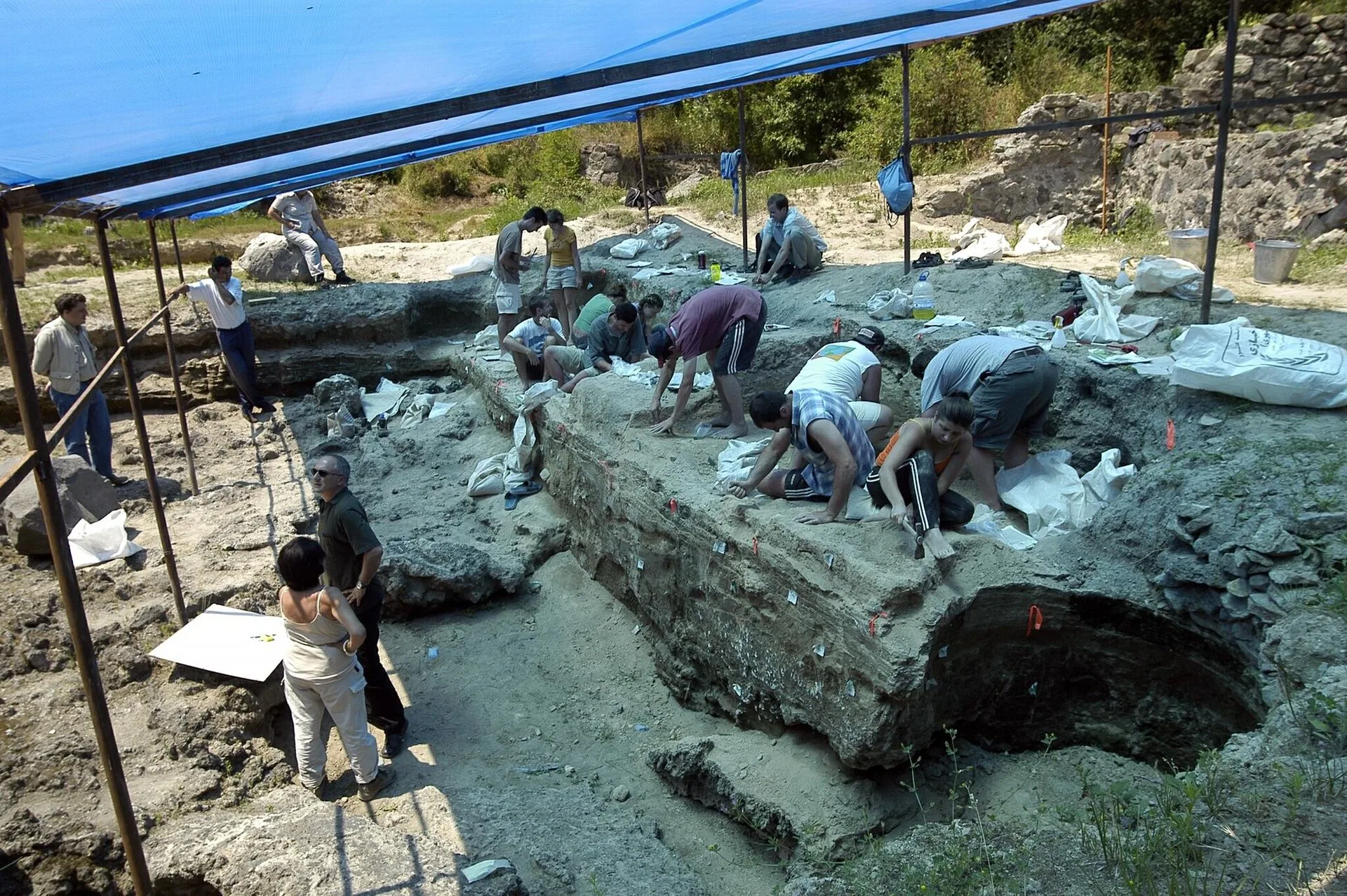
The most extraordinary scientifically credible material in Georgia comes from Dmanisi, south-west of Tbilisi. Beneath the ruins of a medieval town, archaeologists found exceptionally early remains of human ancestors, fossil animals and stone tools dating to roughly 1.8 million years ago. International geological heritage records describe Dmanisi as providing the earliest known evidence of early humans outside Africa, with a substantial collection of hominin remains, thousands of animal fossils and thousands of stone artefacts.[UNESCO World Heritage Centre]whc.unesco.orgUNESCO World Heritage CentreDmanisi Hominid Archaeological SiteSeveral hominid individuals (4 skulls, 3 of them with maxillas, 4 mandible…
For an ordinary visitor, the uncanny quality comes from scale rather than spectacle. The skulls are recognisably human yet sufficiently different to raise difficult questions about what counts as a species and how early populations moved across continents. Five relatively complete skulls found at the site show considerable variation between individuals, contributing to continuing scientific discussion about early human classification. The finds are not archaeological “anomalies” in the Fortean sense: they are carefully excavated, dated and studied evidence. Their strangeness lies in how dramatically they expand Georgia’s place in the human story.
The Dmanisi Museum-Reserve combines several historical layers: a Palaeolithic site, later Bronze Age material and the remains of a medieval settlement. Some original Dmanisi fossils are preserved by the Georgian National Museum in Tbilisi, so travellers should not assume that every celebrated skull is displayed at the excavation site itself.[Georgian Travel Guide]georgiantravelguide.comGeorgian Travel GuideDmanisi Museum-ReserveThe museum-reserve includes: a medieval town, archaeological layers of the Late Bronze Age and…
The State Silk Museum’s cabinet of cocoons
Tbilisi’s State Silk Museum is one of Georgia’s clearest examples of a genuine scientific cabinet of curiosity. Created in connection with a nineteenth-century Caucasian sericulture station, it treats silk not simply as luxury fabric but as an entire biological and industrial system involving moths, larvae, mulberry trees, diseases, dyes, machinery and human labour.
Its most distinctive holding is a collection of up to 5,000 silkworm cocoons of different species and varieties, gathered from the Caucasus, Europe and Asia. The museum also preserves butterflies, containers for silkworm eggs, dye samples, textiles, lace, production tools and educational models. Rows of cocoons differing in shape, size and colour can resemble an archive of tiny natural sculptures.[Museu.MS]museu.msspecial containers for silkworms and eggs (approximately…
The museum is unusual because its old-fashioned scientific atmosphere is authentic rather than artificially themed. Its building, specimens and laboratory heritage grew from a working research institution. This places it somewhere between a natural-history museum, an industrial museum and a surviving nineteenth-century research collection.
After four years of restoration, the museum officially reopened on 9 October 2024. Its own published visitor information lists regular opening days from Tuesday to Saturday, although hours should still be checked before travel.[aracneproject.eu]aracneproject.eustate silk museum reopens celebrating 135 years of georgian sericulture heritagestate silk museum reopens celebrating 135 years of georgian sericulture heritage
Stalin’s objects and the battle over memory
The museum in Gori
The Joseph Stalin Museum in Gori is probably Georgia’s best-known dark-history attraction. Its complex includes the small house associated with Stalin’s childhood, a monumental museum building, personal possessions and gifts, a death mask and an armoured railway carriage used during his leadership of the Soviet Union. The result has often been described less as a critical history museum than as a preserved Soviet-era shrine.[Wikipedia]WikipediaJoseph Stalin MuseumJoseph Stalin Museum
The strangest object may be the railway carriage: a heavily armoured mobile interior linked to journeys including the Tehran and Yalta conferences. Yet the museum’s deeper peculiarity is curatorial. Portraits, presents and heroic imagery give material form to the cult of personality, while the violence of forced collectivisation, mass repression, deportation and the labour-camp system has historically occupied far less space.
Recent reporting and museum commentary continue to criticise the imbalance. Accounts from 2024 described the main galleries as overwhelmingly celebratory, with information about the Great Terror confined to a comparatively small area. Earlier plans to transform or substantially reinterpret the institution were not fully realised.[The Times]thetimes.co.ukThe Times Stalin museum celebrates the local boy made goodThe Times Stalin museum celebrates the local boy made good
Visitors should therefore approach Gori on two levels. It is a collection of authentic and attributed objects connected with Stalin, but it is also an artefact of Soviet museum-making. What is omitted is as important as what appears in the cases. The museum is valuable precisely because it exposes unresolved arguments within Georgia about whether Stalin should be remembered principally as a powerful Georgian, a Soviet victor or the architect of mass state violence. That dispute remains part of the country’s contemporary political culture.[The Guardian]theguardian.comOpen source on theguardian.com.
The underground printing house
Tbilisi’s underground printing-house museum offers a smaller, rougher and more atmospheric encounter with revolutionary history. The original clandestine operation produced illegal anti-tsarist publications in the early twentieth century. Access to the concealed press involved hidden rooms, passages and a well used as part of the entry system, allowing material to be produced away from police scrutiny.[Atlas Obscura]atlasobscura.comAtlas Obscura Stalin's Underground Printing House Museum in TbilisiAtlas Obscura Stalin's Underground Printing House Museum in Tbilisi
The site is often associated prominently with the young Stalin, although the operation involved a wider network of Bolsheviks and other revolutionaries. Its preserved machinery, subterranean chamber and revolutionary memorabilia make it feel closer to a bunker or conspiratorial hideout than a conventional biographical museum.
Interpretation has sometimes depended heavily on individual custodians and inherited Soviet narratives. For that reason, it is better treated as a historic site with a politically layered presentation than as a neutral account of revolutionary activity. Visitor reports and opening arrangements have varied, so access should be confirmed locally rather than assumed.[Tripadvisor]tripadvisor.co.ukOpen source on tripadvisor.co.uk.
Soviet occupation from the victims’ side
The Soviet Occupation Exhibition Hall in Tbilisi provides the essential counterweight to Gori. Opened in 2006 as part of the Georgian National Museum, it covers the Bolshevik invasion of 1921, anti-Soviet resistance, political repression and the restoration of Georgian independence in 1991.
Its collection includes more than 3,000 objects and documents, film material, interrogation records, execution or exile orders and personal files connected with people targeted by the regime. One of its most disturbing exhibits is a railway wagon associated with the killing of participants in the 1924 uprising.[Museum]museum.geOpen source on museum.ge.
This is not an oddity museum in a playful sense. It belongs in Georgia’s strange-collections landscape because it preserves the physical machinery of fear: bureaucratic documents, prison material, surveillance records and transport infrastructure turned into evidence of state violence. Seen alongside the Stalin Museum, it also demonstrates how two institutions can use objects from the same broad period to tell radically different moral stories.
Napoleon’s death mask in Zugdidi
The Dadiani Palaces Museum in Zugdidi combines aristocratic interiors, dynastic history, weapons, art and family possessions. Its most famous curiosity is a bronze death mask of Napoleon Bonaparte. The object reached Georgia through the Dadiani family’s connection with the Murat branch of Napoleon’s extended family after Salome Dadiani married Achille Murat.[Hikasus Travel]hikasustravel.comOpen source on hikasustravel.com.
Death masks were made by taking an impression from a person’s face shortly after death and then producing casts from that mould. They occupied an ambiguous position between documentary portraiture, memorial object and relic. The Zugdidi example is therefore more than a celebrity souvenir: it represents a nineteenth-century culture in which physical likeness was believed to preserve something unusually direct about the deceased.
Claims about exactly which casts are “original” can become confused. Napoleon’s first facial mould was made after his death on Saint Helena in 1821, but multiple casts and later versions circulated. Visitors should understand the Zugdidi mask as a significant Napoleonic object with a strong family provenance, while treating promotional claims about rarity or precise edition numbers cautiously unless supported by specialist cataloguing.[Liverpool Museums]liverpoolmuseums.org.ukOpen source on liverpoolmuseums.org.uk.
The palace collection matters within Georgia because it reveals how far dynastic collecting networks extended. A seemingly improbable French imperial relic in western Georgia becomes understandable once marriage, exile, aristocratic mobility and inherited collections are taken into account.

Folk life rebuilt by hand
Near Batumi, the private Borjgalo Ethnographic Museum presents Adjarian rural life through handmade figures, carved objects, architectural models, tools and recreated work scenes. Its founder, woodcarver Kemal Turmanidze, spent decades constructing an immersive environment populated by costumed figures engaged in weaving, farming, beekeeping, wine production and other traditional activities.[Georgia Travel & Tours]georgia.toTravel & Tours Borjgalo Ethnographical MuseumTravel & Tours Borjgalo Ethnographical Museum
The museum can feel uncanny because the human figures are frozen in action inside densely arranged domestic and workshop settings. Unlike a state ethnographic museum, it reflects the vision and craftsmanship of one collector-maker. This gives it warmth and personality, but also means the display is an artistic reconstruction rather than an untouched village preserved in place.
Its value lies in the meeting of folklore, memory and outsider-scale making. Hundreds of carvings and carefully staged scenes transform ordinary labour into a personal miniature world. It is tourist-facing and accessible, yet more idiosyncratic than a standard regional history museum.
Tbilisi’s much larger Open Air Museum of Ethnography offers a more institutional comparison. Founded in 1966 as the first open-air ethnographic museum in the Caucasus, it gathers historic buildings and material culture from different regions of Georgia. Borjgalo is the personal cabinet; the Tbilisi museum is the national landscape reconstructed at architectural scale.[Museum]museum.geOpen source on museum.ge.
Sacred objects are not simply exhibits
Georgia’s medieval churches, treasuries and art collections contain reliquaries, icons, crosses and objects connected by tradition to saints or biblical events. These should not be approached as though they were paranormal props. In an active religious setting, their function is devotional: believers may regard them as channels of sacred presence, while historians study their materials, inscriptions, style and documented ownership.
The most prominent example is Svetitskhoveli Cathedral in Mtskheta, where Georgian Orthodox tradition holds that the robe of Christ is buried beneath the cathedral. The object is not presented as an ordinary museum exhibit that visitors can inspect in a glass case. The site is an active cathedral and pilgrimage destination, and the tradition is part of its sacred identity rather than an archaeologically verified display claim. Georgian tourism material describes the robe as the country’s most venerated Christian relic.[GNTA API]api.gnta.geGNTA APIorthodox pilgrimage to - georgiaMany sacred relics and works of. For Georgians, the greatest Christian holy relic – the Lord's Ro…
This distinction is essential for strange-history travel. A reliquary in a museum may be catalogued as metalwork with a traditional attribution; a relic in a cathedral remains part of living worship. Neither scholarly uncertainty nor religious conviction should be disguised as the other.
The Georgian National Museum’s broader collections also contain medieval icons, crosses, enamel work and embossed metal objects. These provide a more conventional museum setting in which visitors can examine how sacred belief was materialised through precious metals, miniature compartments and elaborate craftsmanship.[Museum]museum.geOpen source on museum.ge.
Archaeology that resembles myth
Georgia’s archaeological museums contain objects that can look magical even when their context is well understood. The Vani Archaeological Museum, for example, preserves material from an important ancient centre in western Georgia, including rich burials, jewellery, ritual objects and evidence of contact between local communities and the wider Greek and Persian worlds.
Such finds are frequently drawn into romantic accounts of ancient Colchis and the legend of the Golden Fleece. The connection is culturally powerful but should not be treated as proof that a particular excavated treasure belonged to a named mythological figure. Archaeology can demonstrate wealthy communities, metalworking skill, trade and ritual practice; it cannot verify the literal events of an epic tale.
This tension is characteristic of Georgia. Ancient gold, unusual burials and ritual imagery make myth feel tangible, while museum interpretation must separate literary tradition from excavated evidence. The Georgian National Museum’s archaeological holdings include major gold and silver objects from ancient Colchis as well as material from Dmanisi, Vani and other sites.[Museum]museum.geCOLLECTIONS საქართველოს ეროვნული მუზეუმი… Painting… Collection of Russian Art…
What visitors should expect
Georgia’s unusual collections range from internationally significant state museums to small private displays. Presentation quality, English-language interpretation and opening reliability can therefore differ sharply.
Most academically grounded: Dmanisi and the archaeological, natural-history and religious-art collections of the Georgian National Museum. These are the strongest choices for documented material, although individual galleries may change during renovation or exhibition rotation.
Most politically contested: the Stalin Museum in Gori. Its physical collection is substantial, but its interpretation should be compared with the Soviet Occupation Exhibition Hall and independent historical research.
Most like a classic curiosity cabinet: the State Silk Museum, where biology, design, industrial history and rows of specimens meet in a purpose-built historic institution.
Most personal and eccentric: Borjgalo, whose handmade figures and reconstructed village scenes reflect one artist-collector’s vision.
Most surprising single object: Napoleon’s death mask at the Dadiani Palaces Museum, provided its precise casting history is not exaggerated.
Most dependent on belief: sacred traditions at Mtskheta and other active religious sites. These are public places of worship rather than secular museums, and respectful behaviour takes priority over curiosity tourism.
Current hours should always be checked with the institution itself. Georgia’s museum network has undergone closures, restorations and administrative changes, and smaller sites may operate with limited staff or require guided access.
Why Georgia’s curiosity culture matters
Georgia’s unusual collections reveal a country positioned between empires, trade routes, religious traditions and competing historical narratives. The objects are strange not because they have been assembled merely to shock, but because their journeys are unexpected: a French emperor’s face preserved in a western Georgian palace, human ancestors beneath a medieval town, revolutionary pamphlets hidden below Tbilisi, cocoons catalogued like jewels and a dictator’s childhood home enclosed inside monumental architecture.
They also show that museums do not simply store facts. Gori demonstrates how display can preserve propaganda; the Soviet Occupation exhibition shows how archives can restore suppressed victims; Dmanisi shows science revising humanity’s chronology; and Mtskheta shows how an object or place can remain meaningful without becoming a conventional exhibit.
For travellers interested in eerie history, folklore and curiosities, Georgia rewards a slower form of looking. The country’s most compelling oddities sit precisely where evidence and legend, reverence and scepticism, private memory and public history begin to overlap.
Amazon book picks
Further Reading
Books and field guides related to Where Georgia Keeps Its Strangest Stories. Use these as the next step if you want deeper reading beyond the article.
The Silk Roads
The No. 1 Sunday Times and international bestseller - a major reassessment of world history in light of the economic and political renais...
Stalin: A Biography
Overthrowing the conventional image of Stalin as an uneducated political administrator inexplicably transformed into a pathological kille...
The Archaeology of the Caucasus
In The Archaeology of the Caucasus, Antonio Sagona provides the first comprehensive survey of a key area in the Eurasian land mass, from...
The Museum Experience Revisited
The first book to take a "visitor's eye view" of the museum visit when it was first published in 1992, The Museum Experience revolutioniz...
eBay marketplace picks
Marketplace Samples
Live-tested eBay searches with available results related to this page.
Selected fromGeorgia travel poster oneBay.co.uk.

Endnotes
1.
Source: museum.ge
Link:https://museum.ge/index.php?lng=eng&m=305
Source snippet
COLLECTIONS საქართველოს ეროვნული მუზეუმი... Painting... Collection of Russian Art...
2.
Source: iugs-geoheritage.org
Link:https://iugs-geoheritage.org/geo-collections/dmanisi-collection/
Source snippet
IUGSDmanisi CollectionDmanisi presents the earliest evidence of early Homo out of Africa, yielding an impressive collection of fossil hom...
3.
Source: api.gnta.ge
Link:https://api.gnta.ge/storage/files/doc/mart-lmadidebeli-momloc-velebi-eng.pdf
Source snippet
GNTA APIorthodox pilgrimage to - georgiaMany sacred relics and works of. For Georgians, the greatest Christian holy relic – the Lord's Ro...
4.
Source: whc.unesco.org
Link:https://whc.unesco.org/en/tentativelists/5225/
Source snippet
UNESCO World Heritage CentreDmanisi Hominid Archaeological SiteSeveral hominid individuals (4 skulls, 3 of them with maxillas, 4 mandible...
5.
Source: georgia.travel
Link:https://georgia.travel/the-georgian-national-museum
Source snippet
The Georgian National MuseumThe skull is preserved in the Georgian National Museum and the exhibit was the first to examine and study ear...
6.
Source: museu.ms
Link:https://museu.ms/museum/details/16726
Source snippet
special containers for silkworms and eggs (approximately...
7.
Source: aracneproject.eu
Title: state silk museum reopens celebrating 135 years of georgian sericulture heritage
Link:https://aracneproject.eu/state-silk-museum-reopens-celebrating-135-years-of-georgian-sericulture-heritage/
8.
Source: Wikipedia
Title: Joseph Stalin Museum
Link:https://en.wikipedia.org/wiki/Joseph_Stalin_Museum
9.
Source: georgia.to
Title: Travel & Tours Stalin’s Underground Printing House
Link:https://georgia.to/en/places-to-go/tbilisi/underground-printing-house-museum/
10.
Source: museum.ge
Link:https://museum.ge/index.php?m=350&museum=53
11.
Source: Wikipedia
Title: Museum of Soviet Occupation (Tbilisi)
Link:https://en.wikipedia.org/wiki/Museum_of_Soviet_Occupation_%28Tbilisi%29
12.
Source: georgia.to
Title: Travel & Tours Borjgalo Ethnographical Museum
Link:https://georgia.to/en/places-to-go/adjara/batumi/borjgalo-ethnographical-museum/
13.
Source: museum.ge
Link:https://museum.ge/index.php?exhibtion_id=1148&m=326
14.
Source: whc.unesco.org
Title: World Heritage Centre Historical Monuments of Mtskheta
Link:https://whc.unesco.org/en/list/708/
15.
Source: museum.ge
Link:https://museum.ge/index.php?col_id=907&m=305
16.
Source: Wikipedia
Title: Simon Janashia Museum of Georgia
Link:https://en.wikipedia.org/wiki/Simon_Janashia_Museum_of_Georgia
17.
Source: museum.ge
Link:https://museum.ge/index.php?lang=geo&m=350&museum=54
18.
Source: museum.ge
Link:https://museum.ge/index.php?m=350&museum=54
19.
Source: museum.ge
Link:https://museum.ge/index.php?exhibtion_id=16100&m=326
20.
Source: museum.ge
Link:https://www.museum.ge/index.php?lang=geo&m=350&museum=47
21.
Source: museum.ge
Link:https://museum.ge/index.php?m=338
22.
Source: museum.ge
Link:https://museum.ge/index.php?lang=geo&m=350&museum=44
23.
Source: museum.ge
Link:https://museum.ge/index.php?exhibtion_id=16093&m=326
24.
Source: museum.ge
Link:https://museum.ge/index.php?m=297&news_id=1526
25.
Source: museum.ge
Link:https://museum.ge/index.php?m=331
26.
Source: museum.ge
Link:https://museum.ge/index.php?m=297&news_id=1388
27.
Source: museum.ge
Link:https://museum.ge/index.php?lang=geo&lng=eng&m=350&museum=47
28.
Source: museum.ge
Link:https://museum.ge/index.php?m=350&museum=52
29.
Source: museum.ge
Link:https://museum.ge/index.php?exhibtion_id=15869&m=326
30.
Source: museum.ge
Link:https://museum.ge/index.php?m=297&news_id=1070
31.
Source: museum.ge
Link:https://www.museum.ge/index.php?m=350
32.
Source: museum.ge
Link:https://museum.ge/index.php?event_id=52&m=330
34.
Source: museum.ge
Link:https://museum.ge/index.php?m=413
35.
Source: museum.ge
Link:https://museum.ge/index.php?cid=&col_id=596&m=305
36.
Source: museum.ge
Link:https://museum.ge/index.php?col_id=1360&m=305
37.
Source: museum.ge
Link:https://museum.ge/index.php?lang=geo&m=350
38.
Source: museum.ge
Link:https://www.museum.ge/index.php?lng=eng&m=300
39.
Source: museum.ge
Link:https://museum.ge/index.php?cid=139&col_id=1131&m=305
40.
Source: museum.ge
Link:https://museum.ge/index.php?col_id=614&m=305
41.
Source: museum.ge
Link:https://museum.ge/index.php?col_id=810&m=305
42.
Source: museum.ge
Link:https://museum.ge/index.php?col_id=271&m=305
43.
Source: museum.ge
Link:https://museum.ge/index.php?cid=&col_id=11462&m=305
44.
Source: museum.ge
Link:https://museum.ge/index.php?cid=&col_id=843&m=305
45.
Source: museum.ge
Link:https://museum.ge/index.php?m=389
46.
Source: museum.ge
Link:https://museum.ge/index.php?lang=geo&m=350&museum=94
47.
Source: museum.ge
Link:https://www.museum.ge/index.php?m=412
48.
Source: museum.ge
Link:https://museum.ge/index.php?cid=&col_id=837&m=305
49.
Source: museum.ge
Link:https://museum.ge/index.php?m=410
50.
Source: museum.ge
Link:https://museum.ge/index.php?cid=&col_id=1387&m=305
51.
Source: museum.ge
Link:https://museum.ge/index.php?col_id=11532&m=305
52.
Source: museum.ge
Link:https://museum.ge/index.php?col_id=12189&m=305
53.
Source: museum.ge
Link:https://museum.ge/index.php?col_id=877&m=305
54.
Source: Wikipedia
Title: List of museums in Georgia (country)
Link:https://en.wikipedia.org/wiki/List_of_museums_in_Georgia_%28country%29
55.
Source: Wikipedia
Title: Seamless robe of Jesus
Link:https://en.wikipedia.org/wiki/Seamless_robe_of_Jesus
56.
Source: tripadvisor.com
Link:https://www.tripadvisor.com/Attractions-g294194-Activities-c49-Georgia.html
57.
Source: tripadvisor.com
Title: Ethnographic Museum “Borjgalo”
Link:https://www.tripadvisor.com/Attraction_Review-g297576-d10637391-Reviews-Ethnographic_Museum_Borjgalo-Batumi_Adjara_Region.html
58.
Source: tripadvisor.com
Link:https://www.tripadvisor.com/FAQ_Answers-g294195-d671258-t305683-I_wish_to_view_the_Dmanisi_skulls_and_learn_about.html
59.
Source: georgia.travel
Link:https://georgia.travel/svetitskhoveli-a-treasure-of-world-art
60.
Source: georgiantravelguide.com
Link:https://georgiantravelguide.com/en/dmanisi-museum-reserve
Source snippet
Georgian Travel GuideDmanisi Museum-ReserveThe museum-reserve includes: a medieval town, archaeological layers of the Late Bronze Age and...
61.
Source: silkmuseum.ge
Link:https://silkmuseum.ge/en/news/10/museum-reopening
62.
Source: museumstudiesabroad.org
Title: state silk museum tbilisi georgia
Link:https://museumstudiesabroad.org/state-silk-museum-tbilisi-georgia/
63.
Source: museumstudiesabroad.org
Title: stalin museum gori georgia
Link:https://museumstudiesabroad.org/stalin-museum-gori-georgia/
64.
Source: thetimes.co.uk
Title: The Times Stalin museum celebrates the local boy made good
Link:https://www.thetimes.co.uk/article/stalin-museum-celebrates-the-local-boy-made-good-2ffgg0h3r
65.
Source: theguardian.com
Link:https://www.theguardian.com/world/article/2024/may/19/stalin-statues-georgia-kremlin-street-protests
66.
Source: atlasobscura.com
Title: Atlas Obscura Stalin’s Underground Printing House Museum in Tbilisi
Link:https://www.atlasobscura.com/places/stalins-underground-printing-house
67.
Source: tripadvisor.co.uk
Link:https://www.tripadvisor.co.uk/Attraction_Review-g294195-d4961521-Reviews-J_Stalin_s_Underground_Printing_House_Museum-Tbilisi.html
68.
Source: hikasustravel.com
Link:https://www.hikasustravel.com/en/georgia/samegrelo/dadiani-palace-museum/
69.
Source: museumstudiesabroad.org
Title: dadiani palaces museum
Link:https://museumstudiesabroad.org/dadiani-palaces-museum/
70.
Source: liverpoolmuseums.org.uk
Link:https://www.liverpoolmuseums.org.uk/artifact/death-mask-of-napoleon-i-0
71.
Source: georgiantravelguide.com
Link:https://georgiantravelguide.com/en/ethnographic-museum-borjgalo
72.
Source: hikasustravel.com
Link:https://www.hikasustravel.com/en/georgia/dmanisi/dmanisi-museum-reserve/
73.
Source: turkiyeroutes.com
Title: Borjgalo Ethnographic Museum
Link:https://www.turkiyeroutes.com/historical/borjgalo-ethnographic-museum
74.
Source: georgianholidays.com
Title: museums in regions
Link:https://www.georgianholidays.com/attractions/museums-in-regions
75.
Source: georgiantour.com
Link:https://georgiantour.com/dmanisi/
76.
Source: tripadvisor.co.uk
Title: STAT E SILK MUSEUM
Link:https://www.tripadvisor.co.uk/Attraction_Review-g294195-d9857159-Reviews-State_Silk_Museum-Tbilisi.html
77.
Source: weepingredorger.wordpress.com
Title: death mask of napoleon bonaparte
Link:https://weepingredorger.wordpress.com/tag/death-mask-of-napoleon-bonaparte/
78.
Source: kupi.com
Title: Svetitskhoveli Cathedral
Link:https://www.kupi.com/en/explore/georgia/mtskheta/svetitskhoveli-cathedral
79.
Source: atlasobscura.com
Link:https://www.atlasobscura.com/things-to-do/georgia/museums
80.
Source: silkmuseumblog.ge
Link:https://silkmuseumblog.ge/en/tag/collection/
81.
Source: silkmuseumblog.ge
Title: Museum as a Space of Connection
Link:https://silkmuseumblog.ge/en/2026/06/30/museum-as-a-space-of-connection/
Additional References
82.
Source: silkmuseum.ge
Link:https://silkmuseum.ge/en/collection/4/abreshumis-parkebi
Source snippet
The museum houses an impressive collection of up to5 000 different species and varieties of silk cocoons dating back to 19th-21st centuri...
83.
Source: youtube.com
Title: UNEARTHING GEORGIA
Link:http://www.youtube.com/watch?v=Nnip-kyx88M
Source snippet
Dmanisi archaeological site Georgia museum documentary Homo georgicus - the homeland of the earliest hominins outside Africa ეროვნული მუზ...
84.
Source: youtube.com
Title: THE LIFE OF A DICTATOR
Link:http://www.youtube.com/watch?v=Mdu-eub1m8s
Source snippet
Inside Stalin’s Museum (Georgia’s Strangest Attraction)...
85.
Source: facebook.com
Link:https://www.facebook.com/IDMC.al/posts/-a-date-with-sosogroup-entrycreated-by-ani-maia-tsitsi-ana-and-matethis-is-what-/1060043076683060/
86.
Source: facebook.com
Link:https://www.facebook.com/groups/248826877143102/posts/1353992599959852/
87.
Source: reddit.com
Link:https://www.reddit.com/r/Psychic/comments/zb8wwm/bad_energy_at_a_museum/
88.
Source: likealocalguide.com
Link:https://likealocalguide.com/listing/borjgalo-ethnographic-museum/
89.
Source: atinati.com
Link:https://atinati.com/news/60859490516e480038c3b003?lang=en
90.
Source: instagram.com
Link:https://www.instagram.com/p/DZU9VUwlTv-/
91.
Source: instagram.com
Link:https://www.instagram.com/reel/DJBti30NP06/