Within Uncanny Guatemala
When Guatemalan Masks Turn People Into Devils
Devils, animals and conquerors appear in masks designed to move, teach, frighten and satirise through communal performance.
On this page
- Masks inside Casa K'ojom
- Devils, animals and social satire
- Performance, preservation and conservation risks
Page outline Jump by section
Introduction
Guatemalan dance masks are not simply theatrical props. They are carved faces designed to change how a performer moves, speaks and is understood by the community. Once worn with the appropriate costume, music and ritual, a dancer stops representing an individual and becomes a devil, a conquering soldier, an animal, an old man or another symbolic figure. This transformation is the key to their cultural power. Many masks survive in museum collections, especially at Casa K’ojom, but they belong to living traditions rather than to a vanished past. They reveal how Indigenous Maya beliefs, colonial religious drama and local satire merged into performances that continue to educate, entertain and reinforce community identity.[UCLA]newsroom.ucla.edufowler museum masks from guatemalaFowler Museum to present an exhibition featuring masks from Guatemala | UCLAApril 4, 2019…
Masks inside Casa K’ojom
Casa K’ojom, near Antigua Guatemala, is one of the country’s most important centres for understanding ceremonial music, dance and masks. Rather than treating masks as isolated works of folk art, the museum presents them alongside musical instruments, costumes and documentation of traditional performances. This approach reflects an important reality: a carved mask was created to function within a complete performance rather than to sit motionless in a display case.[UCLA]newsroom.ucla.edufowler museum masks from guatemalaFowler Museum to present an exhibition featuring masks from Guatemala | UCLAApril 4, 2019…
The collection demonstrates how a single carved face gains meaning only when combined with movement and sound. Visitors encounter masks portraying:
- Devils with exaggerated horns, teeth and glaring eyes.
- Wild and domestic animals, including deer, bulls and jaguars.
- Colonial officials, soldiers and conquistadors.
- Elderly men, comic characters and authority figures.
Each character follows recognisable movements and interactions understood by local audiences. The mask therefore works as a visual shorthand, immediately signalling the role before the performer even speaks or dances.[UCLA]newsroom.ucla.edufowler museum masks from guatemalaFowler Museum to present an exhibition featuring masks from Guatemala | UCLAApril 4, 2019…
Unlike many museum collections where objects are divorced from their original context, Casa K’ojom emphasises that these carvings remain connected to festivals that continue in Guatemalan towns today. Some dances have changed over time, but the relationship between carved identity and communal performance remains central.
Devils, animals and social satire
The remarkable variety of Guatemalan masks reflects the equally varied stories told through traditional dance.
Devils as moral teachers
One of the best-known traditions is the Dance of the 24 Devils. Although visually dramatic, the performance is not primarily intended as horror. Instead, it developed as a religious morality play in which devils tempt a human soul while angels attempt rescue. Individual devils often embody specific sins or vices, turning the performance into public instruction as well as entertainment. Music from marimba and traditional wind instruments accompanies a performance that can last several hours during patron saint festivals.[Mask Museum]maskmuseum.orgMask Museum Diablo Mask – Second FaceMask Museum Diablo Mask – Second Face
The devil masks exaggerate features that would be impossible on a human face—towering horns, bulging eyes and monstrous teeth—making moral ideas instantly recognisable even in crowded public spaces.
Animals that become people
Animal masks reveal another layer of transformation. In dances centred on deer, bulls or other creatures, performers do not simply imitate animals. Instead, they explore relationships between humans, hunting, agriculture and the natural world.
The Dance of the Deer, for example, combines hunters, dogs, monkeys, jaguars and an extraordinary stylised deer into a symbolic drama about survival and proper offerings. Rather than presenting wildlife realistically, the masks create mythical animal personalities that bridge everyday life and sacred belief.[UCLA]newsroom.ucla.edufowler museum masks from guatemalaFowler Museum to present an exhibition featuring masks from Guatemala | UCLAApril 4, 2019…
Similarly, bull dances often mix danger with comedy. The animal becomes both a genuine threat and a source of humour as dancers portraying cowboys, landowners and spectators stumble, boast and provoke laughter.

Conquerors, Moors and colonial history
Some of Guatemala’s most elaborate masks belong to historical dramas introduced during the colonial period. Dances based on the Moors and Christians tradition, sometimes linked locally with conquest narratives, use masks of European kings, Moorish rulers, soldiers, angels and devils to dramatise religious victory and political authority. Missionaries promoted these performances as teaching tools, but Indigenous communities gradually reshaped them, blending imported stories with local performance styles and humour.[Mask Museum]maskmuseum.orgMask Museum Moro Mask and Costume – Second FaceMask Museum Moro Mask and Costume – Second Face
Modern audiences therefore encounter performances that preserve colonial narratives while simultaneously reflecting centuries of local adaptation.
How masks transform their wearers
The transformation produced by a Guatemalan dance mask is psychological, physical and social rather than supernatural.
A completed performance combines several elements:
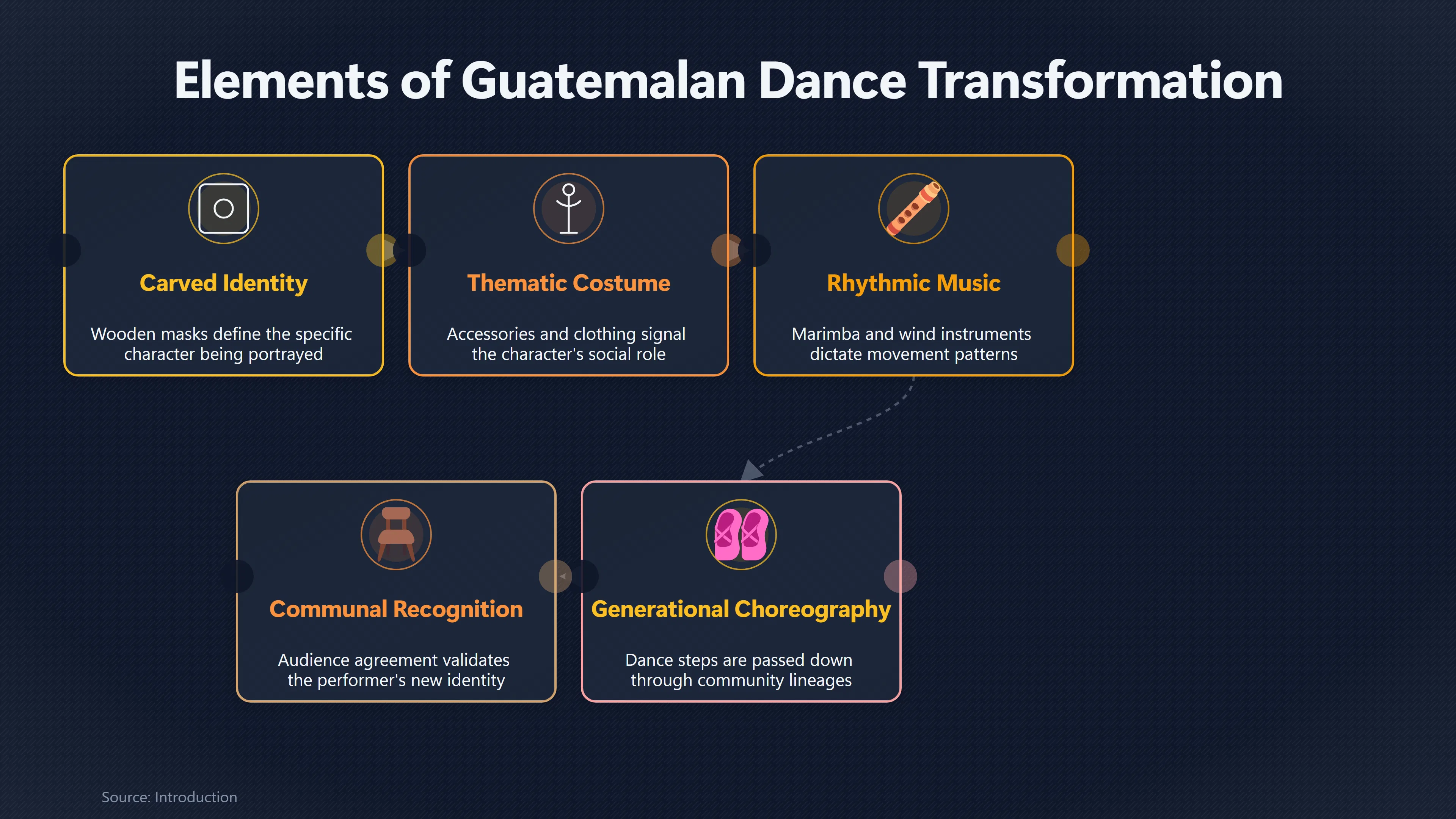
- A carved wooden mask that defines identity.
- Costume and accessories appropriate to the character.
- Traditional music that dictates rhythm and movement.
- Choreography passed between generations.
- Community recognition of the role being performed.
Only when these elements come together does the performer become the recognised character. The audience responds to the devil, the bull or the conquistador—not to the individual hidden beneath the carving.
This helps explain why collectors and museums often stress that a mask separated from its dance loses much of its original purpose. Its artistic craftsmanship remains impressive, but its deepest meaning lies in performance rather than display.[UCLA]newsroom.ucla.edufowler museum masks from guatemalaFowler Museum to present an exhibition featuring masks from Guatemala | UCLAApril 4, 2019…
Performance, preservation and conservation risks
Many of Guatemala’s dance masks occupy an unusual position between museum object and living cultural heritage.
Because they are still used, masks naturally accumulate repairs, repainting and wear. Cracked wood, replacement horns, new paint or reinforced straps often represent continued community use rather than damage. Conservators therefore face a difficult balance between preserving original craftsmanship and respecting evidence of generations of performance.
Transmission is another challenge. Skilled mask carving depends on specialist knowledge, while dances themselves require musicians, dancers and community organisers. Government cultural programmes have increasingly supported workshops that teach younger generations traditional carving techniques, recognising mask-making as part of Guatemala’s intangible cultural heritage rather than merely a craft industry.[Noticias MCD]noticias.mcd.gob.gtMinisterio de Cultura y Deportes de GuatemalaFebruary 23, 2026…
Some traditions also preserve rituals surrounding the masks themselves. Preparations for the Maya Achi drama Rabinal Achí, for example, include ceremonial blessings and vigils for the masks before performance, illustrating that certain communities continue to treat them as culturally and spiritually significant objects rather than ordinary costumes.[Noticias MCD]noticias.mcd.gob.gtMinisterio de Cultura y Deportes de GuatemalaJanuary 18, 2026…

Why these masks matter in Guatemala’s culture of curiosity
For visitors interested in Guatemala’s unusual heritage, dance masks occupy a distinctive place. They are fascinating not because they are grotesque or mysterious in isolation, but because they demonstrate how an everyday person can temporarily assume another identity through art, ritual and communal agreement.
Inside museums such as Casa K’ojom, the carvings invite close inspection as remarkable examples of folk sculpture. Outside museum walls, many still return to streets, church festivals and ceremonial spaces where music, movement and shared memory restore their original purpose. That continuing cycle of display and performance makes Guatemalan dance masks far more than collectible curiosities: they remain active instruments of cultural transformation.
Amazon book picks
Further Reading
Books and field guides related to When Guatemalan Masks Turn People Into Devils. Use these as the next step if you want deeper reading beyond the article.
Popol Vuh
First published 1985. Subjects: Popol vuh, Quiché Indians, Quiché mythology, Religion, Maya literature.
Maya Art and Architecture
“In addition to serving as an introduction to Maya art, the book communicates enthusiasm for the art’s aesthetic power and grace.” —Choic...
Masks of Mexico
A bilingual compilation of the dichos (sayings), adivinanzas (riddles), stories, love quatrains, letters, ballads, and songs from Spanish...
eBay marketplace picks
Marketplace Samples
Live-tested eBay searches with available results related to this page.
Selected fromMaya art print oneBay.co.uk.


Current eBay listing
Maya Angelou quotes Framed Wall Art Poster Canvas Print Picture

Current eBay listing
MAYA JAMA POSTER PRINT WALL ART - CHOOSE DESIGN/SIZE/FRAMED OPTION
Endnotes
1.
Source: newsroom.ucla.edu
Title: fowler museum masks from guatemala
Link:https://newsroom.ucla.edu/releases/fowler-museum-masks-from-guatemala
Source snippet
Fowler Museum to present an exhibition featuring masks from Guatemala | UCLAApril 4, 2019...
Published: April 4, 2019
2.
Source: fowler.ucla.edu
Title: guatemalan masks
Link:https://fowler.ucla.edu/exhibitions/guatemalan-masks/
Source snippet
Masks: Selections From The Jim And Jeanne Pieper Collection | Fowler Museum at UCLAMay 14, 2019 — Image: Selections From The Jim And Jean...
Published: May 14, 2019
3.
Source: maskmuseum.org
Title: Mask Museum Diablo Mask – Second Face
Link:https://www.maskmuseum.org/mask/guat-diablo-sacatepequez/
4.
Source: maskmuseum.org
Title: Mask Museum Moro Mask and Costume – Second Face
Link:https://www.maskmuseum.org/mask/guat-moro-1/
5.
Source: maskmuseum.org
Title: Mask Museum Moor Mask – Second Face
Link:https://www.maskmuseum.org/mask/guat-moor-1/
6.
Source: noticias.mcd.gob.gt
Link:https://noticias.mcd.gob.gt/2026/02/23/elaboracion-de-mascaras-tradicionales-de-la-danza-de-los-micos-fortalece-la-identidad-cultural-de-nahuala/
Source snippet
Ministerio de Cultura y Deportes de GuatemalaFebruary 23, 2026...
Published: February 23, 2026
7.
Source: noticias.mcd.gob.gt
Link:https://noticias.mcd.gob.gt/2026/01/18/velacion-de-las-mascaras-un-rito-intrinseco-en-los-preparativos-del-rabinal-achi/
Source snippet
Ministerio de Cultura y Deportes de GuatemalaJanuary 18, 2026...
Published: January 18, 2026
8.
Source: guatemala.gob.gt
Link:https://guatemala.gob.gt/velacion-de-las-mascaras-un-rito-intrinseco-en-los-preparativos-del-rabinal-achi/
Source snippet
Velación de las máscaras: un rito intrínseco en los preparativos del Rabinal Achí - Gobierno de GuatemalaJanuary 18, 2026 — Image VELACIÓ...
Published: January 18, 2026
9.
Source: books.google.com
Title: Guatemalan Masks
Link:https://books.google.com/books/about/Guatemalan_Masks.html?id=GZRuAAAAMAAJ
10.
Source: maskmuseum.org
Link:https://www.maskmuseum.org/mask/guat-leon-1/
11.
Source: maskmuseum.org
Link:https://www.maskmuseum.org/mask/guat-tiger-1/
12.
Source: maskmuseum.org
Link:https://www.maskmuseum.org/mask/guat-diablo-1/
13.
Source: maskmuseum.org
Link:https://www.maskmuseum.org/mask/maria-baile-tipico/
14.
Source: maskmuseum.org
Link:https://www.maskmuseum.org/mask/guat-mono-1/
15.
Source: maskmuseum.org
Link:https://www.maskmuseum.org/mask/guat-coyote-1/
16.
Source: maskmuseum.org
Link:https://www.maskmuseum.org/mask/guat-cristiano-1/
17.
Source: maskmuseum.org
Link:https://www.maskmuseum.org/mask/guat-caporal-saac/
18.
Source: maskmuseum.org
Link:https://www.maskmuseum.org/mask/vaquero/
19.
Source: casadeartes.com.gt
Link:https://casadeartes.com.gt/learn/the-knowledge/masks
Additional References
20.
Source: youtube.com
Title: Guatemala Mask and Dance Exhibition at the National Museum of Dance
Link:https://www.youtube.com/watch?v=E7vmpBDS3o4
Source snippet
Preserving Guatemala’s Ancient Dance of the Gods...
21.
Source: youtube.com
Title: Preserving Guatemala’s Ancient Dance of the Gods
Link:https://www.youtube.com/watch?v=cLVDC_dYJTg
Source snippet
Guatemalan dance masks Guatemalan Masks Exhibit LA THIS WEEK...
22.
Source: revistas.una.ac.cr
Link:https://www.revistas.una.ac.cr/index.php/istmica/article/view/7269
23.
Source: mexicandancemasks.com
Link:https://mexicandancemasks.com/?p=4094
24.
Source: ipsnews.net
Link:https://www.ipsnews.net/1999/02/arts-and-entertainment-culture-lifting-the-mask-in-guatemala/
25.
Source: youtube.com
Title: Dances and Masks of Guatemala
Link:https://www.youtube.com/watch?v=wnRgIaT3i48
Source snippet
Guatemala Mask and Dance Exhibition at the National Museum of Dance...
26.
Source: mexicandancemasks.com
Title: The Dance of the Moors and Christians In Guatemala | Mexican Dance Masks
Link:https://mexicandancemasks.com/?p=3905
27.
Source: youtube.com
Title: Guatemalan Masks: Selections from the Jim and Jeanne Pieper Collection
Link:https://www.youtube.com/watch?v=fmHG0qazaEI
Source snippet
Guatemalan Masks Exhibit...
28.
Source: youtube.com
Title: Guatemalan Masks Exhibit
Link:https://www.youtube.com/watch?v=OXBSn_fJa2o
Source snippet
Dances and Masks of Guatemala...
29.
Source: britishmuseum.org
Link:https://www.britishmuseum.org/collection/object/E_Am1977